
Four Treasures Reference Database
Record No. 6329
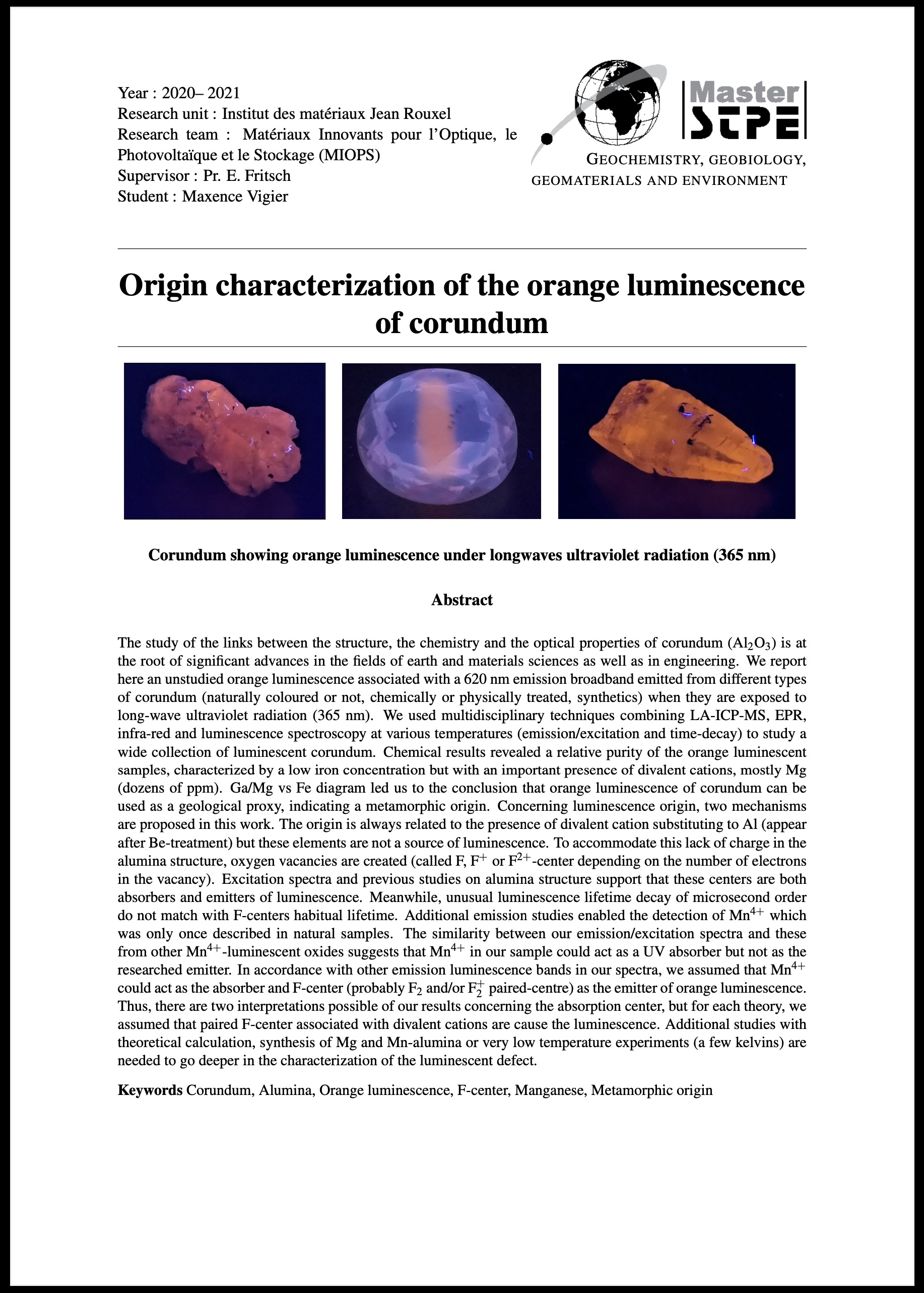
Origin characterization of the orange luminescence of corundum
Thesis
Vigier, M. (2021) Origin characterization of the orange luminescence of corundum., Nantes: Institute of Materials Jean Rouxel (IMN), 30 pp.
Sinkankas/Born No.: NIS/NIB | RWHL*
Close Abstract
Hide Keywords
Copy Reference
gems, corundum, color.4, luminescence, fluorescence
The study of the links between the structure, chemistry, and optical properties of corundum (Al₂O₃) has led to important advances in earth and materials sciences and engineering. This work reports a previously unstudied orange luminescence, characterized by a 620 nm emission broadband observed in various types of corundum (natural, treated, synthetic) under long-wave ultraviolet radiation (365 nm). Using multidisciplinary methods—LA-ICP-MS, EPR, infrared, and temperature-dependent luminescence spectroscopy (emission, excitation, time-decay)—the study examined a broad collection of luminescent corundum. Chemically, these orange-luminescent samples were relatively pure, low in iron but notably containing divalent cations, especially Mg (in the tens of ppm). A Ga/Mg vs Fe plot suggests that this orange luminescence serves as a geological proxy for metamorphic origin. Two luminescence mechanisms are proposed. Though the presence of divalent cations substituting for Al (potentially introduced by Be-treatment) is essential, these cations are not themselves luminescent. Their substitution creates charge imbalances, accommodated by oxygen vacancies—F, F⁺, or F²⁺ centers—known to act as both absorbers and emitters. However, the observed microsecond-scale decay times are atypical of isolated F-centers. Emission studies also detected Mn⁴⁺, rarely reported in natural samples, and the similarity to Mn⁴⁺ spectra in other oxides suggests that Mn⁴⁺ might function as a UV absorber rather than the luminescent center. Consequently, the orange emission is attributed to paired F-centers (likely F₂ and/or F₂⁺) associated with divalent cations, with Mn⁴⁺ potentially playing an indirect sensitizing role. Further studies, including theoretical modeling, synthesis of Mg/Mn-doped alumina, and ultra-low temperature experiments, are needed to fully characterize the defect responsible for this luminescence.