
Four Treasures Reference Database
Record No. 6345
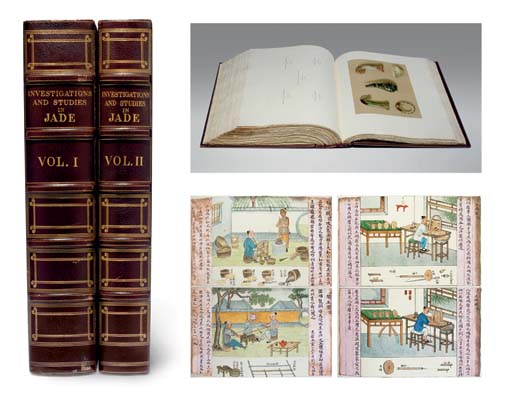
The Bishop Collection: Investigations and Studies in Jade
Book
Bishop, H.R. (1906) The Bishop Collection: Investigations and Studies in Jade. New York, The Bishop Collection, 2 Vols., 277, 293 pp.
Sinkankas/Born No.: 663 | RWHL**
Close Abstract
Hide Keywords
Copy Reference
gems, jade, jadeite, fei cui, nephrite, Burma, China, Fischer-Other, Broken Bangle
One of the earliest jade books in English is also the rarest, largest, and most sumptuous: The Bishop Collection: Investigations and Studies in Jade (1906). Bishop (1840–1902) was a businessman and philanthropist. Retiring at age 36, he devoted his attention to fine arts. In 1878, he began acquiring the finest examples of Chinese jade, from Late Neolithic through Qing dynasty periods. Bishop’s fascination with jade was not limited to China, but included specimens from other cultures, both carved and uncarved. His collection grew to more than 1000 pieces and is unparalleled even today. In 1902, just before his death, he gifted his entire collection to New York’s Metropolitan Museum of Art, where much of it is on view today. But Bishop was no mere acquirer of jade, and his book is far more than just a catalog. He was determined, at this embryonic stage of jade scholarship, to answer questions regarding its mineralogy and properties, where it was found, how it was carved, its significance and symbolism, and many other important aspects. To organize these studies, he enlisted prominent mineralogist Dr. George Frederick Kunz, who in turn assembled a team of 28 specialists in every aspect of jade. They documented the results of this 20-year project in an “elephant folio” two-volume set measuring 25 × 19 inches (63.5 × 48 cm) and weighing 125 pounds (57 kg). No expense was spared. Printed on handmade paper, the volumes include 20 original watercolors, 36 copper etchings, 17 woodcuts, and 36 color lithographs, some by famed lithographer Louis Prang. Many of Bishop’s finest jades were shipped to Paris just for artists to prepare the color plates. For this project, Bishop set aside $50,000 (equivalent to US$1.5 million today). Only 100 sets were printed and the plates were then destroyed and the type scattered. Eight sets were given to family members, six to crowned heads of state in Europe and Asia, and the balance distributed to scholarly libraries worldwide. No copies were for sale. Readers are therefore unlikely to encounter a set outside of a major library. The one or two sets that have escaped into general commerce have sold for over US$200,000. A steal, considering that, at the time of their publication, they represented the most expensive books ever produced on Earth. Although more than a century has passed, much remains of value. The color plates of Chinese craftsmen cutting, carving, and polishing jade, for example, continue to be reproduced in books. True students of jade will want to seek out the closest library holding a set and arrange to enjoy these magnificent volumes.