
Four Treasures Reference Database
Record No. 6481
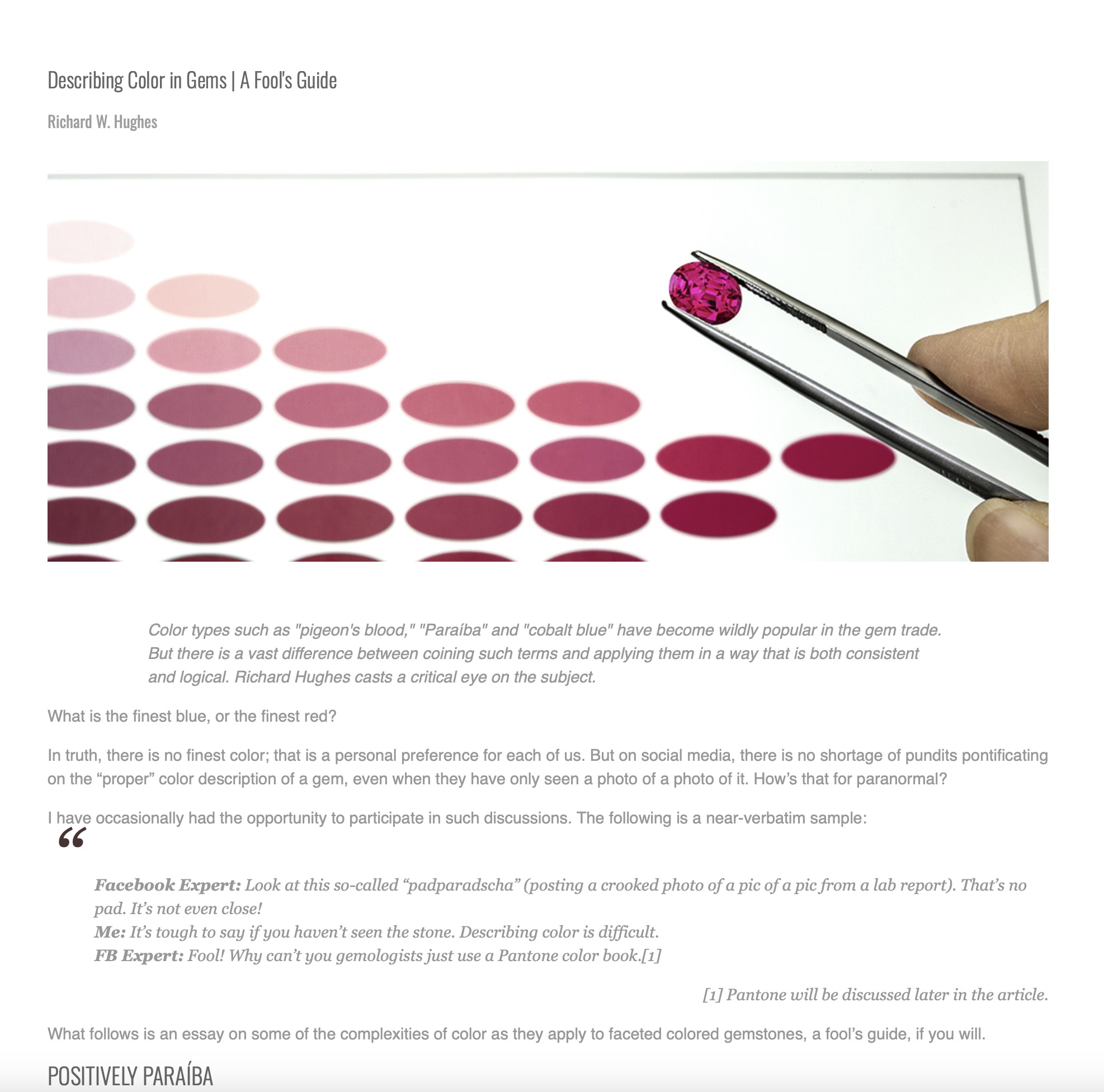
Describing color: A fool’s guide
Journal Article
Hughes, R.W. (2023) Describing color: A fool’s guide. GemGuide, May/June, pp. 1–7.
Sinkankas/Born No.: NIS / NIB | RWHL*
gems, corundum, spinel, cobalt blue spinel, paraíba tourmaline, quality analysis, pigeon’s blood ruby, quality.10, color science, colored stone grading, Broken Bangle
An examination of the complexities and limitations of describing color in faceted gemstones, particularly the growing practice of including commercial color designations on gemological laboratory reports. The author questions the scientific validity and consistency of terms such as “pigeon’s blood,” “royal blue,” “padparadscha,” “Paraíba,” and “cobalt blue,” arguing that their definitions are often subjective, commercially driven, or dependent on chemical criteria that do not necessarily correspond to visual appearance. Examples involving copper-bearing tourmaline, cobalt-bearing spinel, and chromium-colored ruby illustrate how chromophore concentration, light path length, and interactions between coloring agents complicate color interpretation. Additional difficulties arise from pleochroism, color zoning, inclusions, metamerism, cutting, and the three-dimensional mosaic of colors displayed by faceted stones. Conventional color atlases, photographs, computer monitors, and printed reproductions cannot adequately capture these effects. The author further argues that beauty and color preference are inherently subjective and culturally conditioned, making universal quality grading of colored gemstones problematic. He warns that commercial pressure on laboratories to assign prestigious color designations risks undermining their scientific independence and creating inconsistent, potentially misleading reports. Rather than attempting to impose rigid definitions of exceptional color, the article advocates distinguishing objective gemological determinations—identity, natural or synthetic origin, and treatments—from subjective judgments of beauty and quality, which ultimately belong to the individual observer.