
Four Treasures Reference Database
Record No. 6525
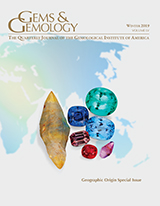
A review of analytical methods used in geographic origin determination of gemstones
Journal Article
Groat, L.A., Giuliani, G., Stone-Sundberg, J., Sun, Z., Renfro, N. and Palke, A.C. (2019) A review of analytical methods used in geographic origin determination of gemstones. Gems & Gemology, Vol. 55, No. 4, pp. 512–535.
Close Abstract
Hide Keywords
Copy Reference
gems, corundum, beryl, emerald, origin
Origin determination is of increasing importance in the gem trade. It is possible because there is a close relationship between the geological environment of formation and the physical and chemical properties of gemstones, such as trace element and isotopic compositions, that can be measured in the laboratory using combinations of increasingly sophisticated instrumentation. Origin conclusions for ruby, sapphire, and emerald make up the bulk of demand for these services, with growing demand for alexandrite, tourmaline, and spinel. However, establishing origin with a high degree of confidence using the capabilities available today is met with varying degrees of success. Geographic origin can be determined with a high level of confidence for materials such as emerald, Paraíba-type tourmaline, alexandrite, and many rubies. For some materials, especially blue sapphire and some rubies, the situation is more difficult. The main problem is that if the geology of two deposits is similar, then the properties of the gemstones they produce will also be similar, to the point where concluding an origin becomes seemingly impossible in some cases. Origin determination currently relies on a combination of traditional gemological observations and advanced analytical instrumentation.