
Four Treasures Reference Database
Record No. 6544
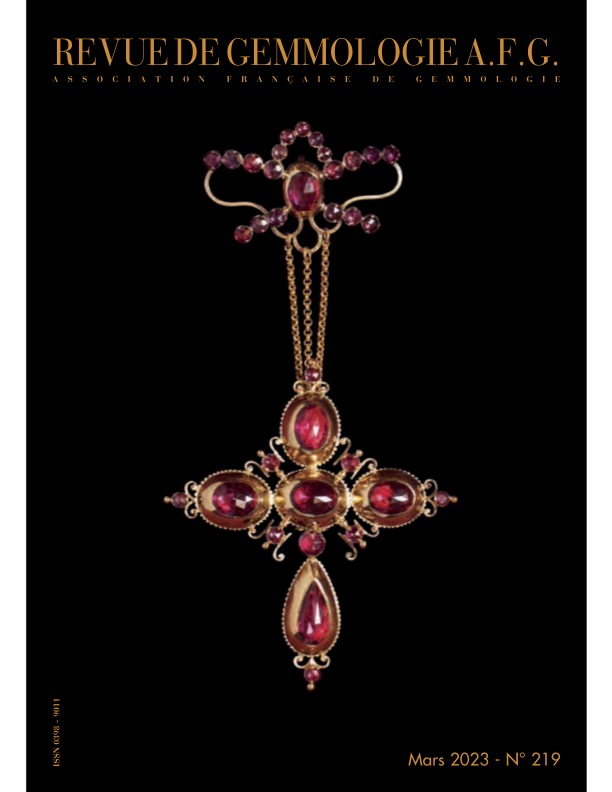
Escarboucles & dragons, lexicologie des gemmes rouges
Garnets & dragons, lexicology of red gemstones
Journal Article
Zylberman, N. (2023) Escarboucles & dragons, lexicologie des gemmes rouges. [Garnets & dragons, lexicology of red gemstones] Revue de Gemmologie A.F.G., No. 219, Mars, pp. 27–30.
Sinkankas/Born No.: NIS/NIB | Language: in French | RWHL*
Close Abstract
Hide Keywords
Copy Reference
gems, corundum, spinel, history.1, carbuncle, garnet
This study traces the linguistic, literary, and gemmological history of the escarboucle or carbuncle over approximately three millennia. Beginning with the red stones odem and nophek in the biblical breastplate, it follows their translation and reinterpretation through the Greek anthrax, Latin carbunculus, and French escarboucle. Ancient and medieval lapidaries associated the carbuncle with a fiery brilliance supposedly capable of illuminating darkness, while legends placed the luminous stone in the heads of dragons, griffins, eagles, and the serpent-like vouivre. Accounts by Theophrastus, Pliny, Marbode, Albertus Magnus, Jean de Mandeville, Cardan, Cellini, de Boodt, and others demonstrate how the term came to encompass sardonyx, carnelian, garnet, ruby, and spinel, whose reflected light could be intensified by polishing, rounded forms, metal foils, and controlled illumination. The development of crystallography and chemical mineralogy during the late eighteenth and early nineteenth centuries finally separated these materials into distinct species. The article also examines the origins and evolution of such names as ruby, pyrope, almandine, rhodolite, Bohemian garnet, spinel, and zircon, presenting the carbuncle as a historical category founded upon the appearance of fiery red light rather than a single mineral species.