
Four Treasures Reference Database
Record No. 6558
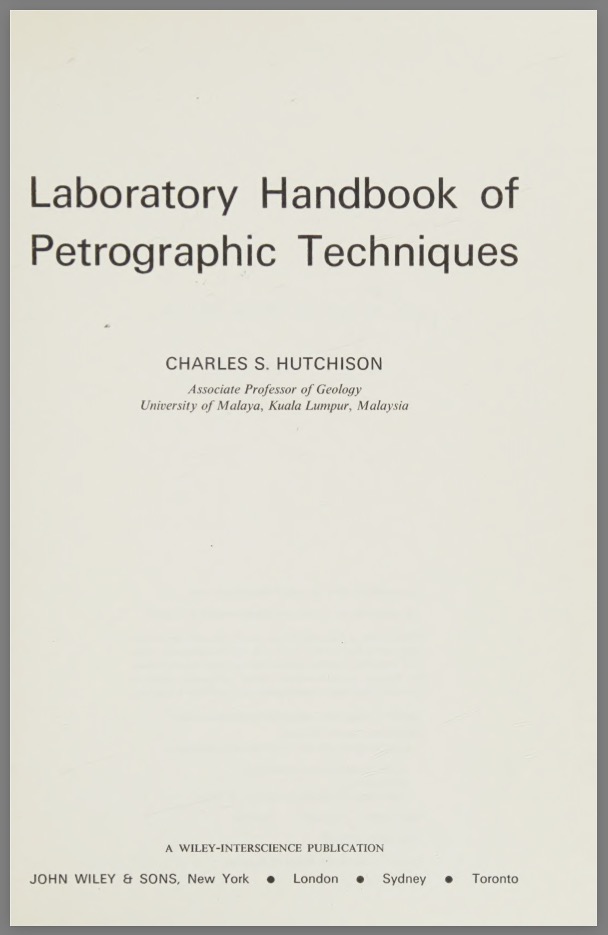
Laboratory Handbook of Petrographic Techniques
Book
Hutchison, C.S. (1974) Laboratory Handbook of Petrographic Techniques. New York, Wiley-Interscience, 527 pp.
Sinkankas/Born No.: NIS / NIB | RWHL
gems, jade, jadeite, fei cui, hardness, aesthetics, Art, Default Mode Network, fMRI, preference, visual, quality analysis
This laboratory handbook brings together practical techniques for investigating igneous and metamorphic rocks, with many methods also applicable to sedimentary materials. It is intended both as a framework for undergraduate laboratory teaching and as a working reference for researchers. The organising principle is that analytical measurements must be grounded in field relationships and conventional petrographic examination: laboratory results acquire geological meaning through knowledge of a rock’s setting, texture and mineral assemblage. Procedures are presented largely as numbered exercises, with alternative methods, equipment requirements, calibration instructions, calculations and supporting references. Initial chapters cover cutting, impregnation, mounting, grinding and polishing specimens, followed by staining methods, ultraviolet examination and identification of opaque minerals through reflectivity and indentation hardness. Quantitative microscopy includes grain-size measurement, modal analysis by point counting and other methods, and photomicrography. Spindle-stage and universal-stage procedures extend optical investigation to refractive indices, optic axial angles, feldspar composition and structural state, and petrofabrics. Mineral separation is addressed through crushing, cleaning, magnetic separation, heavy liquids, flotation and representative sample splitting. Extensive treatment of X-ray powder diffraction covers specimen preparation, instrument alignment, calibration, phase identification and indexing, followed by applications to specific mineral groups, particularly feldspars, garnets, carbonates, olivine, cordierite, pyroxenes and clays. Separate chapters describe specific-gravity and immersion refractive-index measurements. Chemical analysis is developed through X-ray fluorescence spectrometry, atomic absorption spectrophotometry and supplementary determinations of iron oxidation state, water, carbon dioxide and fluorine. Attention is given to analytical standards, backgrounds, matrix effects and instrumental operating conditions. A substantial section explains how to organise and interpret results using variation diagrams, mineral structural formulae, rock-classification schemes, normative calculations and elementary statistical analysis. The final chapter covers differential thermal analysis, thermogravimetry and thermoluminescence, including calibration, experimental reporting and interpretation. Theory is kept subordinate to practical implementation, and electron microprobe analysis is largely left to specialised references. A bibliography, equipment and materials supplier list, and index support laboratory use. The handbook’s central contribution is an integrated collection of procedures that extends petrography beyond descriptive microscopy while maintaining field observation and thin-section study as the foundation of petrological investigation.