
Four Treasures Reference Database
Record No. 661
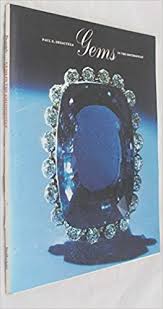
Gems in the Smithsonian Institution
Book
Desautels, P.E. (1965) Gems in the Smithsonian Institution. Washington, DC, Smithsonian, 74 pp.
Sinkankas/Born No.: NIS/NIB | RWHL
corundum, quality.10, gems
This illustrated introduction to the Smithsonian Institution’s National Gem Collection combines an account of its development with an accessible survey of gemstone properties, cutting, identification, substitutes, and cultural associations. The collection originated in an exhibit of American precious stones assembled by F.W. Clarke in 1884 and expanded through acquisitions, gifts, and endowments, notably those associated with Isaac Lea and Leander T. Chamberlain. By 1965, more than one thousand selected items were displayed to illustrate the diversity of gem materials and the effects of skilled cutting and polishing. Desautels explains gemmology as a specialized branch of mineralogy, relating gemstone appeal to beauty, durability, rarity, brilliance, and fashion. Hardness, specific gravity, chemical composition, colour, transparency, refraction, double refraction, and dispersion are introduced through practical explanations and diagrams. Chatoyancy, asterism, and other optical effects are illustrated with collection specimens. The discussion of lapidary work connects facet arrangement and proportions with the control of light, contrasting brilliant, step, rose, and fancy cuts and describing sawing, grinding, polishing, and cabochon fashioning. Separate treatment of gem substitutes distinguishes imitations, assembled stones, reconstructed or altered materials, and synthetic products. Examples include doublets and triplets, coatings, dyes, heat treatment, irradiation, and laboratory growth, with emphasis on the identification problems created when appearance or conventional tests conceal a stone’s construction or treatment. Flame-fusion and hydrothermal synthesis are outlined, and synthetic gemstones are distinguished by their chemical and structural correspondence with natural counterparts. A section on gem lore surveys religious symbolism, astrological associations, medicinal beliefs, and birthstones as historical and commercial influences on public appreciation. Accounts of the principal gem species describe their composition, varieties, distinguishing properties, geographical sources, and suitability for jewellery, using notable Smithsonian specimens as examples. Jade is treated as two distinct materials, jadeite and nephrite, whose toughness supports carving; the discussion includes the Maude Monell Vetlesen collection of Chinese jades. Rarer faceted minerals receive attention as collectors’ stones, including materials limited commercially by scarcity, softness, or cleavage. Photographs document exceptional gems, jewellery, and carvings, while comparative tables summarize identifying properties. A concluding inventory records approximately one-third of the collection, listing selected specimens by weight, colour, origin, catalogue number, and donor. The volume presents the collection as both a public treasury and an educational resource connecting mineral science, craftsmanship, collecting history, and the cultural appeal of gems.