
Four Treasures Reference Database
Record No. 6795
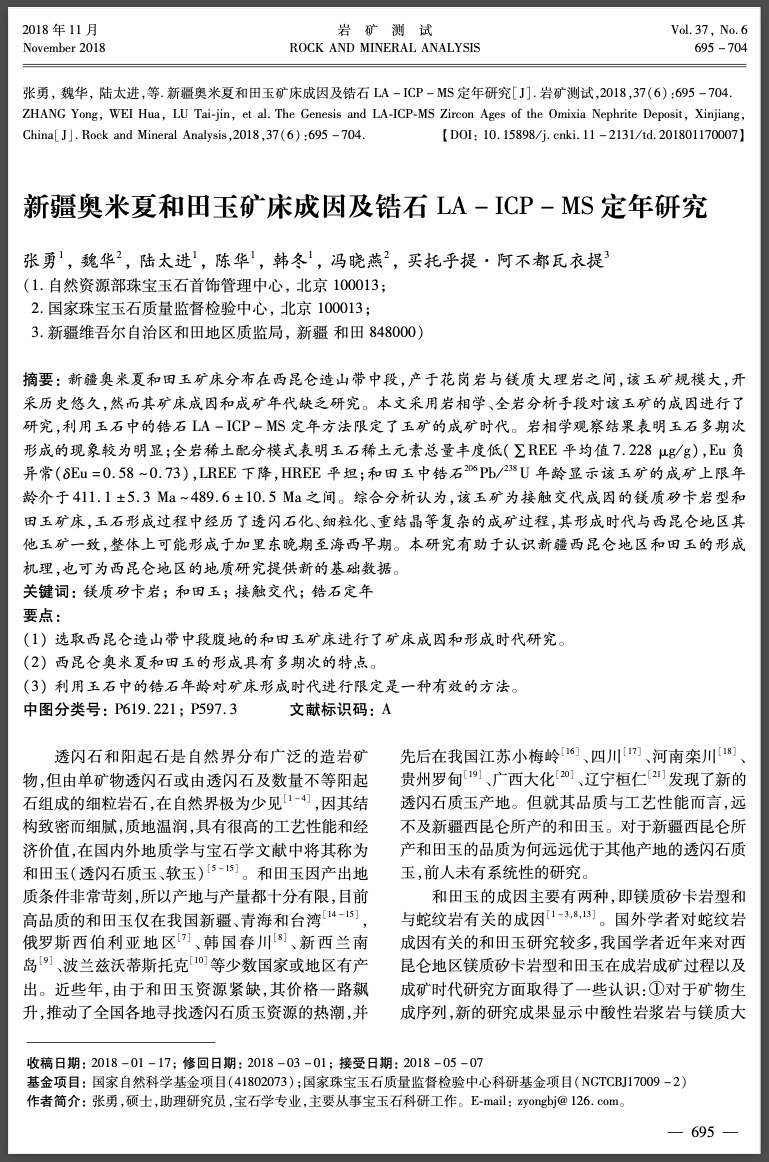
The genesis and LA-ICP-MS zircon ages of the Omixia nephrite deposit, Xinjiang, China
新疆奥米夏和田玉矿床成因及锆石LA-ICP-MS定年研究
Journal Article
Zhang, Y., Wei, H., Lu, T.-j., Chen, H., Han, D., Feng, X.-y. and Maituohuti, A. (2018) The genesis and LA-ICP-MS zircon ages of the Omixia nephrite deposit, Xinjiang, China. [新疆奥米夏和田玉矿床成因及锆石LA-ICP-MS定年研究] Rock and Mineral Analysis, Vol. 6, pp. 695–704.
DOI: https://doi.org/10.15898/j.cnki.11-2131/td.201801170007 | Sinkankas/Born No.: NIS/NIB | Language: in Chinese | not seen
Close Abstract
Hide Keywords
Copy Reference
gems, jade, nephrite, Xinjiang, Chinese jade, Khotan, inclusions, zircon dating
The Omixia nephrite deposit, situated in the central West Kunlun Orogenic Belt, is hosted in Mg-skarn formed between granite and magnesian marble. Despite its large size and extensive exploration, the ore genesis and precise age of the deposit have remained poorly understood. This study aims to clarify the genesis and constrain the upper age of the deposit through petrological analysis and LA-ICP-MS U-Pb zircon dating. Petrographic observations reveal that nephrite formed in multiple stages, including tremolite mineralization, diapolitization, fine granulation, and recrystallization. Geochemically, the nephrite displays low total rare earth element (ΣREE) content, averaging 7.228 μg/g, with strongly negative Eu anomalies (δEu = 0.58–0.73), declined light REE patterns, and flat heavy REE patterns. U-Pb zircon ages in the nephrite range from 489.6 ± 10.5 Ma to 411.1 ± 5.3 Ma, indicating formation during the Late Caledonian to Early Hercynian periods. These findings confirm that the Omixia deposit is a typical contact metasomatic Mg-skarn nephrite deposit, and they provide valuable insights into the genesis of nephrite in the West Kunlun region of Xinjiang, contributing foundational data for further geological research in the area.