
Four Treasures Reference Database
Record No. 6818
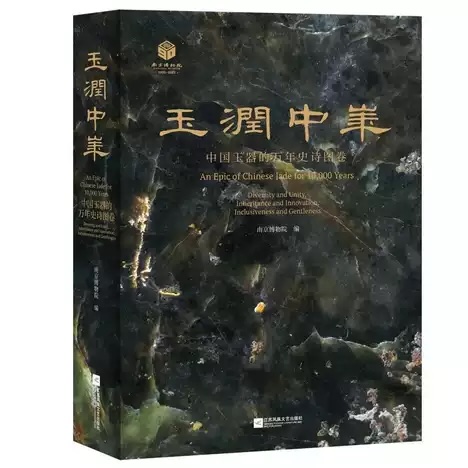
An Epic of Chinese Jade for 10,000 Years
玉潤中華 中國玉器的萬年史詩圖卷
Book
Nanjing Museum (2023) An Epic of Chinese Jade for 10,000 Years. [玉潤中華 中國玉器的萬年史詩圖卷] Jiangsu, Jiangsu Phoenix Literature and Art Publishing, 488 pp.
ISBN/ISSN: 9787560000000 | Sinkankas/Born No.: NIS/NIB | Language: in Chinese with small English sections | RWHL*
Close Abstract
Hide Keywords
Copy Reference
gems, jade, archaic jade, China, Chinese jade carving, nephrite, amphibole jade, Fischer-Chinese, Broken Bangle
Nanjing Museum ushered in the 90th anniversary of its establishment. After nearly three years of preparation and careful planning, its blockbuster special exhibition Yurun China - The Ten-Year Epic Scroll of Chinese Jade" finally began on November 7th, and the public will enter for free! The exhibition cooperated with 44 domestic archaeological and cultural institutions, and gathered more than 600 pieces (groups) of top jade art from archaeological excavations and collections from all over the country. The exhibition is divided into three chapters. Yusheng Huaxia focuses on the origin of Chinese jade culture and presents the Neolithic Xiaonanshan, Hongshan, Liangzhu and Longshan cultural jade. Among them, the jade unearthed at the Xiaonanshan site of the Heilong River can be traced back to 9,000 years ago. It is the earliest jade known in China and provides extremely valuable physical data for the study of jade culture in China and even the whole East Asia. "Yucheng China" exhibited jade in the Xia, Shang and Zhou dynasties and the Qin and Han dynasties, focusing on exploring the relationship between jade and "li" and "de". "Jade Beauty Shenzhou" displays jade from the Three Kingdoms to the Qing Dynasty, reflecting the prosperity and development of jade categories, themes and crafts. This chapter collects the representative collections of many cultural and museum institutions. Highlights include the Yuliang Jinbao belt collected by the Institute of Archaeology of the Western Province, the Guan'er jade pot of the Anhui Museum of the Song Dynasty, the jade used by the Wanli emperor in the Ming Tombs Museum, and the court jade collected by the Palace Museum of the Qing Dynasty. The special exhibition catalogue is also divided into three parts: "Yusheng Huaxia", "Yucheng China" and "Yumei Shenzhou" in chronological order. It contains more than 340 pieces (groups) of unearthed and handed down jade. Using rich high-definition detailed drawings, artifact rubbings, line drawings, etc., the system tells the development of jade from mysterious rituals in ancient times to the royal and ordinary people's play accessories. Cheng. Finally, in the academic paper, four current hot experts (Deng Shuping, an expert in the Forbidden City of Taipei, Xu Lin, an expert in the Forbidden City, Deng Cong of Shandong University, and Yang Zhishui, an expert from the Academy of Social Sciences), wrote articles about the early Chinese jade rituals, the development of jade from the Sui and Tang Dynasties to the Qing dynasties, the ancient jade cutting examination and the gold-inlaid jade."