
Four Treasures Reference Database
Record No. 6838
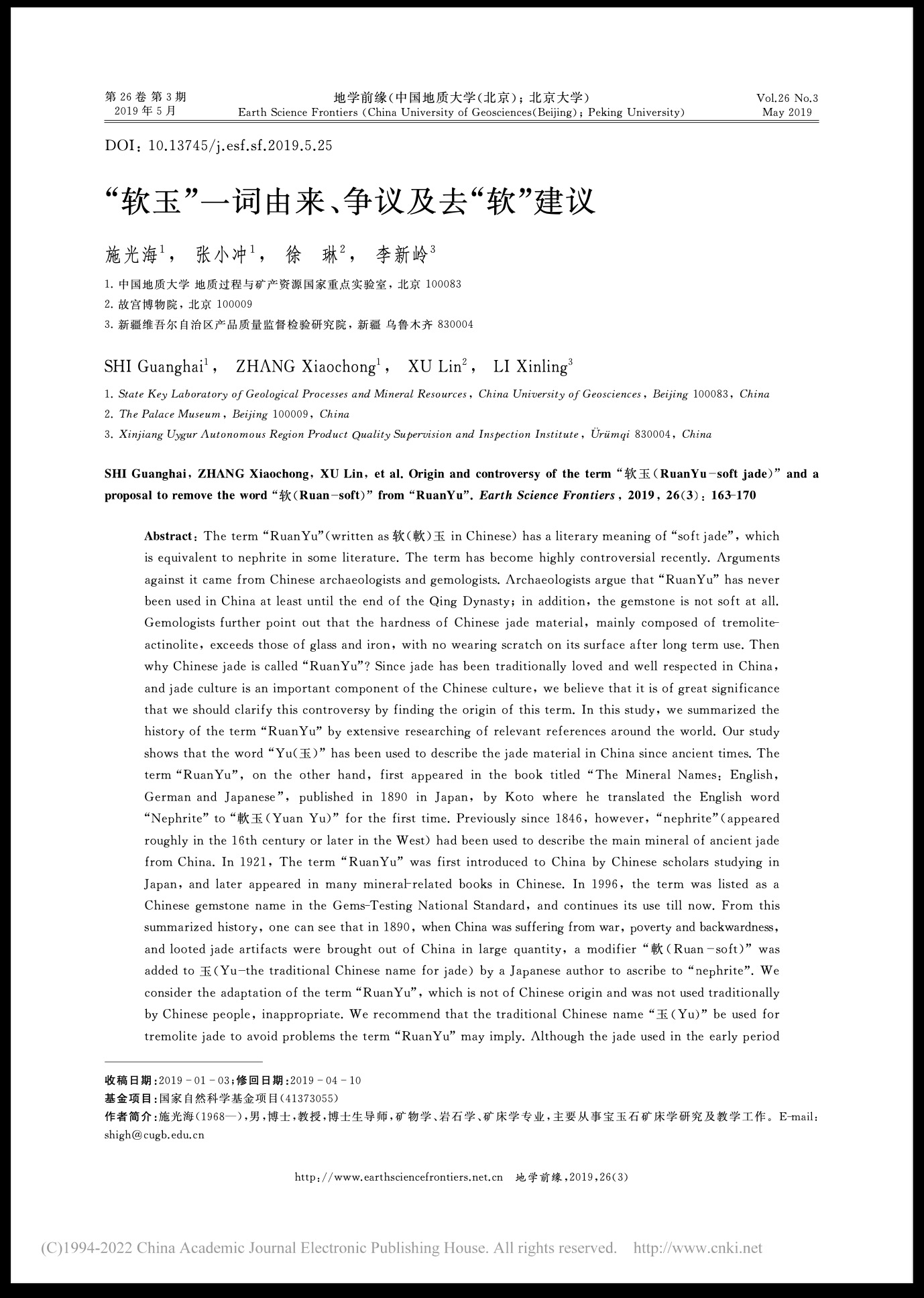
Origin and controversy of the term “软玉 (Ruan Yu soft jade)” and a proposal to remove the word “软 (Ruan soft)” from “Ruan Yu”
“软玉”一 词由来、争议及去“软”建议
Journal Article
Shi, G., Zhang, X., Xu, L. and Li, X. (2019) Origin and controversy of the term “软玉 (Ruan Yu soft jade)” and a proposal to remove the word “软 (Ruan soft)” from “Ruan Yu”. [“软玉”一 词由来、争议及去“软”建议] Earth Science Frontiers, Vol. 26, No. 3, pp. 163–170.
Sinkankas/Born No.: NIS/NIB | Language: in Chinese with English abstract | RWHL
gems, jade, amphibole jade, nephrite, China, pyroxene jade, jadeite, fei cui, soft jade, hard jade, Hetian jade, Broken Bangle
The term RuanYu" (written as 软(軟)玉 in Chinese) literally means "soft jade," equivalent to nephrite in some literature. However, this term has recently become highly controversial, with arguments against it from Chinese archaeologists and gemologists. Archaeologists contend that "RuanYu" was not used in China until at least the end of the Qing Dynasty, and the gemstone itself is not soft. Gemologists further highlight that the hardness of Chinese jade, primarily composed of tremolite-actinolite, exceeds that of glass and iron, showing no wear scratches even after long-term use. The question arises: why is Chinese jade called "RuanYu"? Given the longstanding love and respect for jade in Chinese tradition and its integral role in Chinese culture, it is crucial to address this controversy by uncovering the term's origin. This study delves into the history of "RuanYu" through extensive research of relevant references worldwide. The term "Yu (玉)" has historically been used in China to describe jade. However, "RuanYu" first appeared in the book "The Mineral Names: English, German, and Japanese" published in 1890 in Japan by Koto, where he translated the English word "Nephrite" to "軟玉 (RuanYu)" for the first time. Prior to this, since 1846, "nephrite" had been used to describe the main mineral of ancient Chinese jade. In 1921, "RuanYu" was introduced to China by Chinese scholars studying in Japan, later appearing in many mineral-related Chinese books. In 1996, the term was officially listed as a Chinese gemstone name in the Gems-Testing National Standard and continues to be used. This historical overview reveals that in 1890, during a tumultuous period in China marked by war, poverty, and backwardness, and amid the large-scale looting of jade artifacts, a modifier "軟 (soft)" was added to "玉 (jade)" by a Japanese author to describe "nephrite." Considering that "RuanYu" is not of Chinese origin and was not traditionally used by the Chinese, we find its adaptation inappropriate. Therefore, we recommend reverting to the traditional Chinese name "玉 (Yu)" to describe tremolite jade, avoiding potential implications associated with the term "RuanYu." While early Chinese jade had various types, tremolite jade has been predominant since the Western Zhou Dynasty. By restoring the name "Yu" to describe Chinese jade, we align with Chinese history and cultural tradition."