
Four Treasures Reference Database
Record No. 6870
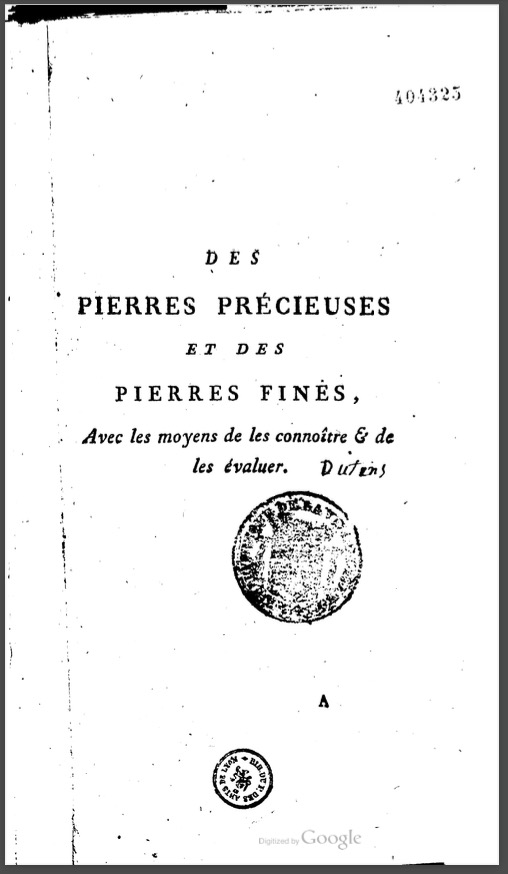
Des Pierres précieuses et des Pierres fines, avec les moyens de les connoitre & de les évaluer
On Precious Stones and Fine Stones, with the Means to Recognize and Evaluate Them
Book
Dutens, L. (1776) Des Pierres précieuses et des Pierres fines, avec les moyens de les connoitre & de les évaluer. [On Precious Stones and Fine Stones, with the Means to Recognize and Evaluate Them] Paris, F.A. Didot & De Bure, 224 pp.
Sinkankas/Born No.: 1819 | Language: in French | RWHL
Close Abstract
Hide Keywords
Copy Reference
gems, jade, Fischer-Book
Jonathan Hill: First edition of this introduction to precious stones written for collectors and jewelers; according to the author this is the first complete treatise on precious stones. Dutens describes the chief varieties including diamonds, rubies, sapphires, emeralds, etc. He has also provided an interesting table at the end of current prices of diamonds of increasing carats. In the Preface, Dutens reviews the writings on precious stones of earlier authors including Pliny, Theophrastus, Boyle, and Romé de l’Isle. This work is a notable work in typography as well: it is the first book printed by François Ambroise Didot, l’aîné (1730-1804), who promoted technical innovation in printing and papermaking and introduced the new form of typographical measurement, the “point Didot.” We quote from the 1783 catalogue of Mérard de Saint-Just: “Ce petit Traité est le premier Ouvrage sorti des presses de M. Didot l'aîné, où l’on ait aperçu cette supériorité de talents qui l’a mis tout de suite au-dessus de tous ses confrères de France, d’Italie, d’Allemagne et de Hollande, et qui l’associe dès lors à la gloire de Baskerville, et surtout à celle d’Ibarra.”–from André Jammes’ wonderful Les Didots catalogue, no. 73. Dutens (1730-1812), diplomat and man of letters, edited the works of Leibniz (1768), was a fellow of the Royal Society, and was historiographer to the King of England. Sinkankas: In his preface, Dutens discusses the merits of previous works on gemstones and explains why he decided to write this one. A connoisseur of arts and of gems, he traveled widely throughout Europe and spent much time visiting collections and discussing their contents with their owners. One would therefore expect that the book was based on his experiences, but it seems that it is no more than a reworking of information available in earlier books treating gemstones, as remarked by King above, who believes Dutens derived most of his information from De Boodt and De Laet. In the first part, Dutens explains his system of classification whereby the finest and most durable of gemstones are dubbed “oriental,” while those of lesser quality and hardness receive the title of “occidental,” thus perpetuating in a highly popular and widely distributed work these unfortunate and misleading terms that persisted in use well into the last century. Some generalities on gemstones also appear here, such as curious lore, origin of gemstones, and other topics, followed by separate chapters on the major gemstones beginning with diamond. The latter chapter records recent experiments in France and elsewhere on the combustibility of diamond, one such experiment he personally observed. The second part describes lesser gemstones, mainly massive types used mostly in cabochons or in the manufacture of small to large ornamental articles or decorations. Despite King’s criticisms, Dutens’ work did provide useful, accurate information and received acclaim and wide distribution.