
Four Treasures Reference Database
Record No. 7098
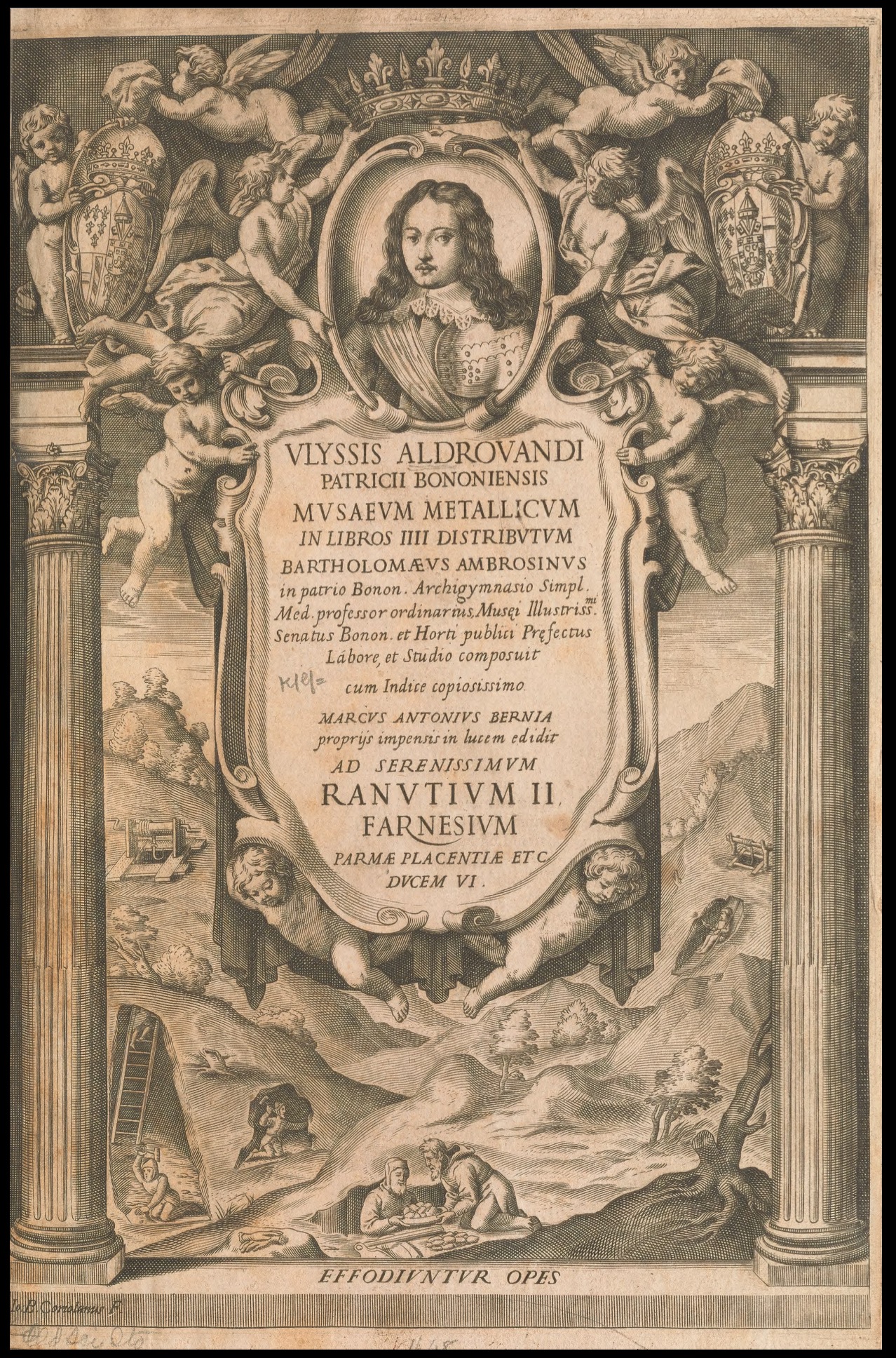
Musaeum metallicum
Metallic Museum
Book
Aldrovandi, U. (1648) Musaeum metallicum. [Metallic Museum], 979 pp. (see p. 706)
Language: in Latin | RWHL
Close Abstract
Hide Keywords
Copy Reference
gems, jade, Fischer-Book, mineralogy, early mineralogy
Very scarce. Edited by Bartolomeo Ambrosini [see note below]. Some forty years after he died, Aldrovandi's Musaeum Metallicum was published as a thick folio volume. Since his death, the work had existed as a manuscript, Geologica ovvero Fossilibus" in the library collections of the University of Bologna, which had been bequeathed all of Aldrovandi's manuscripts. Even unpublished, many scholars studied it as a resource for their own researches. The value others placed upon Aldrovandi's material did not go unnoticed, which is why a former student of the author, Bartolomeo Ambrosini was entrusted by the Bologna senate to edit the material Aldrovandi had accumulated and oversee its publication. The final product is a superb book. The work consists of a single volume divided into four books: on metals, earths, succi concreti (concrete juices), and stones (minerals, rocks, and fossils). Within each of these books, whole chapters are devoted to the consideration of a single "fossil." In a style typical of its time, each chapter then describes the fossil's medical properties, synonyms, localities, origins, varieties, and uses. Aldrovandi includes references to classical and medival authors through out the volume in a fashion that anticipated modern scholars by compiling long lists of authorities but omitting those commonly cited (Partington, 1961-70). The antiquarian nature of the book commonly gives the names and descriptions of the items listed a strange, unrecognizable character. However, Foresti (1887) attempted to ease the struggle by matching relatively modern names to Aldrovandi's. The comprehensive index included at the end of Musaeum Metallicum also makes this a reader friendly book. Perhaps the most outstanding feature for the connoiseur of mineralogic literature are the several hundered woodcuts scattered throughout the volume. Some of these are full page but most are smaller, with many possessing a quaint, interesting character. These figures are designed to illustrate features described in the text, but since minerals do not easily lend themselves to illustration, the pictures "rather require the text to explain them" (Adams, 1938). That Aldrovandi was a man of accumulation is clearly shown by his inclusion of all facts that came to his attention without apparently any critical faculty to distinguish between the true and imaginary, the important and nonessential. A great amount of scientific value is contained in Musaeum Metallicum but an overburden must be removed to discover those nuggets. In truth, the author was a product of his time. The influence of the church and other authorities did not bind his writings and ideas as they had past authors, "and so," as Adams (1938) writes, "one gathers the impression that he was writing at the opening of a new age ...""