
Four Treasures Reference Database
Record No. 7138
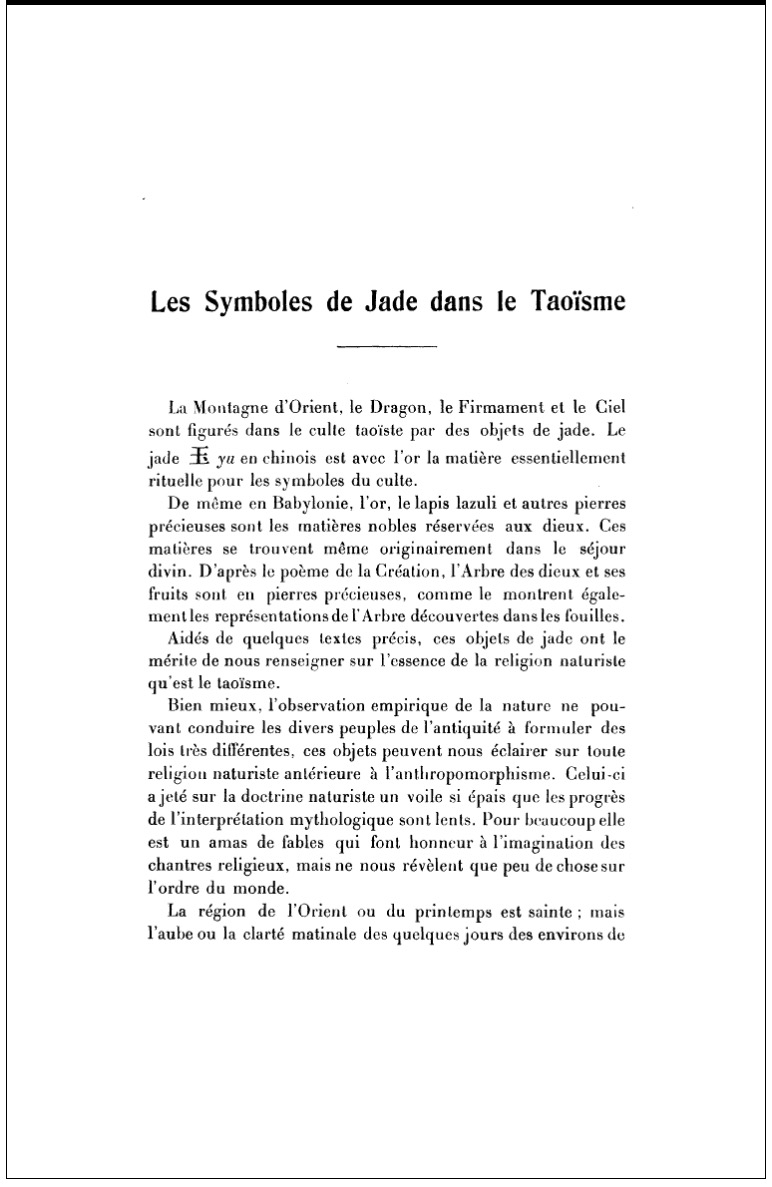
Les Symboles de Jade dans le Taoïsme
The symbols of jade in Taoism
Journal Article
Gieseler, G. (1932) Les Symboles de Jade dans le Taoïsme. [The symbols of jade in Taoism] Revue de l'Hstoire des Religions, Vol. 105, pp. 158–181.
ISBN/ISSN: 00351423, 21052573 | Sinkankas/Born No.: NIS/NIB | Language: in French | seen
Close Abstract
Hide Keywords
Copy Reference
gems, jade, amphibole jade, nephrite, China, Chinese jade, archaic jade
Gieseler examines the religious and symbolic significance of jade in Taoism, concentrating on its associations with immortality, preservation, purity, and the supernatural properties attributed to the material in Chinese tradition. Drawing on Taoist texts and related Chinese literary sources, he discusses jade as a substance believed capable of protecting the body from corruption and consequently associated with funerary practices and aspirations toward physical immortality. Jade objects and substances appear in rites, talismans, magical preparations, and accounts of immortals, while the ingestion of jade or jade-derived preparations forms part of traditions concerned with prolonging life and achieving transcendence. Gieseler also considers particular jade symbols and ritual objects within Taoist cosmology, showing how their forms and uses acquired meanings extending beyond jade’s value as a precious material. The article emphasizes the close relationship between the physical qualities traditionally attributed to jade—hardness, durability, purity, and incorruptibility—and its religious significance, in which those qualities became metaphors and instruments for attaining longevity, bodily preservation, spiritual transformation, and immortality.