
Four Treasures Reference Database
Record No. 7415
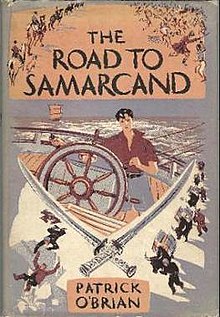
The Road to Samarcand
Book
O’Brien, P. (1955) The Road to Samarcand. London, Rupert Hart-Davis, 255 pp.
Sinkankas/Born No.: NIS/NIB | RWHL
gems, jade, nephrite, China, fiction
Patrick O’Brian’s The Road to Samarcand, first published in 1954, is an adventure novel set in China and Central Asia during the turbulent years of the early twentieth century, combining exploration, archaeology, maritime adventure, political intrigue, and a considerable interest in Chinese jade and antiquities. The story follows Derrick, an orphaned boy raised in China by missionary parents, who lives aboard the schooner Wanderer with his uncle, Captain Terence Sullivan, and the Scottish navigator Sandy Ross. When the adults decide that Derrick requires a formal education, his scholarly cousin, Professor Ayrton, proposes an extraordinary overland journey to Samarcand (Samarkand) before the boy is sent to school. An authority on Asian archaeology, the professor hopes to investigate ancient sites along the Silk Road, particularly those associated with Buddhist civilization and early Chinese history. Accompanied by Mongol guides, the Chinese cook Li Han, the Swedish sailor Olaf, and Derrick’s dog Chang, the expedition travels from Peking (Beijing) across the Mongolian steppes and the Gobi Desert toward Central Asia. The narrative incorporates vivid descriptions of caravan travel, horses, camels, desert landscapes, Buddhist monasteries, ancient ruins, and the dangers posed by bandits and competing Chinese warlords. Of particular gemological interest are several passages devoted to Chinese jade collecting and archaeology. Professor Ayrton discusses the historical preference for pale, creamy-white “mutton-fat jade” in ancient Chinese collections, contrasting it with the growing popularity of green jade in more recent periods. He describes an extraordinarily valuable collection of ancient Chinese jades belonging to a collector named Wu Ti, whose treasures are regarded as among the finest in China. The professor’s fascination with these objects reflects the importance of jade in Chinese antiquarian scholarship and the prestige attached to early carved and inscribed pieces. During excavations along the Silk Road, the expedition also encounters a carved jade charm bearing Chinese characters, which the professor identifies as comparatively modern rather than contemporary with the archaeological site. This episode illustrates the difficulty of distinguishing ancient artifacts from later objects discovered in apparently archaeological contexts. Other passages concern Chinese bronze antiquities, including ritual vessels, inscriptions, questions of authenticity, and the long history of reproducing earlier artistic styles. O’Brian uses Professor Ayrton’s enthusiasm for ancient objects to contrast scholarly appreciation of historical artifacts with their commercial value, while also introducing the dangers of looting, warfare, and the dispersal of important collections. Although the book is a work of fiction rather than a historical or gemological treatise, its treatment of jade reflects contemporary European ideas about Chinese material culture, collecting, and the antiquities trade. The novel is distinguished by O’Brian’s characteristic humor, lively characterization, detailed observations of navigation and travel, and sympathetic portrayal of the friendships that develop among people of different cultural backgrounds. For gemological historians, its principal interest lies in its literary depiction of Chinese jade collecting, the distinction between ancient white and more recently fashionable green jade, and the relationship between archaeological discoveries and the commercial appreciation of precious carved stones.