
Four Treasures Reference Database
Record No. 760
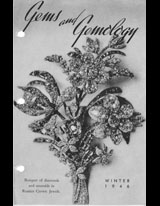
Jewels of the Russian Diamond Fund
Journal Article
Fersman, A.E. (1946–47) Jewels of the Russian Diamond Fund. Gems & Gemology, Trans. by Marie Pavlovna Warner, Vol. 5, Part I: No. 8, Winter, pp. 363, 372–376; Part II: No. 9, Spring, pp. 403–405; Part III: No. 10, Summer, pp. 432–434; Part IV: No. 11, Fall, pp. 467–470.
ISBN/ISSN: 0016626X | Sinkankas/Born No.: NIS/NIB | RWHL
corundum, quality.10, Tajikistan.12, spinel, gems
Drawing on his examination of the Russian Diamond Fund, A.E. Fersman combines descriptions of exceptional gemstones and jewelry with historical narratives, mineralogical observations, and personal recollections. Translated by Marie Pavlovna Warner, the four installments present the collection as a record of gemstone sources, craftsmanship, royal patronage, and the movement of treasures between countries. The opening survey describes notable diamonds, including the Orlov and Shah, alongside colored diamonds, large emeralds, sapphires, rubies, spinels, tourmalines, and pearls. Fersman distinguishes natural color from effects produced by settings, explaining that the reputedly red diamond associated with Paul I owes its strong appearance to colored backing rather than an inherently ruby-red body color. He also questions historical accounts of enormous rubies, suggesting that some celebrated red stones were actually spinel or tourmaline. His appreciation of jewelry emphasizes composition and workmanship rather than gemstone quality alone: eighteenth-century artists could combine imperfect or relatively inexpensive stones into outstanding designs. Examples include emerald-and-diamond bouquets with flexible stems and moving flowers, a diamond rivière, a fountain-shaped aigrette, and floral ornaments employing yellow and white diamonds. The third installment concentrates on three historically significant diamonds. A flat portrait diamond illustrates the preservation of a large transparent surface and the technical uses of similarly shaped stones. Fersman argues that the Orlov and Koh-i-Noor are separate stones, rejecting accounts that confuse their histories, and relates his reconstruction of the Orlov’s Indian origin, subsequent ownership, and acquisition for Catherine II. The Shah diamond’s engraved inscriptions provide a framework for tracing its passage through Indian and Persian courts and its eventual presentation to Russia following the killing of the diplomat and writer A.S. Griboyedov. The concluding installment returns to the distinction between historical names and mineral identity, identifying Catherine II’s celebrated large “ruby” as rubellite on the basis of appearance, color, and density evidence. It then broadens beyond the Diamond Fund to discuss lapis lazuli from Afghanistan and the Pamirs, including an expedition’s encounter with high-altitude deposits and Fersman’s recollection of a carved lapis elephant given to Amanullah Khan. The final narrative concerns the large emerald associated with Yakov Ivanovich Kakovin, tracing its discovery in the Urals, disputed custody, incorporation into a private collection, and eventual preservation in the Academy of Sciences’ mineralogical museum. Throughout, Fersman treats gemstones as scientific specimens and cultural objects whose significance depends on mineral identity, artistic treatment, provenance, and the reliability of historical testimony.