
Four Treasures Reference Database
Record No. 7689
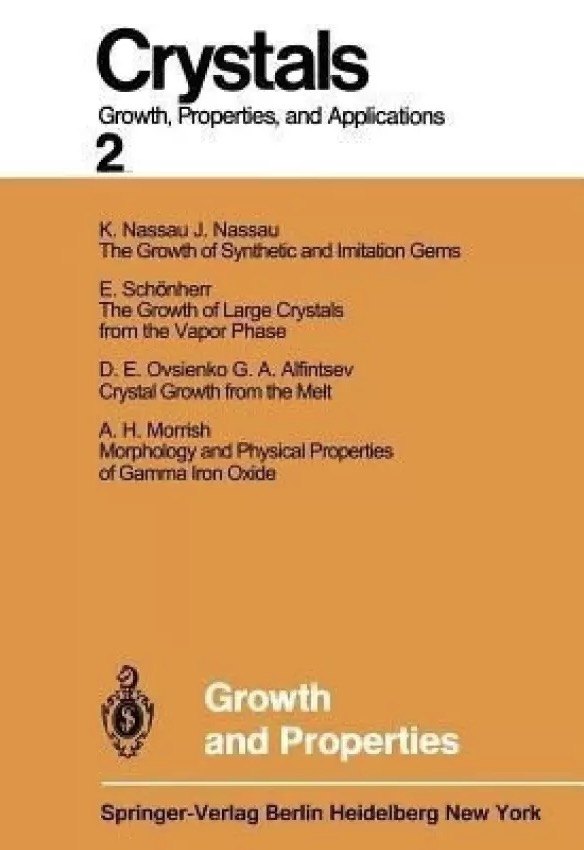
The growth of synthetic and imitation gems
Book Section
Nassau, K. and Nassau, J. (1980) The growth of synthetic and imitation gems. In: Crystals: Growth, Properties and Applications, Berlin: Springer, Vol. 2 , pp. 1–50.
Sinkankas/Born No.: NIS/NIB | RWHL
synthetic gems, synthetic corundum.7, synthetic beryl, emerald, gems, beryl
The production of synthetic and imitation gemstones is reviewed through the relationships between crystal growth methods, material properties, gemmological identification and commercial feasibility. Synthetic gems are distinguished from imitations by their correspondence to natural materials in composition and structure, whereas imitations reproduce appearance using different substances. The principal methods considered are Verneuil flame fusion, Czochralski pulling, Bridgman solidification, skull melting, flux growth, hydrothermal growth and high-pressure synthesis. Their suitability depends on melting behaviour, viscosity, phase stability, growth rate, crystal perfection, equipment investment, operating skill and production costs. Diamond growth is described in terms of high-pressure solution transport through a molten metal solvent onto cooler seeds, with controlled impurities producing yellow or blue material. At the time of writing, gem-quality synthetic diamond remained costly relative to natural diamond, although technical improvements offered possible future competition. Emerald requires solution growth, and the authors reconstruct aspects of incompletely disclosed commercial flux and hydrothermal processes from published evidence, patents and inclusions. Water content, optical constants and characteristic inclusions are discussed as indicators of growth history. Corundum receives detailed treatment, particularly the inexpensive Verneuil process, its feed preparation and thermal conditions, and the origin of diagnostic curved growth striations. Synthetic star ruby and sapphire are produced by incorporating titanium and subsequently precipitating oriented rutile needles through heat treatment. Alternative corundum methods provide improved crystal quality or different growth forms, often for technological applications. Hydrothermal quartz production illustrates the transfer of industrial crystal growth technology into jewellery, with impurities, irradiation and heating controlling colour. Further sections cover spinel, chrysoberyl and alexandrite, cubic zirconia, yttrium aluminium garnet, gadolinium gallium garnet, rutile and strontium titanate. Skull melting is highlighted as the means of overcoming containment difficulties in growing cubic zirconia. Synthetic opal is explained through the preparation, regular packing and consolidation of uniform silica spheres, while turquoise and other aggregate materials raise questions about the criteria for a true synthetic equivalent. Appendices introduce gem properties, valuation, shaping and testing. The authors emphasise that successful synthesis alone does not ensure a viable gem product: durability, appearance, consumer demand and distribution also matter. Future developments are expected particularly from research supported by technological applications, improved production economics and materials displaying special optical effects.