
Four Treasures Reference Database
Record No. 7748
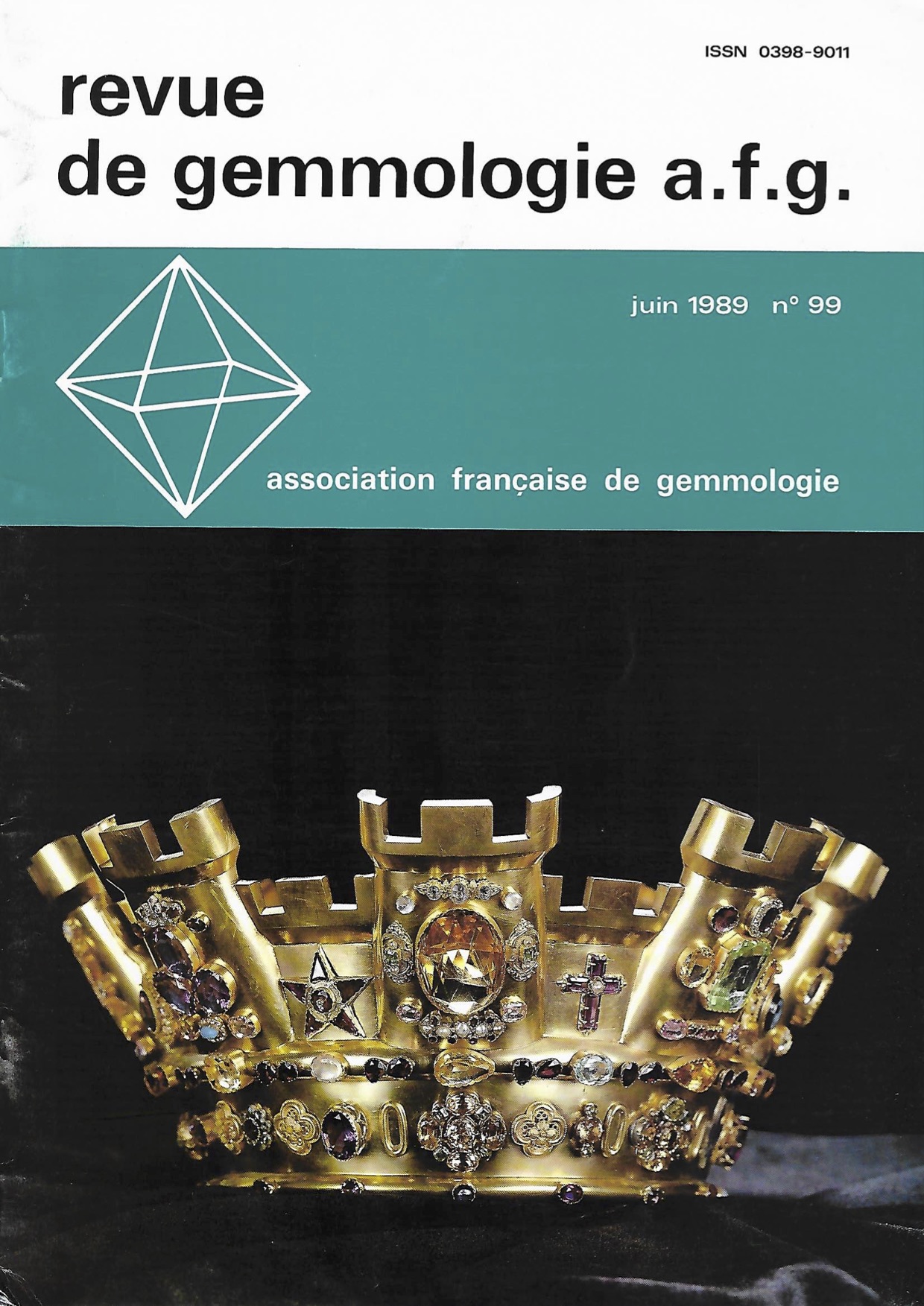
Les gisements de saphirs et rubis associés aux basaltes alcalins de Madagascar: Caractéristiques géologiques et minéralogiques 1ère partie: caractéristiques géologiques des gisements
The sapphire and ruby deposits associated with alkaline basalts of Madagascar: Geological and mineralogical characteristics. Part 1: Geological characteristics of the deposits
Journal Article
Rakotosamizanany, S., Giuliani, G., Ohnenstetter, D., Rakotondrazafy, A.F.M. and Fallick, A.E. (2009) Les gisements de saphirs et rubis associés aux basaltes alcalins de Madagascar: Caractéristiques géologiques et minéralogiques 1ère partie: caractéristiques géologiques des gisements. [The sapphire and ruby deposits associated with alkaline basalts of Madagascar: Geological and mineralogical characteristics. Part 1: Geological characteristics of the deposits] Revue de Gemmologie A.F.G., No. 169, pp. 13–21.
Language: in French | not seen
Close Abstract
Hide Keywords
Copy Reference
corundum, Geology.11, Madagascar.12, gems
Madagascar is one of the principal producers of gem corundums recovered from continental basaltic fields. The main deposits are the secondary deposits of Ambondromifehy from the Antsiranana Province in the northern part of the country (sapphire-bearing palaeoplacer and placer), Soamiakatra–Mandrosohasina from the Antananarivo Province in the central part (primary ruby deposit, and ruby and/or sapphire-bearing placer and palaeoplacer), and Vatomandry from the Toamasina Province in the eastern part of the island (ruby- and sapphire-bearing paleoplacer). Soamiakatra is the only known primary deposit where ruby is found in metagabbro and pyroxenite xenoliths, which were entrained and brought up to the upper crust by the Ankaratra volcanic event. Petrographic studies have demonstrated the existence of two different conditions of ruby formation at the boundary of the eclogite domain (HT ~1100 °C, HP ~20 kbar) and granulite facies (HT ~1100 °C, BP <15 kbar). In contrast, the sapphires originated from alkaline mafic magmatic chambers at the lower continental crust–mantle boundary. They occur within syenite and anorthoclasite xenoliths in the basalts or are associated with them. These alkali basalts transported corundum and their host rocks to the surface; they are linked with asthenosphere upwelling and thinning of the lithosphere underneath the Ankaratra Plateau during the Oligocene–Quaternary. The mineralogical study of ruby and sapphire permitted us to establish the relationships that exist between their chemical composition, their colour, and the nature of their solid inclusions. Iron is the main chromophore of sapphire, and the Fe²⁺/Fe³⁺ ratio in its structure, in addition to the quantity of titanium and chromium available in the fluid, determines the colour of the sapphire and the hue of the polychrome sapphires. Chromium is the second most important chromophore for pink, violet-blue, and some blue-green to light-blue sapphires. For ruby, chromium is the chromophore, but iron and vanadium interfere to produce red-brown to purplish-blue crystals. The deeply coloured, high-quality rubies are characterized by a Fe₂O₃/Cr₂O₃ ratio less than 1. The chemical diagrams used for the genetic classification of corundum indicate a metamorphic origin for all rubies from the central and eastern regions of Madagascar: rubies are hosted either by mafic and/or ultramafic rocks or by metasomatites formed by fluid–mafic rock alteration (“plumasite” or biotitite). Two processes have been identified to explain the origin of sapphires from the different regions: (i) a dominant magmatic process linked to syenites (anorthoclasite), and (ii) a metamorphic process (probably of skarn type). The oxygen isotopic compositions of the corundum corroborate these two origins. Solid inclusions such as pyrochlore, samarskite, uraninite, and anorthoclase in the sapphires confirm their syenitic origin. The presence of pentlandite, talc, sillimanite, titanite, and phlogopite in the rubies testifies to a metamorphic paragenesis.