
Four Treasures Reference Database
Record No. 8065
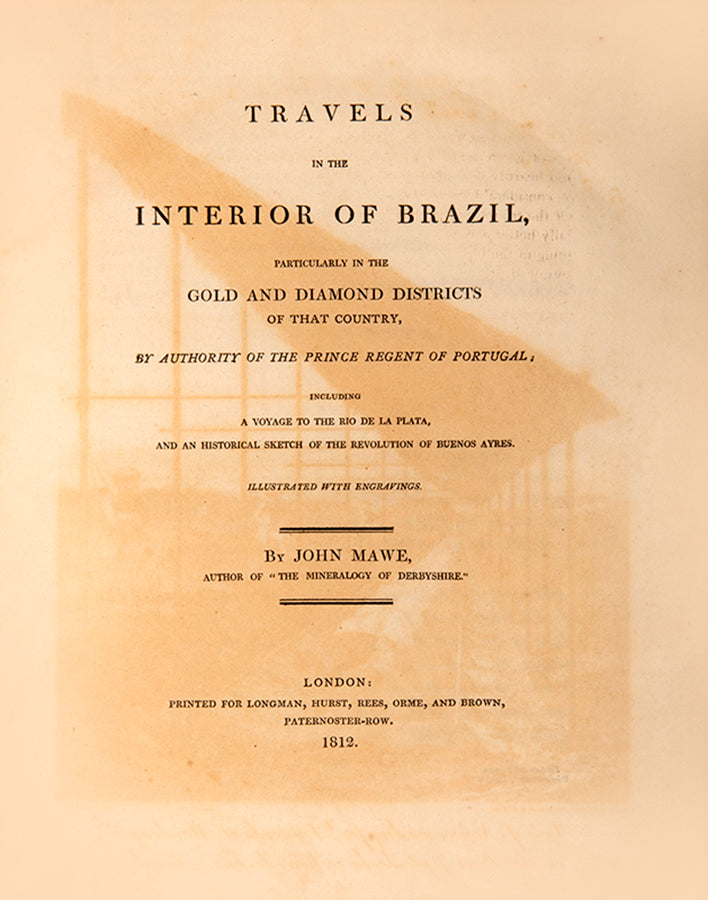
Travels in the Interior of Brazil
Book
Mawe, J. (1812) Travels in the Interior of Brazil. London, Longman, Hurst, Rees, Orme, and Brown, 366 pp.
Sinkankas/Born No.: 4270–4281 | RWHL
gems, Brazil
Sinkankas: A work much valued by historians and geographers as one of the earliest reliable accounts of Brazil under Portuguese colonization, and the first on the diamond & gold washings and the manner in which they were conducted. The account is replete in details on the geography, the people and their customs, habitations, plants and animals, trade, and many others made by a shrewd and intelligent observer. Chapters 10 to 15 contain scattered references to diamonds and other gemstones, but the best specific information is found in Chapters 8 and 15, on all aspects of diamond mining. Near the end of Chapter 10 Mawe mentions his visit to the famous precious topaz mines near Villa Rica (Ouro Preto), this probably being the first printed account of a deposit which still produces fine gem topaz. The appendix is a potpourri of information, e.g., the revolution in Buenos Aires, recommendations for improving agriculture, derogatory comments on the diamond-mining regulations which Mawe considered excessively harsh, his views on Brazilian society, on negroes, on diseases peculiar to Brazil, and on the use of mercury in recovering metals from ores. The frontispiece plate is the well-known view of diamond-washing showing negro workmen under a thatched sun shelter; other plates depict scenes in the diamond region, mining machinery, crystal drawings, a plate of land shells, and mineral specimens, including a diamond crystal in conglomerate matrix, hand-colored. Not all copies contain hand-colored plates. In general, most copies are moderately to severely foxed. In this connection, Borba de Moraes, Bibliogr. Brasiliana, 2, p. 41, states that “Mawe’s book had considerable success … [which] lies in the fact that it is the first narration made ‘de visu’ of the gold and diamond mines in Brazil. The view of the Jaraguá mining camp is the first landscape document we have of the interior of São Paulo, as noted by Taunay.”