
Four Treasures Reference Database
Record No. 8099
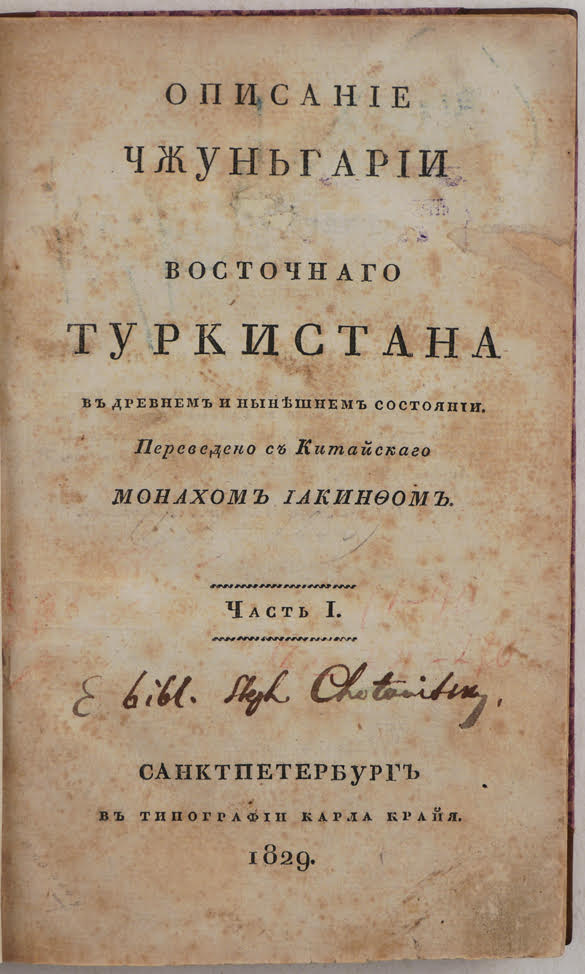
Opisanie Chzhungarii i Vostochnogo Turkestana v drevnem i nyneshnem sostoyanii | Perevedeno s kitaiskago monakhom Iakinfom [Ци-ши-и: Собрание сведений о народах, обитавших в Средней Азии в древние времена]
Description of Dzungaria and Eastern Turkestan in its Ancient and Modern State. Translated from Chinese by Monk Iakinf
Book
Iakinf [Bichurin, N.I., a.k.a. Father Hyacinth], (1829) Opisanie Chzhungarii i Vostochnogo Turkestana v drevnem i nyneshnem sostoyanii | Perevedeno s kitaiskago monakhom Iakinfom [Ци-ши-и: Собрание сведений о народах, обитавших в Средней Азии в древние времена]. [Description of Dzungaria and Eastern Turkestan in its Ancient and Modern State. Translated from Chinese by Monk Iakinf] St. Petersburg, Tip. Karla Kreya, 270 pp.
Sinkankas/Born No.: NIS/NIB | Language: in Russian | RWHL*
gems, jade, China, Chinese jade carving, Chinese lapidary arts, Khotan, Hetian, yu, nephrite, Xinjiang, Fischer-Book
An important work by the famous Russian sinologist archimandrite Iakinf, the first translation into a European language of three important Chinese sources on the history and contemporary state of so-called “Western Lands,” or Chinese Turkestan (modern Xinjiang Uyghur Autonomous Region of China). The book describes the ancient history of the Western Lands as early as 126 B.C., and their modern state, and is based on three original Chinese sources: Yu Chuen’s (a.k.a. Qishiyi)” (“Narration about the Western Lands”), a portion of the “Tscen Han shoo” by Pan Koo (“History of the early Han dynasty”), and “Se yu vuin tzeen lŭh” (“Notes about seen and heard in the Western Lands”). The book opens with Iakinf’s preface, followed by an alphabetic index of ancient geographical names clarifying their present location.The main text is commenced with a table of distances between military stations in Chinese Turkestan, and is supplemented with texts of different government regulations and statutes regarding the region (about Chinese exiles and criminals sent for a settlement there, about duties and customs, about the possessions of the Turkestan princes allowed to be taken during travelling et al.), and with genealogical lists of the princes and rulers of the lands in the Eastern Turkestan. Coloured lithographed plates depict a Kalmykian warrior and his wife, an inhabitant of the area near Bukhara, and a Turkestan girl.