
Four Treasures Reference Database
Record No. 8123
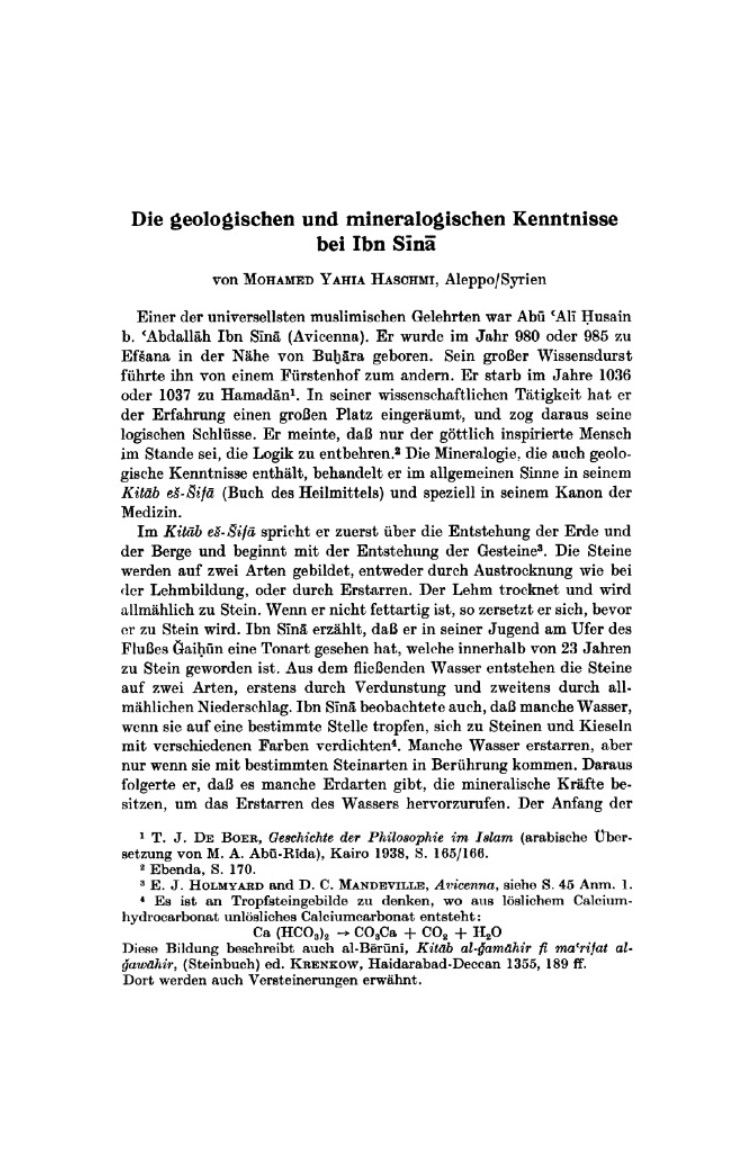
Die geologischen und mineralogischen Kenntnisse bei Ibn Sīnā
The geological and mineralogical knowledge in Ibn Sina
Journal Article
Haschmi, M.Y. (1966) Die geologischen und mineralogischen Kenntnisse bei Ibn Sīnā. [The geological and mineralogical knowledge in Ibn Sina] Zeitschrift der Deutschen Morgenländischen Gesellschaft, Vol. 116, No. 1, pp. 44–59.
Sinkankas/Born No.: NIS/NIB | Language: in German | RWHL*
gems, Arabic mineralogy, ibn Sina, Avicenna, early lapidaries
Haschmi examines Ibn Sīnā’s geological and mineralogical knowledge, drawing principally on the Kitāb al-Shifāʾ and the Canon of Medicine. He discusses Ibn Sīnā’s explanations for the formation of mountains and rocks, including sedimentation, the action of water, earthquakes, erosion, and the petrification of plants and animals, and notes his recognition that mountains could arise through both uplift and the erosional removal of surrounding material. The mineralogical section considers Ibn Sīnā’s classification of mineral substances into stones, fusible substances or metals, sulfurous substances, and salts, followed by his descriptions of individual minerals and substances. These include gold, silver, copper, iron, lead, tin, vitriol, alum, borax, mercury, sulfur, arsenic, sal ammoniac, magnetite, marcasite, hematite, lapis lazuli, malachite, gypsum, and others, with observations on their colors, physical characteristics, preparation, medicinal applications, and occasionally their artificial production or imitation. Haschmi also discusses Ibn Sīnā’s rejection of the alchemical transmutation of base metals into gold and silver, emphasizing his view that artificial products might resemble natural substances externally without acquiring their essential nature. In conclusion, Haschmi considers Ibn Sīnā’s geological ideas within the earlier Greek and Islamic traditions, particularly Aristotle and his followers, while arguing that Ibn Sīnā also made independent observations; he further notes the subsequent transmission of his mineralogical ideas to medieval Europe through Latin translations and their influence on Albertus Magnus.