
Four Treasures Reference Database
Record No. 838
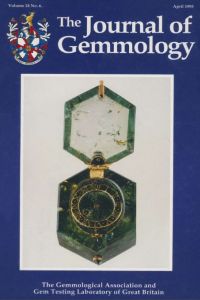
The Cheapside Hoard confusion
Journal Article
Gosling, J.G. (1995) The Cheapside Hoard confusion. Journal of Gemmology, Vol. 24, No. 6, April, pp. 395–400.
ISBN/ISSN: 221252 | Sinkankas/Born No.: NIS / NIB | RWHL
corundum, quality.10, gems
Reviews conflicting accounts of the discovery and recovery of the Cheapside Hoard, a collection of approximately 340 jewellery items unearthed in London in 1912, and combines this historical investigation with descriptions of exceptional gemstones and workmanship. The hoard is interpreted as the stock of a Jacobean goldsmith, pawnbroker or dealer, buried under unknown circumstances in the early seventeenth century. Gosling compares museum catalogues, historical studies, newspaper tributes and recollections that disagree over the precise location, date, container and manner of recovery. Reports variously describe a decayed wooden box, a bucket, or jewels embedded in lumps of clay, while the absence of a direct account of the actual excavation prevents a definitive reconstruction. Central to the story is G.F. Lawrence, known as “Stony Jack”, whose relationships with building labourers enabled him to recover archaeological objects for London museums. Accounts portray him purchasing finds from workmen and receiving successive deliveries of clay-encrusted jewellery at his Wandsworth premises. The article highlights both his contribution to preserving the hoard and the unresolved details surrounding ownership, payments and Treasure Trove claims. Institutional disputes delayed agreement until 1916, when the collection was divided principally between the London and Guildhall museums, with smaller holdings elsewhere. Their later amalgamation reunited most of the material in the Museum of London. Gemmological notes describe a watch enclosed in Colombian emerald, identified by characteristic multiphase inclusions; a table-cut diamond estimated at three to four carats with a modified scissors-cut pavilion; and a hexagonal sapphire displaying rutile silk, pronounced growth zoning and an unusual combination of crown facets and a stepped pavilion. The sapphire’s appearance and setting are compared with those of the Stuart Sapphire. Amethyst and emerald grape pendants illustrate sophisticated lapidary methods, apparently involving intersecting annular drillings followed by removal of intervening material and rounding of the exposed ends. Gosling also considers how damp clay beneath a chalk cellar floor could explain decay of the container and dispersal of its contents. He concludes that the surviving uncertainties justify a new authoritative illustrated catalogue and consideration of further reunification of the collection, while recognising its importance as evidence of Elizabethan and Jacobean jewellery, gem cutting and material culture.