
Four Treasures Reference Database
Record No. 842
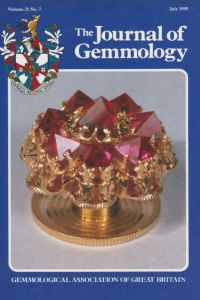
A fourteenth century crown
Journal Article
Gray, A. (1989) A fourteenth century crown. Journal of Gemmology, Vol. 21, No. 7, pp. 431–432.
ISBN/ISSN: 221252 | Sinkankas/Born No.: NIS / NIB | RWHL
corundum, quality.10, gems
The fourteenth-century “English Crown”, exhibited at the Royal Academy’s Age of Chivalry exhibition and normally preserved in Munich’s Residence Museum, is described in terms of its gemstones, metalwork, construction and uncertain origins. The crown passed to the Wittelsbach family as part of the dowry of Blanche, daughter of Henry IV, on her marriage to Ludwig III of Bavaria in 1401. Although its individual gemstones are judged unexceptional, their arrangement with gold, pearls and coloured enamel produces a striking decorative effect. The two-tier structure comprises twelve lower rosettes supporting twelve golden lilies of alternating heights. Each rosette contains an enamelled hexagon with fine gold tracery and a central pale blue sapphire, usually fashioned as an oval cabochon. Drilled examples suggest reuse of earlier beads, while one flat hexagonal stone appears to be a slice of a corundum crystal. Alternating red and blue enamel grounds carry small white enamel flowers and are complemented by ruby cabochons or clusters of drilled pearls surrounding small diamond octahedra. The taller lilies combine trefoil gold leaves with beaded margins, ruby and sapphire cabochons, pearl clusters and diamond crystals. Smaller lilies vary this arrangement through different gemstone combinations and suspended single pearls. The pearls’ good condition may partly reflect restoration undertaken in 1925, although replacement is not established. Elaborately enamelled connecting plaques allow the crown to fold for transport, and a fitted case survives. Numbering of the rosettes ensures that the detachable lilies can be returned to their correct positions. Historical evidence establishes the crown’s presence in an inventory of royal valuables in 1399 but does not securely identify its earlier owner. A possible association with Anne of Bohemia, who married Richard II in 1382, is considered alongside similarities to crowns represented in contemporary religious and royal imagery. Enamelling techniques and beaded goldwork suggest French workmanship, but comparable features occur on English objects, and French-trained craftspeople could also have worked in Prague. The article therefore leaves both the place of manufacture and original ownership unresolved, emphasising the crown’s historical importance, ingenious portability and coordinated use of materials and colour.