
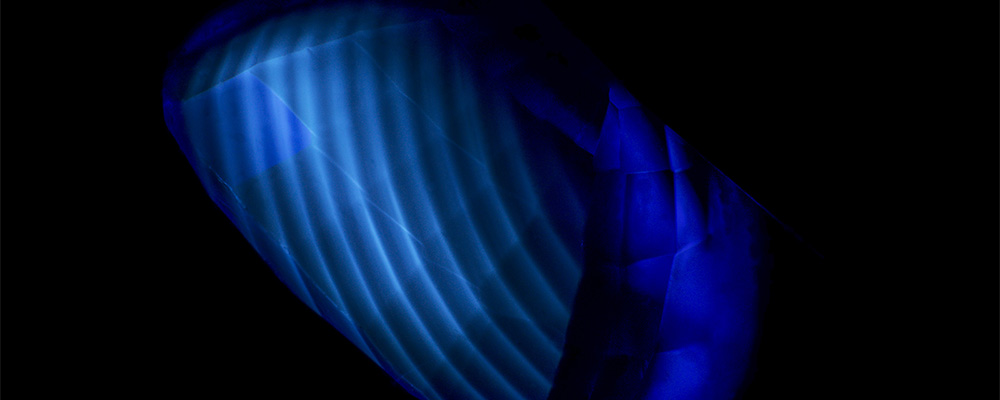
Short-wave fluorescent illumination provides a useful tool to spot curved banding in flame-fusion synthetic sapphire.
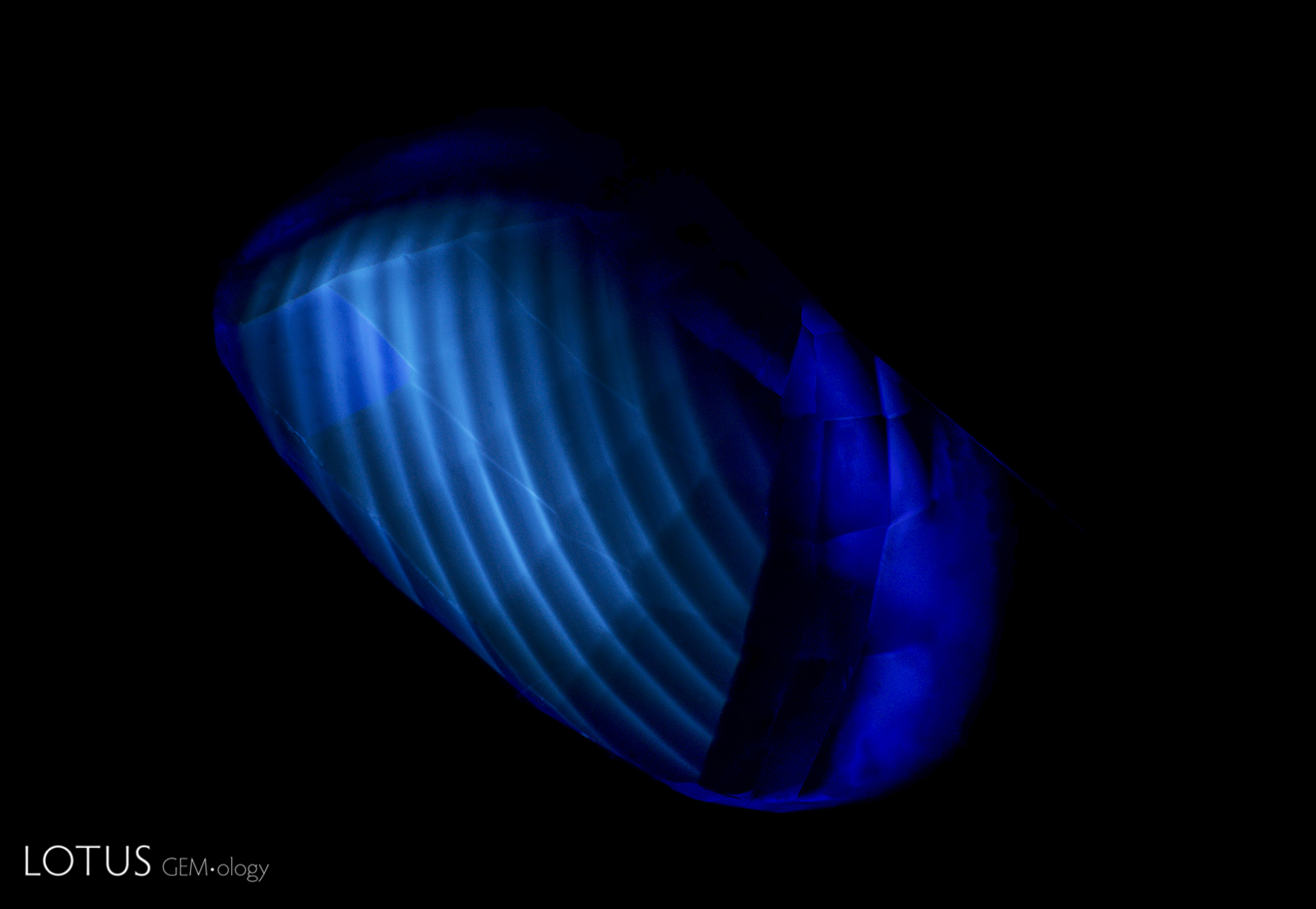 Figure 1. Curved banding is easily spotted in this flame-fusion blue synthetic sapphire when illuminated with the Magilabs deep-UV fluorescence system, a short-wave UV source. Photomicrograph by E. Billie Hughes; field of view ~13 mm.
Curved Banding in Flame-Fusion Synthetic Sapphires Under Short-Wave UV
Most synthetic ruby and sapphire on the market is grown by Verneuil flame fusion. It can usually be separated from natural corundum by its distinctive curved banding, in contrast to the angular zoning seen in natural stones. Gemologists may see these features in the microscope when using darkfield or brightfield illumination. This zoning can also be seen with use of a short-wave fluorescent light, as noted in Ruby & Sapphire: A Gemologist's Guide (R.W. Hughes et al., Lotus Publishing, Bangkok, 2017).
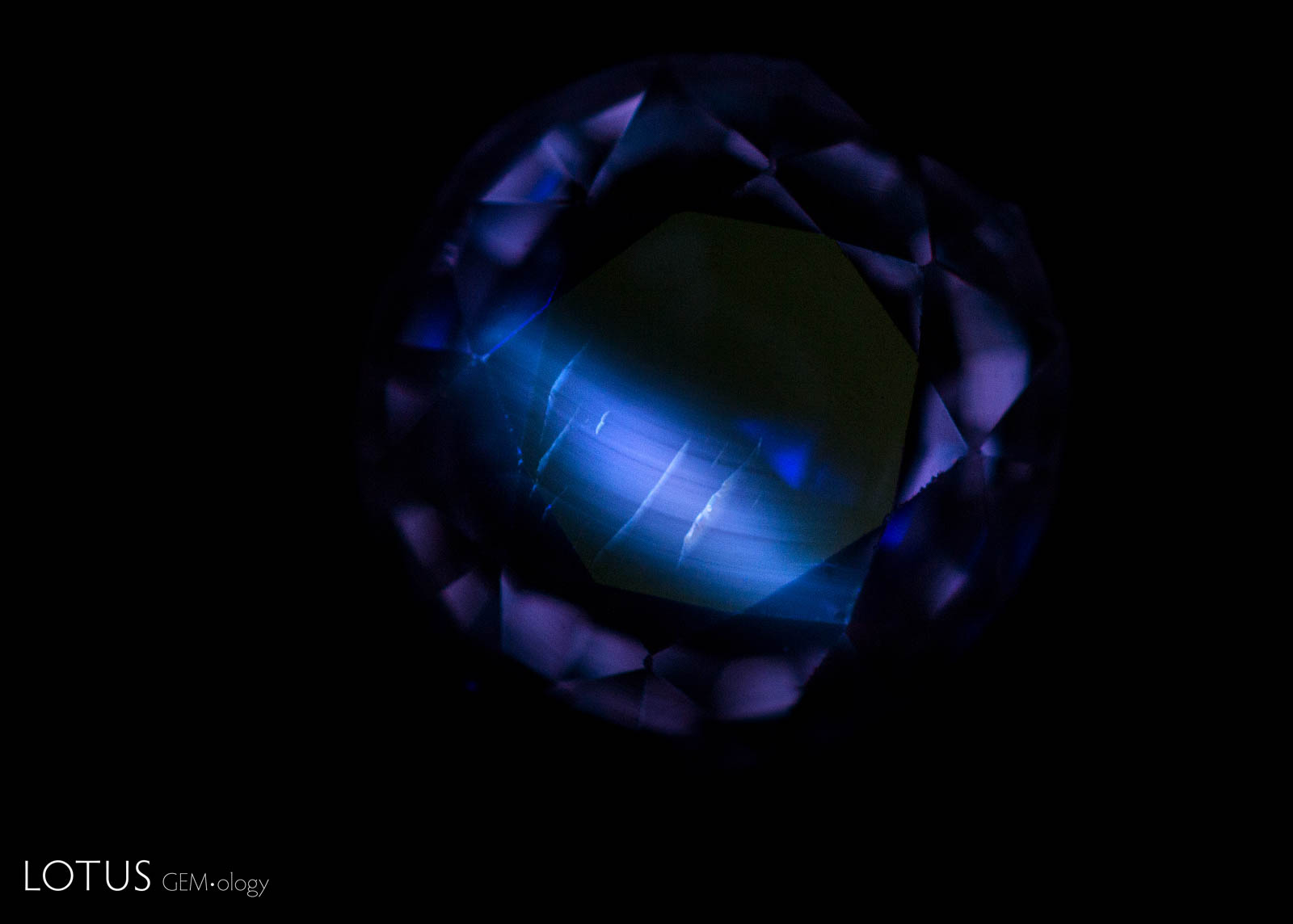 Figure 2. Observed with a short-wave UV light source, the sample displays curved banding, a telltale sign of a flame-fusion synthetic sapphire. Photomicrograph by E. Billie Hughes; field of view ~24.5 mm.
Recently the author noticed two excellent examples. When viewed with the Magilabs deep-UV fluorescence system (a proprietary short-wave UV source), the curved banding in the synthetics was clear (figures 1 and 2), allowing them to be easily separated from natural corundum. Gemologists using a DiamondView may see the same reaction.

About the Author
E. Billie Hughes is Co-Founder and Managing Director of Lotus Gemology, where she oversees the company's day-to-day operations while continuing gemological research and laboratory work. After graduating from UCLA, she became a Fellow of the Gemmological Association of Great Britain (FGA). Her research focuses on ruby and sapphire, including low-temperature heat treatment, and she has authored and co-authored articles in leading gemological journals. She has conducted fieldwork at gem deposits around the world, including nearly every major ruby and sapphire locality.
Billie is an internationally recognized educator who has lectured for trade organizations, museums, and luxury jewelry houses, including extensive educational work with Van Cleef & Arpels. She has also served as a judge on Thailand's The Secret Gems television series. An award-winning photographer and photomicrographer, her images have received honors in the Nikon Small World and Gem-A competitions and have appeared in publications including National Geographic and Forbes. She is also the creator of Hyperion, Lotus Gemology's online inclusion database.
Billie developed an interest in gemstones from an early age, accompanying her parents on expeditions to mines and gem-producing regions around the world. That lifelong passion for fieldwork, laboratory research, education, and photography continues to shape her work at Lotus Gemology today.
Notes
This article first appeared in Gems & Gemology, Summer 2019, Vol. 55, No. 2, pp, 264–265.