
A 6 ct Mozambique ruby submitted as untreated showed evidence of heat treatment through infrared spectroscopy and microscopic examination. Diagnostic features included a 3232 cm⁻¹ infrared peak, partially broken-down crystals associated with rutile silk, and surface spall marks indicating heating after cutting. The case highlights how treatment can substantially reduce a fine ruby’s value while offering little improvement in appearance.
Gemologists at Bangkok’s Lotus Gemology recently received a 6 ct ruby for identification. Declared to be an untreated ruby from Mozambique, the stone featured a superb vivid red color of a type that is often termed “pigeon’s blood” in the trade. As it was also of good clarity and well cut, it was obvious we were dealing with a gem of potentially high value.
The UV-Vis-NIR spectrum was typical for ruby/synthetic ruby. The infrared spectrum revealed peaks at 3309 and 3232 cm⁻¹. The 3232 cm⁻¹ peak generally indicates that a stone has been subjected to artificial heat treatment. We proceeded to examine the gem in the microscope, where we found two additional pieces of evidence of heat treatment.
The first feature was rutile silk of a type that is typical of rubies from East Africa. In these stones, the silk consists of high-relief needles of rutile with attached unidentified “daughter” crystals of another substance of lower relief. In the case of heat-treated stones, the daughter crystals will sometimes show a partial breakdown ('GIA Lab reports on low-temperature heat treatment of Mozambique ruby,' GIA Research News, April 28, 2015). Small amounts of breakdown in the form of irregular white patches were found in this stone (Figure 1).
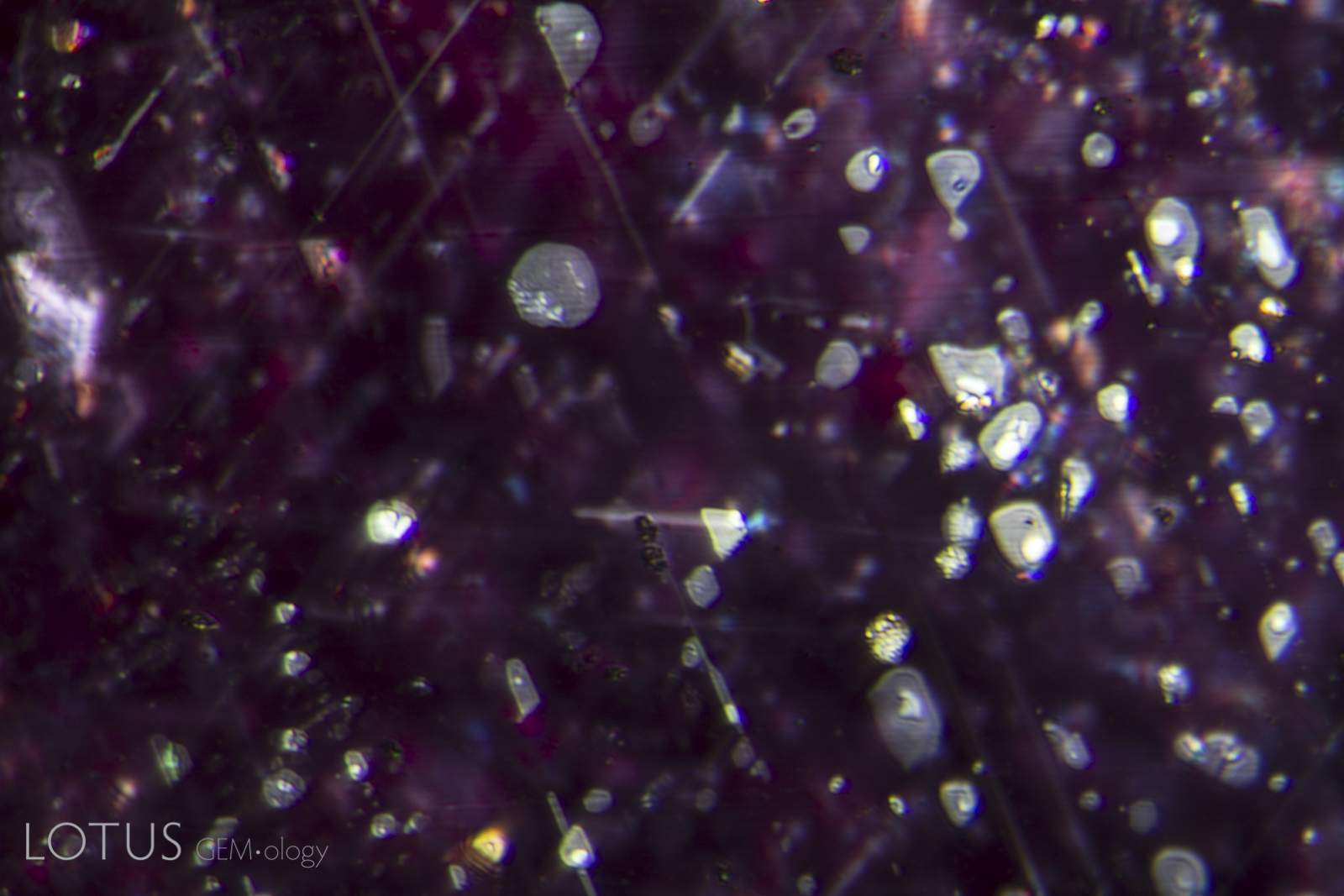 Figure 1. Silk in corundum often unmixes into two different solid phases, one highly reflective (rutile) and the other of lower relief (ilmenite or hematite-ilmenite). When the Mozambique ruby was heated, the lower-relief crystals began to break down, developing irregular white patches, as shown here. Photomicrograph by Richard W. Hughes; field of view 1 mm.
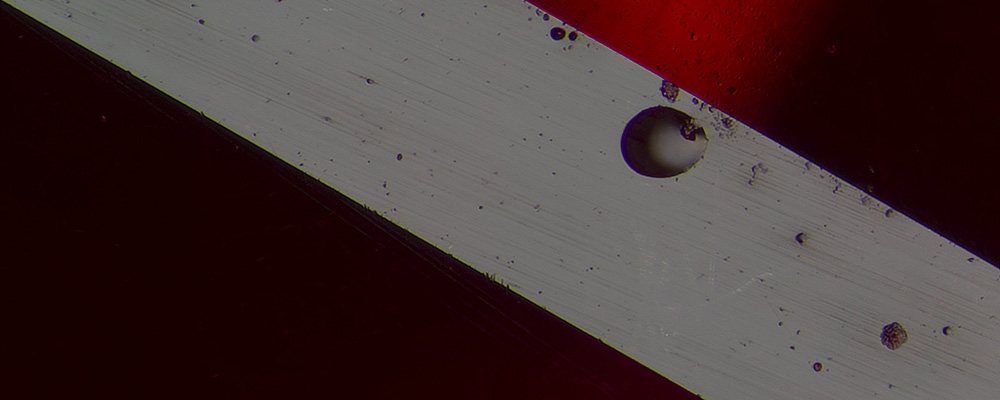
But the most obvious evidence of heat treatment was the presence of spall marks (Figures 2 & 3), which are solidified droplets of material on the surface that melted or were dissolved during heating. These spall marks across the stone showed that the ruby had been heated after cutting and not repolished following the treatment. We can only guess about the reasons for heating such a valuable gem, but there is no doubt that this particular roll of the dice was a losing gamble because the potential improvement in appearance is slight compared to the large price difference between untreated and heated ruby. We concluded that this was a heat-treated Mozambique ruby.
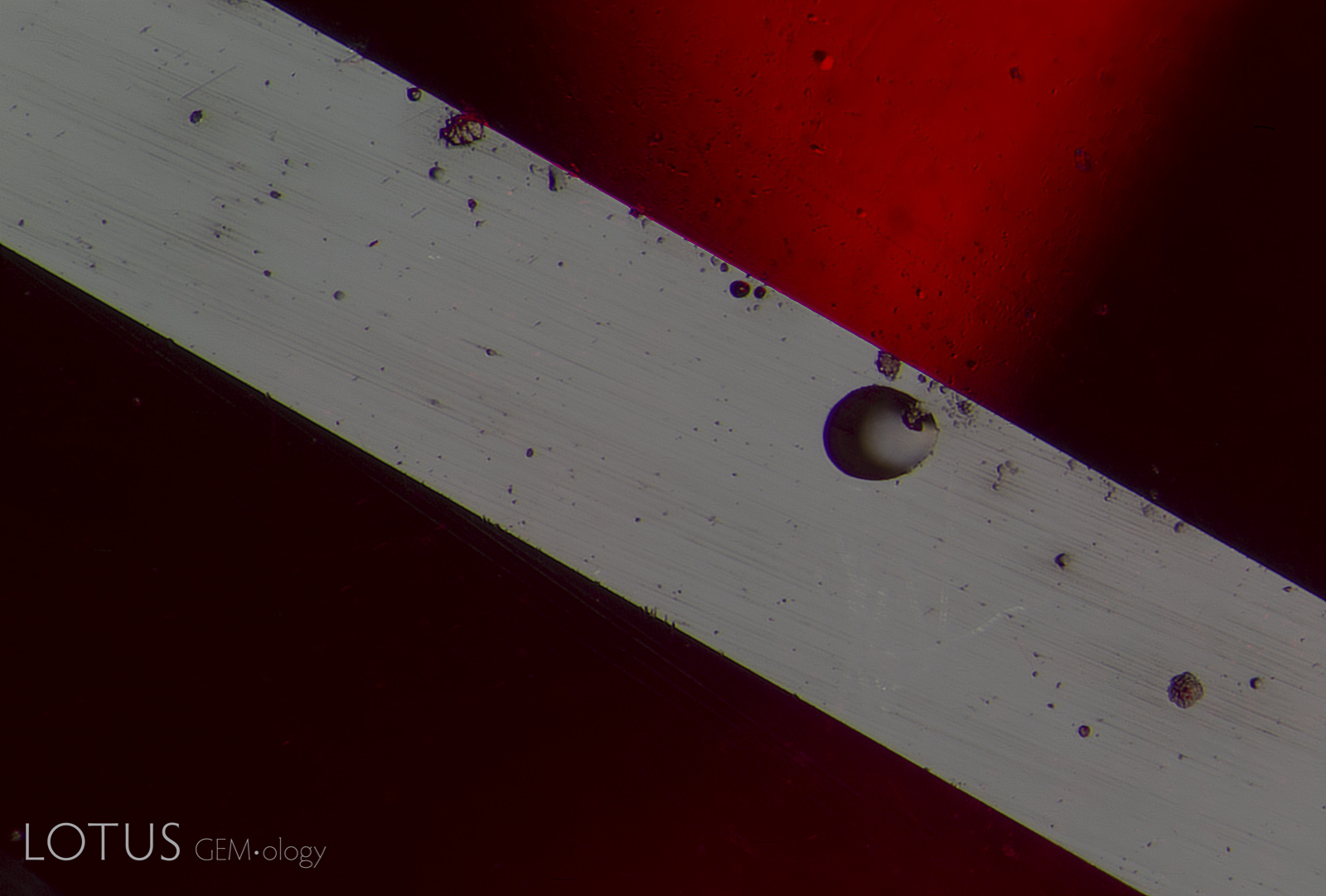 Figure 2. Spall marks on the surface of the Mozambique ruby prove it was heat treated after cutting and polishing. Photomicrograph: Richard W. Hughes; field of view 2.0 mm.
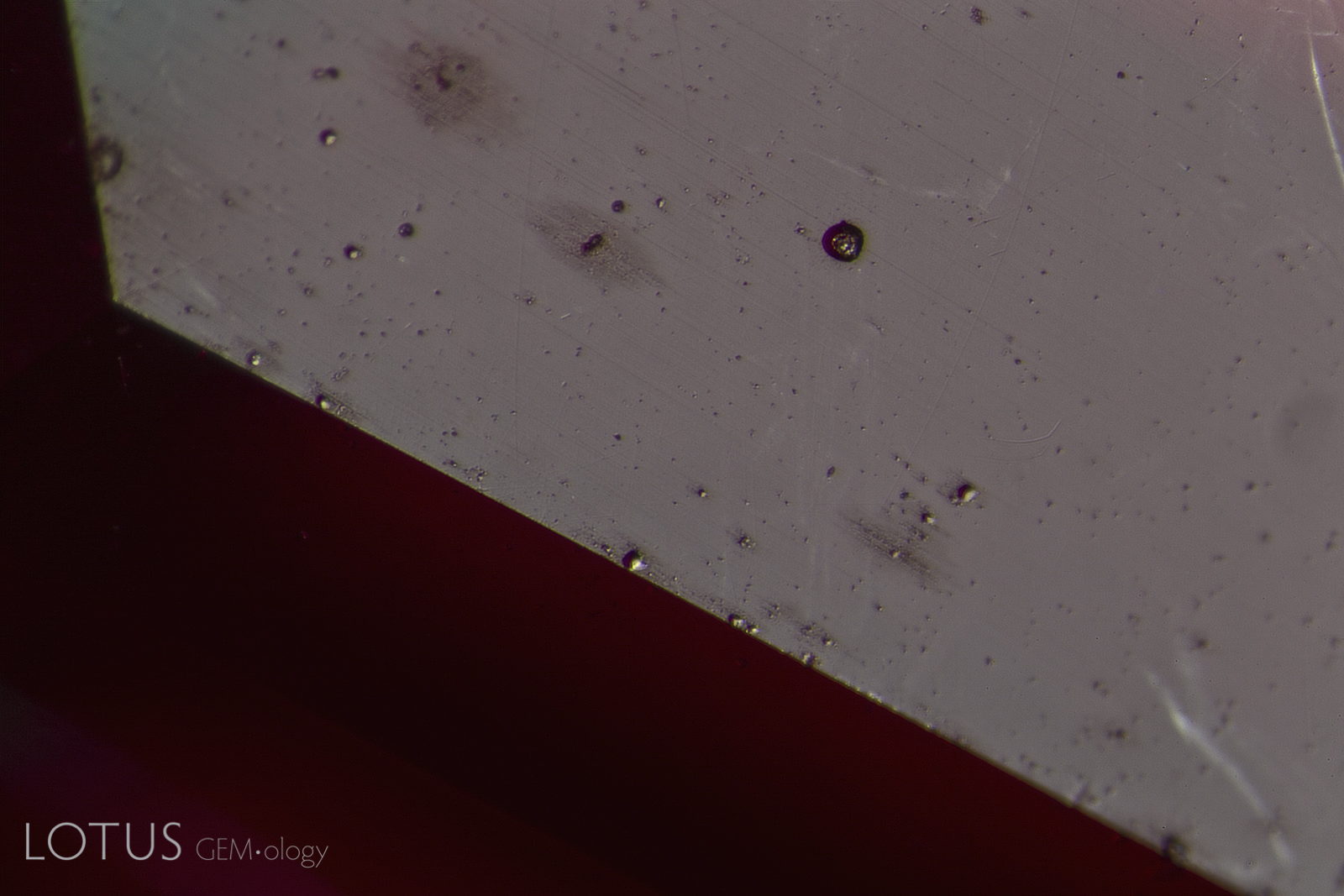 Figure 3. Spall marks on the surface of the Mozambique ruby prove it was heat treated after cutting and polishing. Note that some of the spall marks have dark halos around them. Photomicrograph: Richard W. Hughes; field of view 2.5 mm.

About the Authors
Richard W. Hughes is one of the world’s foremost experts on ruby and sapphire. The author of many books and over 170 articles, his writings and photographs have appeared in a diverse range of publications, and he has received numerous industry awards. Co-winner of the 2004 Edward J. Gübelin Most Valuable Article Award from Gems & Gemology magazine, the following year he was awarded a Richard T. Liddicoat Journalism Award from the American Gem Society. In 2010, he received the Antonio C. Bonanno Award for Excellence in Gemology from the Accredited Gemologists Association. The Association Française de Gemmologie (AFG) in 2013 named Richard as one of the Fifty most important figures that have shaped the history of gems since antiquity. In 2016, Richard was awarded a visiting professorship at Shanghai's Tongji University. 2017 saw the publication of Richard and his wife and daughter's Ruby & Sapphire • A Gemologist's Guide, arguably the most complete book ever published on a single gem species and the culmination of four decades of work in gemology. In 2018, Richard was named Photographer of the Year by the Gem-A, recognizing his photo of a jade-trading market in China, while in 2020, he was elected to the board of directors of the Accredited Gemologists Association and was appointed to the editorial review board of Gems & Gemology and The Australian Gemmologist magazine. In 2022, Richard published Jade • A Gemologist's Guide, while 2024 brought Broken Bangle • The Blunder-Besmirched History of Jade Nomenclature. His jade trilogy was completed in 2025 with his translation of Heinrich Fischer's Nephrite and Jadeite.
Notes
This article first appeared in Gems & Gemology, 2022, Vol. 58, No. 2, Summer, pp. 258–259.
References
- Pardieu, V., Saeseaw, S., Detroyat, S., Raynaud, V., Sangsawong, S., Bhusrisom, T., Engniwat, S. and Muyal, J. (2015) "Low temperature" heat treatment of Mozambique ruby: Results report. GIA News from Research, Bangkok: Gemological Institute of America, 16 April, 34 pp.