Tanzanian Spinel Inclusions
Explore Tanzanian spinel inclusions in Hyperion, the Lotus Gemology inclusion database. Hyperion contains photomicrographs of inclusions and internal features in natural spinels from Tanzania documented with information on treatment, lighting conditions, field of view, photographer and published references.

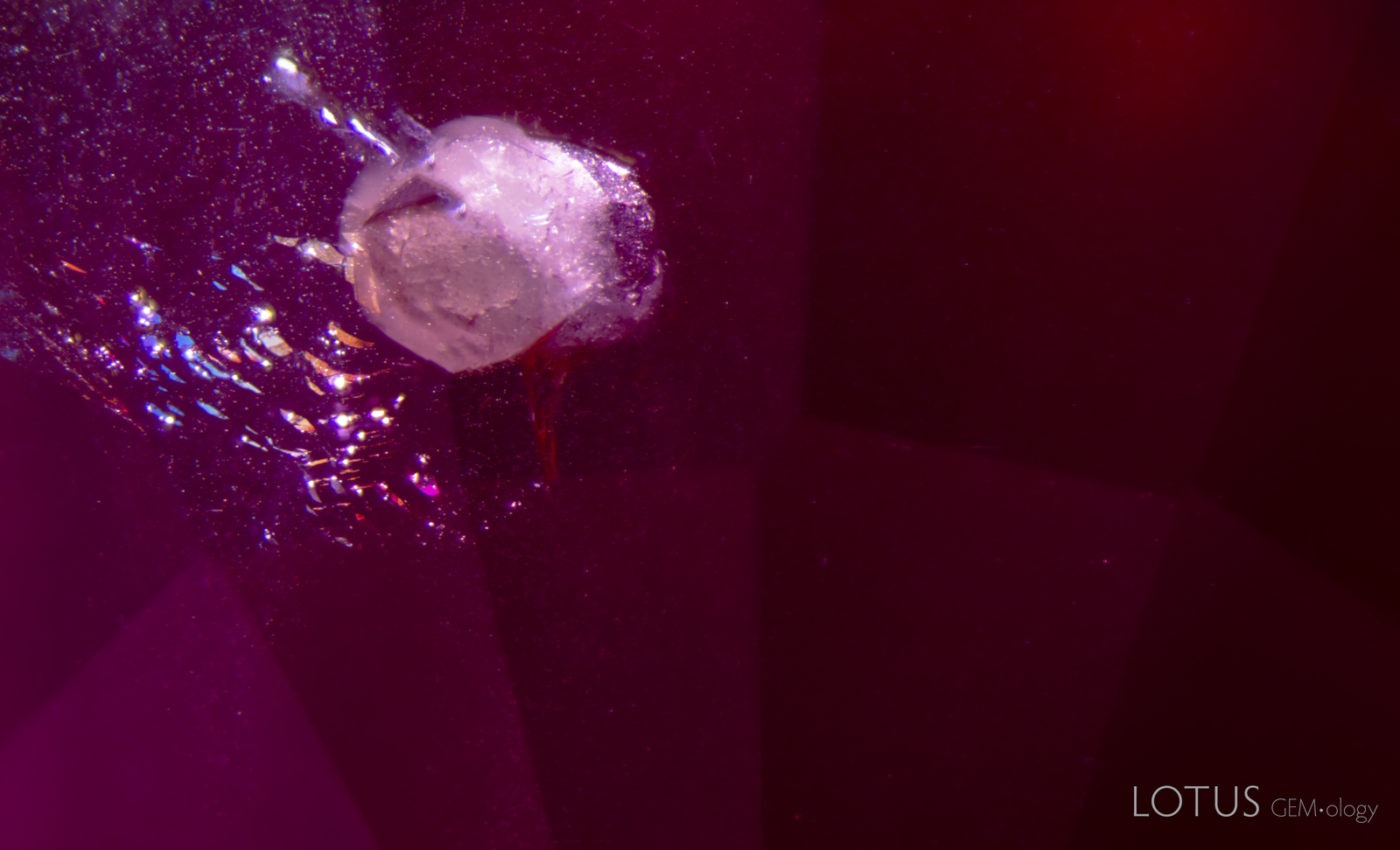
When viewed under the microscope, this spinel can be seen hosting a tiny dolomite inclusion, which was identified with Raman spectroscopy.
Natural Spinel •
Tanzania •
Enhancements:
None Detected (None) •
Lighting Conditions:
Dark Field + Diffuse Fiber Optic
Photographer:
E. Billie Hughes •
Image Number:
A-006-0331-1
• Field of View = 4.5mm
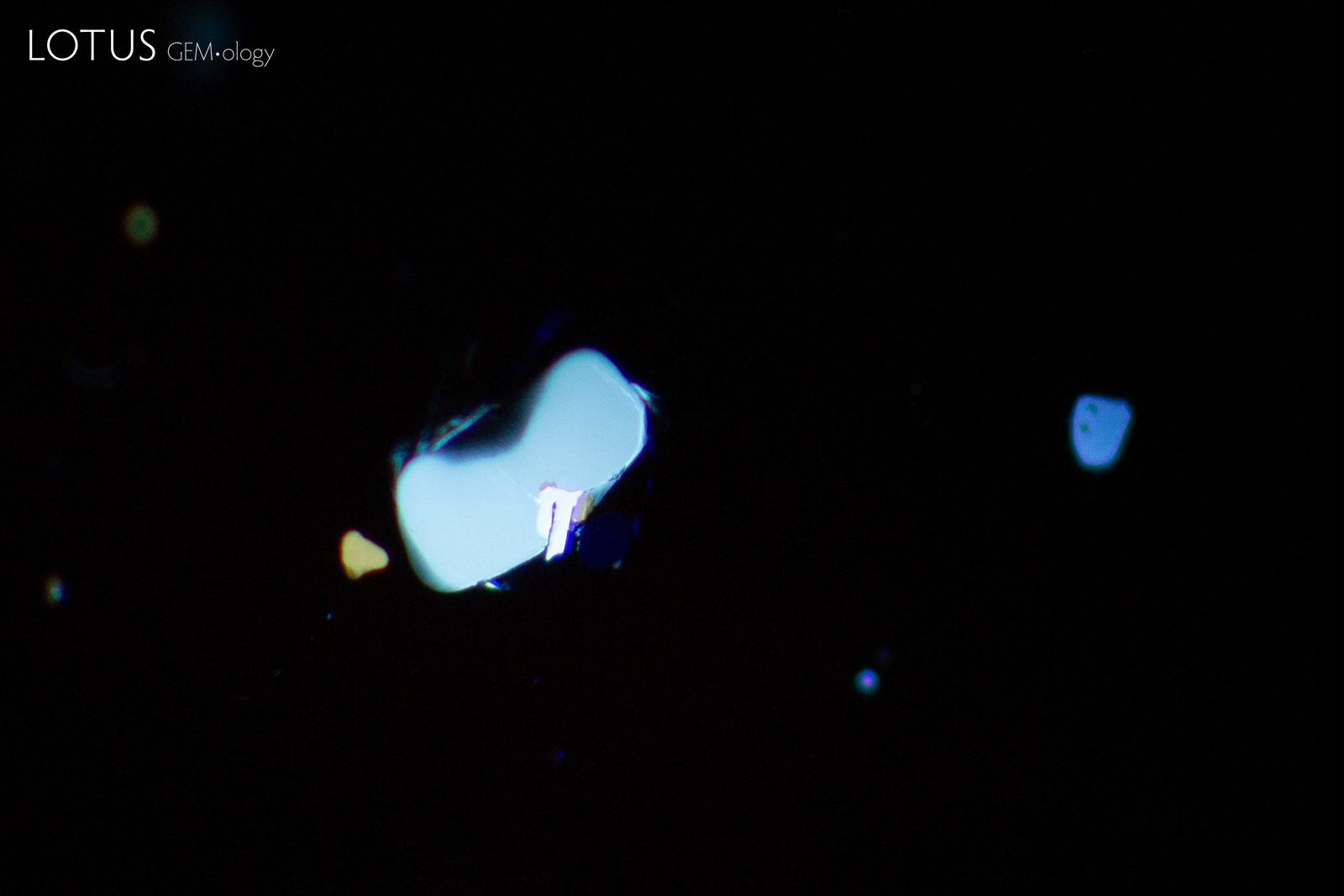
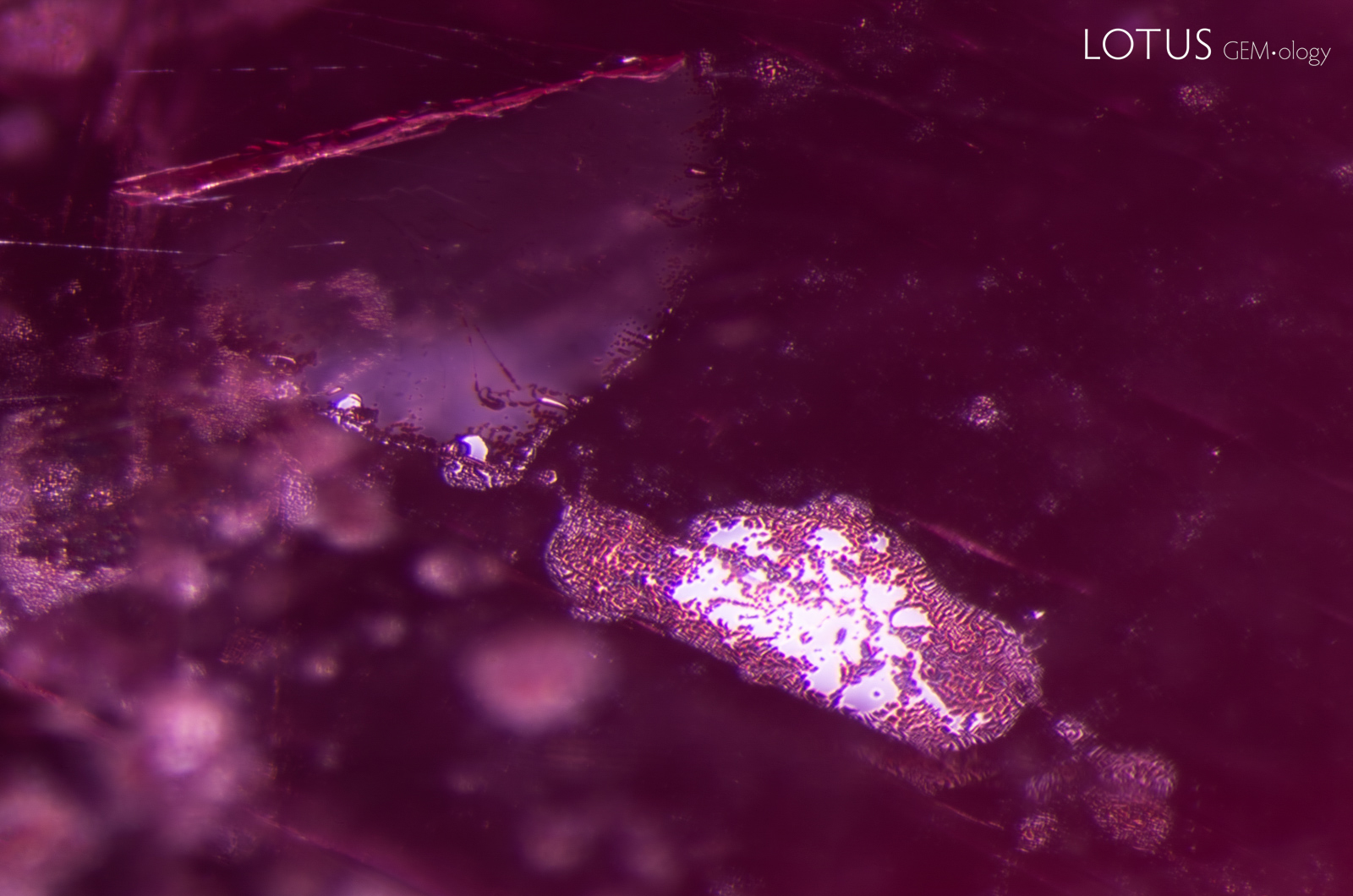
A cluster of mineral inclusions in Tanzanian spinel, identified by micro-Raman spectroscopy as diopside, phlogopite, and edenite, exhibits fluorescence under short-wave UV.
Natural Spinel •
Tanzania •
Enhancements:
None Detected (None) •
Lighting Conditions:
Ultraviolet: Shortwave
Photographer:
Natcha Rattana-anan •
Image Number:
A-005-8638-3
• Field of View = 3.6mm
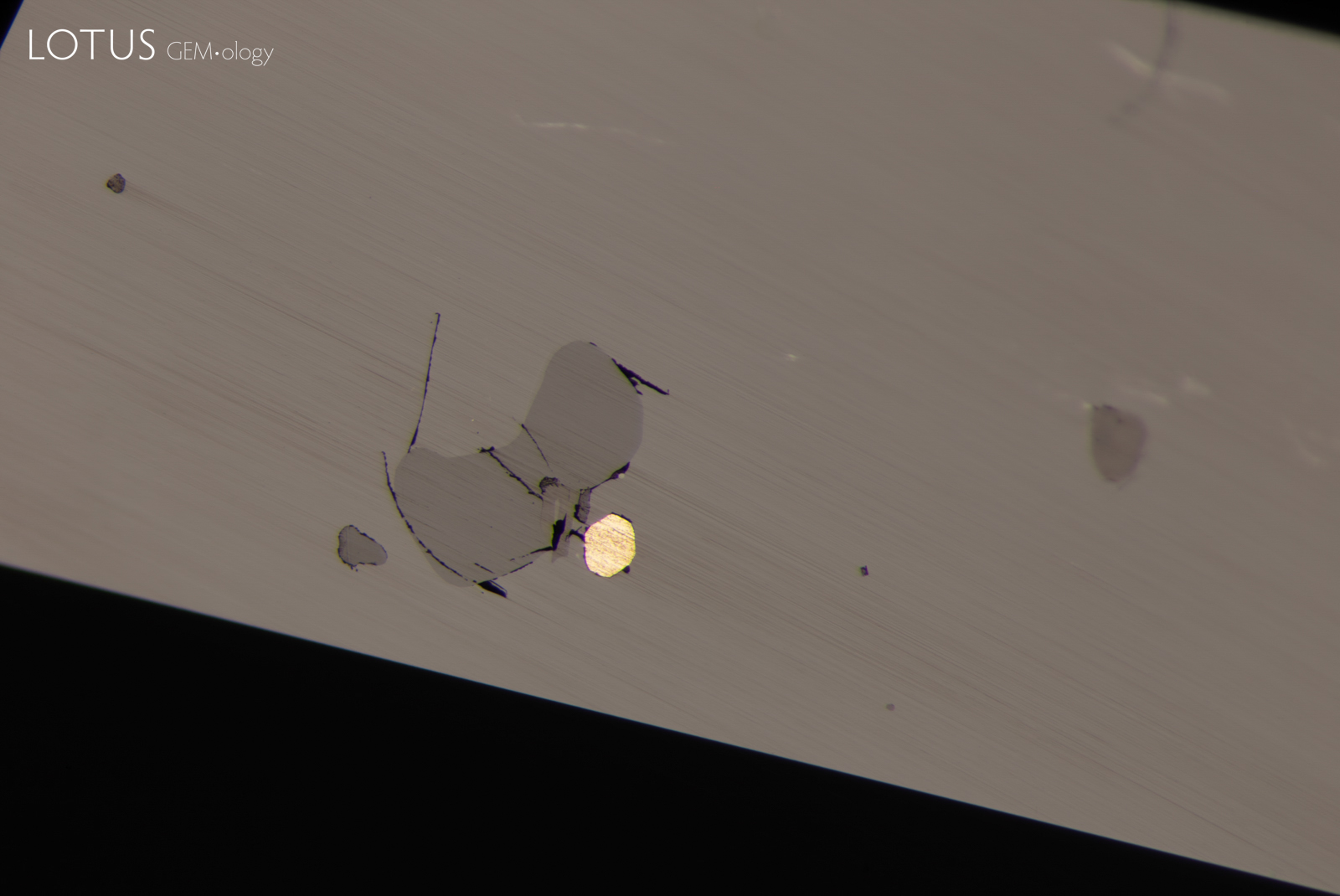
A cluster of mineral inclusions in Tanzanian spinel, identified by micro-Raman as diopside, phlogopite, and edenite, exhibits lower luster than the host, while a golden pyrite crystal stands out with higher luster.
Natural Spinel •
Tanzania •
Enhancements:
None Detected (None) •
Lighting Conditions:
Fiber Optic: Diffuse Oblique
Photographer:
Natcha Rattana-anan •
Image Number:
A-005-8638-2
• Field of View = 3.6mm
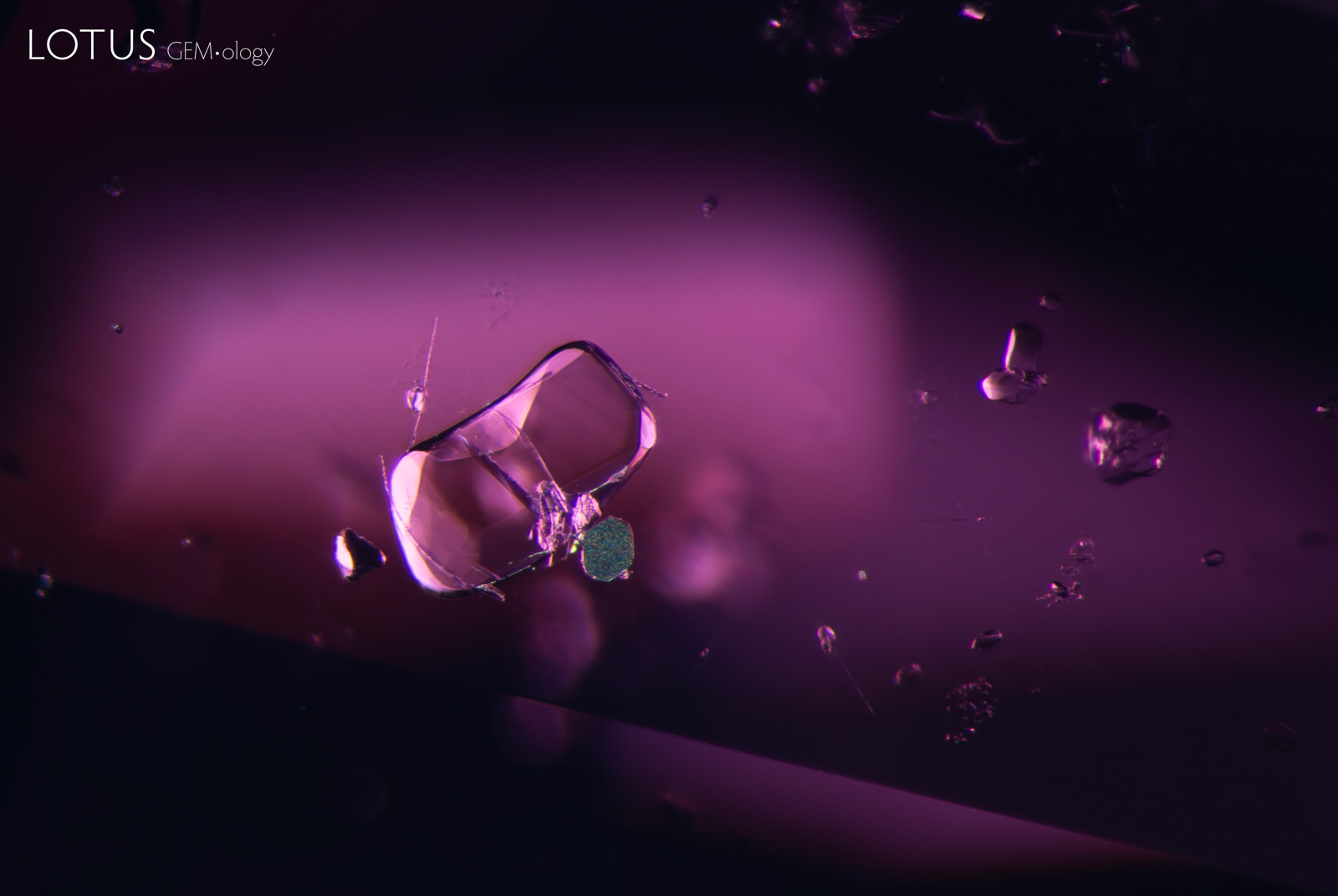
A cluster of mineral inclusions in Tanzanian spinel, identified by micro-Raman as diopside, phlogopite, and edenite, with a dark opaque pyrite crystal.
Natural Spinel •
Tanzania •
Enhancements:
None Detected (None) •
Lighting Conditions:
Fiber Optic: Diffuse Oblique
Photographer:
Natcha Rattana-anan •
Image Number:
A-005-8638-1
• Field of View = 3.6mm
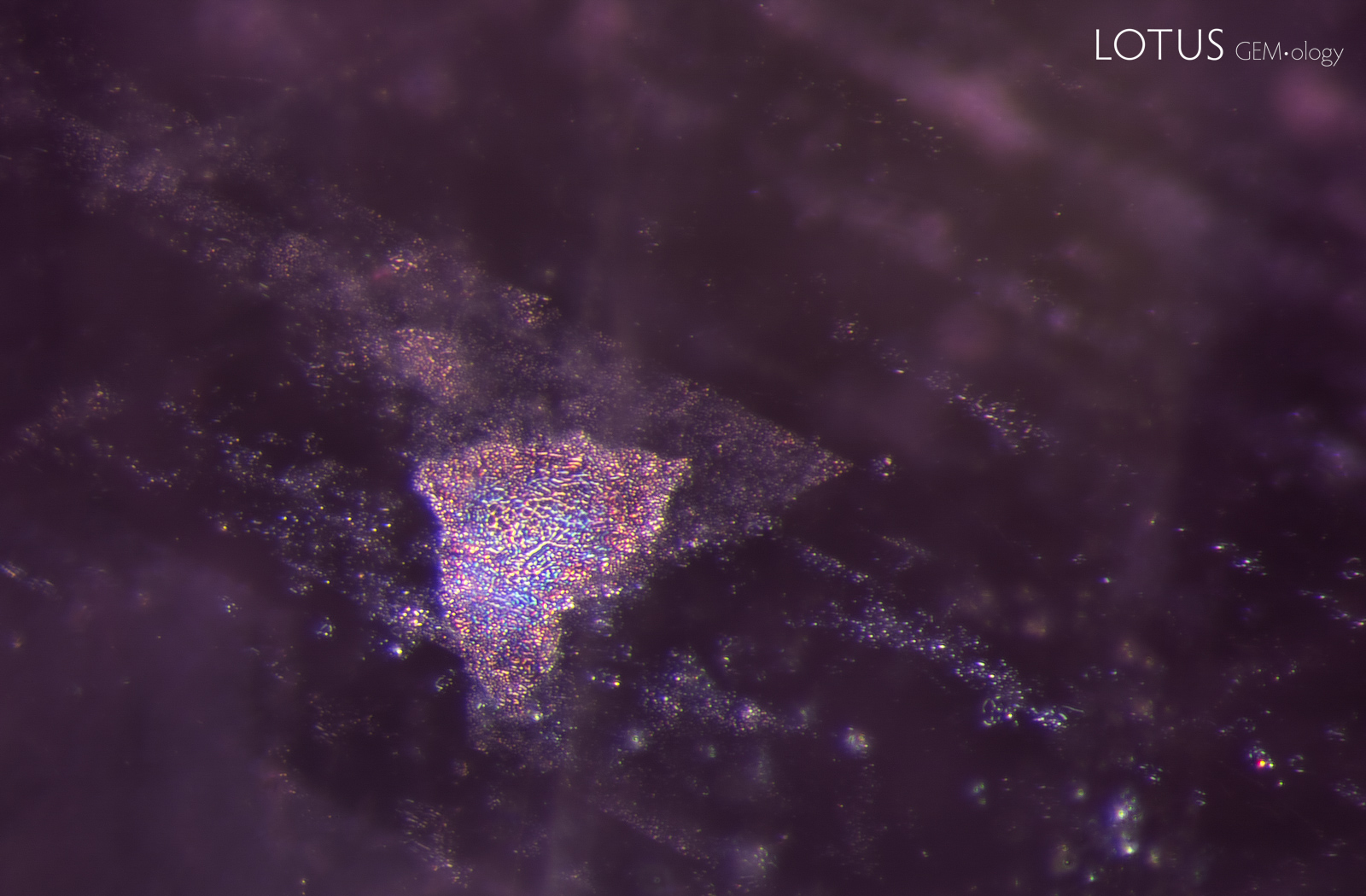
The euhedral crystal in this spinel displays a beautiful iridescent surface.
Natural Spinel •
Tanzania •
Enhancements:
None Detected (None) •
Lighting Conditions:
Dark Field + Diffuse Fiber Optic
Photographer:
Natcha Rattana-anan •
Image Number:
A-005-7029-2
• Field of View = 2.2mm
• Magnification = 8x
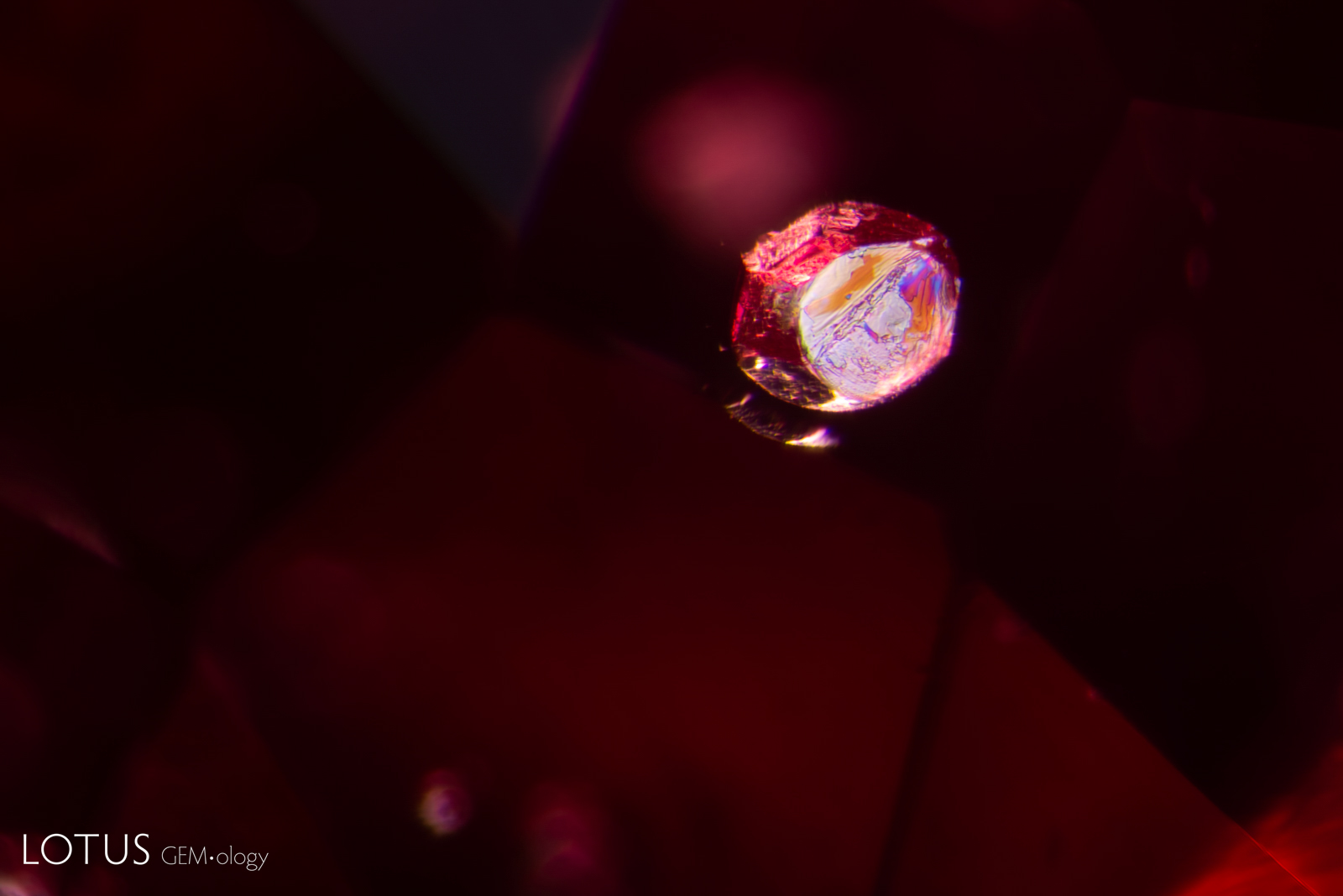
Within this heated red spinel from the Mahenge region of Tanzania, lies a large crystal (possibly apatite or a carbonate) that exhibits signs of heat damage, specifically the frosted appearance; attached to the crystal is an iridescent plane of thin-films. Additionally, fine remnants of partially dissolved silk (likely högbomite) are scattered across the stone.
Natural Spinel •
Tanzania •
Enhancements:
Heat (H) •
Lighting Conditions:
Fiber Optic: Oblique
Photographer:
Kaylan Khourie •
Image Number:
A-005-6953-1
• Field of View = 3.1mm
• Magnification = 5.8x
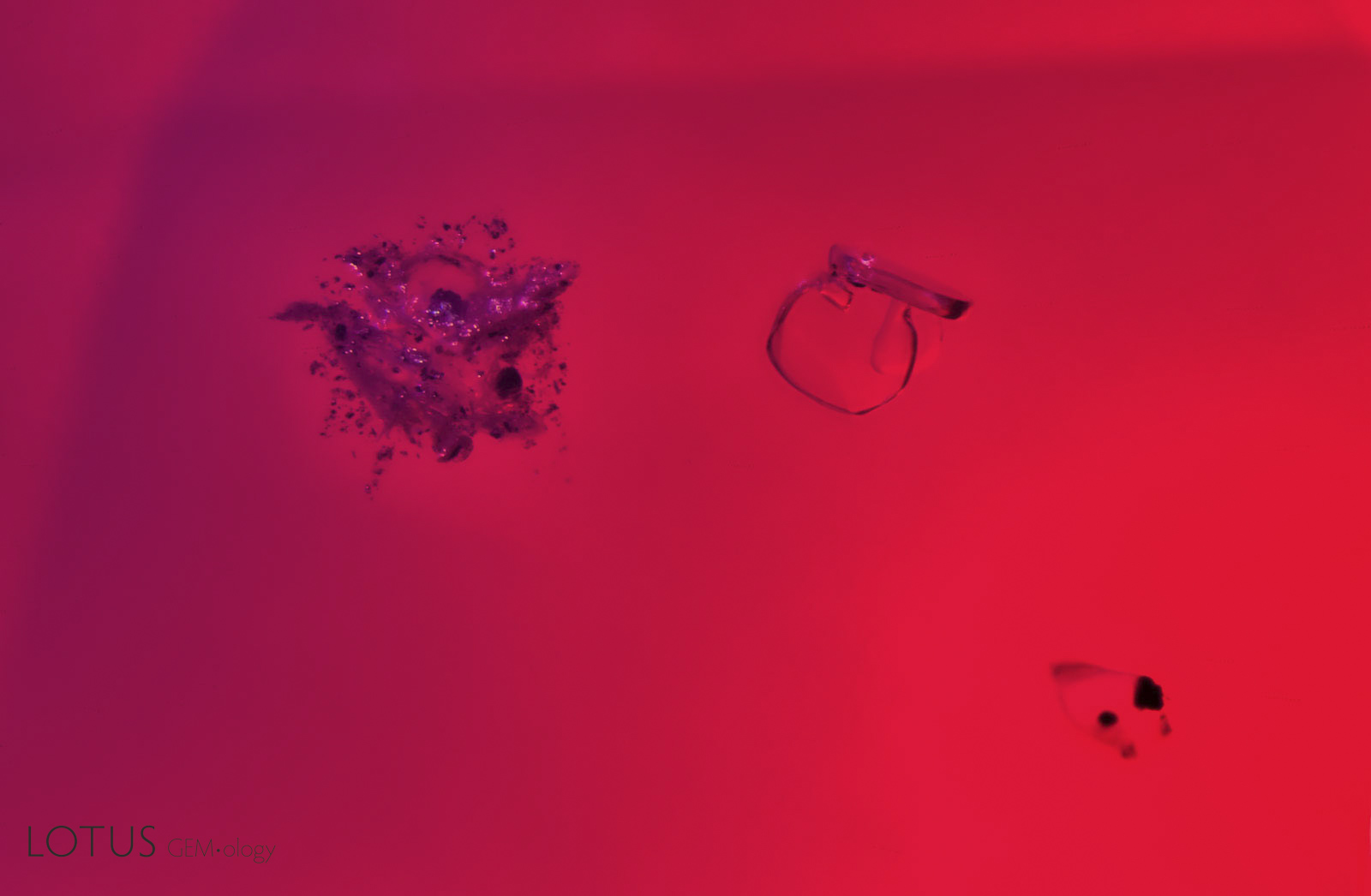
This red spinel from Tanzania’s Mahenge deposit contains thin places of what is probably mica, along with a two low-relief crystals of unknown identity containing embedded black crystals.
Natural Spinel •
Tanzania •
Enhancements:
None Detected (None) •
Lighting Conditions:
Light Field + Oblique Fiber Optic
Photographer:
Richard W. Hughes •
Image Number:
A-005-6710-1
• Field of View = 4mm
While still rare in the market, some spinels are heat treated. We identified that this stone was heated through a combination of the PL (photoluminescence) spectrum and the inclusions, which show signs of melting.
Natural Spinel •
Tanzania •
Enhancements:
Heat (H) •
Lighting Conditions:
Dark Field + Diffuse Fiber Optic
Photographer:
E. Billie Hughes •
Image Number:
A-005-6687-2
• Field of View = 1.9mm
While still rare in the market, some spinels are heat treated. We identified that this stone was heated through a combination of the PL (photoluminescence) spectrum and the inclusions. In this case, the dotted planes that we see may be remnants of the oriented lamellae sometimes seen in Tanzanian spinel.
Natural Spinel •
Tanzania •
Enhancements:
Heat (H) •
Lighting Conditions:
Fiber Optic: Diffuse Oblique
Photographer:
E. Billie Hughes •
Image Number:
A-005-6687-1
• Field of View = 1.6mm
Under the girdle of this spinel, a tiny “fingerprint,” or partially healed fissure, can be spotted.
Natural Spinel •
Tanzania •
Enhancements:
None Detected (None) •
Lighting Conditions:
Dark Field
Photographer:
E. Billie Hughes •
Image Number:
A-005-5734-4
• Field of View = 2.4mm
Under magnification, a small, transparent crystal stands out in this spinel. This is likely a carbonate or apatite.
Natural Spinel •
Tanzania •
Enhancements:
None Detected (None) •
Lighting Conditions:
Dark Field + Diffuse Fiber Optic
Photographer:
E. Billie Hughes •
Image Number:
A-005-5733-2
• Field of View = 3mm
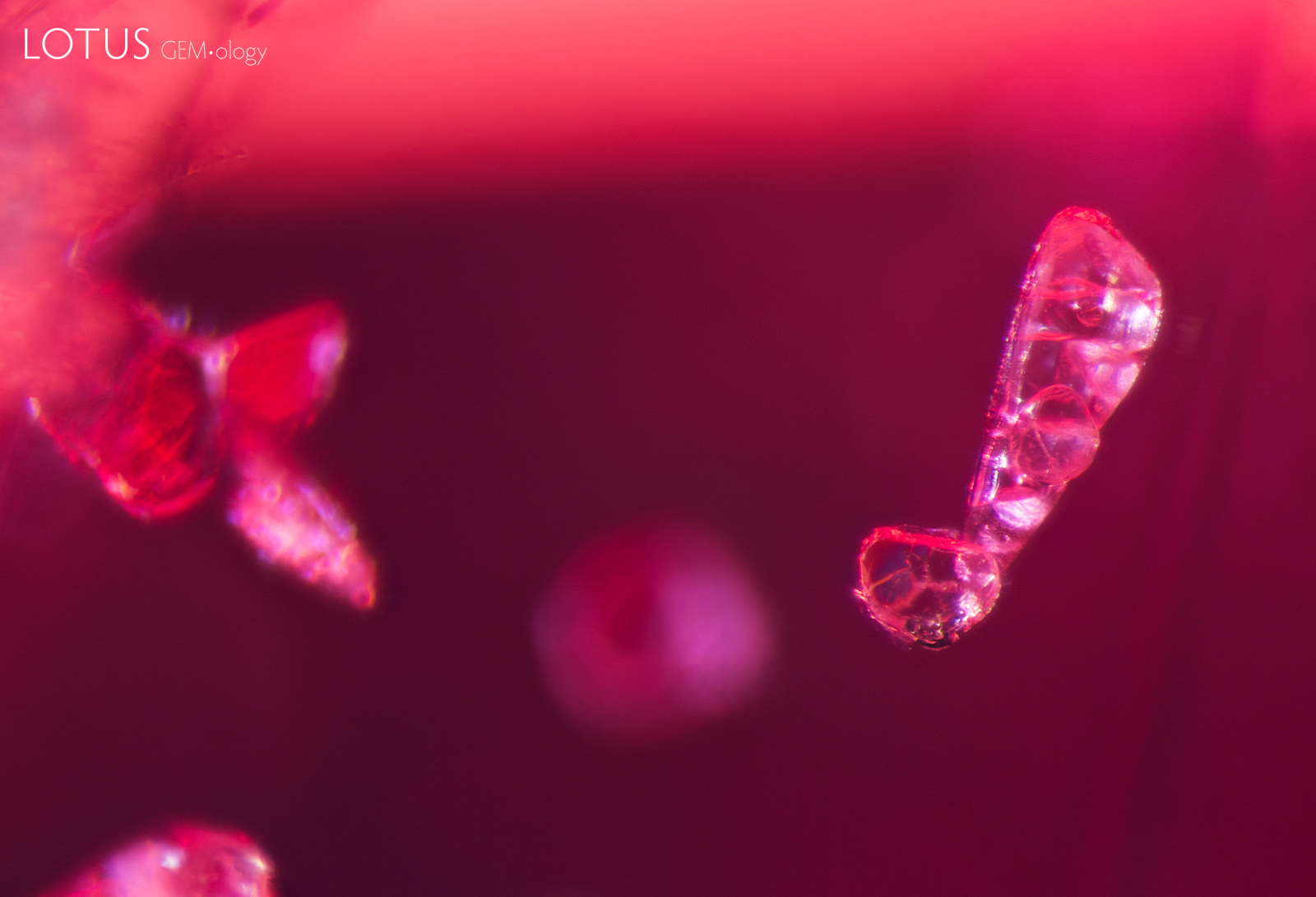
These exclamation mark-shaped crystals make a strong statement in their spinel host. They were identified as dolomite using Raman spectroscopy.
Natural Spinel •
Tanzania •
Enhancements:
None Detected (None) •
Lighting Conditions:
Dark Field + Diffuse Fiber Optic
Photographer:
E. Billie Hughes •
Image Number:
A-005-2208-1
• Field of View = 1.5mm
Tanzanian spinel inclusions may include mineral crystals, healed fissures, fluid inclusions, negative crystals, growth features and other internal features formed during or after crystal growth. Such features are important to gemologists because they can provide evidence useful in identifying spinel and evaluating a possible Tanzanian origin.
Tanzanian Spinel Inclusion Photomicrographs
The Hyperion Tanzanian spinel gallery includes microscopic features documented in spinels from Tanzania, including the famous Mahenge locality. Each entry is accompanied by descriptive information and, where available, references to the gemological literature.
What Inclusions Can Reveal About Tanzanian Spinel
Inclusions are an important part of geographic origin determination in spinel. Their form, composition and associations can provide evidence that, when considered together with other gemological properties, may support or contradict a Tanzanian origin.
Hyperion combines inclusion photomicrography with supporting gemological information so that individual features can be compared with documented examples from Tanzanian spinels.
About Hyperion
Hyperion is the Lotus Gemology searchable inclusion database. It allows users to browse gemstone inclusions by gem type, geographic origin, treatment and keyword.