Treated Ruby Inclusions
Explore treated ruby inclusions in Hyperion, the Lotus Gemology inclusion database. Hyperion contains photomicrographs of inclusions and internal features in natural rubies that have undergone treatment, documented with information on geographic origin, treatment, lighting conditions, field of view, photographer and published references.
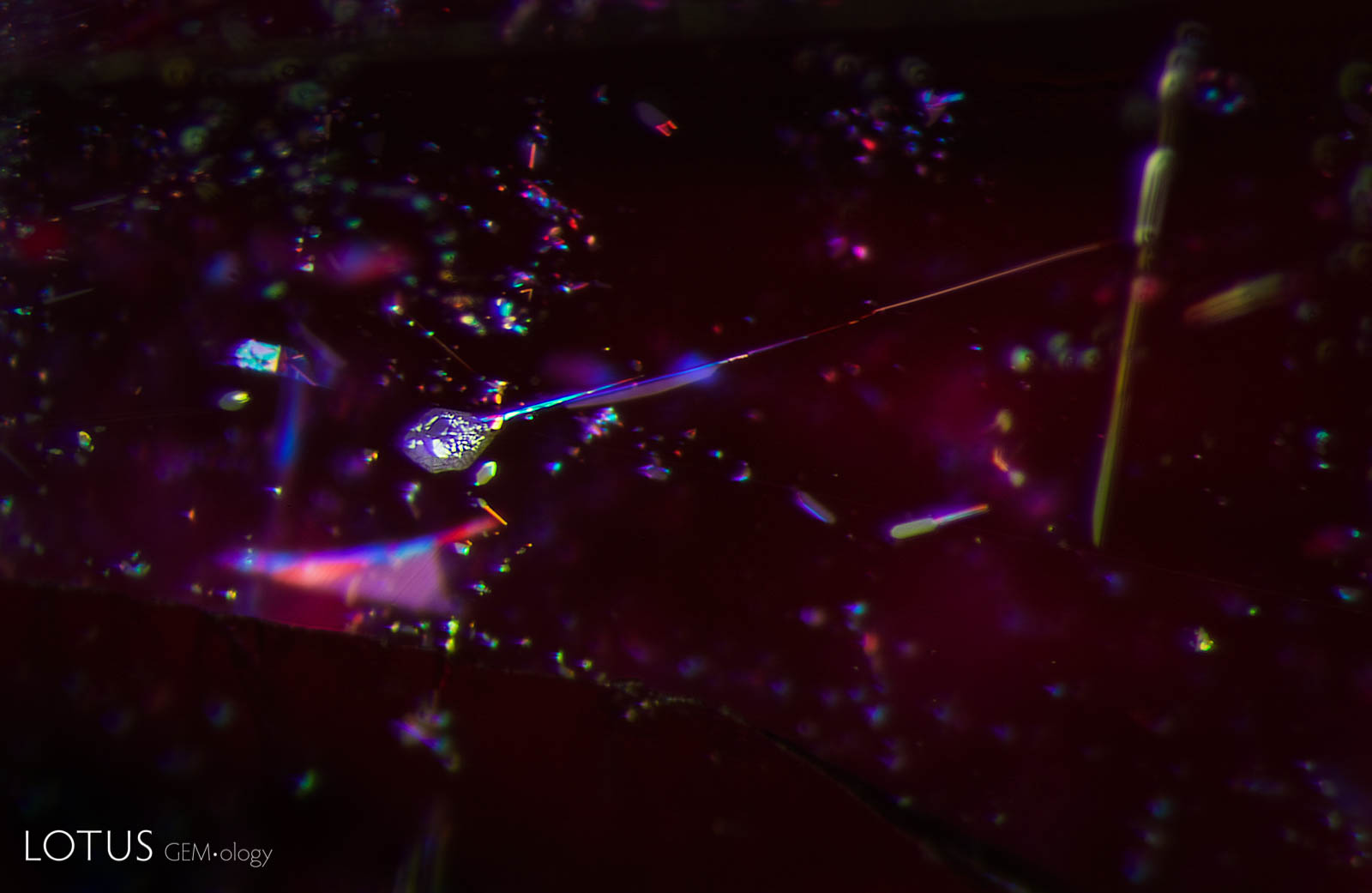
Iridescent fingerprint in a ruby from the Thai/Cambodian border.
Natural Ruby •
Thailand/Cambodia •
Enhancements:
Heat (H) •
Lighting Conditions:
Fiber Optic: Oblique
Photographer:
E. Billie Hughes •
Image Number:
A-001-4425-2
• Field of View = 4mm
Hughes, R.W., Manorotkul, W. and Hughes, E.B. (2017) Ruby & Sapphire: A Gemologist's Guide. Bangkok, Lotus Publishing, 816 pp.; RWHL*.
Gübelin, E.J. and Koivula, J.I. (2008) Photoatlas of Inclusions in Gemstones, Volume 3. Basel, Switzerland, Opinio Publishers, 672 pp.; RWHL*.
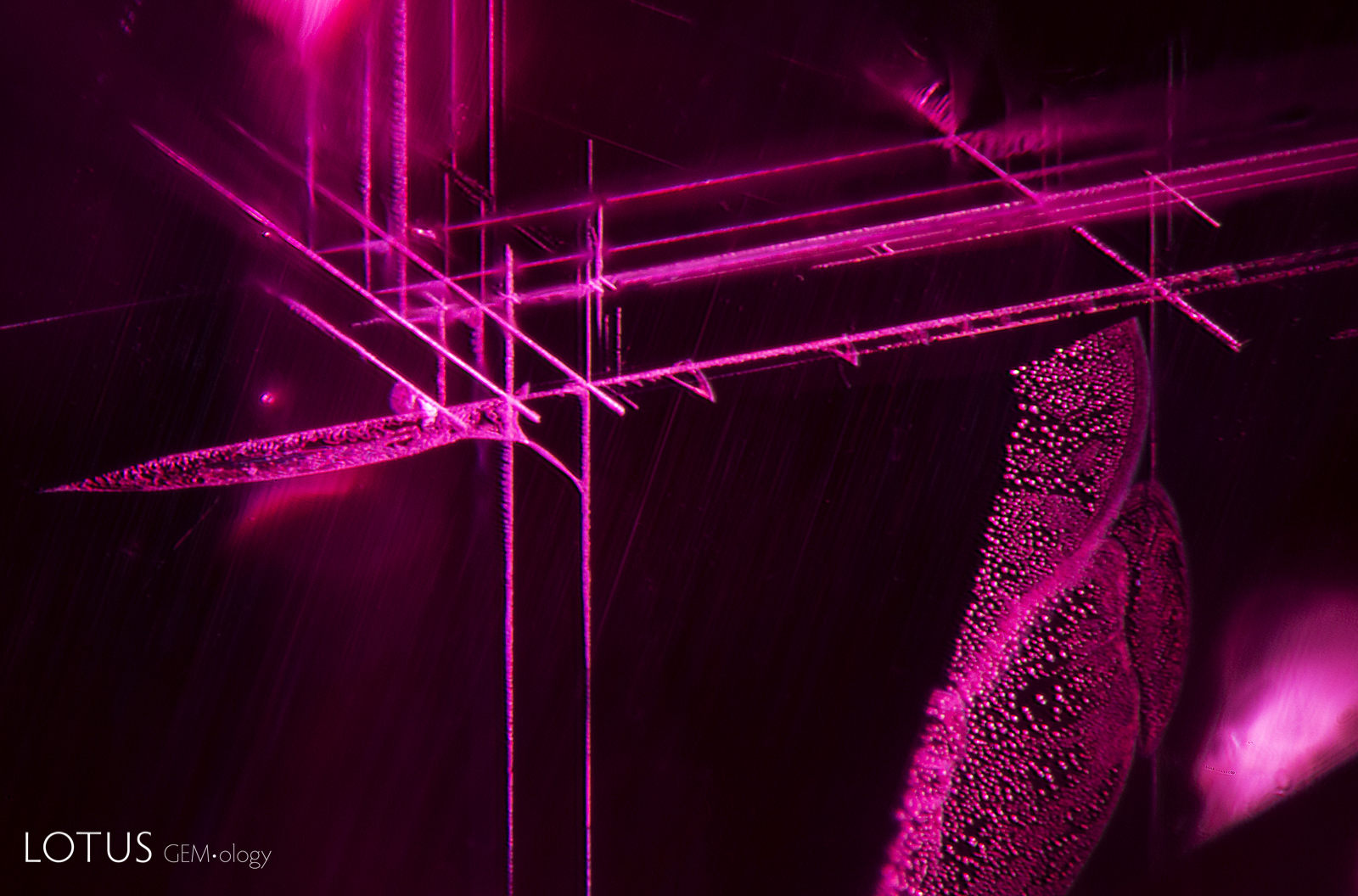
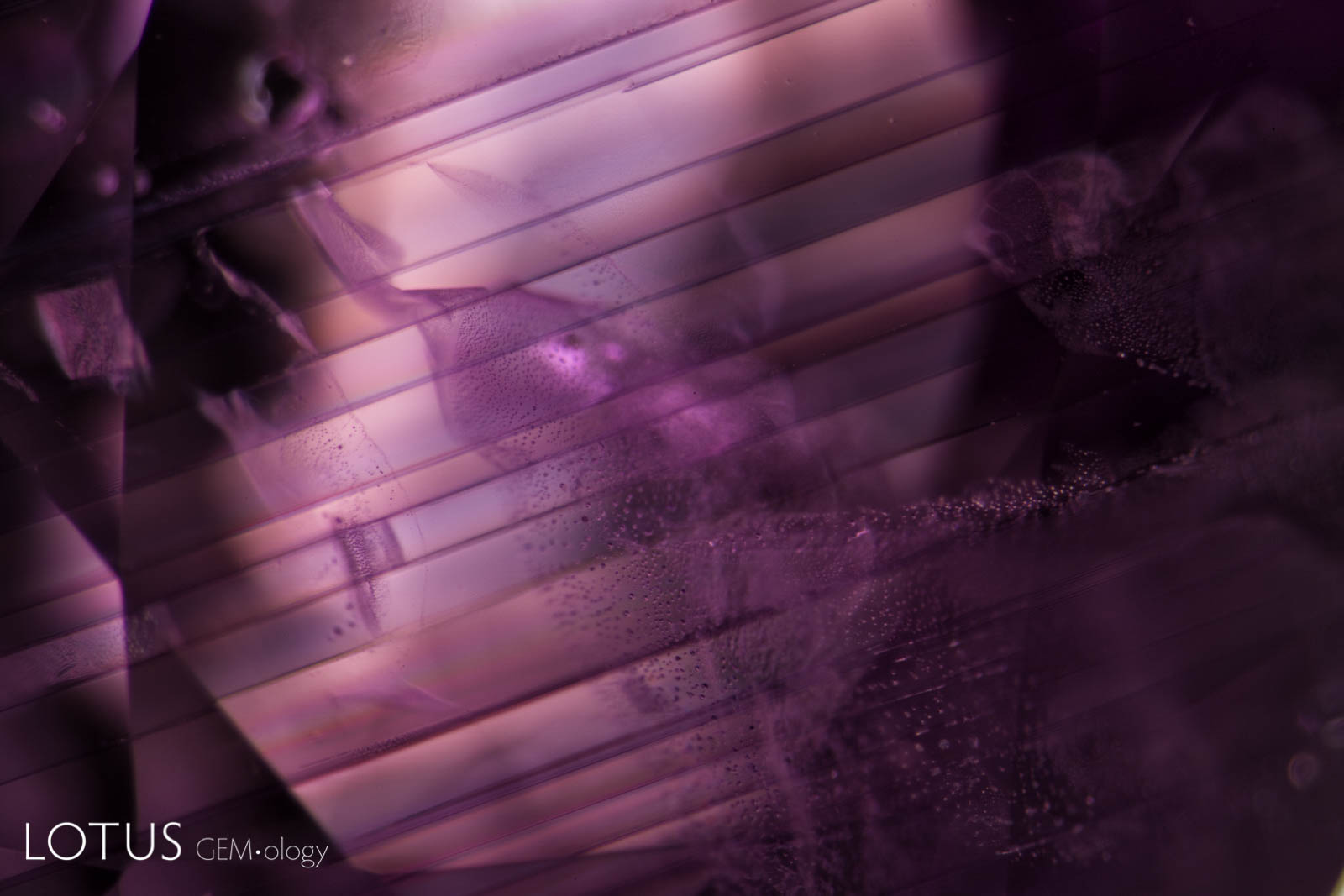
Rose channels in Thai/Cambodian ruby. These are often confused with rutile silk in corundum, but they are easily distinguished as they run in entirely different crystallographic directions. Rutile silk unmixes in three intersecting directions (60/120°) parallel to the faces of the hexagonal prism in the plane of the basal pinacoid (90° to the c-axis). In contrast, Rose channels form parallel to the edges of the rhombohedron, in three directions, but only two in the same place, oblique to the c-axis. They intersect at 86.1/93.9°.
Natural Ruby •
Thailand/Cambodia •
Enhancements:
Heat (H) •
Lighting Conditions:
Dark Field
Photographer:
E. Billie Hughes •
Image Number:
A-001-4425-1
• Field of View = 6mm
Hughes, R.W., Manorotkul, W. and Hughes, E.B. (2017) Ruby & Sapphire: A Gemologist's Guide. Bangkok, Lotus Publishing, 816 pp.; RWHL*.
Gübelin, E.J. and Koivula, J.I. (2008) Photoatlas of Inclusions in Gemstones, Volume 3. Basel, Switzerland, Opinio Publishers, 672 pp.; RWHL*.
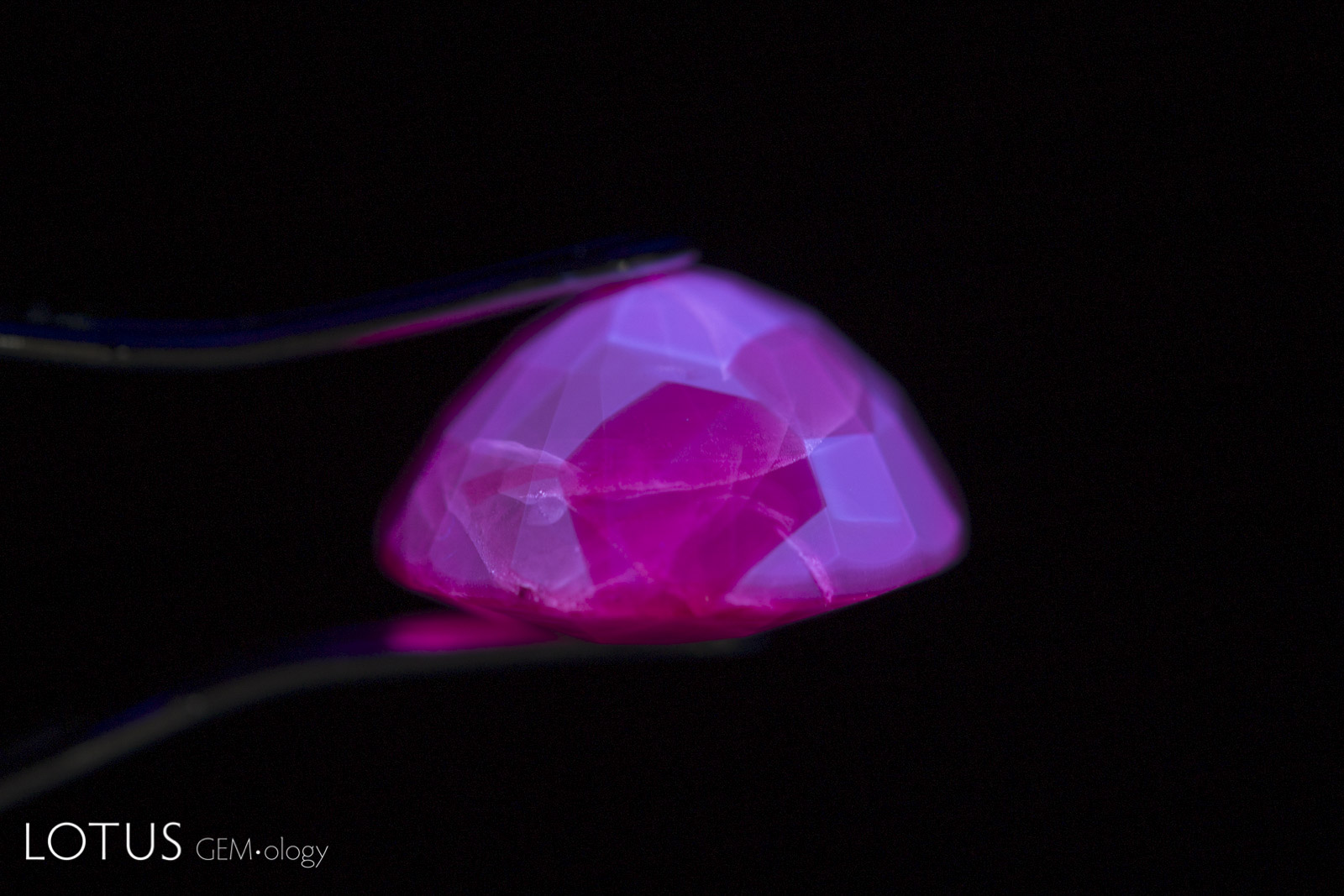
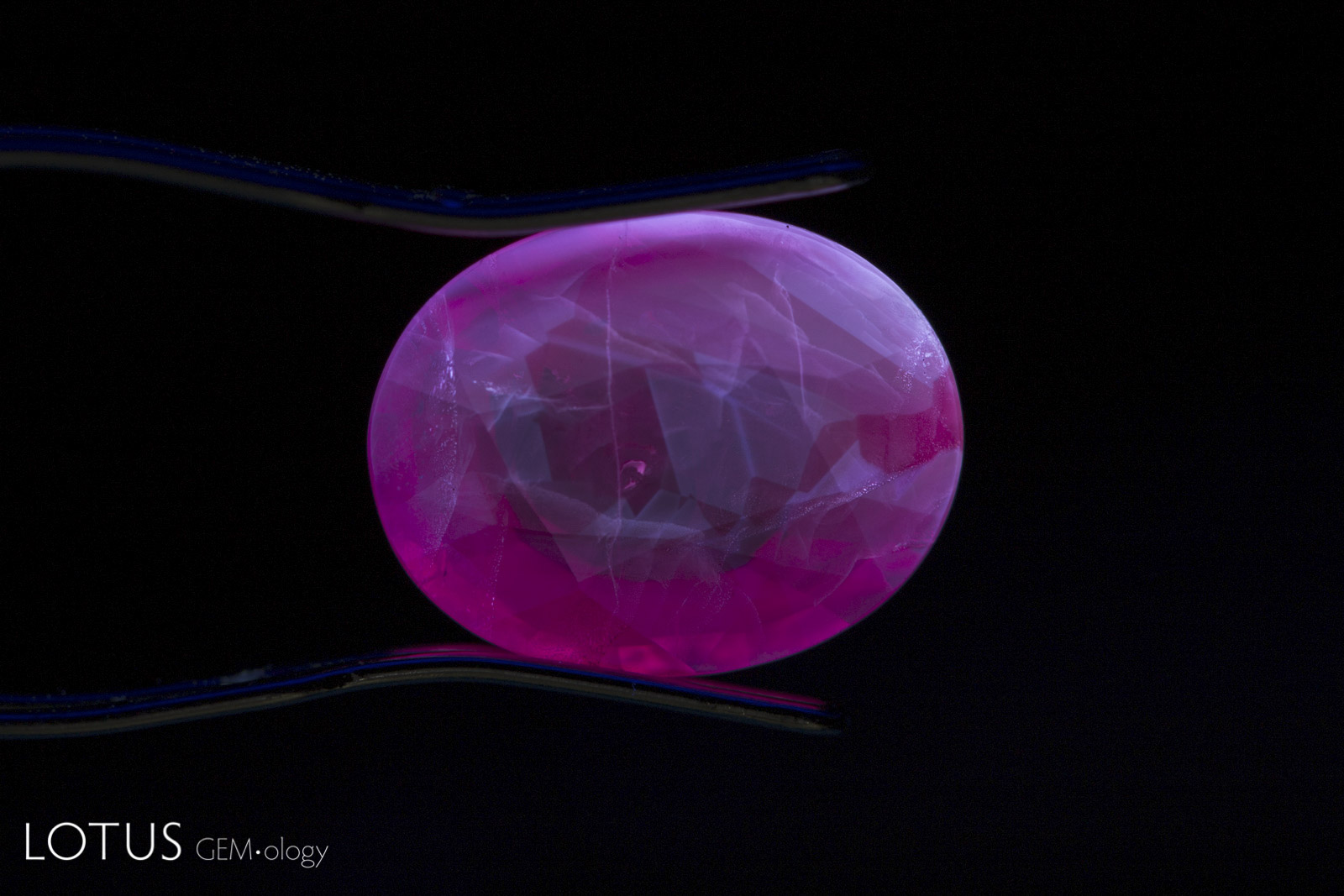
When Burmese rubies, such as this stone from Mong Hsu, are heat treated, they often develop a zoned chalky fluorescence in shortwave UV. In this position, the stone’s original blue core has been removed by the heat treatment, but that zone does not display the chalky fluorescence, just fluorescing red.
Natural Ruby •
Myanmar (Burma); Mong Hsu •
Enhancements:
Heat + Fissure Healing (H-FH) •
Lighting Conditions:
Ultraviolet: Shortwave
Photographer:
Patharaphum Sudprasert •
Image Number:
A-001-4392-2
Hughes, R.W. and Emmett, J.L. (2005) Heat Seeker: UV fluorescence as a gemological tool. The Guide, Vol. 24, No. 5, Part 1, Sept.–Oct., pp. 1, 4–7; RWHL*.
When Burmese rubies, such as this stone from Mong Hsu, are heat treated, they often develop a zoned chalky fluorescence in shortwave UV.
Natural Ruby •
Myanmar (Burma); Mong Hsu •
Enhancements:
Heat + Fissure Healing (H-FH) •
Lighting Conditions:
Ultraviolet: Shortwave
Photographer:
Patharaphum Sudprasert •
Image Number:
A-001-4392-1
Hughes, R.W. and Emmett, J.L. (2005) Heat Seeker: UV fluorescence as a gemological tool. The Guide, Vol. 24, No. 5, Part 1, Sept.–Oct., pp. 1, 4–7; RWHL*.
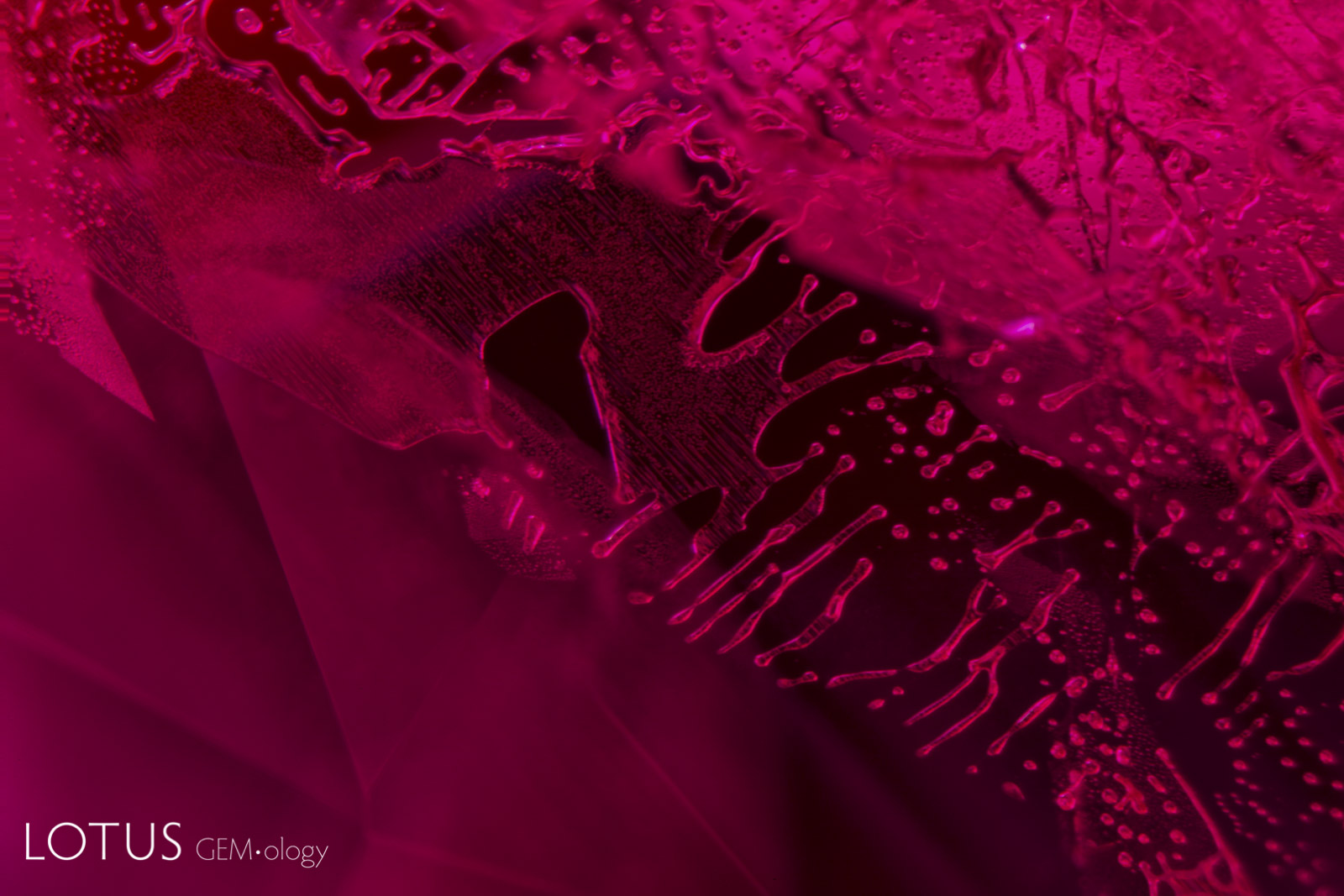
When a ruby is heat-treated at a high enough temperature, the angular channels of fingerprints begin a “necking down” process where they become more rounded, as seen here. This is particularly true if fluxes are used during the treatment.
Natural Ruby •
Myanmar (Burma); Mong Hsu •
Enhancements:
Heat + Fissure Healing (H-FH) •
Lighting Conditions:
Dark Field
Photographer:
Richard W. Hughes •
Image Number:
A-001-4393-1
Hughes, R.W. and Emmett, J.L. (2004) Fluxed up: The fracture healing of ruby. The Guide, Vol. 23, Issue 5, Part 1, Sept.–Oct., pp. 1, 4–9; RWHL*.
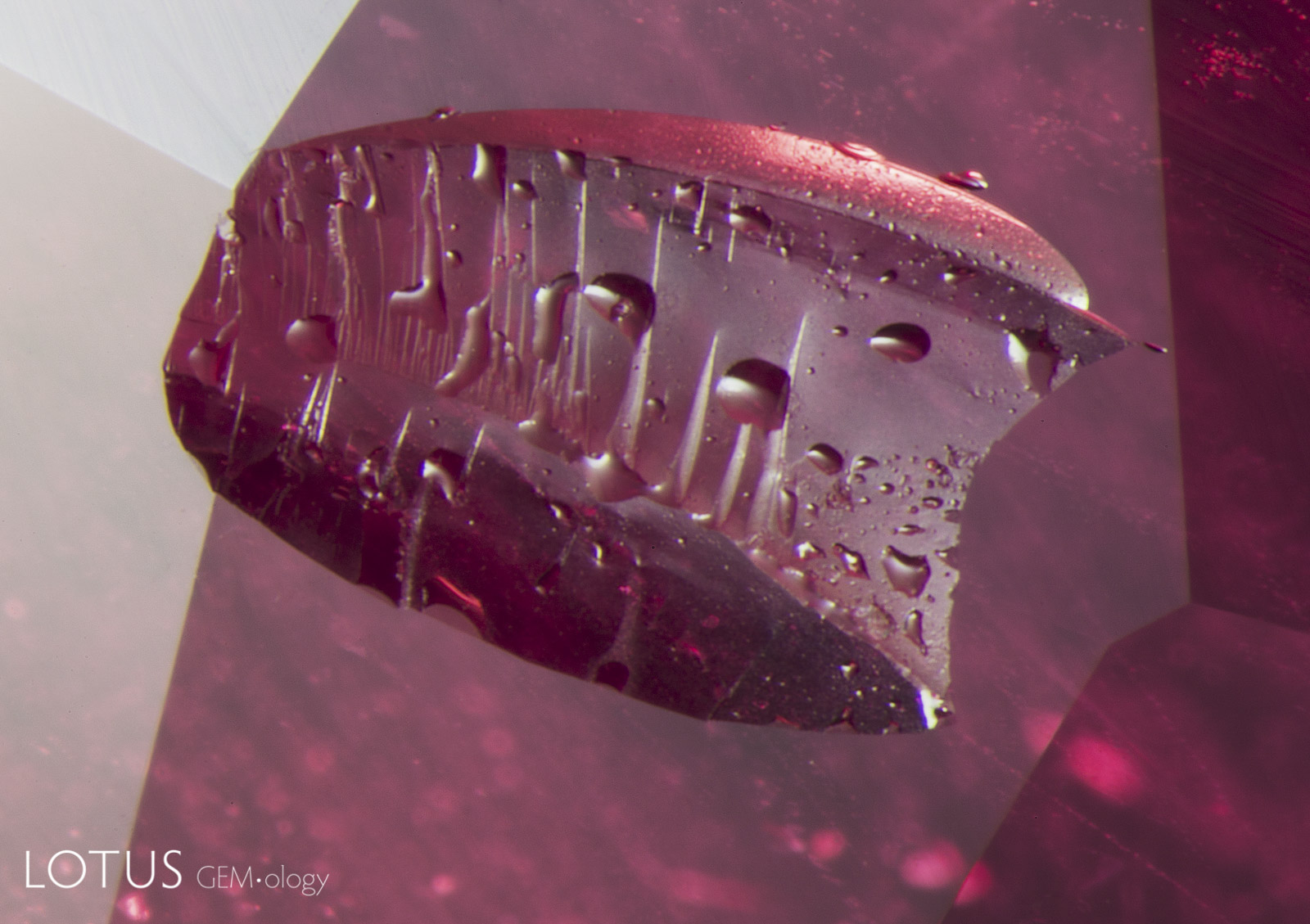
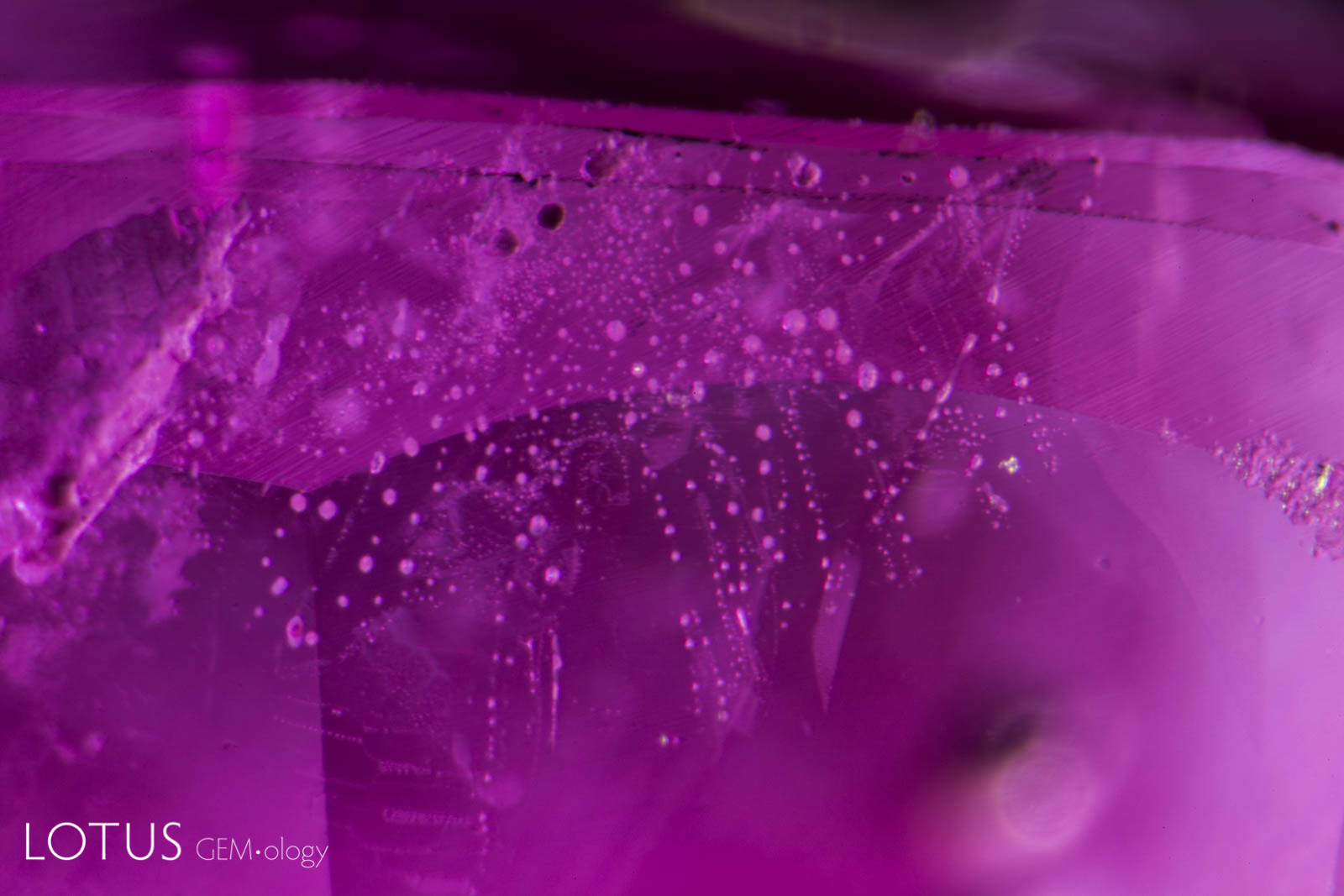
The fact that this hot pink ruby from Mozambique owes some of its beauty to artificial heat treatment is betrayed by the spall marks on a small natural on the pavilion. Like drops of frozen water, they cannot be scraped off with a dental pick, thus demonstrating that they are the result of heat treatment.
Natural Ruby •
Mozambique •
Enhancements:
Heat (H) •
Lighting Conditions:
Fiber Optic: Overhead
Photographer:
E. Billie Hughes •
Image Number:
A-001-4190-1
Pardieu, V., Saeseaw, S. et al. (2015) "Low temperature" heat treatment of Mozambique ruby: Results report. Gemological Institute of America, 16 April, 34 pp.; RWHL*.
Pardieu, V., Sturman, N. et al. (2010) FAPFH/GFF treated ruby from Mozambique: A preliminary report. Gemological Institute of America, 11 May, 18 pp.; RWHL*.
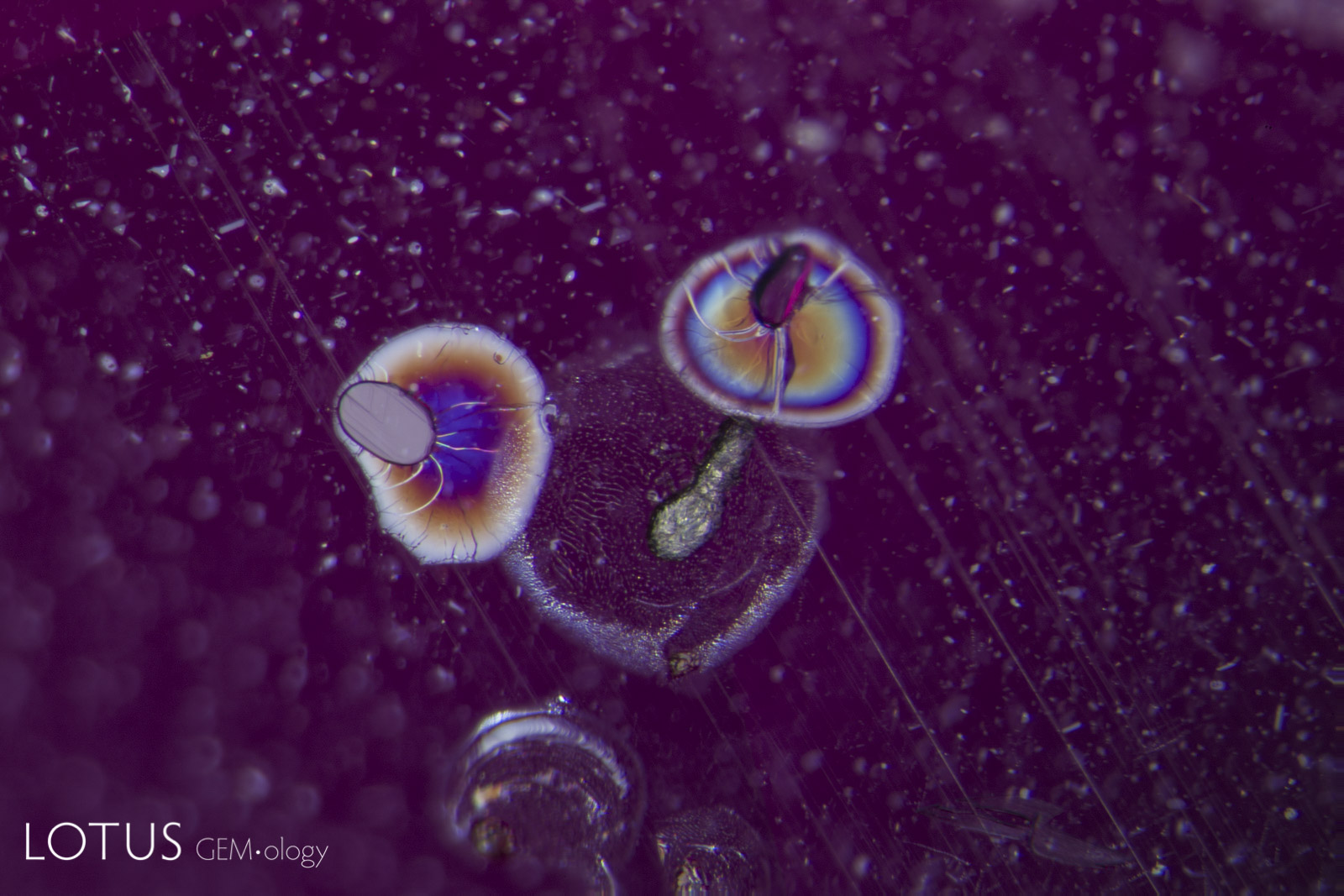
This platelet in a Mozambique ruby shows clear signs of heat treatment. Note the spotted, mottled appearance where the platelet has begun to break down.
Natural Ruby •
Mozambique •
Enhancements:
Heat + Fissure Healing (H-FH) •
Lighting Conditions:
Fiber Optic: Diffuse Oblique
Photographer:
E. Billie Hughes •
Image Number:
A-001-3425-1
Pardieu, V., Saeseaw, S. et al. (2015) "Low temperature" heat treatment of Mozambique ruby: Results report. Gemological Institute of America, 16 April, 34 pp.; RWHL*.
Pardieu, V., Sangsawong, S. et al. (2013) Rubies from the Montepuez area (Mozambique). Gemological Institute of America, October 5, 84 pp.; RWHL*.
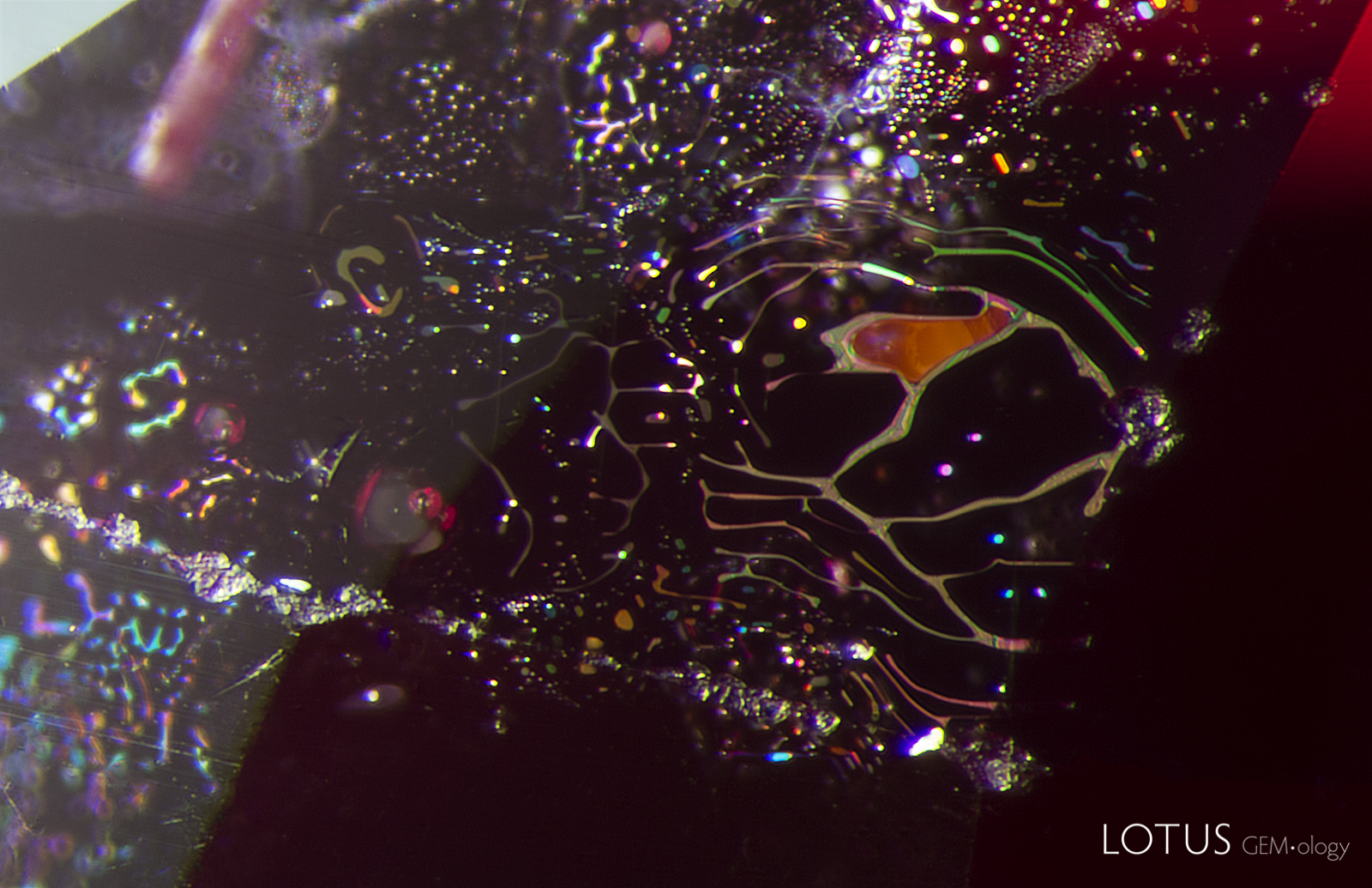
The elongated, melted droplets are part of a flux-healed fingerprint in a flux-heated ruby.
Natural Ruby •
Not Determinable •
Enhancements:
Heat + Fissure Healing (H-FH) •
Lighting Conditions:
Diffuse Light Field (Transmitted Light)
Photographer:
E. Billie Hughes •
Image Number:
A-001-3278-1
Hughes, R.W. and Emmett, J.L. (2004) Fluxed up: The fracture healing of ruby. The Guide, Vol. 23, Issue 5, Part 1, Sept.–Oct., pp. 1, 4–9; RWHL*.
Hughes, R.W. and Galibert, O. (1998) Foreign affairs: Fracture healing/filling of Möng Hsu ruby. Australian Gemmologist, Vol. 20, No. 2, April–June, pp. 70–74; RWHL*.
Polysynthetic twinning and fingerprints are both common features in rubies from Tajikistan.
Natural Ruby •
Tajikistan •
Enhancements:
Heat (H) •
Lighting Conditions:
Diffuse Light Field + Crossed Polars
Photographer:
Richard W. Hughes •
Image Number:
R-001-3276-3
Sorokina, E.S., Litvinenko, A.K. et al. (2015) Rubies and Sapphires from Snezhnoe, Tajikistan. Gems & Gemology, Vol. 51, No. 2, pp. 160–175; RWHL.
Hughes, R.W., Pardieu, V. et al. (2006) Moon over the Pamirs: Chasing ruby and spinel in Tajikistan. LotusGemology.com, RWHL*.
A heat-altered fingerprint lies just below the surface of this Tajikistan ruby.
Natural Ruby •
Tajikistan •
Enhancements:
Heat (H) •
Lighting Conditions:
Fiber Optic: Oblique
Photographer:
Richard W. Hughes •
Image Number:
R-001-3276-2
Sorokina, E.S., Litvinenko, A.K. et al. (2015) Rubies and Sapphires from Snezhnoe, Tajikistan. Gems & Gemology, Vol. 51, No. 2, pp. 160–175; RWHL.
Hughes, R.W., Pardieu, V. et al. (2006) Moon over the Pamirs: Chasing ruby and spinel in Tajikistan. LotusGemology.com, RWHL*.
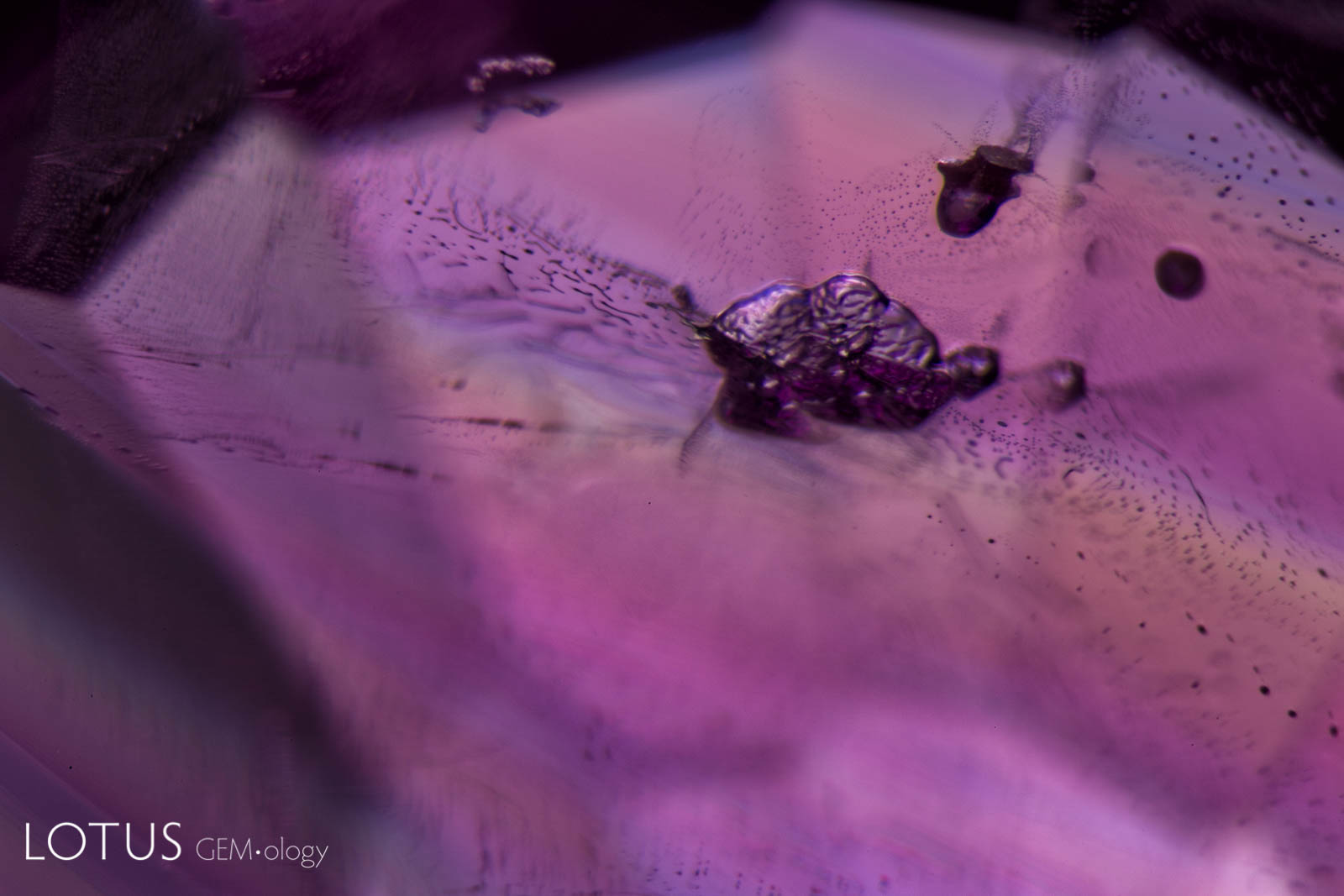
A melted crystal betrays the heat-treated origin of this ruby from Tajikistan.
Natural Ruby •
Tajikistan •
Enhancements:
Heat (H) •
Lighting Conditions:
Diffuse Light Field + Crossed Polars
Photographer:
Richard W. Hughes •
Image Number:
R-001-3276-1
Sorokina, E.S., Litvinenko, A.K. et al. (2015) Rubies and Sapphires from Snezhnoe, Tajikistan. Gems & Gemology, Vol. 51, No. 2, pp. 160–175; RWHL.
Hughes, R.W., Pardieu, V. et al. (2006) Moon over the Pamirs: Chasing ruby and spinel in Tajikistan. LotusGemology.com, RWHL*.
166 Total Images
Results: 73 – 84 | Page 7 of 14 Pages
Search the Complete Hyperion Database
Treatment can alter existing inclusions and produce new microscopic features in ruby. These may include changes to mineral inclusions, altered rutile silk, tension fractures, healed fissures, residues and other features associated with heating, fissure healing, glass filling and other treatment processes.
Treated Ruby Inclusion Photomicrographs
The Hyperion treated ruby gallery includes microscopic features documented in natural rubies subjected to treatment. Each entry identifies the recorded treatment and is accompanied by descriptive information and, where available, references to the gemological literature.
What Inclusions Can Reveal About Ruby Treatment
Microscopic examination is an important part of detecting treatment in ruby. The appearance and alteration of inclusions, fractures and growth features can provide evidence of treatment and, in some cases, information about the processes to which a ruby has been subjected.
Hyperion combines inclusion photomicrography with supporting gemological information so that treatment-related features can be compared with documented examples in natural ruby.
About Hyperion
Hyperion is the Lotus Gemology searchable inclusion database. It allows users to browse gemstone inclusions by gem type, geographic origin, treatment and keyword.