
Sapphire
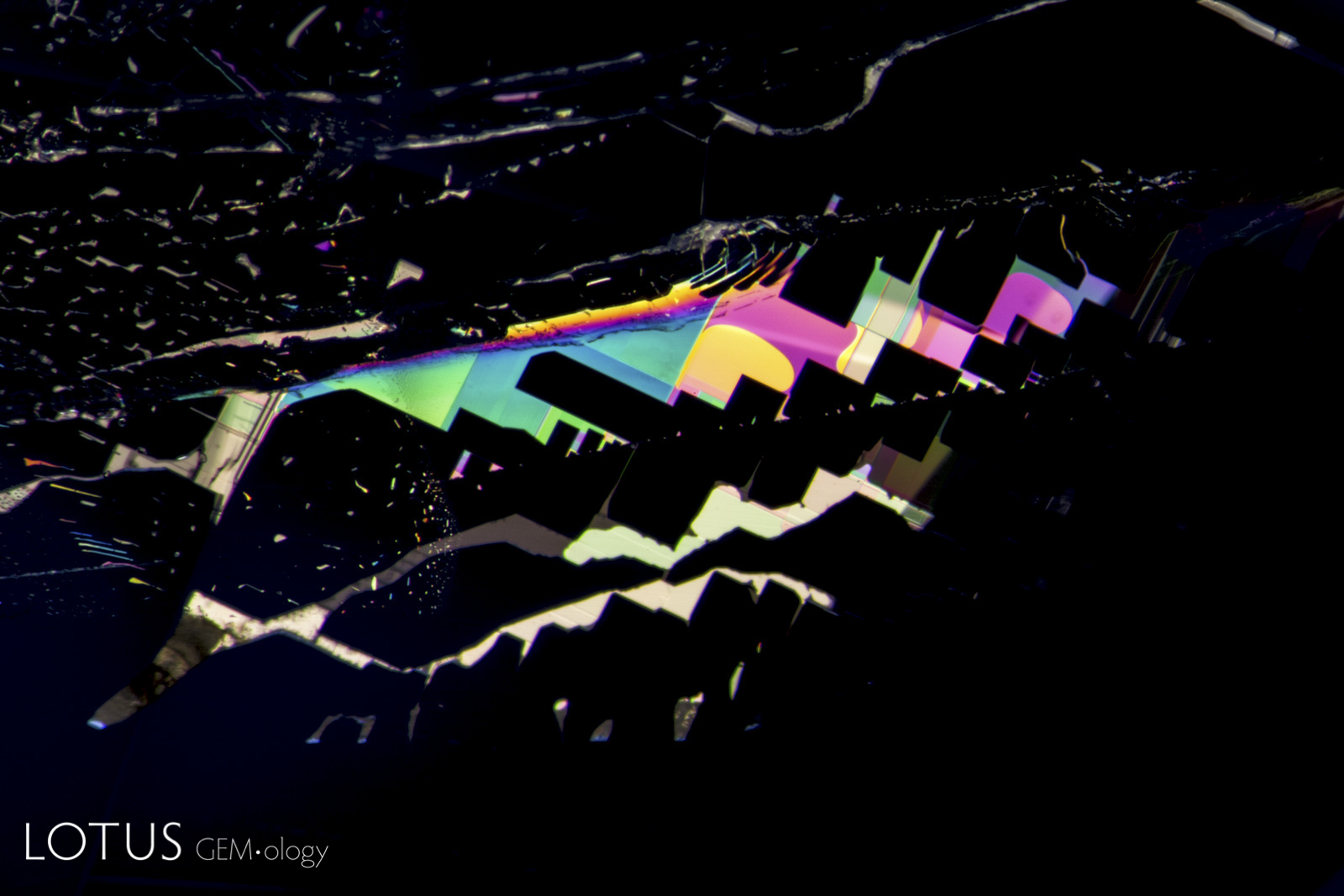
Secondary healed fissures in corundum are often filled with carbon dioxide, but usually in liquid form. On occasion we see it in both liquid and gaseous form. This series of four images shows liquid carbon dioxide with a gas bubble (the yellow area). As the heat of the microscope warms the specimen, the gas bubble shrinks and eventually disappears. The critical temperature at which the phase changes is 31.2°C. Solid carbon dioxide is what we know as “dry ice.” The existence of carbon dioxide inclusions in sapphire was first noted by David Brewster in 1826. He also noted the explosive nature of such inclusions, which burst at temperatures generally between 250–400°C.
- Origin
- Sri Lanka (Ceylon)
- Image number
- LGI-000704
- Enhancements
- None Detected (None)
- Lighting conditions
- Fiber Optic: Diffuse Overhead
- Photographer
- Richard W. Hughes
- Field of view
- Not recorded
Reference(s)
© Lotus Gemology and the credited photographer. All rights reserved. Reproduction or sharing, including on social media, requires prior written permission. Please contact us for image use.