
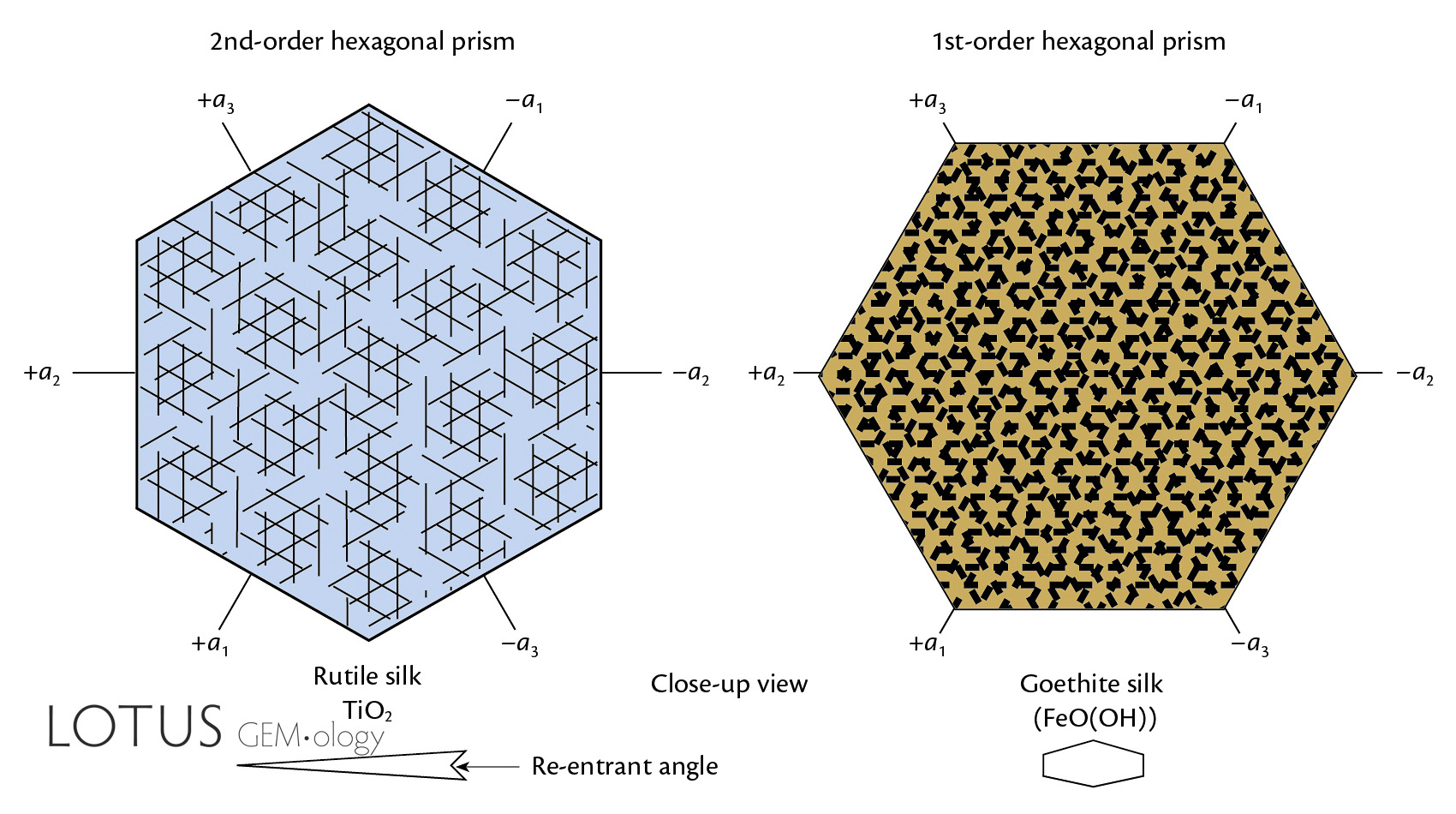
Rutile vs. Hematite/Ilmenite Silk
Silk in natural corundum is exsolved along three directions (parallel to the hexagonal prism) in the basal plane, meeting at 60/120°. Left: Rutile silk forms parallel to the faces of the second-order prism, and tends to occur as dart- or arrow-shaped twins with tiny reentrant angles at the broad end. Rutile silk is commonly found in corundum from a variety of sources, particularly Myanmar and Sri Lanka. At right, Fe-rich silk forms parallel to the faces of the first-order prism, and tends to be more platy (rather than slender needles). Fe-rich silk is common in Fe-rich sapphires, particularly those from Thailand, Australia and Kenya. Some Thai black-star sapphires (from Khao Ploi Waen and Bang Kha Cha) may contain both Fe-rich and rutile silk, and thus can be cut into 12-rayed star stones.
- Image number
- LGI-001873
- Field of view
- Not recorded
© Lotus Gemology and the credited photographer. All rights reserved. Reproduction or sharing, including on social media, requires prior written permission. Please contact us for image use.