
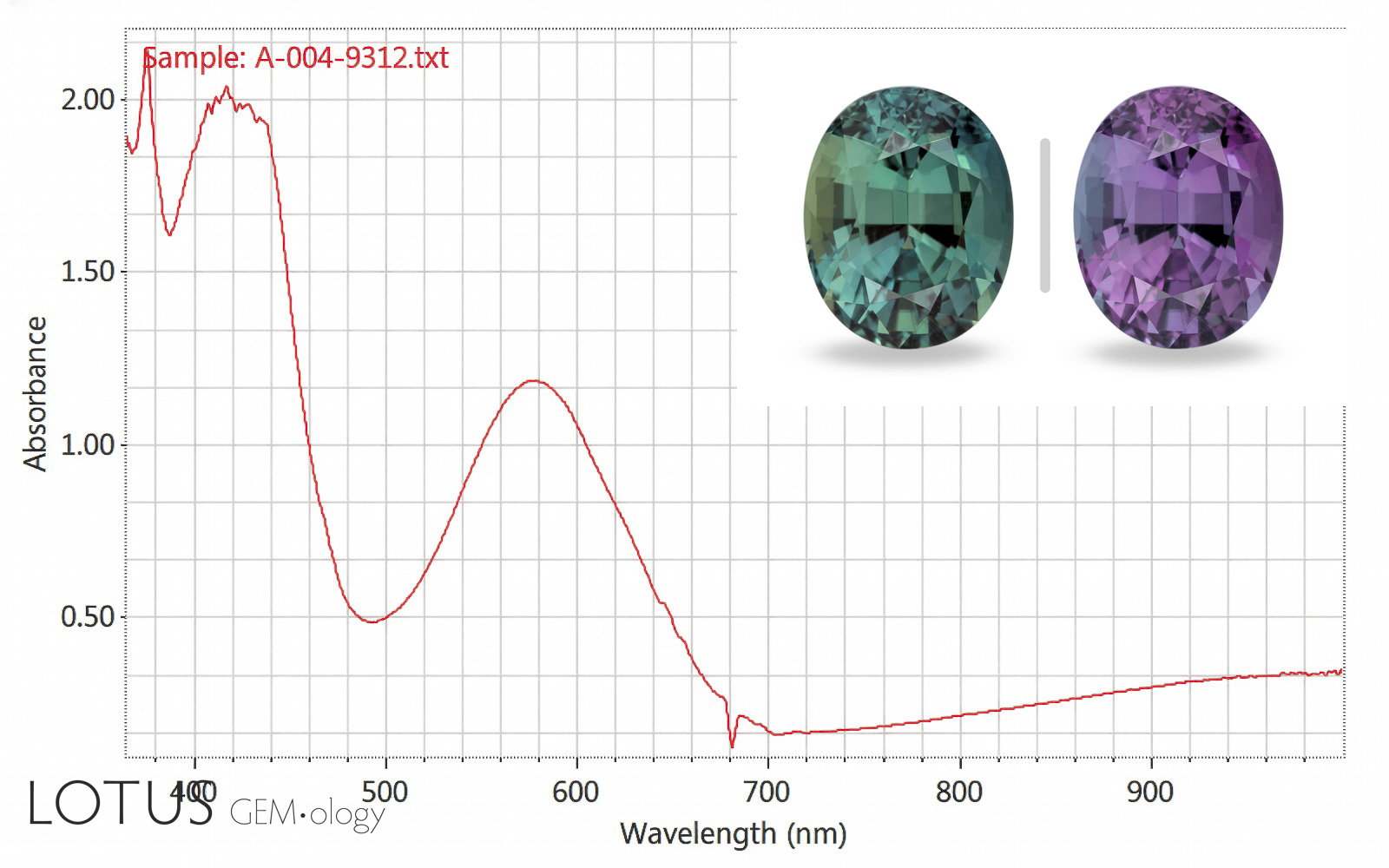
Alexandrite Chrysoberyl—Strength of Color Change
Alexandrite chrysoberyl is normally colored by the Cr³⁺ ion. This creates transmission in the blue-green and deep red ends of the spectrum, separated by a large absorption band in the yellow at about 580 nm. Because our eyes are more sensitive to green light, balanced daylight causes the color to appear greenish. In contrast, incandescent lights are extremely poor in the short wavelengths and strong in the yellow, orange and red wavelengths. This tips the balance, making them appear purple to red. The height of the absorption band in the yellow determines the strength of the color change.
Chrysoberyl is BeAl₂O₄ and it crystallizes in the orthorhombic system. When Cr³⁺ substitutes for Al³⁺ in alexandrite, the slightly different composition and structure shifts the spectrum slightly to the longer wavelengths, producing a gem with a color that sits on the fence between the red of ruby and green of emerald. This change-of-color (color inconstancy) effect is highly prized in the gem market.
- Image number
- LGI-001879
- Field of view
- Not recorded
© Lotus Gemology and the credited photographer. All rights reserved. Reproduction or sharing, including on social media, requires prior written permission. Please contact us for image use.