Ruby & Sapphire Bibliography

Ruby & Sapphire Bibliography

Explore books, articles and historical sources on ruby, sapphire and corundum in Four Treasures, the Lotus Gemology reference database. This bibliography brings together matching records from the collection, with publication details, abstracts and cover images where available.

Ruby & Sapphire References

The list below matches the terms ruby, rubies, sapphire or corundum in the database's searchable fields. Some references discuss these gems as part of a broader subject. Linked titles take you to external links where you may find the full reference.
3,981–4,000 of 4,671 matching references

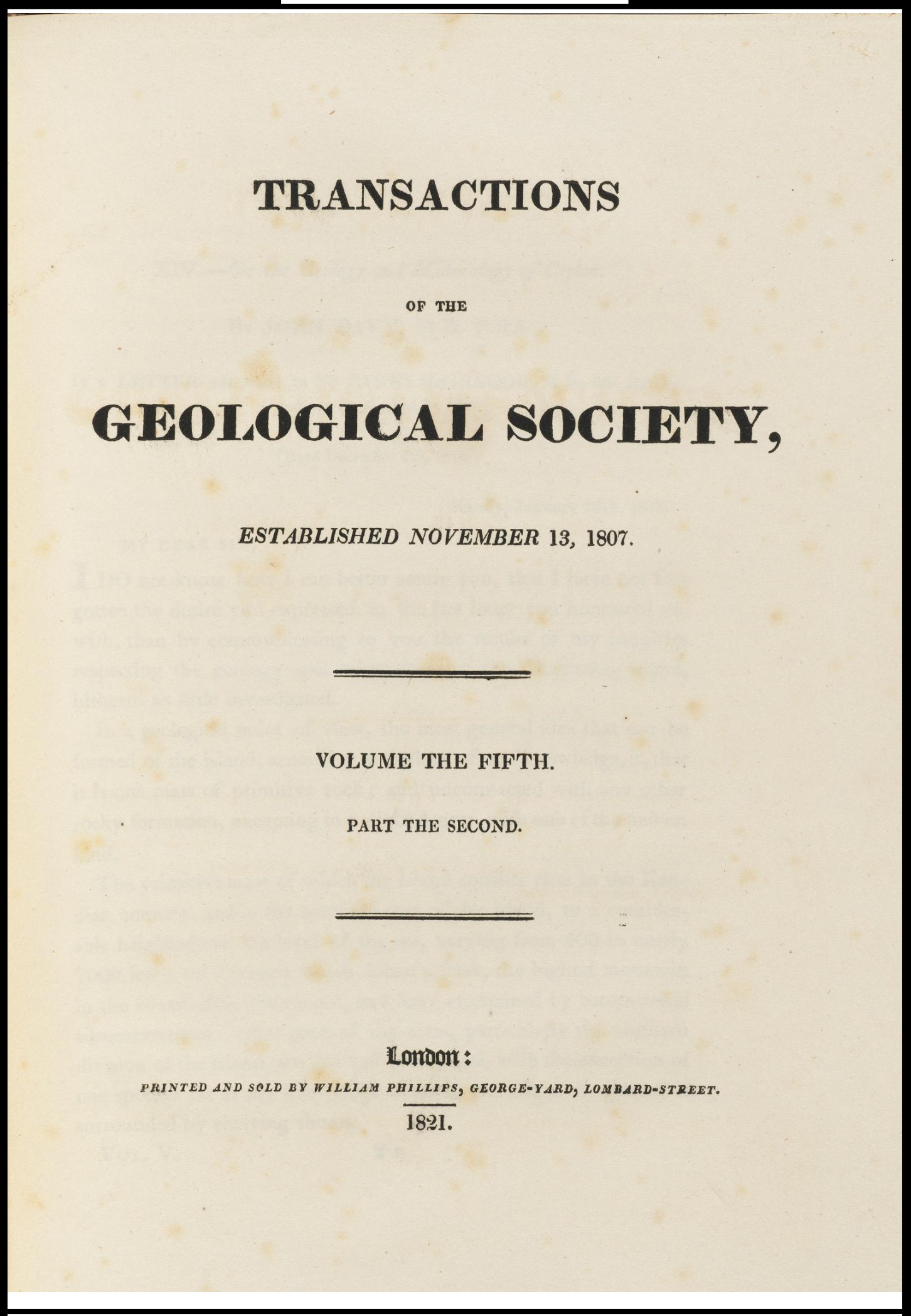
On the geology and mineralogy of Ceylon
Journal Article
Davy, J. (1821) On the geology and mineralogy of Ceylon. Transactions of the Geological Society [of London], Vol. 5, Part 2, pp. 311–327.
Record No. 657  |  Sinkankas/Born No.: NIS/NIB  |  RWHL
A concise geological and mineralogical account of Ceylon (Sri Lanka) by John Davy, based on his investigations while resident on the island. Davy describes Ceylon as consisting largely of ancient crystalline rocks, including gneiss and crystalline limestone, and records a variety of associated minerals. Of particular gemological interest are his observations on spinel, zircon, cinnamon-stone garnet, tourmaline, corundum and other gem minerals, together with their geological associations. The paper is an important early scientific account of the geology and mineralogy of Sri Lanka and one of the earliest attempts to relate its celebrated gemstones to the rocks in which they occur.

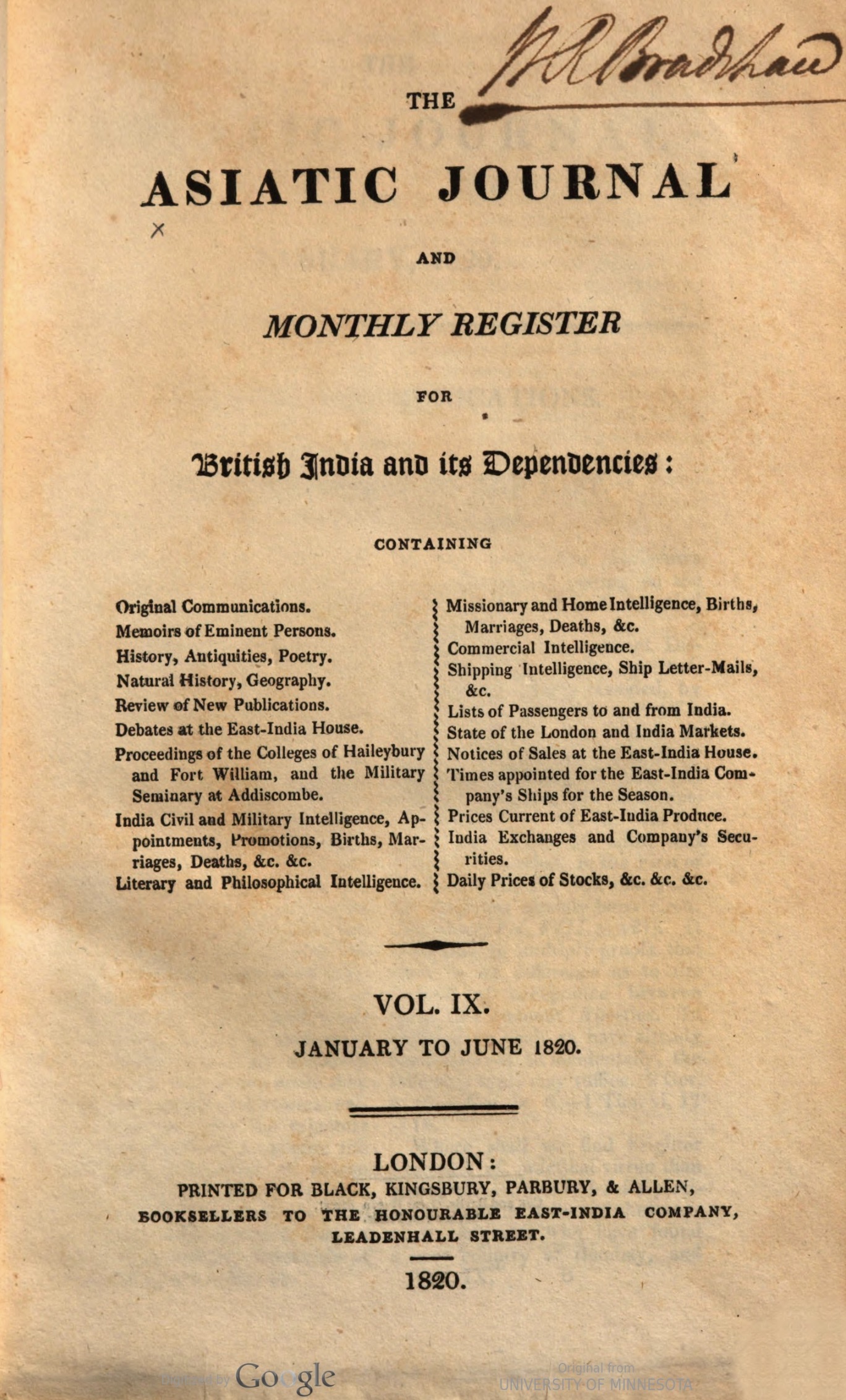
Essay on the turquoise and the calaite
Journal Article
Fischer, G. (1820) Essay on the turquoise and the calaite. The Asiatic Journal, Vol. 9, No. 49, pp. 23–30.
Record No. 29053  |  Sinkankas/Born No.: NIS/NIB  |  RWHL
An early mineralogical study by Gotthelf Fischer of two very different substances historically called turquoise. Fischer distinguishes “oriental turquoise,” which he regards as a true mineral, from “occidental turquoise” or turquoise odontolite, which he identifies as fossil tooth or bone colored by a copper compound. He proposes the name calaite for the mineral turquoise and discusses its occurrence, physical character and historical nomenclature, comparing it with Pliny’s descriptions of callais. Fischer notes that calaite occurs as rounded pieces in alluvial deposits rather than in a rocky matrix and discusses its resemblance to emerald and sapphire in ancient descriptions. The work is important in the history of gemology for its attempt to separate true mineral turquoise from odontolite and to reconcile contemporary mineralogical observations with the terminology of classical lapidary sources.

Account of the mine or quarry of corundum in Singraula
Journal Article
Hamilton, F. (1820) Account of the mine or quarry of corundum in Singraula. Edinburgh Philosophical Journal, Vol. 2, November, pp. 305–307.
Record No. 927  |  Sinkankas/Born No.: NIS/NIB  |  RWHL
A brief account by Francis Hamilton (formerly Buchanan) of the corundum mine or quarry at Singraula in India. Hamilton summarizes information gathered from several sources concerning the occurrence and extraction of corundum in the district, rather than presenting the paper as a detailed firsthand geological survey. The notice is important as an early nineteenth-century record of an Indian corundum locality and of the exploitation of massive corundum, a material widely valued for its extreme hardness and use as an abrasive. It forms part of the early literature documenting Indian sources of corundum before the mineralogical relationships among common corundum, ruby and sapphire were fully standardized.

Gems

Book Section
Rees, A. (1819) Gems. In: The Cyclopædia; or Universal Disctionary of Arts, Sciences, and Literature, London: Longman, Hurst, Rees, Orme, & Brown, 39 Vols., Vol. 15 , see Gems.
Record No. 3144  |  RWHL
An encyclopedia entry on gems in Abraham Rees’s Cyclopædia; or, Universal Dictionary of Arts, Sciences, and Literature. The article surveys the principal precious stones known in the early nineteenth century, discussing their names, physical characters, varieties, relative value and uses, and reflecting contemporary attempts to reconcile traditional jewelers’ terminology with developing mineralogical classification. As part of Rees’s broad technical encyclopedia, the entry is useful for understanding how gemological knowledge was presented to educated English readers at the time and for tracing the transition from older lapidary descriptions toward more scientific treatments based on mineralogy and chemistry. Contains a note on peacock feather put under sapphire.

Auszüge aus dem persischen Werke ʿAjāʾib al-makhlūqāt wa gharāʾib al-mawjūdāt d. i. das Buch der Edelsteine, von Mohammed Ben Manssur
Extracts from the Persian Work ʿAjāʾib al-makhlūqāt wa gharāʾib al-mawjūdāt, i.e., The Book of Gems, by Mohammed ibn Mansur
Book Section
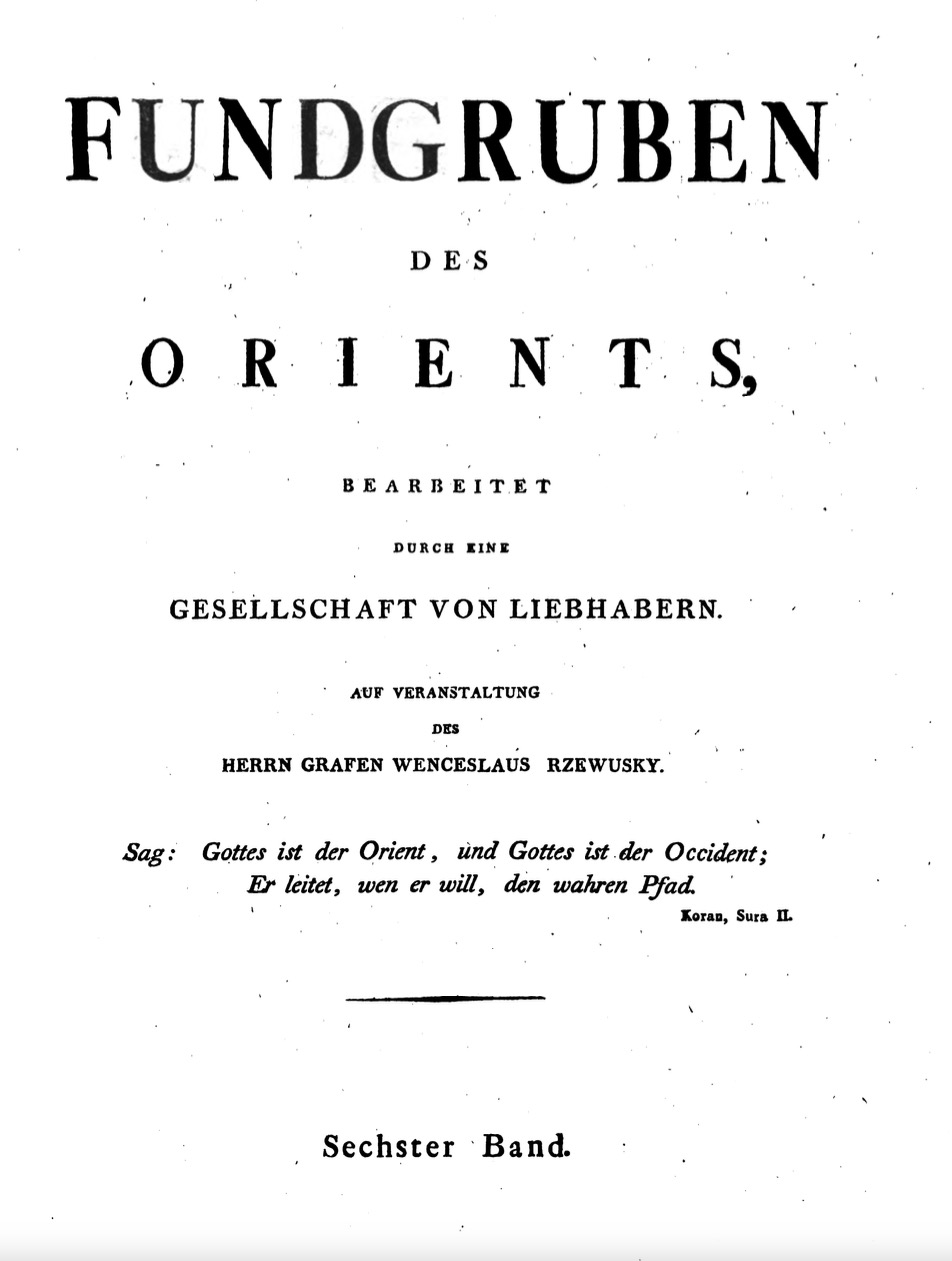
Hammer-Purgstall, V. (1818) Auszüge aus dem persischen Werke ʿAjāʾib al-makhlūqāt wa gharāʾib al-mawjūdāt d. i. das Buch der Edelsteine, von Mohammed Ben Manssur. [Extracts from the Persian Work ʿAjāʾib al-makhlūqāt wa gharāʾib al-mawjūdāt, i.e., The Book of Gems, by Mohammed ibn Mansur] In: Fundgruben des Orients [Treasures of the Orient], Vienna: Aton Schmid, K.K. Privil, and N.O. Landschfts-Buchdrucker, 6 Vols., Vol. 6 , pp. 126–142.
Record No. 16381  |  Language: in German and Arabic  |  RWHL
A German translation by Joseph von Hammer of selected portions of a medieval Persian lapidary by Muḥammad ibn Manṣūr, published in Fundgruben des Orients. The original work treats individual gemstones systematically under four headings: their physical characteristics, places of occurrence, value, and supposed occult or talismanic properties. Hammer deliberately translated principally the first two sections—description and sources—while omitting much of the material on prices and supernatural properties. The extracts discuss numerous precious stones and mineral substances and constitute an important early European presentation of medieval Persian gemological knowledge. The work is especially valuable for preserving information on historical gemstone terminology, characteristics and localities and for demonstrating the relationship between Persian and earlier Arabic lapidary traditions.

Catalogue de la Collection Minéralogique particulière du Roi
Catalog of the King's Private Mineralogical Collection
Book
Bournon, J.-L., de (1817) Catalogue de la Collection Minéralogique particulière du Roi. [Catalog of the King's Private Mineralogical Collection] Paris, Abel Lanoe, 557 pp.
Record No. 28352  |  Sinkankas/Born No.: 827: NIB  |  Language: in French  |  RWHL
This Catalogue first appeared, for the first time, at the end of the year 1813, when particular circumstances led me to feel the desire to part with my collection. At that time I had already been in England for nearly twenty years. The Battle of Battle of Leipzig, which soon afterwards took place, allowed me to glimpse the long-desired moment when my legitimate sovereign would be restored to the throne of his ancestors, and the worthy and respected princes of his august house reinstated in their rights. From that moment, I desired only to bring back to my homeland the fruit of the immense labour to which I had devoted myself ever since its deplorable and most unfortunate Revolution had voluntarily exiled me from it. I abandoned the project of selling my collection and became irrevocably attached to it. I had not been mistaken: the events that the outcome of this battle had led me to foresee soon came to pass. France, restored to herself, recalled to the inalienable right of ruling over her the illustrious family under whose ancestors she had risen to such a high degree of splendour, and whose exile and misfortunes had been the prelude to those of all Europe, which could not expect to remain forever the peaceful spectator of the crimes committed during that period. I had sacrificed absolutely everything in order to remain faithful to that family; its return to France restored to me a homeland toward which my desires and my hopes had ceaselessly turned, for more than twenty-five years, with regret and sorrow. I soon returned there, and upon my arrival I was rewarded for the many sacrifices that my constancy in fulfilling, without hesitation, all that my principles — the fruit of my fathers’ education — had always caused me to regard as duty, had led me to make. The King, to whom nothing concerning human knowledge is foreign, was gracious enough to acquire my mineralogical collection for himself, while entrusting me with its direction in his service. My wishes could not have been more completely satisfied: my love of tranquillity, my taste for work, and my desire to make that work useful — the only ambition to which my soul can today remain open — all these were contained in His Majesty’s act of kindness toward me. My gratitude can only be equalled by the wishes I form for the prosperity of his reign and for his happiness, so closely bound to that of the princes of his illustrious family. May those wishes be fulfilled! And may my beautiful homeland, through its return to justice, morality, and religion — inseparable foundations of the happiness of society — forget its errors and its misfortunes, just as a sick man forgets his most painful sufferings when health has been restored to him!

An account of the Swedish corundum from Gellivara, in Lapland
Journal Article
Swedenstierna, C.T. (1816) An account of the Swedish corundum from Gellivara, in Lapland. Transactions of the Geological Society [of London], Vol. 3, pp. 415–420.
Record No. 2614  |  Sinkankas/Born No.: NIS/NIB  |  RWHL
An early mineralogical account of corundum from Gellivara (Gällivare) in Swedish Lapland, describing its occurrence, physical characters, and geological associations. Swedenstierna compares the Swedish material with corundum known from other localities and discusses its remarkable hardness and related mineralogical properties. The paper documents an important early European occurrence of corundum at a time when the relationships among corundum, ruby, sapphire, and emery were becoming more clearly understood, and contributes to the developing nineteenth-century knowledge of the mineral’s geographical distribution and geological setting.

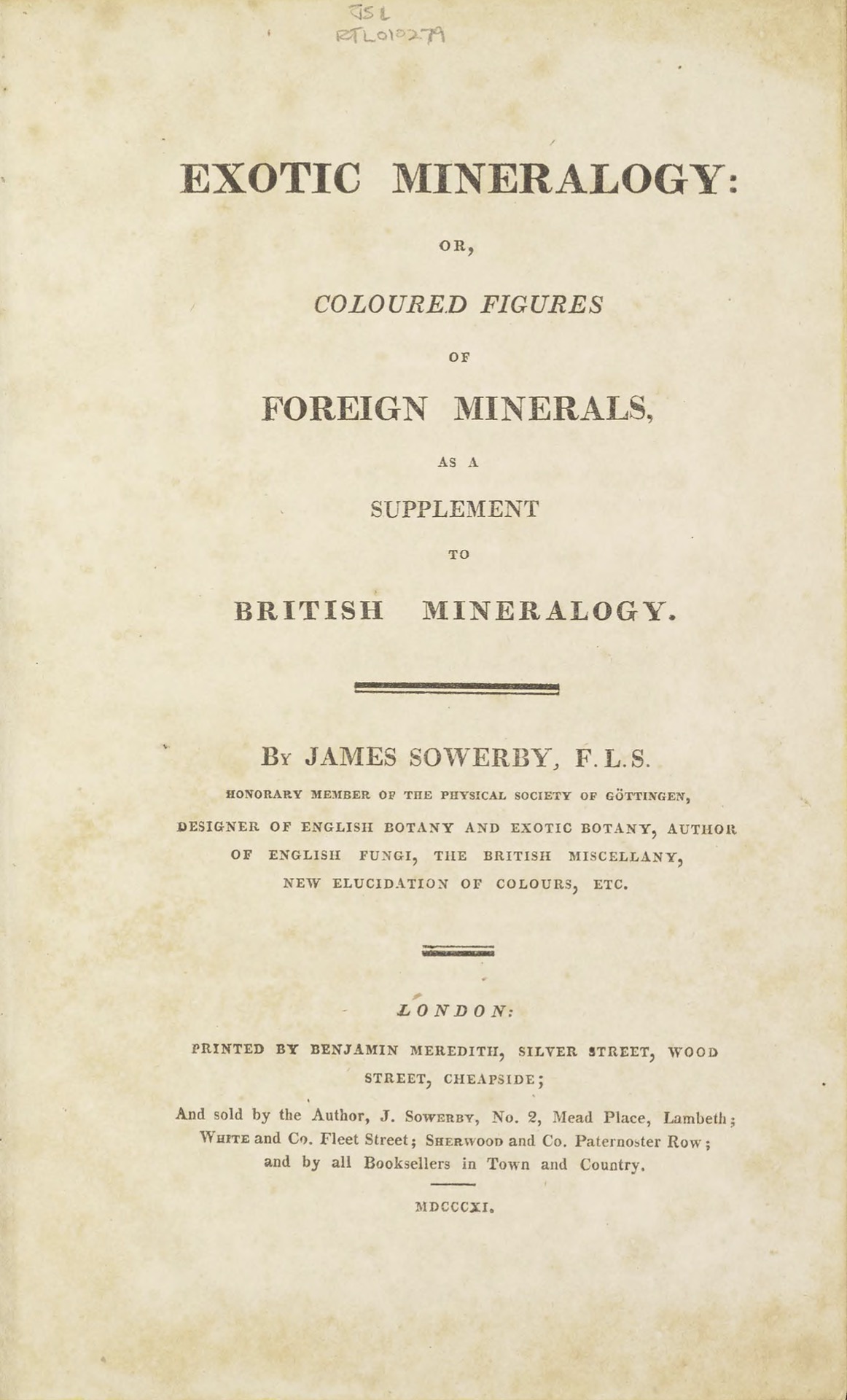
Exotic Mineralogy

Book
Sowerby, J. (1811–1817) Exotic Mineralogy. London, 2 Vols., 100, 69 color plates
Record No. 1631  |  RWHL
Very scarce. As the title states, Exotic Mineralogy was intended to supplement Sowerby's other great mineralogical work, British Mineralogy; however, perhaps due to a lack of interest in the mineralogy of localities outside Great Britain, there appear to have been far fewer subscribers to Exotic Mineralogy. The result is these two volumes are exceptionally rare. Exotic Mineralogy is chiefly noted for its engraved, hand-colored plates, which are among the most realistic mineral depictions ever produced by Sowerby. In preparing the illustrations for this work, Sowerby sought out the best examples of minerals not then known in Great Britain. Weighted by a high quality in the models, the plates in Exotic Mineralogy are overall more appealing than those of British Mineralogy, whose purpose was to depict examples of every known type of mineral found in Great Britain not simply prime examples. Even though the plates of Exotic Mineralogy are numbered through 169, plate 73 was not always issued in section; therefore, a complete copy of the work contains only 168 plates. A note on the wrapper to the 13th section, which was to have contained the missing plate states, It was intended to have published the Turquois in Tab. 73, but it has been found necessary to postpone that plate." In fact, plate 93 figuring turquois is the postponed plate with the seven clearly over-engraved into a nine in some printings. [from Schuh]"

On the corundum stone from Asia

Journal Article
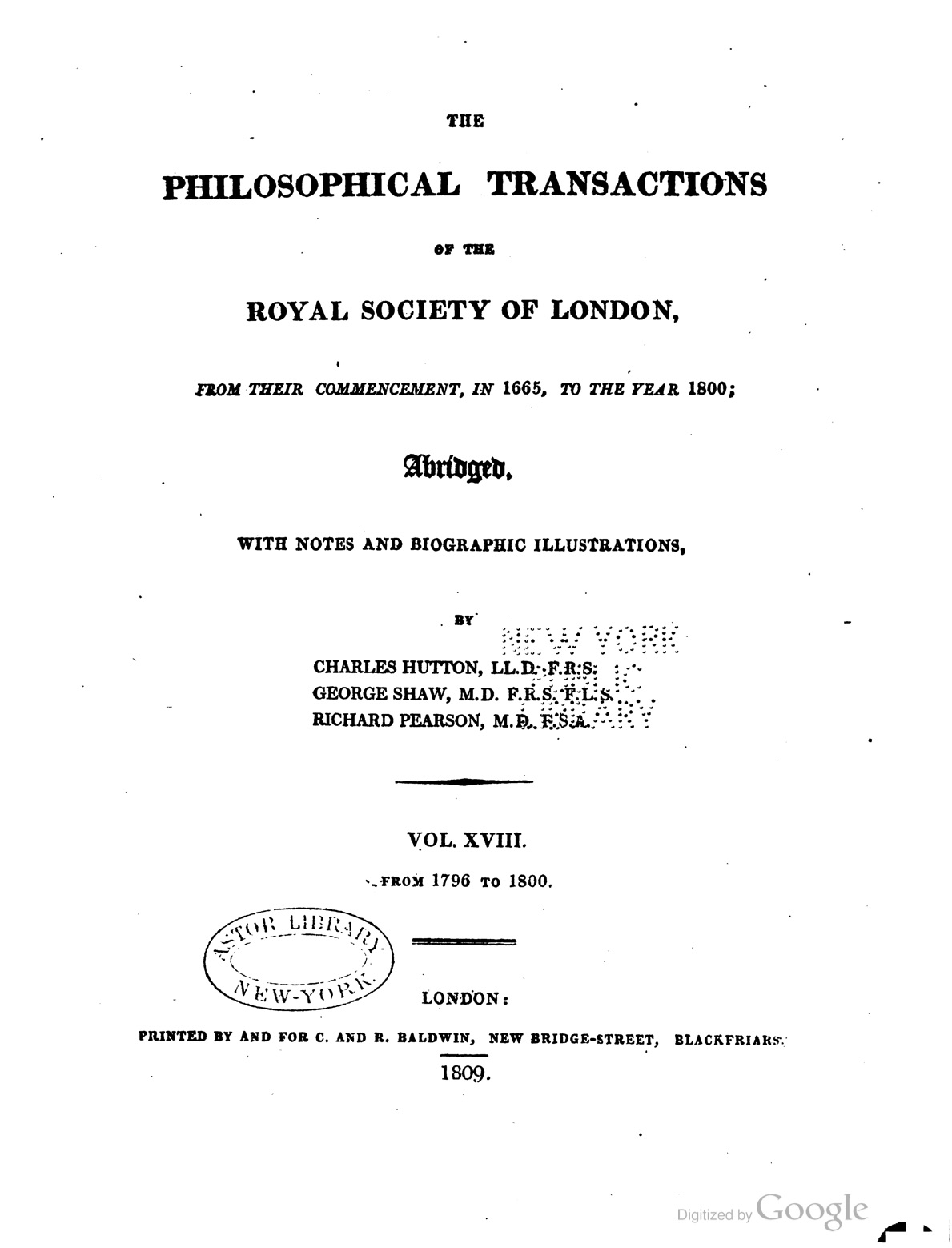
Greville, C.F. (1809) On the corundum stone from Asia. Philosophical Transactions of the Royal Society of London, Abridged, Vol. 18, pp. 356–378.
Record No. 848  |  Sinkankas/Born No.: 2526B; NIB  |  RWHL
An abridged republication of Charles Francis Greville’s important study of Asian corundum, originally published in the Philosophical Transactions in 1798. The paper treats principally massive non-gem corundum from India and its use as an abrasive for cutting gemstones, including a large block used as a hand-rubbing lap for cutting cabochons and a Chinese wire saw employing crushed corundum. Greville discusses its occurrence, specific gravity, characteristic parting and chemical composition, as well as asterism in suitably oriented material and differences between corundum and the so-called “octahedral ruby” (spinel). It also incorporates crystallographic observations by the Comte de Bournon and comparative specific-gravity data for corundum and several gemstones. The work is an important early study in the scientific characterization of corundum and its relationship to gem materials.

Traite elementaire de Mineralogie

Elementary Treatise of Mineralogy
Book
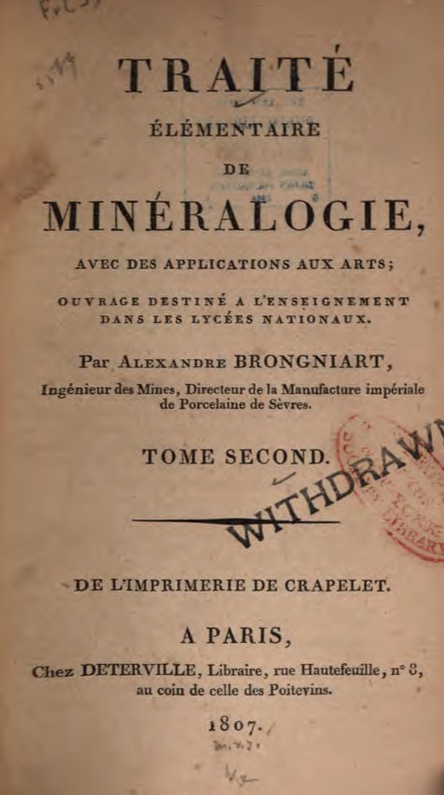
Brongniart, A. (1807) Traite elementaire de Mineralogie. [Elementary Treatise of Mineralogy] Paris, Deterville, 2 Vols., 564, 444 pp.
Record No. 7962  |  Sinkankas/Born No.: 953  |  Language: in French  |  RWHL
Sinkankas: An economic mineralogy. The large introduction is a condensed treatise on mineralogy, followed by a scheme of classification, then a large table and descriptions and discussions of mineral substances that extend into the second volume. In Volume I, under “pierres dures” (“hard stones”), are quartzes, flints and generally chalcedonic forms of quartz, as well as obsidian, lapis lazuli, jade, axinite, euclase, and others from p. 271 onward; however, the principal treatment of gemstones is found in Volume II, pp. 67–484, and includes zircon, quartzes, obsidian, jades, feldspars, andalusite, lazulite, diopside, garnets, tourmalines, euclase, beryls, chrysoberyls, corundums, peridot, and others. Serpentine is classified as an “unctuous” stone, while amber appears among the “combustibles” together with diamond.

A Description of Ceylon, Containing an Account of the Country, Inhabitants, and Natural Productions
Book
Cordiner, J. (1807) A Description of Ceylon, Containing an Account of the Country, Inhabitants, and Natural Productions. Aberdeen, Longman, Hurst, Rees and Orme, 2 Vols., Vol. 1, pp. 14–15 (gems); Vol. 2, pp. 35–78 (pearls)
Record No. 7390  |  Sinkankas/Born No.: NIS/NIB  |  RWHL
A two-volume account of Ceylon (Sri Lanka) by the British chaplain James Cordiner, describing the island’s geography, inhabitants, customs, economy and natural productions during the early period of British rule. Of gemological interest, Cordiner briefly discusses the island’s precious stones (Vol. 1, pp. 14–15), reflecting Ceylon’s longstanding reputation as a source of gems. A much more extensive section is devoted to the pearl fishery of the Gulf of Mannar (Vol. 2, pp. 35–78), describing the pearl banks, oysters, fishing grounds, diving, organization of the fishery and its economic importance. The work provides a valuable contemporary account of both gemstones and the natural-pearl industry of early nineteenth-century Ceylon.

Le saphir merveilleux, ou le talisman du bonheur, conte oriental
The marvelous sapphire, or the talisman of happiness, an oriental tale
Book Section
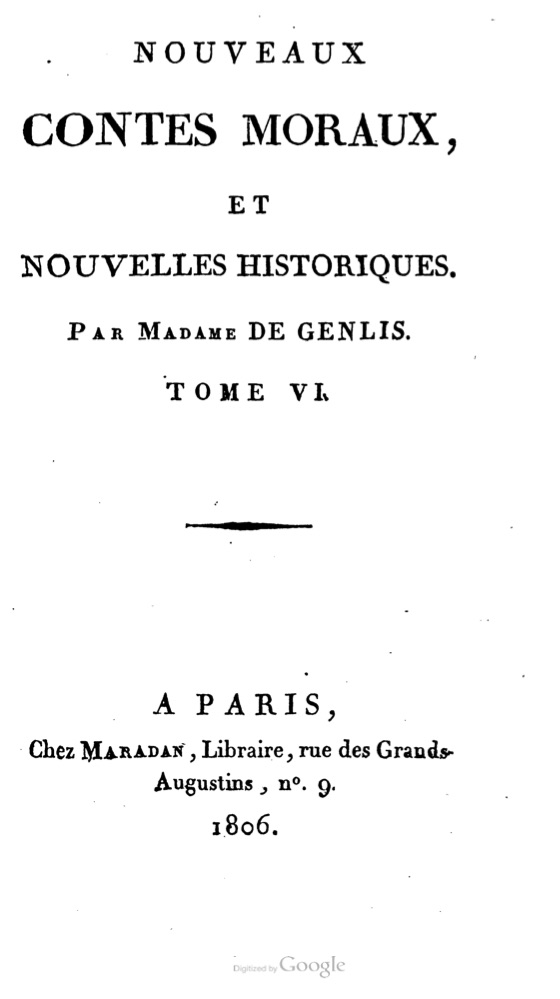
Genlis, S.F., comtesse de (1806) Le saphir merveilleux, ou le talisman du bonheur, conte oriental. [The marvelous sapphire, or the talisman of happiness, an oriental tale] In: Nouveaux Contes Moraux, et Nouvelles Historiques, Paris: Chez Maradan, pp. 193–252.
Record No. 818  |  Sinkankas/Born No.: NIS/NIB  |  Language: in French  |  RWHL
An oriental moral tale by Stéphanie Félicité, comtesse de Genlis, centered on a marvelous sapphire endowed with talismanic significance. Published as part of her Nouveaux Contes Moraux, et Nouvelles Historiques, the story employs the exotic setting and supernatural associations characteristic of the European conte oriental tradition, using the sapphire as a literary device in an exploration of happiness, virtue and human conduct. Although fictional rather than mineralogical, the tale is of interest to the cultural history of gemstones for its portrayal of the sapphire as a precious object invested with magical and symbolic powers, reflecting the persistence of traditional beliefs concerning gems in early nineteenth-century European literature.

An Account of the Island of Ceylon

Book
Percival, R. (1803) An Account of the Island of Ceylon. London, C. and R. Baldwin, pp. 59–80 (pearls); pp. 352–360 (minerals)
Record No. 2844  |  Sinkankas/Born No.: NIS/NIB  |  RWHL
An early nineteenth-century account of Ceylon (Sri Lanka) by Robert Percival, describing the island’s geography, inhabitants, economy, natural resources and colonial administration. Of particular gemological interest are his detailed remarks on the pearl fisheries (pp. 59–80), including the Gulf of Mannar fishery, its organization, diving and commercial importance, and his discussion of the island’s minerals and precious stones (pp. 352–360). The work is a useful contemporary source for the natural resources and gem-related industries of Ceylon at the beginning of British rule.

An analysis of a variety of the corundum [from Thibet]
from Thibet
Journal Article
Gregor, W. (1803) An analysis of a variety of the corundum [from Thibet]. Nicholson’s Journal, Vol. 4, April, pp. 209–214.
Record No. 844  |  Sinkankas/Born No.: NIS/NIB  |  RWHL
An early chemical analysis by William Gregor of a variety of corundum from Tibet. Gregor examines the material to determine its composition and compare it with other forms of corundum then under study in Europe. The paper belongs to the period when chemical analysis was being used increasingly to establish the identity and relationships of hard minerals that had previously been distinguished mainly by appearance and locality. It is particularly relevant to the history of gemology because it contributed to the chemical characterization of corundum and to the broader effort to understand the relationship between massive corundum and its gem varieties, ruby and sapphire.

Chemical examination of the circon, or jargon of Ceylon; Chemical examination of hyacinth
Book Section
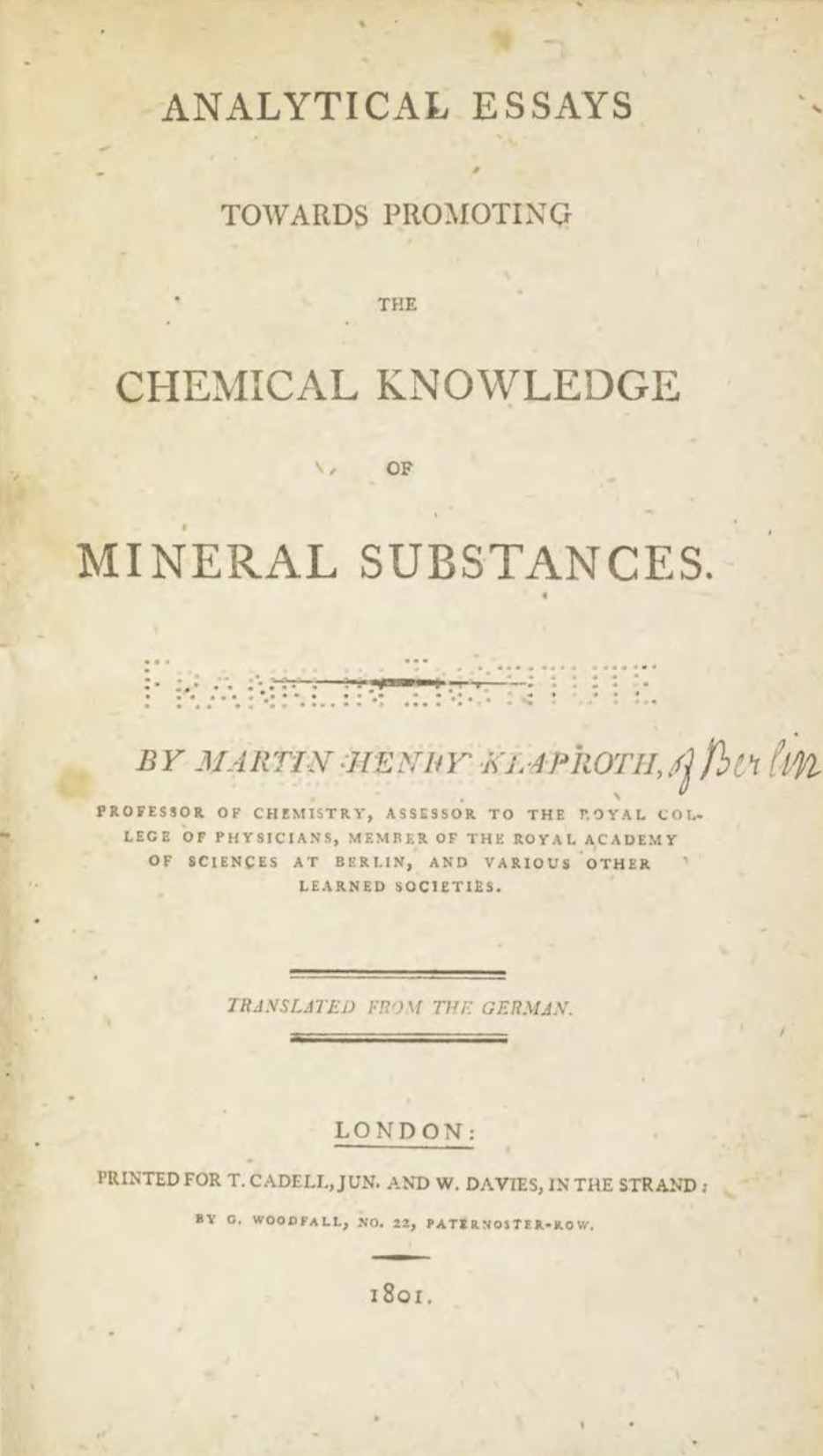
Klaproth, M.H. (1801–1804) Chemical examination of the circon, or jargon of Ceylon; Chemical examination of hyacinth. In: Analytical Essays Towards Promoting the Chemical Knowledge of Mineral Substances, London: Cadell, Jun and W. Davies, Vol. 1 , pp. 175–199.
Record No. 28354  |  Sinkankas/Born No.: NIS/NIB  |  RWHL
Among the precious stones coming from Sri Lanka, there occurs a particular genus, hitherto little noticed, which is distinguished from other gems by the following characters. Its colour consists of various shades of pale yellowish green and a dull hue inclining altogether toward smoky grey. Externally, a greasy lustre is observed, and it feels rough when uncut. The size of the individual stones is inconsiderable; commonly twenty or thirty of them weigh only one drachm. The form of their crystals is a rectangular four-sided prism (parallelepipedon), terminated by tetrahedral faces resting upon the edges. However, this form of crystallization is distinctly perceptible in very few specimens only, for the greater part occur merely as loose, minute, rounded grains (abgerundete Geschiebe). But this kind of gem is especially distinguished by its specific gravity, which I have found to be 4.615. Romé de l’Isle was the first, to my knowledge, who mentioned these particular species of stones from Ceylon as a gem; giving them the name Jargon of Ceylon, and stating their specific weight, according to Brisson’s experiments, at 4.416. Other mineralogists and writers, who notice this stone, class it — some with the sapphire, others with the topaz, others with the ruby, others with the diamond, and some with the hyacinth. But Werner has assigned to it a peculiar place in the mineralogic system, immediately under the diamond and the chrysoberyl, and called it Zircon (Silex circonius).

Opera omnia

Complete Works
Book
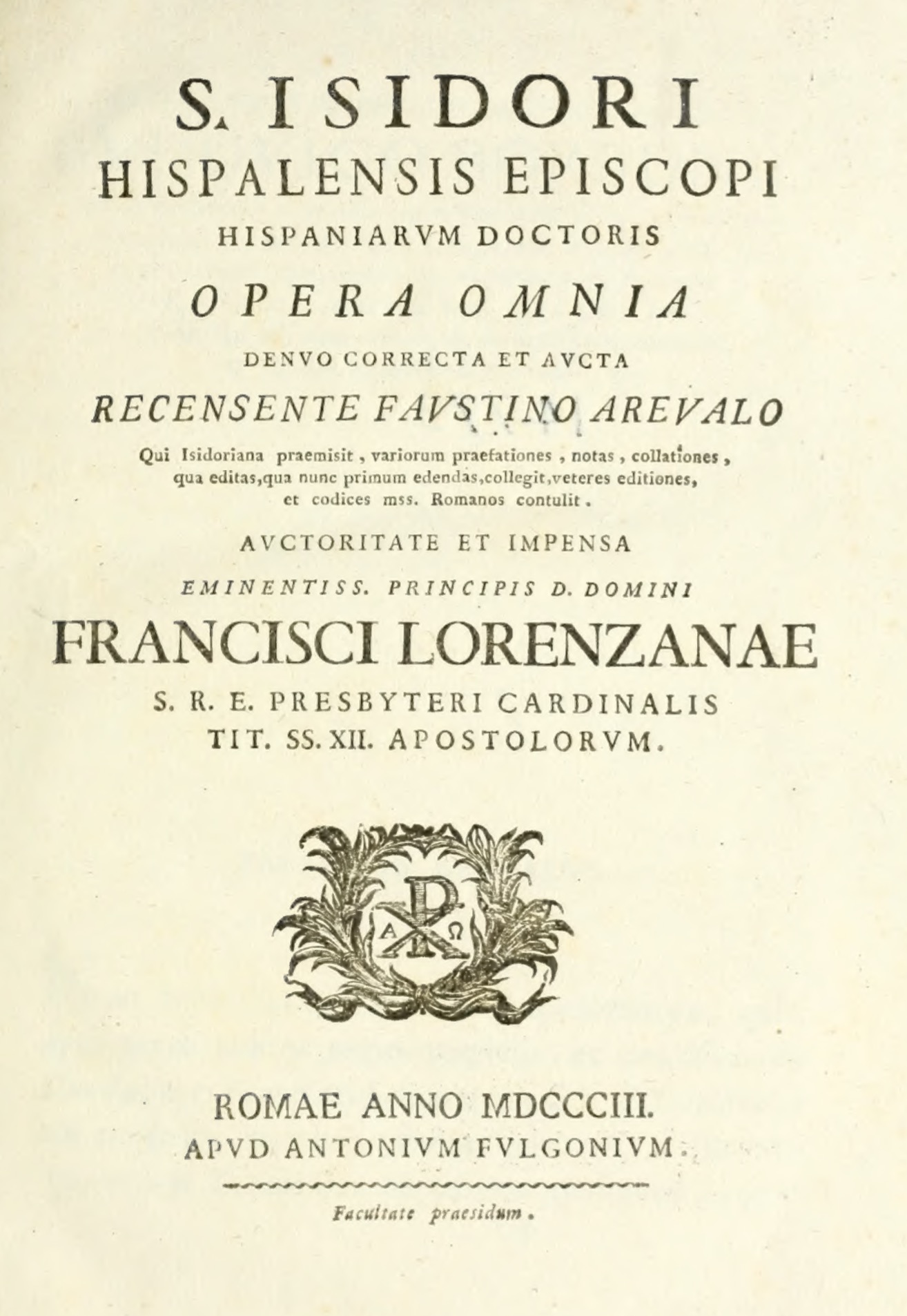
Isidore of Seville (1801) Opera omnia. [Complete Works], 7 Vols., see Vol. 4, gemmis, p. 263 , 563 pp.
Record No. 10939  |  Sinkankas/Born No.: NIS/NIB  |  Language: in Latin  |  RWHL
A collected edition of the works of Isidore of Seville (c. 560–636), the influential early medieval scholar and archbishop of Seville. Of particular importance to the history of gemology is his Etymologiae (or Origines), an encyclopedic compilation of knowledge derived largely from classical and late-antique sources. Book XVI, De lapidibus et metallis(On Stones and Metals), discusses minerals, metals and numerous precious stones, including emerald, beryl, sapphire, amethyst, jasper, diamond and pearls, giving their names, supposed origins, physical characteristics and traditional properties. Isidore’s writings became an important conduit through which classical lapidary knowledge was transmitted to medieval Europe and strongly influenced subsequent medieval encyclopedias and lapidaries.

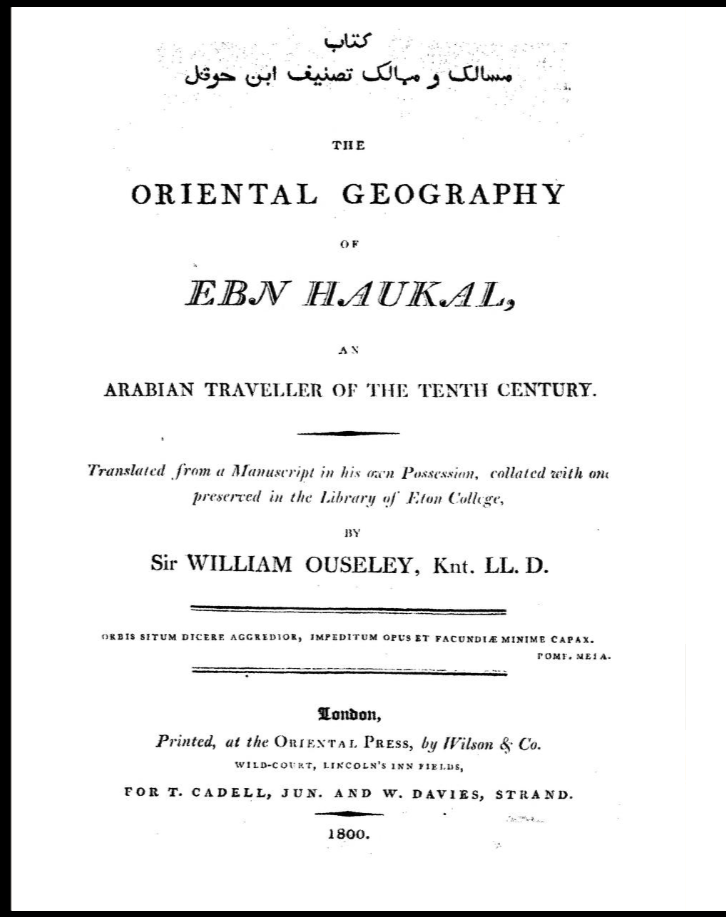
Ebn Ḥawqal, Masālek al-mamālek: The Oriental Geography of Ebn Haukal, an Arabian Traveller of the Tenth Century

Book
Ouseley, W. (1800) Ebn Ḥawqal, Masālek al-mamālek: The Oriental Geography of Ebn Haukal, an Arabian Traveller of the Tenth Century. London, Wilson & Co., 327 pp.
Record No. 28238  |  Sinkankas/Born No.: NIS/NIB  |  RWHL
The first English translation of Ibn Ḥawqal’s Masālik al‑Mamālik (“Routes and Realms”), a 10th‑century Arabic geography. Based on manuscripts in Ouseley’s collection, the work surveys lands from North Africa through Persia and Central Asia, describing routes, resources, and cultures. It introduced European readers to Islamic geographical science and provided a foundation for later Orientalist scholarship.

Account of an Embassy to the Kingdom of Ava
Book
Symes, M. (1800) Account of an Embassy to the Kingdom of Ava. London, J. Debrett, 2 Vols., Vol. 2, see pp. 375–381
Record No. 1673  |  RWHL
An account of Michael Symes’s diplomatic mission to the Burmese court at Ava in 1795, undertaken on behalf of the British government in India. Symes describes Burma’s geography, government, society, religion, commerce, natural resources and relations with neighboring countries, together with his journey to and reception at the royal court. Of particular gemological interest is his discussion of Burma’s precious stones, including the ruby-producing region and the royal control and valuation of gemstones. The work provides an important late eighteenth-century European account of the Burmese gem trade and of the association between the kingdom and its celebrated ruby deposits.

Analysis of the spinel

Journal Article
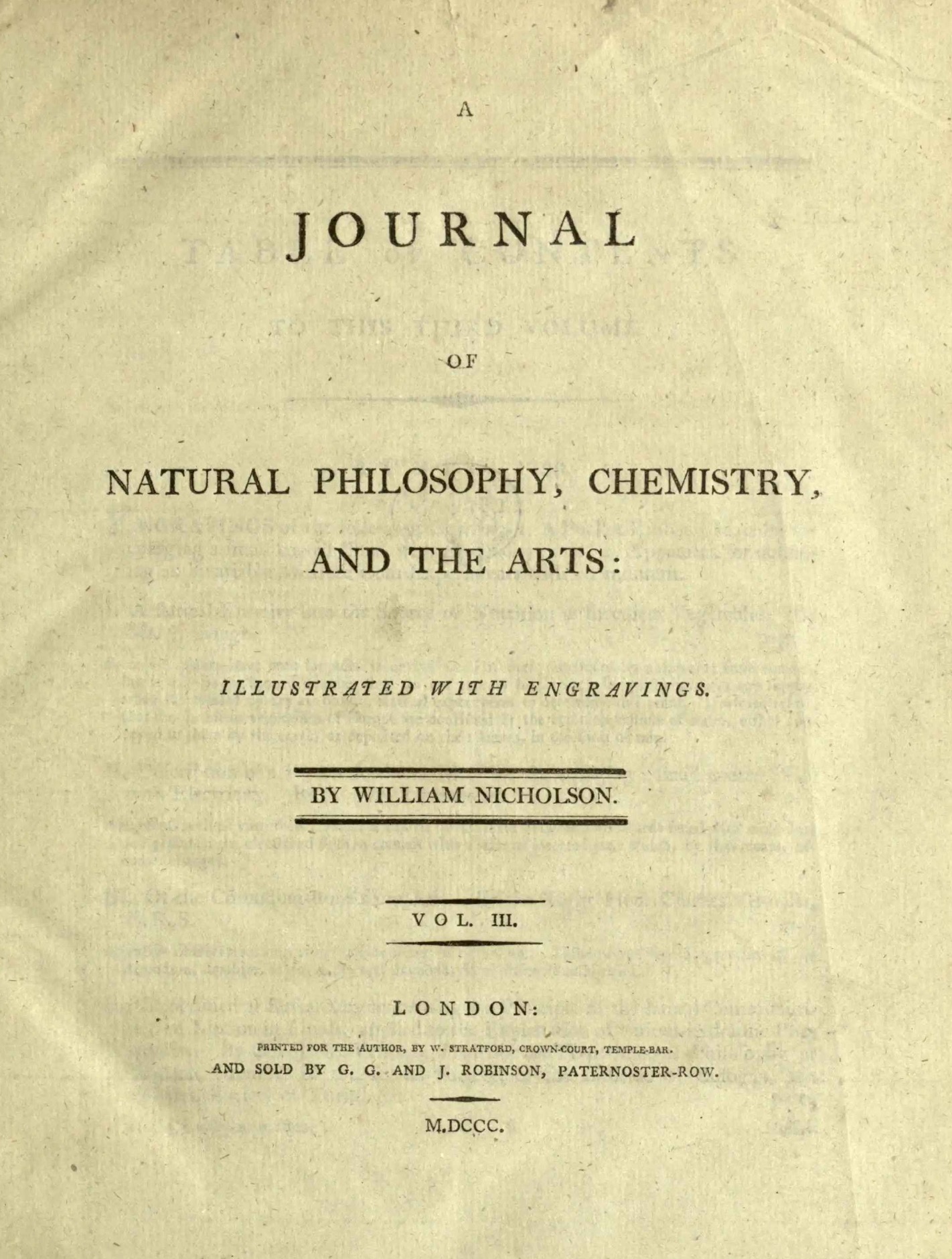
Klaproth, M.H. (1799) Analysis of the spinel. Journal of Natural Philosophy, Chemistry and the Arts, Vol. 3, pp. 349–353.
Record No. 29301  |  Sinkankas/Born No.: NIS/NIB  |  RWHL
An English translation of Martin Heinrich Klaproth’s chemical investigation of spinel, reporting experiments undertaken to determine its composition and mineralogical character. Klaproth’s analysis showed spinel to consist principally of alumina and magnesia, providing a chemical basis for distinguishing it from other hard gemstones with which it had historically been confused. Of particular gemological importance was the differentiation of red spinel from ruby, whose similar appearance had long led the two materials to be grouped together in the gem trade. The paper illustrates the increasing importance of quantitative chemical analysis in establishing mineral species and represents an important step in the scientific characterization of spinel.

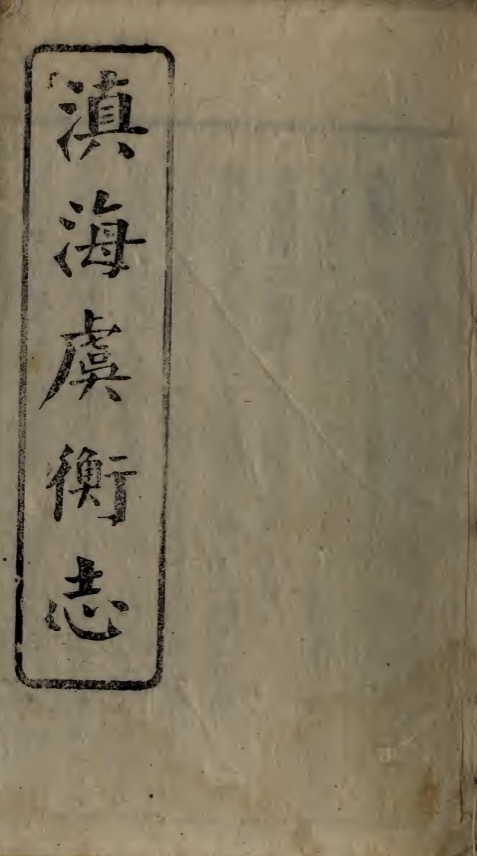
Record of the Resources of Yunnan

Dian Hai Yu Heng Zhi; 滇海虞衡志
Book
Tan, C. (1799) Record of the Resources of Yunnan. [Dian Hai Yu Heng Zhi; 滇海虞衡志], 13 juan
Record No. 16784  |  Sinkankas/Born No.: NIS/NIB  |  Language: in Chinese  |  RWHL
A wide-ranging description of the natural resources, products, geography, peoples, and material culture of Yunnan, completed by Tan Cui in 1799. The work comprises 13 sections, including caves and mountains, minerals and stones, aromatics, implements, animals, plants, and peoples. Of particular gemological importance is the second section, Zhi Jinshi [志金石], which discusses gold, silver, copper, jade, amber, gemstones, pearls, cinnabar, and other mineral substances. Its account of jade is especially significant because it explicitly describes jade from the region beyond Tengyue, the extraction and trading of boulder-like rough material, its transport to Dali and Yunnan, and the considerable uncertainty involved in cutting the rough to reveal fei cui [翡翠]. It is therefore an important early source for the history of the Burmese jadeite trade into China. The work was completed in 1799 and first printed in 1804. Sun Laichen: Volumes 2, 5, and 9 contain descriptions of Burmese products, including jade and jade Buddha images, penis bells, eggplants, insects, rubies, cotton, and cotton cloth. Prefaced in 1799 and printed in 1804.

Exploring the Literature of Corundum

Ruby and sapphire research spans mineralogy, gem deposits, identification, treatments, synthesis and the history of the gem trade. Older publications can also be useful for tracing terminology, early observations and accounts of mining localities. Publication dates and the original source should be considered when using historical descriptions.

For an introduction to collecting books on this subject, read Ruby & Sapphire Books: Collecting the Literature of Corundum.

About Four Treasures

Four Treasures is Lotus Gemology's freely accessible gemological reference database. Use the full database to search by author, title or keyword and explore literature on gemology, mineralogy, jewelry and related fields. Where available, hyperlinks on titles may lead directly to the full publication.

Search the Complete Four Treasures Database