Ruby & Sapphire Bibliography

Ruby & Sapphire Bibliography

Explore books, articles and historical sources on ruby, sapphire and corundum in Four Treasures, the Lotus Gemology reference database. This bibliography brings together matching records from the collection, with publication details, abstracts and cover images where available.

Ruby & Sapphire References

The list below matches the terms ruby, rubies, sapphire or corundum in the database's searchable fields. Some references discuss these gems as part of a broader subject. Linked titles take you to external links where you may find the full reference.
4,001–4,020 of 4,671 matching references

An analytical description of the crystalline forms of corundum, from the East-Indies, and from China
Journal Article
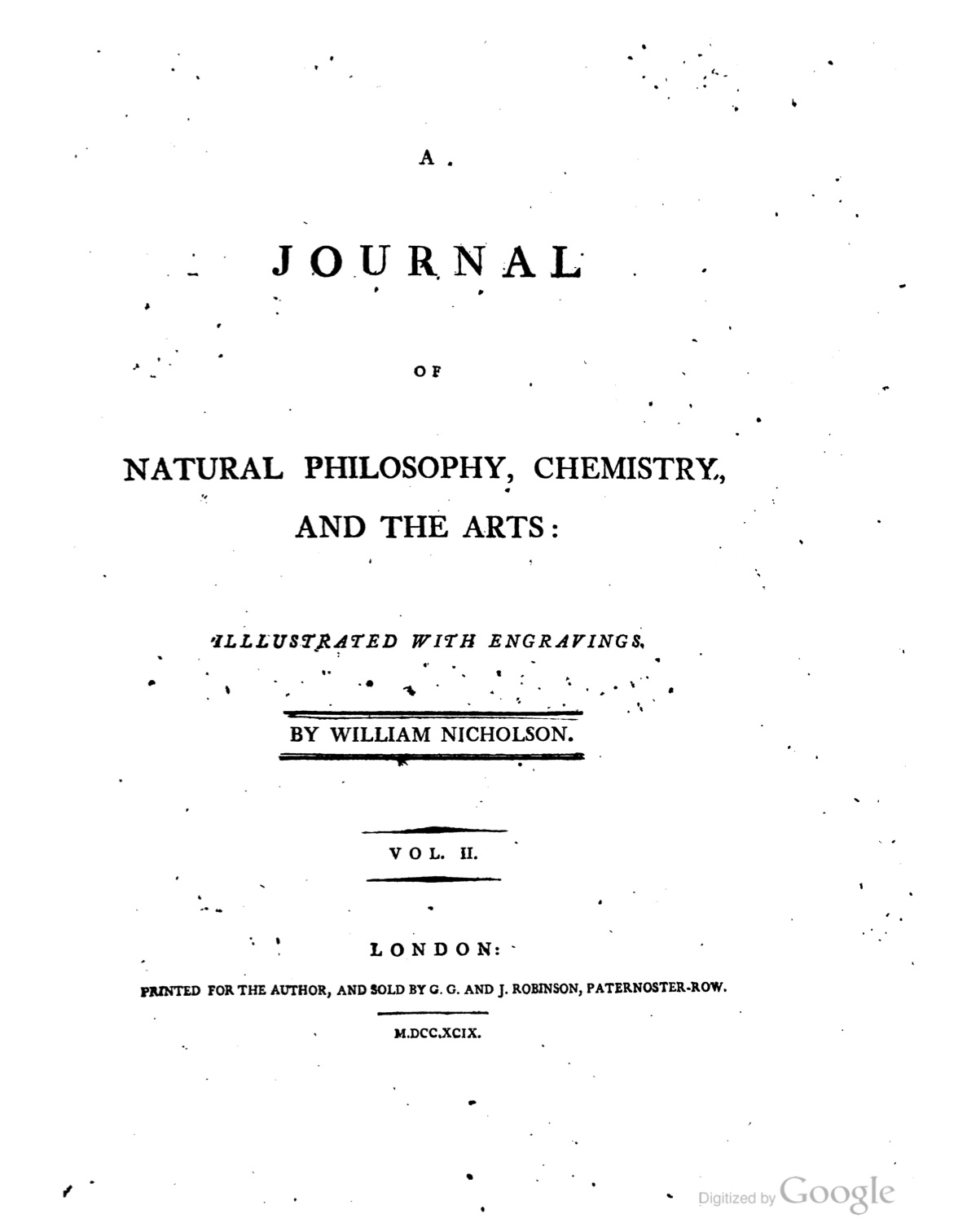
Bournon, J.-L., de (1799) An analytical description of the crystalline forms of corundum, from the East-Indies, and from China. A Journal of Natural Philosophy, Chemistry and the Arts [Nicholson's journal], Vol. 2, March, pp. 540–544, plate facing p. 556.
Record No. 16631  |  Sinkankas/Born No.: 823; NIB  |  RWHL
An early crystallographic study by Jacques-Louis, Comte de Bournon, devoted to corundum specimens from the East Indies and China. Bournon describes the principal crystal forms and their modifications, using geometrical relationships to characterize the mineral more precisely. The paper was closely associated with contemporary work by Charles Francis Greville on corundum and helped establish crystallography as an important means of distinguishing corundum from other hard stones then confused with it. Of particular gemological significance, the study contributed to the scientific recognition of corundum as the mineral species that includes ruby and sapphire.

Observations sur des Cristaux trouvés parmi des Pierres de Ceylan, et qui Paroissent Appartenir à l’espèce du Corindon, vulgairement Spath Admantin
Observations on the crystals found among the stones of Ceylon, and which appear to be a variety of corundum, commonly called adamantine spar
Journal Article
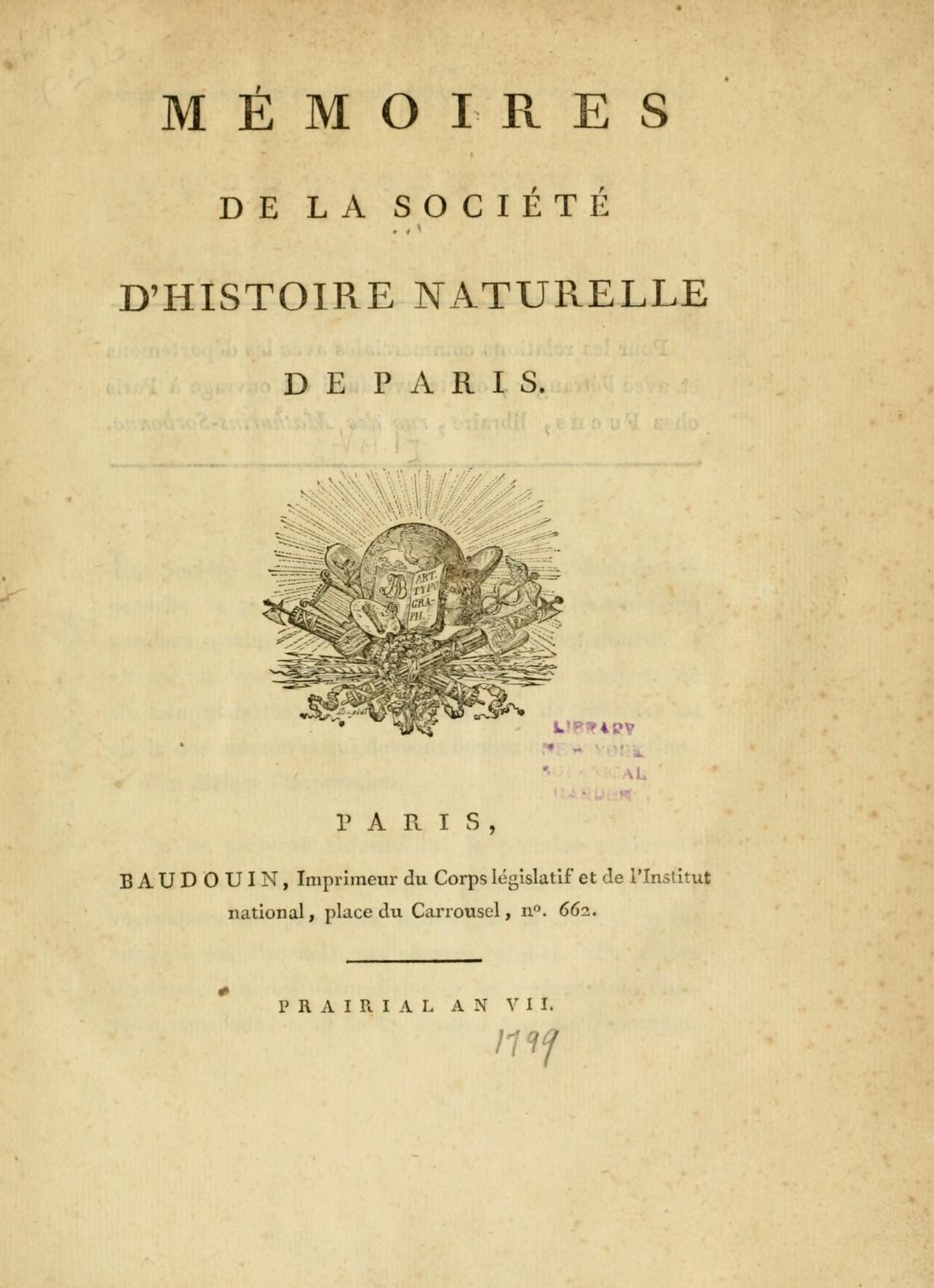
Haüy, R.J. (1799) Observations sur des Cristaux trouvés parmi des Pierres de Ceylan, et qui Paroissent Appartenir à l’espèce du Corindon, vulgairement Spath Admantin. [Observations on the crystals found among the stones of Ceylon, and which appear to be a variety of corundum, commonly called adamantine spar] Mémoires de la Société d’Histoire Naturelle de Paris, Vol. 1, pp. 55–58.
Record No. 8083  |  Sinkankas/Born No.: NIS/NIB  |  Language: in French  |  RWHL
An early crystallographic study by René-Just Haüy of crystals found among gemstones from Ceylon (Sri Lanka) which he recognized as belonging to corundum, then commonly termed adamantine spar. Haüy examines their crystal forms and physical characters and uses crystallographic evidence to establish their relationship to the corundum species. The paper belongs to the period in which stones previously distinguished largely by color, appearance or trade name were being brought together as varieties of the same mineral through crystallographic and physical analysis. It is an important contribution to the early scientific classification of corundum and to the recognition of the mineralogical relationships among the gem materials of Ceylon.

De la topase blanche de Saxe

On the white topaz of Saxony
Journal Article
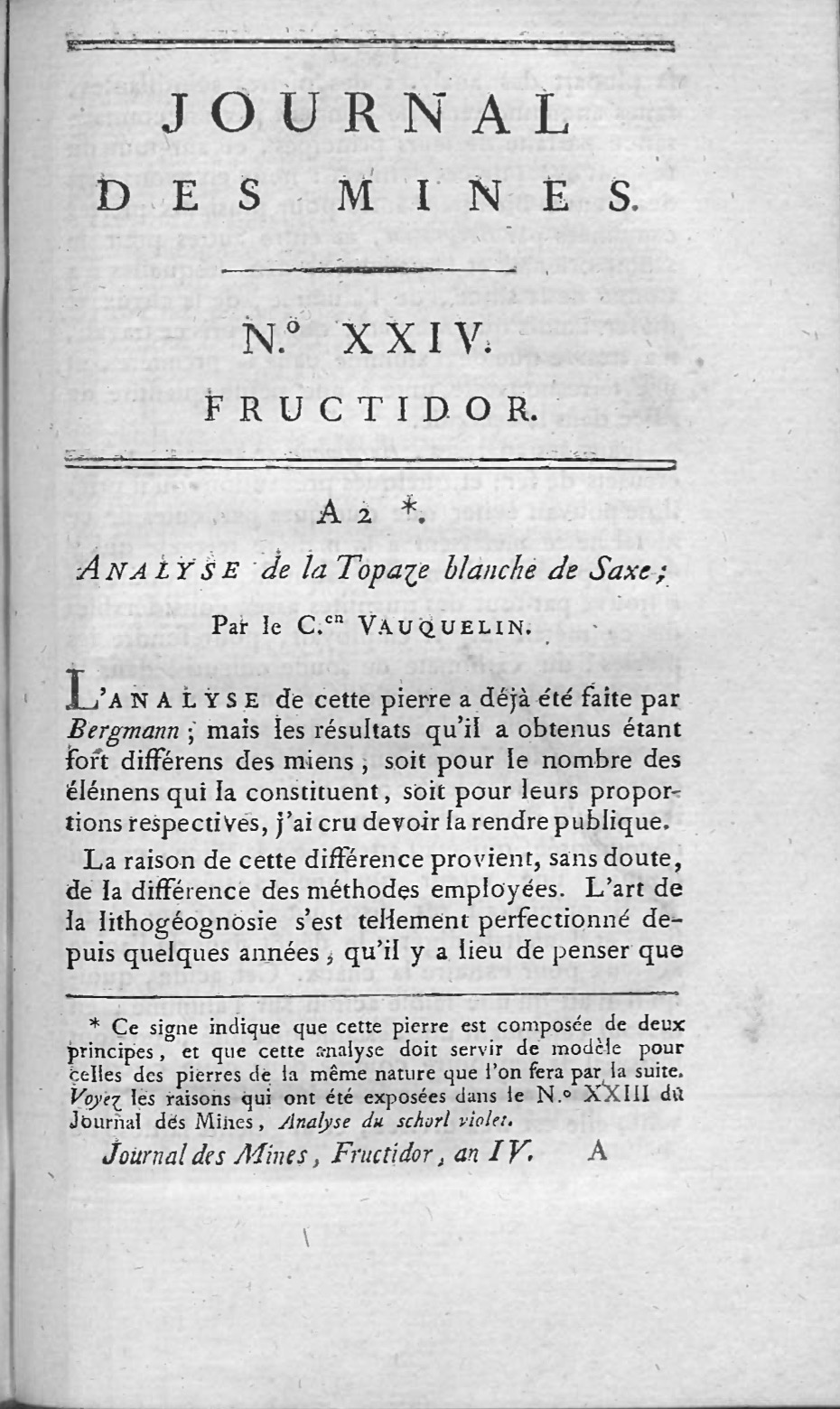
Vauquelin, N.-L. (1798) De la topase blanche de Saxe. [On the white topaz of Saxony] Journal des mines, Vol. 4, No. 24, pp. 1–4.
Record No. 28380  |  Sinkankas/Born No.: NIS/NIB  |  Language: in French  |  RWHL
Early analysis of topaz. The analysis of this stone has already been carried out by Torbern Olof Bergman; but the results which he obtained being very different from mine, either as regards the number of the elements which constitute it, or their respective proportions, I believed it my duty to make my analysis public. The reason for this difference doubtless arises from the difference in the methods employed. The art of lithogeognosy has become so perfected during the past few years that there is reason to think that most of the analyses of sparkling stones formerly made do not provide a complete knowledge of their principles, and above all of the exact relation of these latter: we already have striking proofs of this for several stones examined by Bergmann, and among others for the oriental sapphire and the hyacinth, in which he found silica, alumina, lime, and iron, whereas Martin Heinrich Klaproth, who repeated this work, found only alumina in the first, and in the second a new earth united with a small quantity of silica.

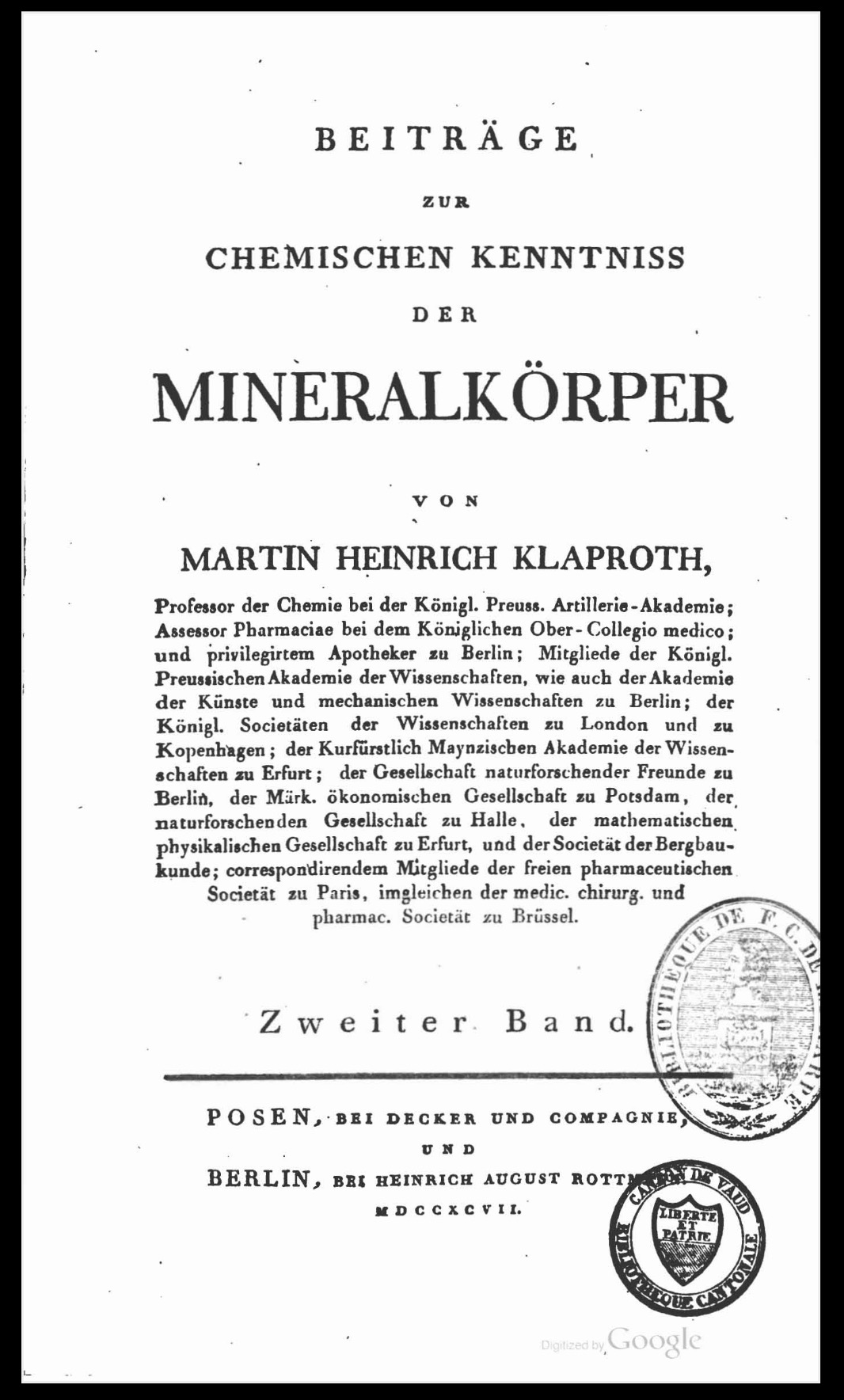
Untersuchung des Spinells, Beiträge zur chemischen Kenntniss der Mineralkörper
Investigation of the spinel, contributions to the chemical knowledge of mineral bodies
Book Section
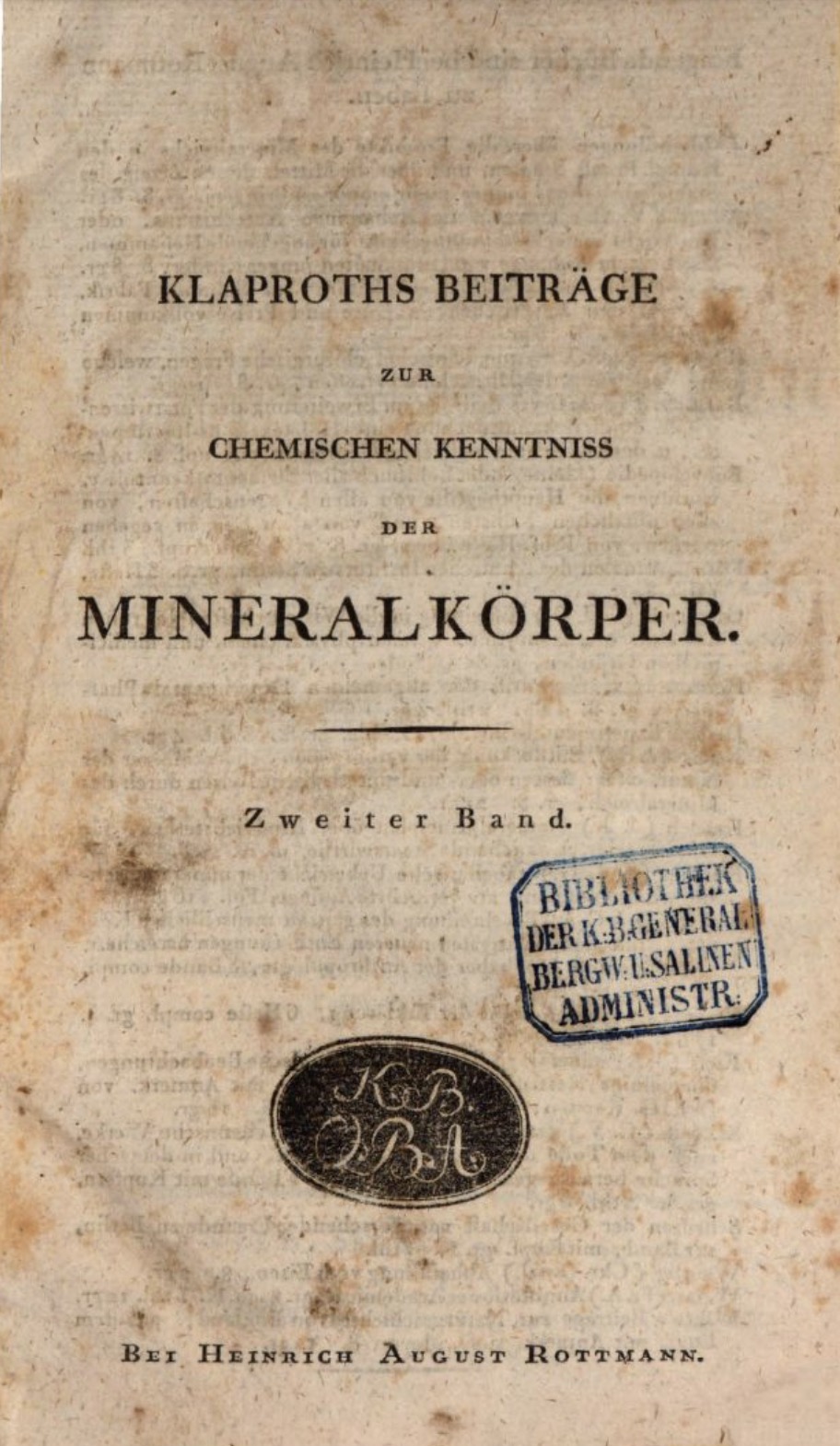
Klaproth, M.H. (1797) Untersuchung des Spinells, Beiträge zur chemischen Kenntniss der Mineralkörper. [Investigation of the spinel, contributions to the chemical knowledge of mineral bodies] In: Beiträge zur chemischen Kenntniss der Mineralkörper, Vol. 2 , pp. 1–11.
Record No. 29302  |  Language: in German  |  RWHL
Spinel appears to belong among those varieties of precious stones which the ancients included under the name hyacinth, since they described its colour not as yellowish-red, like that of our modern hyacinth, but as light violet-red, and also rose-red. Pliny, for example, says:* “The hyacinth differs greatly from the amethyst, although closely related to it. The difference is this: the violet splendour which gleams in the amethyst is diluted in the hyacinth.” Epiphanius enumerates four varieties of hyacinth, of which he calls the third Νήτιος,** which, according to Athanasius, was of a colour “between rose-red and a paler shade.” The reason why our modern hyacinth came to be regarded as the hyacinth of the ancients probably lies in the following passage of Pliny:* “Ethiopia sends hyacinths and chrysolites of a golden colour.” According to a better-founded critical reading, however, the passage should read: “The hyacinth fades more quickly than the flower whose name it bears. Ethiopia also sends chrysolites, etc.” Thus the “golden colour” of the latter—which, as is well known, was our modern topaz—has no further reference to the “hyacinth”; and at the same time we are left with one fewer apparent contradiction in Pliny.

Analyse du rubis spinelle; Analyse de lemeraude du Pérou"
Analysis of ruby spinel; Analysis of the emerald from Peru
Journal Article
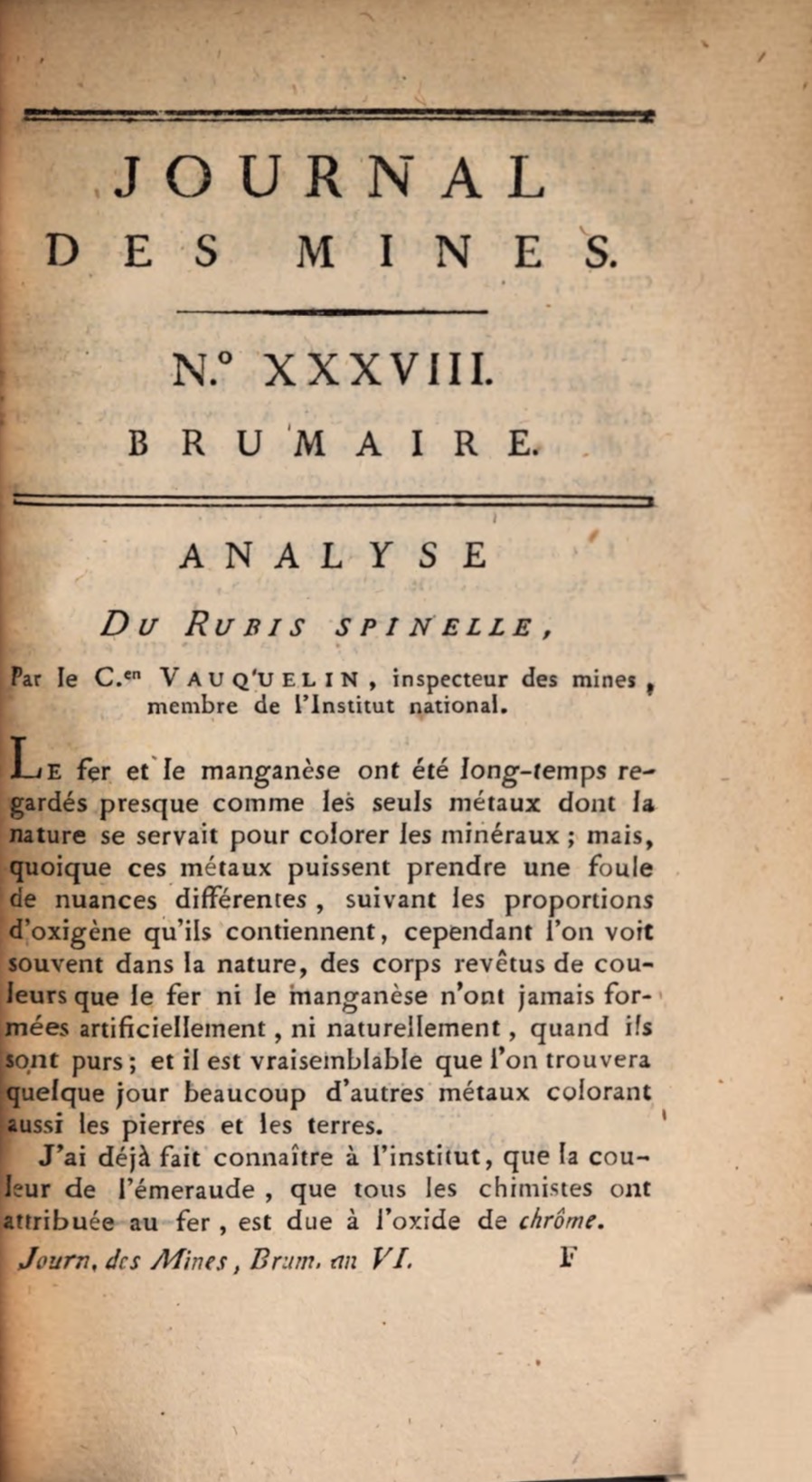
Vauquelin, N.-L. (1797) Analyse du rubis spinelle; Analyse de lemeraude du Pérou". [Analysis of ruby spinel; Analysis of the emerald from Peru] Journal des Mines, Vol. 8, No. 38, pp. 81–98.
Record No. 28355  |  Sinkankas/Born No.: NIS/NIB  |  Language: in French  |  RWHL
Vauquelin reports chemical analyses of spinel ruby and emerald from Peru. His investigation of spinel distinguishes its composition from that of true ruby, while the emerald analysis is historically important for the identification of a previously unknown constituent, later named beryllium (beryllia as the oxide). The paper represents an important early application of quantitative chemical analysis to gemstones and contributed to the mineralogical distinction of visually similar gem materials.

Chemische Untersuchung des Spinells

Investigation of the spinel, contributions to the chemical knowledge of mineral bodies
Book Section
Klaproth, M.H. (1797) Chemische Untersuchung des Spinells. [Investigation of the spinel, contributions to the chemical knowledge of mineral bodies] In: Beiträge zur chemischen Kenntniss der Mineralkörper, Berlin: Heinrich August Rottmann, Vol. 2 , pp. 1–11.
Record No. 4636  |  Sinkankas/Born No.: NIS/NIB  |  Language: in German  |  RWHL
An important chemical investigation of spinel by Martin Heinrich Klaproth, published in his Beiträge zur chemischen Kenntniss der Mineralkörper. Klaproth subjects spinel to quantitative chemical analysis in order to determine its constituent substances and clarify its mineralogical nature. The study belongs to his pioneering program of applying rigorous analytical chemistry to minerals, helping to replace classifications based primarily on color and external appearance with distinctions based on composition. Of particular importance to gemology, the work contributed to the scientific characterization of spinel as a distinct mineral at a time when red spinel and ruby had long been confused in both commercial and descriptive literature. It represents an important step in the chemical differentiation and modern classification of gemstones.

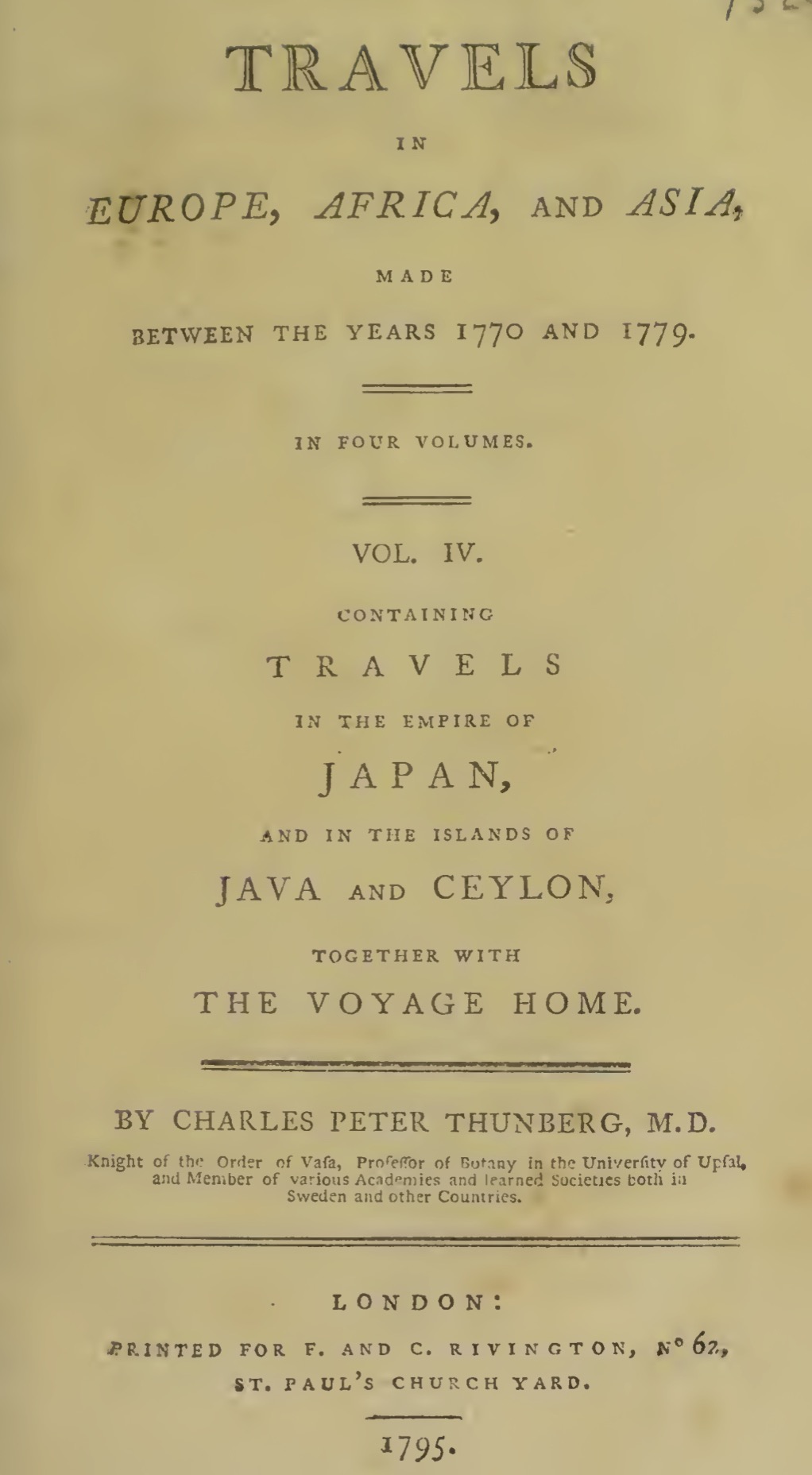
Travels in Europe, Africa and Asia, Made Between the Years 1770 and 1779
Book
Thunberg, C.P. (1796) Travels in Europe, Africa and Asia, Made Between the Years 1770 and 1779. London, F. and C. Rivington, 4 Vols.
Record No. 29753  |  Sinkankas/Born No.: NIS/NIB  |  RWHL
Volume 4 contains a substantial firsthand account of the minerals and precious stones of Ceylon, which Thunberg collected both rough and polished. He notes that transparent stones sufficiently hard to take a polish were locally classed as precious stones, and records their Dutch, Malabar and Cingalese names. His list includes ruby, amethyst, garnet, hyacinth, red, blue, green, yellow and white tourmaline, blue and green sapphire, topaz, cinnamon-stone, rock crystal, water-sapphire, smoky crystals, black tourmaline and cat’s-eye. He gives detailed observations on their colors, transparency, crystal forms, water-worn appearance, relative abundance, value and lapidary uses. Rubies are described as generally small, with value increasing with depth of red color, size, transparency and freedom from flaws. Particularly noteworthy are his descriptions of cinnamon-stone as a flame-colored or yellowish-brown garnet and of the various materials then sold under the name “tourmaline” or “Maturese diamond.” He also describes heat treatment of the so-called white tourmaline: milky stones were calcined, enclosed in fine lime and burned with rice chaff to improve their transparency. Gem cutting and polishing were largely carried out by poorer Moors on lead plates, and Thunberg purchased suites of both rough and polished specimens for his collections.

Analyse du saphir oriental

Analysis of the Oriental sapphire
Journal Article
Klaproth, M.H. (1796) Analyse du saphir oriental. [Analysis of the Oriental sapphire] Essays, pp. 3–8.
Record No. 28370  |  Language: in French  |  RWHL
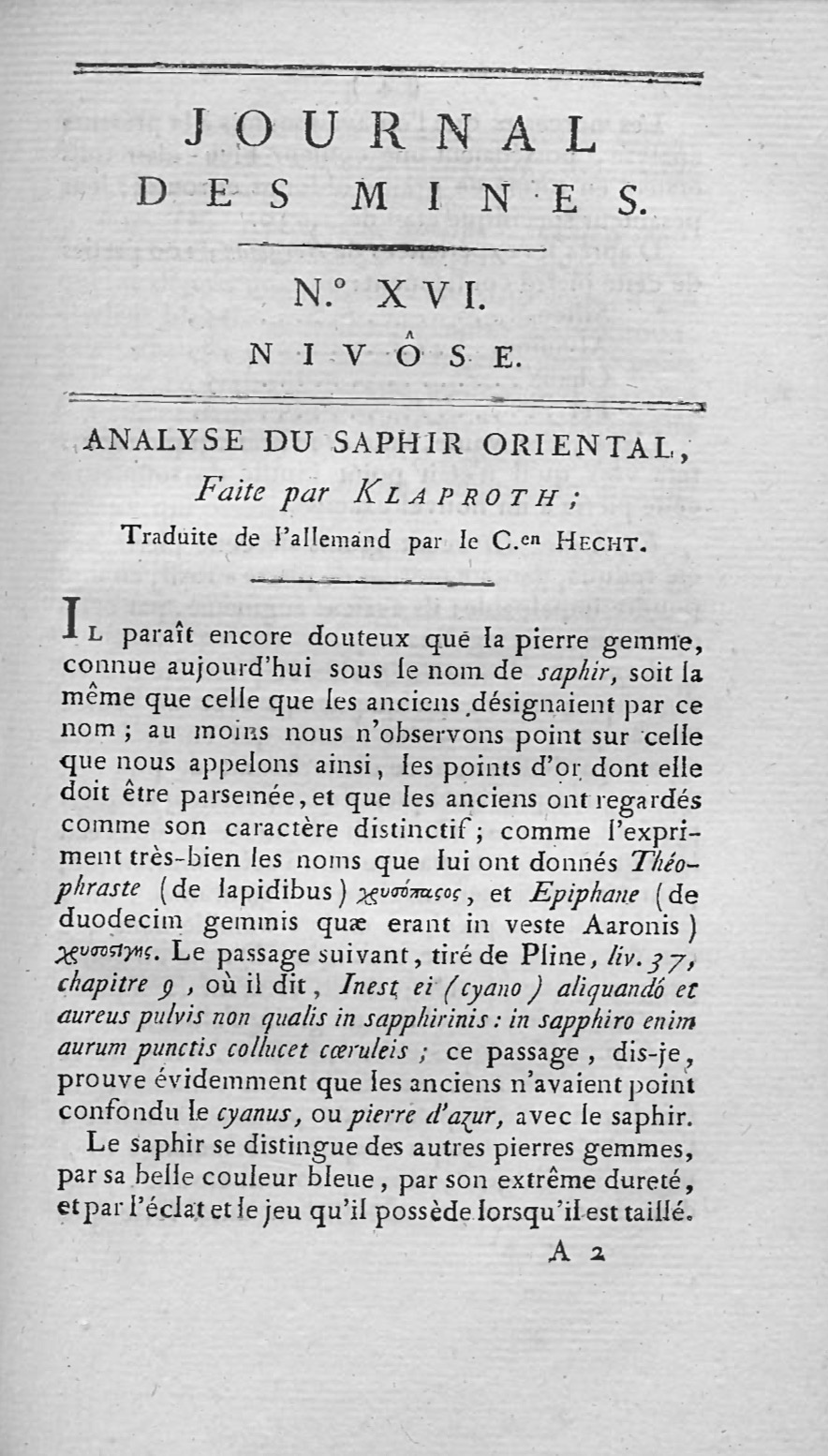
It still appears doubtful that the gemstone known today under the name sapphire is the same as that which the ancients designated by this name; at least, we do not observe upon the stone that we so call the golden points with which it ought to be sprinkled, and which the ancients regarded as its distinctive characteristic, as is very well expressed by the names given to it by Theophrastus in De lapidibus, χρυσόπαστος, and by Epiphanius of Salamis in De duodecim gemmis quae erant in veste Aaronis, χρυσόλιθος. The following passage, taken from Pliny the Elder, Book 37, chapter 9, where he says, Inest ei (cyano) aliquandò et aureus pulvis non qualis in sapphirinis: in sapphiro autem aurei punctis collucent caeruleis; this passage evidently proves that the ancients had not confused the cyanus, or “gold stone,” with the sapphire. The sapphire is distinguished from other gemstones by its beautiful blue colour, by its extreme hardness, and by the brilliance and play that it possesses when cut.

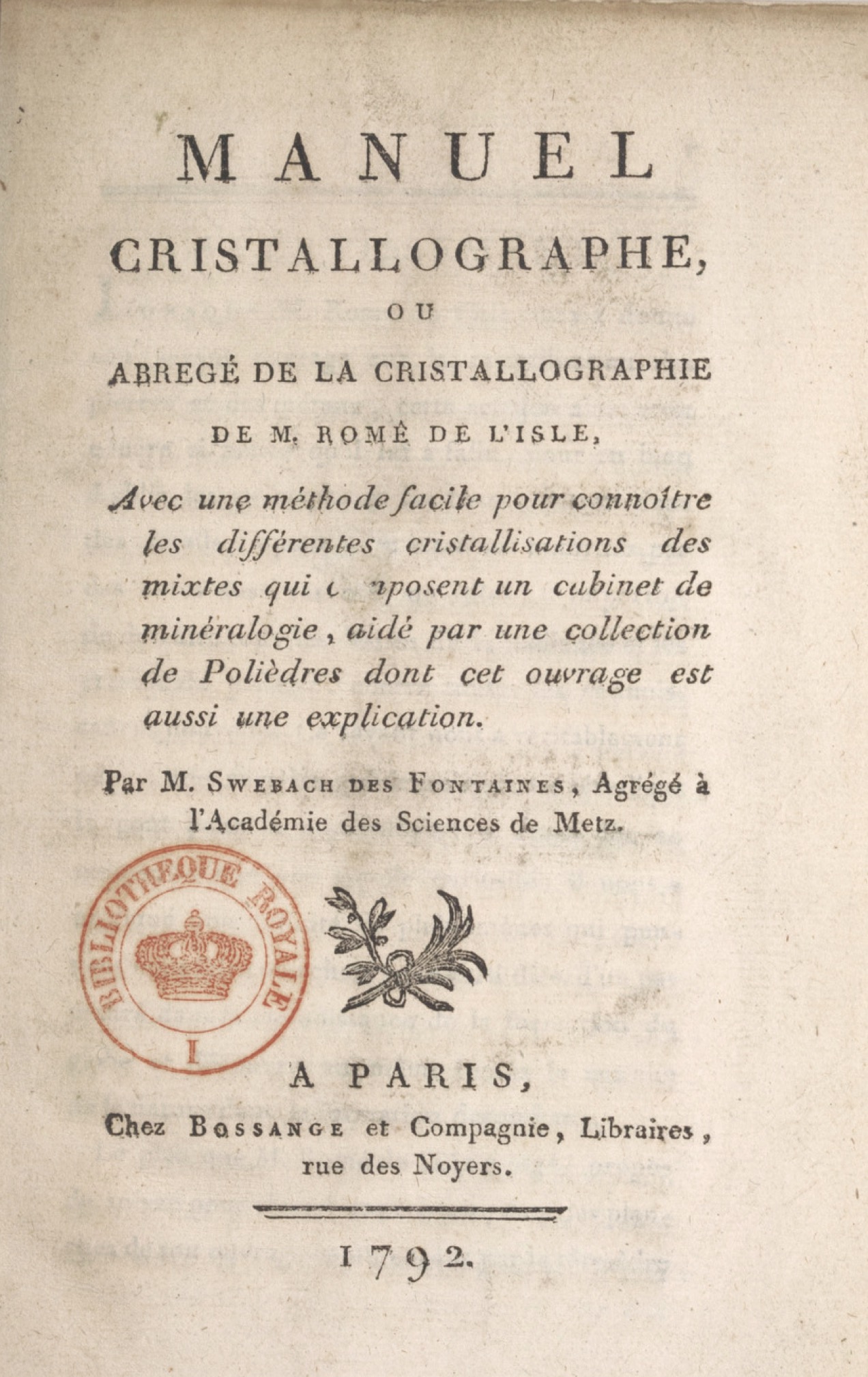
Manuel cristallographe, ou Abrégé de la cristallographie de M. Romé de l'Isle
Crystallographer’s Manual, or Abridgement of the Crystallography of M. Romé de l’Isle
Book
Swebach des Fontaines, F.-L. (1792) Manuel cristallographe, ou Abrégé de la cristallographie de M. Romé de l'Isle. [Crystallographer’s Manual, or Abridgement of the Crystallography of M. Romé de l’Isle] Paris, Bossange e Companie, viii + 74 pp., 1 plate
Record No. 29407  |  Sinkankas/Born No.: NIS/NIB  |  Language: in French  |  RWHL
A concise practical introduction to crystallography based on the system of Jean-Baptiste Louis de Romé de l’Isle. Published in Paris in 1792, the work abridges Romé de l’Isle’s much larger Cristallographie (1783) and presents a simplified method for recognising and distinguishing the crystal forms of minerals in a collection. It was intended for use with a collection of polyhedral models, which served as three-dimensional representations of the forms described in the text. The manual was designed particularly for mineral collectors, providing an accessible means of identifying and arranging specimens according to their crystallisation. It thus served both as an elementary guide to Romé de l’Isle’s crystallographic system and as an explanation of the accompanying crystal models.

Inventaire des Diamans de la Couronne, Perles, Pierries, Tableaux, Pierres Gravées et autres Monumens des Arts & des Sciences existens au Garde-Meuble
Inventory of the Diamonds of the Crown, Pearls, Jewelry, Paintings, Engraved Stones, and other Monuments of the Arts & Sciences existing in the Garde-Meuble
Book
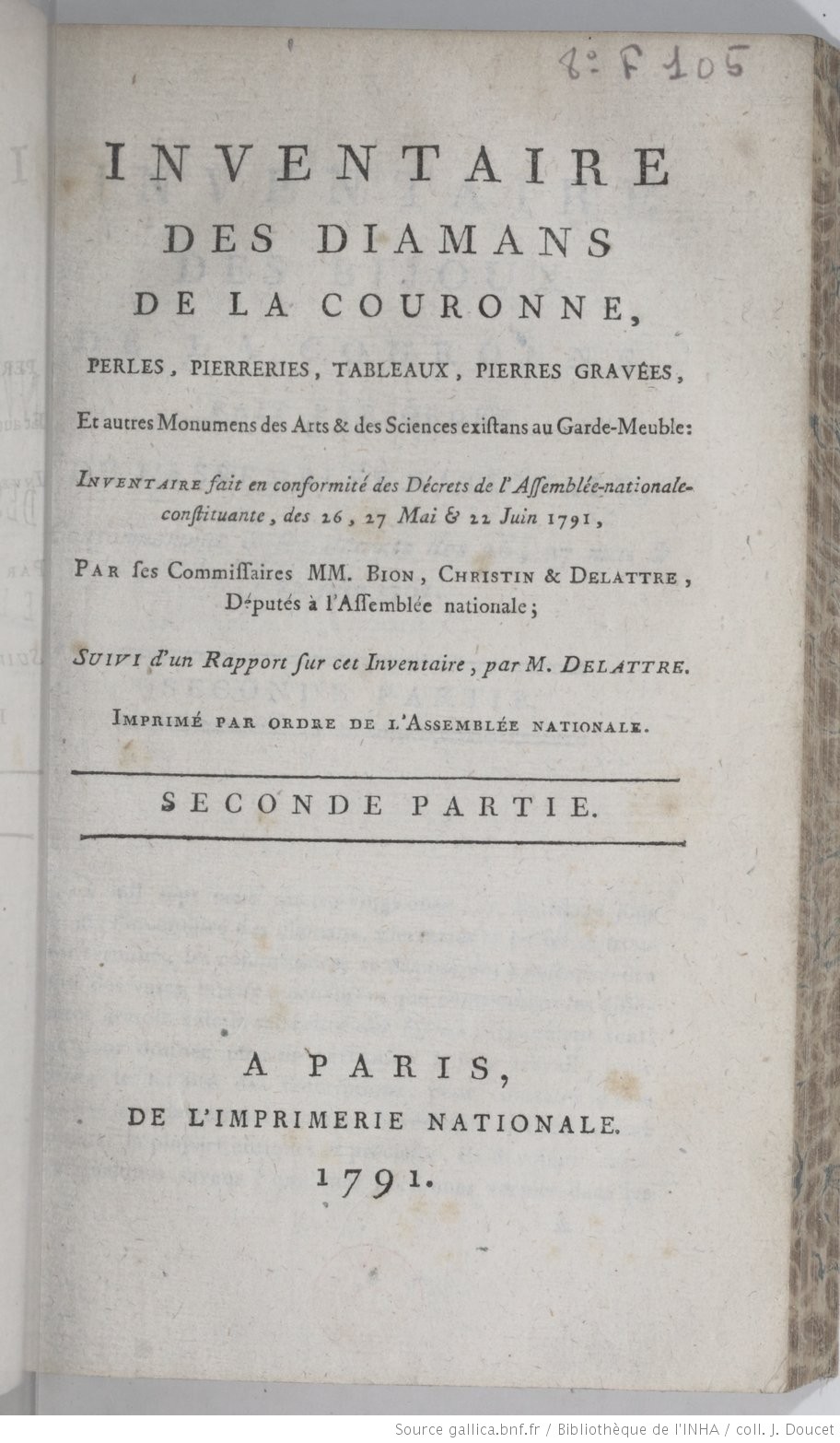
Bion, J.-M., Christin, C.-G.-F. and Delattre, F.-P. (1791) Inventaire des Diamans de la Couronne, Perles, Pierries, Tableaux, Pierres Gravées et autres Monumens des Arts & des Sciences existens au Garde-Meuble. [Inventory of the Diamonds of the Crown, Pearls, Jewelry, Paintings, Engraved Stones, and other Monuments of the Arts & Sciences existing in the Garde-Meuble] Paris, L’Assemblée Nationale, 272 pp.
Record No. 5223  |  Sinkankas/Born No.: NIS/NIB  |  Language: in French  |  RWHL
An official inventory of the French Crown’s diamonds, pearls, jewels, engraved stones, paintings and other objects preserved in the Garde-Meuble during the early years of the French Revolution. Compiled for the National Assembly by Jean-Marie Bion, Charles-Gabriel-Frédéric Christin and François-Pierre Delattre, the volume records the contents and valuations of the royal collections at a moment when Crown property was being documented as national property. Of particular gemological and jewelry-historical importance are the detailed listings of diamonds, pearls, mounted jewels and engraved gems, making the work a major primary source for the composition and value of the French Crown Jewels immediately before the famous theft from the Garde-Meuble in 1792.

Chemische Untersuchung des Rubins

Chemical investigation of ruby
Journal Article
Klaproth, M.H. (1789) Chemische Untersuchung des Rubins. [Chemical investigation of ruby] Schriften der Gesellschaft Naturforschender Freunde zu Berlin, Vol. 9, pp. 336–350.
Record No. 29303  |  Sinkankas/Born No.: NIS/NIB  |  Language: in German  |  RWHL
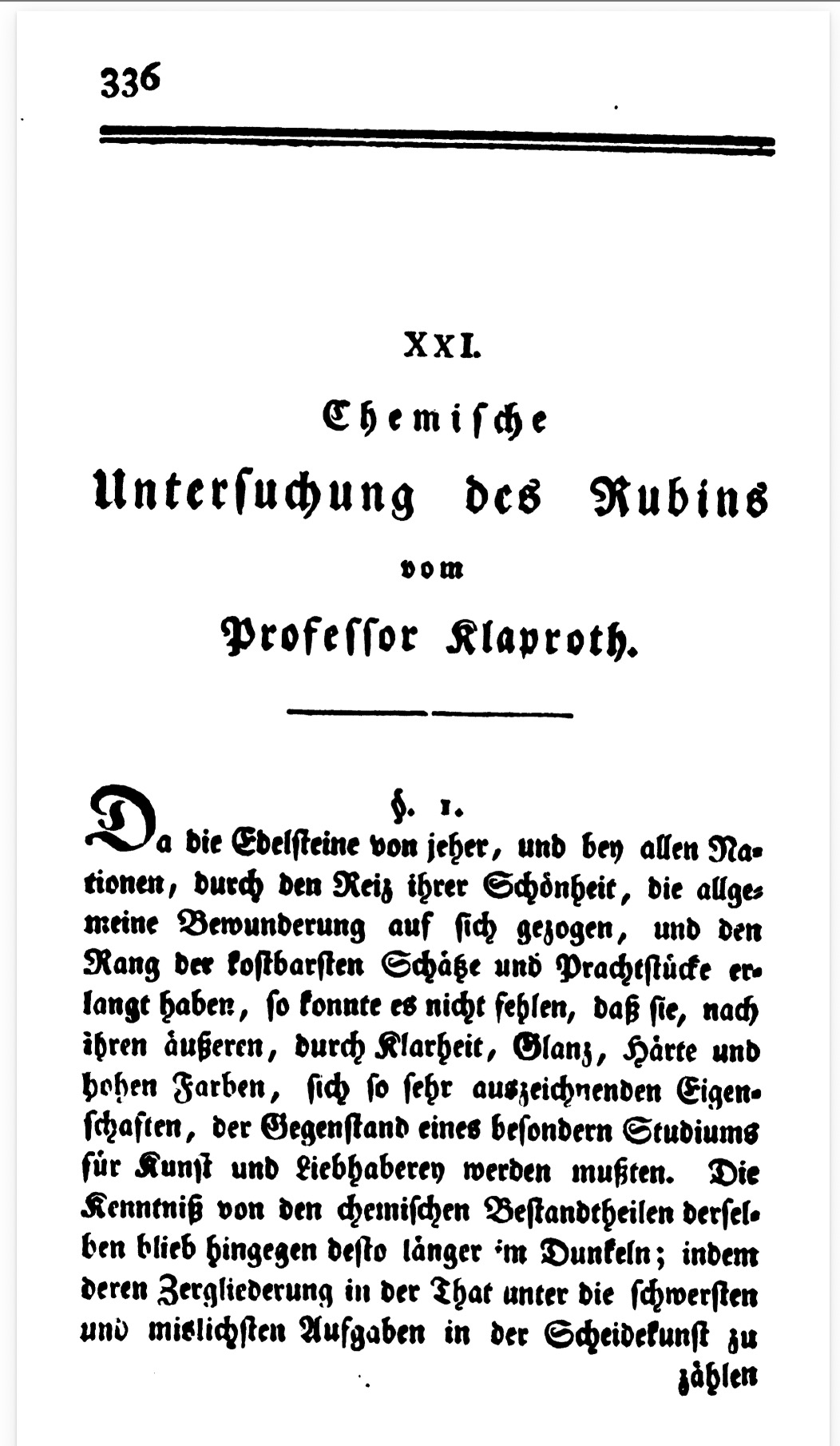
Since precious stones have, from time immemorial and among all nations, attracted universal admiration through the charm of their beauty, and have attained the rank of the most costly treasures and objects of splendour, it was inevitable that their outward properties—so remarkably distinguished by clarity, lustre, hardness, and rich colours—should become the subject of special study both for science and for connoisseurship. Knowledge of their chemical constituents, however, remained obscure for much longer, since their analysis was in fact one of the most difficult and uncertain tasks in analytical chemistry, until Marggraf, the father of more rigorous analytical chemistry, opened the way; after him Bergmann, Scheele, and other celebrated men attempted to pursue it further. On the occasion of his analysis of topaz, he found that precious stones were not, as had previously been believed, simple natural products consisting solely of the most homogeneous and pure siliceous or quartz substance, but that their composition was more complex, and particularly that pure alumina constituted a considerable proportion of them. Bergmann confirmed this finding in his treatise on the earth of precious stones, published in 1777,* in which he gave an account particularly of the constituents found in ruby, sapphire, topaz, hyacinth, and emerald. Soon afterwards another celebrated chemist, Director Achard, published a treatise on the same subject,** whose account of the constituents of precious stones agreed entirely with Bergmann’s, differing only slightly in their proportions.

Gazetteer of the Yongchang Prefecture
永昌府志
Book
Xuan, S. (1785) Gazetteer of the Yongchang Prefecture. [永昌府志]
Record No. 16783  |  Sinkankas/Born No.: NIS/NIB  |  Language: in Chinese  |  RWHL
A local gazetteer of Yongchang Prefecture (永昌府), in western Yunnan, an important region on the routes connecting China with Burma and Southeast Asia. The work records the prefecture’s administrative geography, history, settlements, mountains and rivers, population, customs, products and other local information. Of particular gemological interest are its notices concerning jade and other valuable materials associated with the Yunnan–Burma trade, for which Yongchang was an important commercial and administrative center. The gazetteer is consequently a useful Qing-period source for studying the movement of Burmese jade and other commodities into southwestern China. Sun Laichen: Volumes 23, 25, and 26 of the 1785 edition by Xuan Shitao contain several memorials from Ming and Qing times that touch upon Ming- and Qing-Burmese relations, a number of poems and records by Ming poets regarding Burmese precious stones and other products, and a short account of a Burmese letter to the Ming during the late 16th century. Volumes 65 and 66 of the 1884 edition by Liu Yuke includes several other poems on Ming- and Qing-Burmese relations. There are altogether four editions of this work, and I have so far gained access to only the two mentioned above. The other two were compiled in 1702 and 1826, respectively.

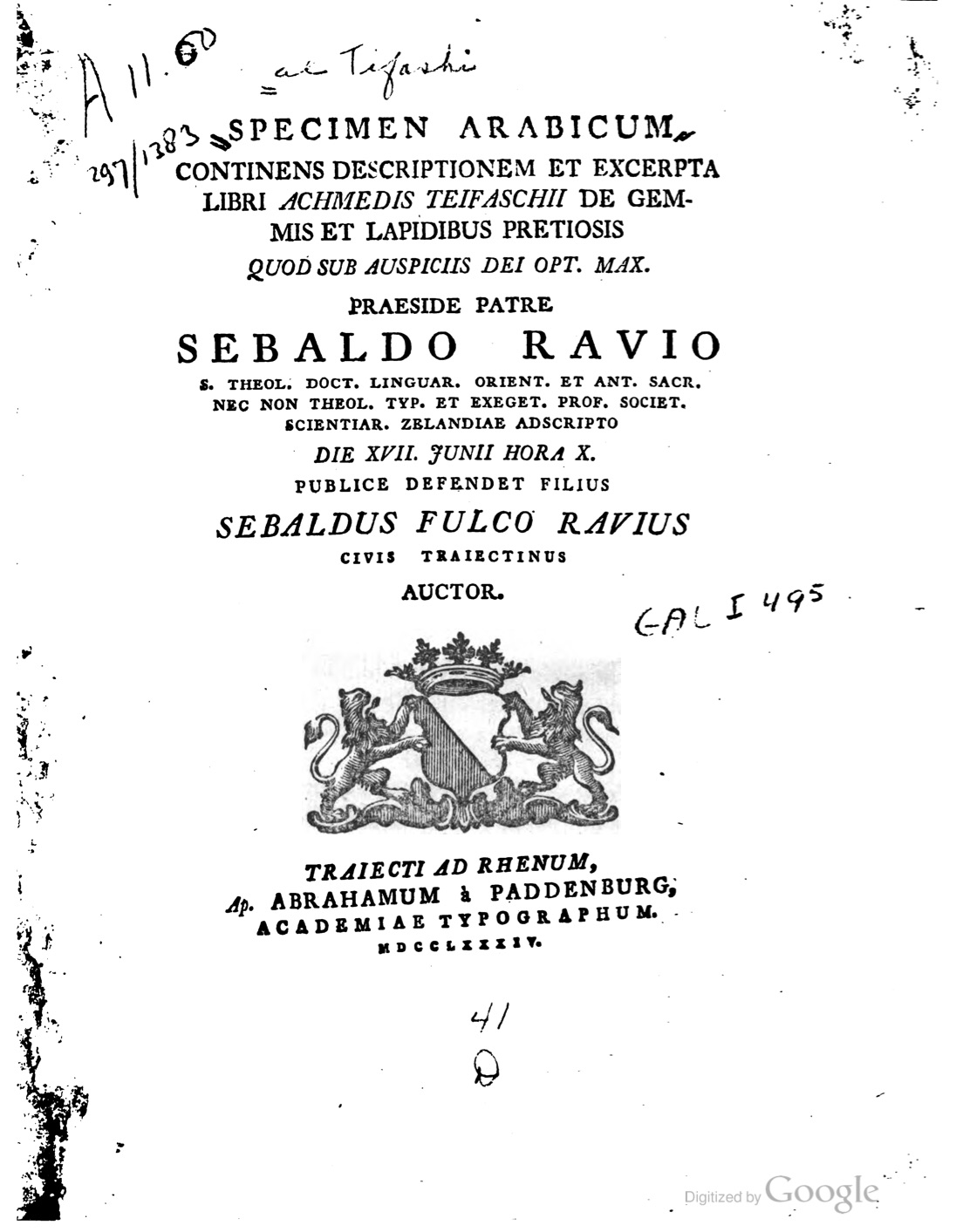
Specimen Arabicum: Continens Descriptionem et Excerpta Libri Achmedis Teifaschii de Gemmis et Lapidibus Pretiosis
Arabic Specimen: Containing a Description and Excerpts from the Book of Ahmed Teifaschi on Gems and Precious Stones
Book
al-Tīfāshī, A.i.Y.i.I. (1784) Specimen Arabicum: Continens Descriptionem et Excerpta Libri Achmedis Teifaschii de Gemmis et Lapidibus Pretiosis. [Arabic Specimen: Containing a Description and Excerpts from the Book of Ahmed Teifaschi on Gems and Precious Stones] Utrecht, Academiae Typographum, 103 pp.
Record No. 6846  |  Sinkankas/Born No.: 6556; NIB  |  Language: in Latin  |  RWHL
A Latin scholarly edition presenting a description of, and selected extracts from, the Arabic gemstone treatise of Aḥmad al-Tīfāshī (Teifaschi), the thirteenth-century author of one of the most important medieval works on precious stones. The volume introduces al-Tīfāshī’s text to European readers and reproduces passages dealing with individual gems and precious materials, their names, properties, sources, qualities and uses. It is of particular importance to the history of gemology as an early printed European engagement with the Arabic lapidary tradition and as a conduit through which medieval Islamic knowledge of gemstones entered eighteenth-century Orientalist scholarship.

Bestimmung der Bestandtheile einiger Edelgesteine
Determination of the components of some gemstones
Book
Achard, F.C. (1779) Bestimmung der Bestandtheile einiger Edelgesteine. [Determination of the components of some gemstones] Berlin, Arnold Wever, 128 pp.
Record No. 2688  |  Sinkankas/Born No.: NIS/NIB  |  Language: in German  |  RWHL
An early chemical investigation of gemstones by the German chemist Franz Carl Achard. The work reports experiments intended to determine the constituent substances of several precious stones through the analytical methods then available, particularly treatment with heat, fusion and chemical reagents. It belongs to the important late eighteenth-century transition from identifying gemstones principally by external properties toward understanding them through chemical composition. Achard’s analyses contributed to contemporary attempts to distinguish mineral species that could appear similar and to establish a chemical basis for mineral classification. The work is consequently of historical importance in the development of analytical mineralogy and gemology.

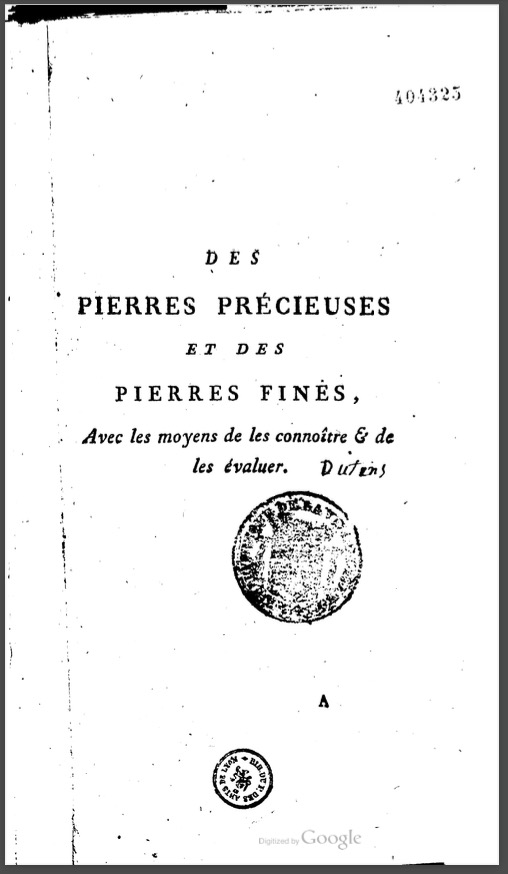
Des Pierres précieuses et des Pierres fines, avec les moyens de les connoitre & de les évaluer
On Precious Stones and Fine Stones, with the Means to Recognize and Evaluate Them
Book
Dutens, L. (1776) Des Pierres précieuses et des Pierres fines, avec les moyens de les connoitre & de les évaluer. [On Precious Stones and Fine Stones, with the Means to Recognize and Evaluate Them] Paris, F.A. Didot & De Bure, 224 pp.
Record No. 6870  |  Sinkankas/Born No.: 1819  |  Language: in French  |  RWHL
Jonathan Hill: First edition of this introduction to precious stones written for collectors and jewelers; according to the author this is the first complete treatise on precious stones. Dutens describes the chief varieties including diamonds, rubies, sapphires, emeralds, etc. He has also provided an interesting table at the end of current prices of diamonds of increasing carats. In the Preface, Dutens reviews the writings on precious stones of earlier authors including Pliny, Theophrastus, Boyle, and Romé de l’Isle. This work is a notable work in typography as well: it is the first book printed by François Ambroise Didot, l’aîné (1730-1804), who promoted technical innovation in printing and papermaking and introduced the new form of typographical measurement, the “point Didot.” We quote from the 1783 catalogue of Mérard de Saint-Just: “Ce petit Traité est le premier Ouvrage sorti des presses de M. Didot l'aîné, où l’on ait aperçu cette supériorité de talents qui l’a mis tout de suite au-dessus de tous ses confrères de France, d’Italie, d’Allemagne et de Hollande, et qui l’associe dès lors à la gloire de Baskerville, et surtout à celle d’Ibarra.”–from André Jammes’ wonderful Les Didots catalogue, no. 73. Dutens (1730-1812), diplomat and man of letters, edited the works of Leibniz (1768), was a fellow of the Royal Society, and was historiographer to the King of England. Sinkankas: In his preface, Dutens discusses the merits of previous works on gemstones and explains why he decided to write this one. A connoisseur of arts and of gems, he traveled widely throughout Europe and spent much time visiting collections and discussing their contents with their owners. One would therefore expect that the book was based on his experiences, but it seems that it is no more than a reworking of information available in earlier books treating gemstones, as remarked by King above, who believes Dutens derived most of his information from De Boodt and De Laet. In the first part, Dutens explains his system of classification whereby the finest and most durable of gemstones are dubbed “oriental,” while those of lesser quality and hardness receive the title of “occidental,” thus perpetuating in a highly popular and widely distributed work these unfortunate and misleading terms that persisted in use well into the last century. Some generalities on gemstones also appear here, such as curious lore, origin of gemstones, and other topics, followed by separate chapters on the major gemstones beginning with diamond. The latter chapter records recent experiments in France and elsewhere on the combustibility of diamond, one such experiment he personally observed. The second part describes lesser gemstones, mainly massive types used mostly in cabochons or in the manufacture of small to large ornamental articles or decorations. Despite King’s criticisms, Dutens’ work did provide useful, accurate information and received acclaim and wide distribution.

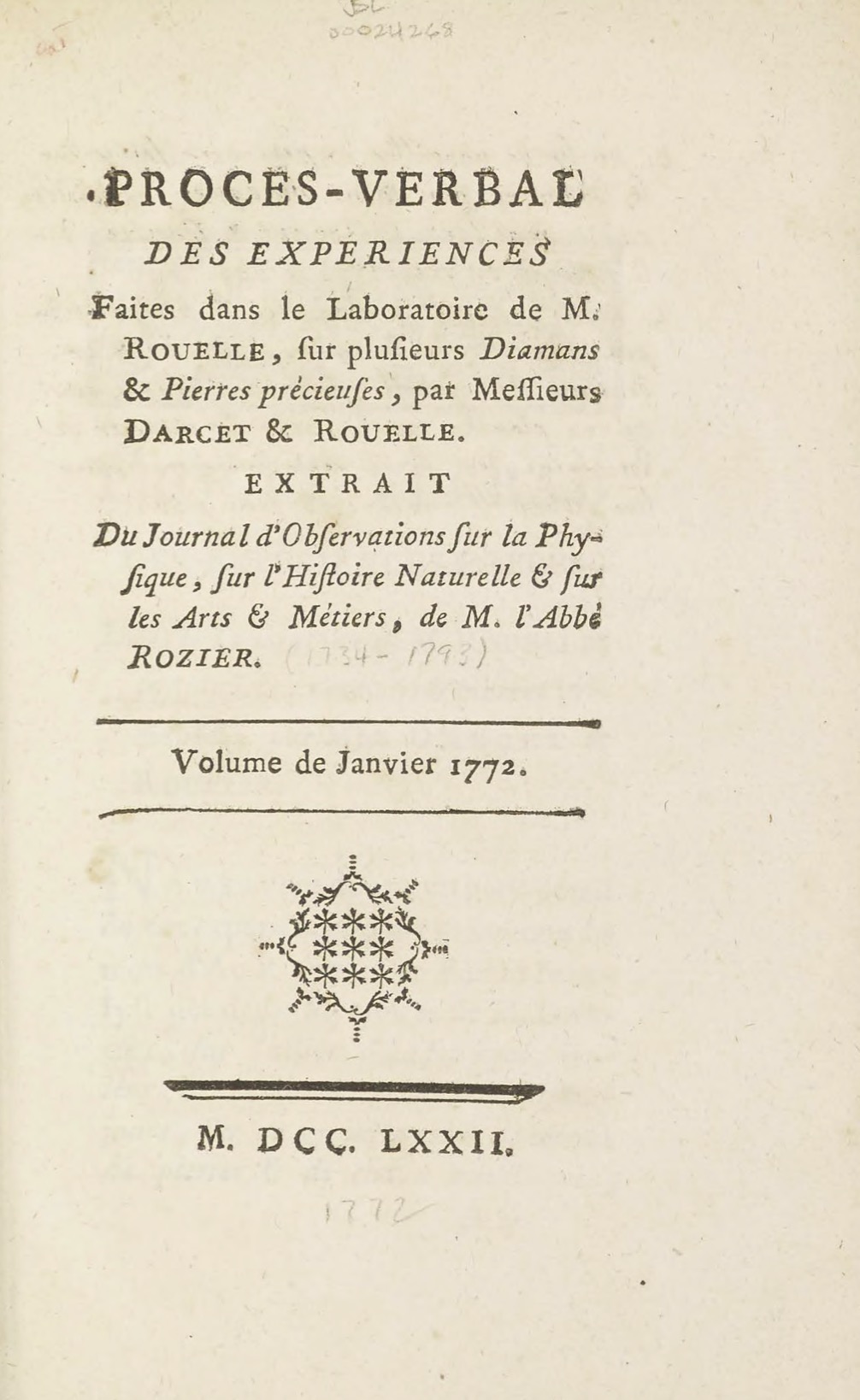
Proces-Verbal des Expériences Faites dans le Labratoire de M. Rouelle, sur plusiers Diamans & Pierres précieuses, par Messieurs Darcet & Rouelle
Verbal process of the Experiments Made in the Laboratory of Mr. Rouelle, on several Diamonds & Precious Stones, by Messrs. Darcet & Rouelle
Journal Article
Darcet, J., d’ and Rouelle, G.F. (1772) Proces-Verbal des Expériences Faites dans le Labratoire de M. Rouelle, sur plusiers Diamans & Pierres précieuses, par Messieurs Darcet & Rouelle. [Verbal process of the Experiments Made in the Laboratory of Mr. Rouelle, on several Diamonds & Precious Stones, by Messrs. Darcet & Rouelle] Du Journal d’Observations sur la Physique l’Histoire Naturelle & sur les Arts & Métiers, January,
Record No. 7729  |  Sinkankas/Born No.: 1575; NIB  |  Language: in French  |  RWHL
An account of experiments conducted by Jean d’Arcet and Guillaume-François Rouelle in Rouelle’s laboratory on diamonds and other precious stones subjected to intense heat. The investigations formed part of the eighteenth-century debate over the nature of diamond and its behavior in fire. By comparing diamonds with other gemstones under strongly heated conditions, the experiments showed the exceptional disappearance or destruction of diamond while other stones behaved differently. These observations contributed to the experimental work that eventually established diamond as a combustible substance and, subsequently, as a form of carbon. Published in the Journal de Physique in January 1772, the paper is an important early contribution to the experimental chemistry of gemstones.

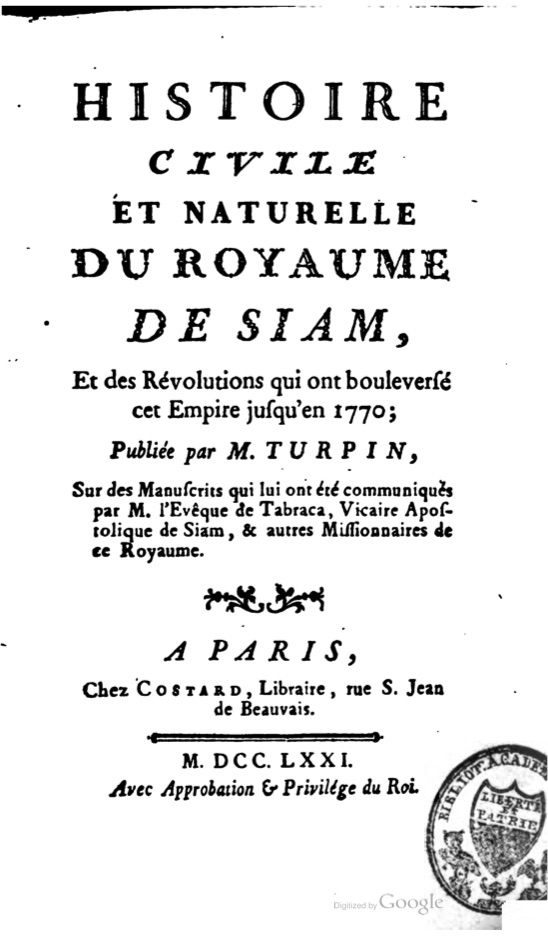
Histoire Civile et Naturelle du Royaume de Siam
Civil and Natural History of the Kingdom of Siam
Book
Turpin, F.H. (1771) Histoire Civile et Naturelle du Royaume de Siam. [Civil and Natural History of the Kingdom of Siam] Paris, Chez Costard, Vol. 1
Record No. 2649  |  Sinkankas/Born No.: NIS/NIB  |  Language: in French  |  RWHL
A historical and natural account of the Kingdom of Siam by François-Henri Turpin, compiled from earlier European sources rather than from personal travel in the country. The work describes Siam’s geography, government, religion, customs, commerce and natural products, drawing particularly upon seventeenth-century French accounts produced during the reign of Louis XIV and King Narai. Of interest to gemological research are its notices of the mineral and commercial resources of Siam, including precious materials and luxury goods traded in the kingdom. The book provides a useful eighteenth-century synthesis of European knowledge of Siam, although its statements should be treated as derivative rather than eyewitness observations.

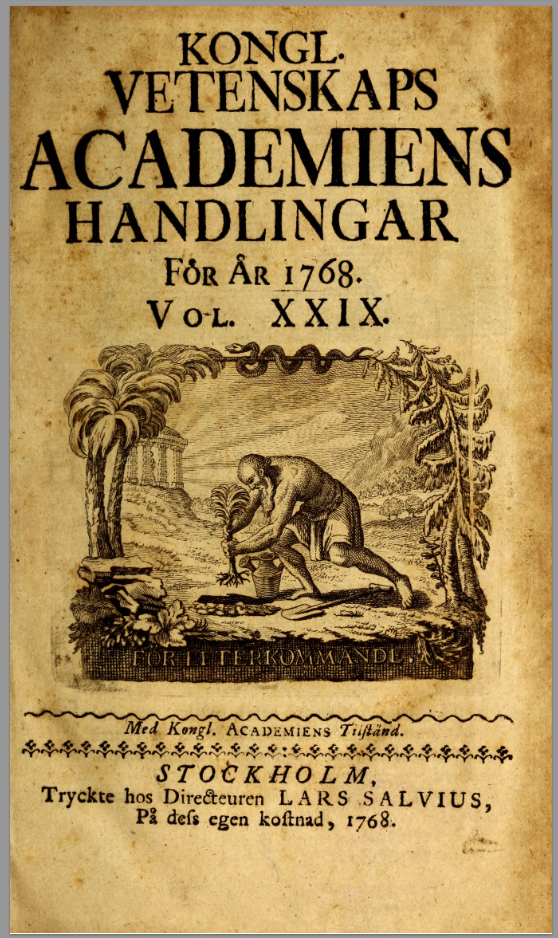
Försök På En del Kiesel-Arter, och i synnerhet de hårdare så kallade Äkta Stenar
Experiments on Some Siliceous Species, and in Particular the Harder so-called Genuine Stones
Journal Article
Qvist, B.A. (1768) Försök På En del Kiesel-Arter, och i synnerhet de hårdare så kallade Äkta Stenar. [Experiments on Some Siliceous Species, and in Particular the Harder so-called Genuine Stones] Kongl. Vetenskaps Academiens Handlingar [Proceedings of the Royal Swedish Academy of Sciences], Series 1, Vol. 29, January–March,
Record No. 28075  |  ISBN/ISSN: 0023-5377  |  Sinkankas/Born No.: NIS/NIB  |  Language: in Swedish  |  RWHL
Swedish article describing the fusibility and other physical properties of gems. Also includes a table listing the different gems by density and hardness from diamond (1) to zeolite (13). According to Schuh, this hardness scale was modified by Richard Kirwan in his 1784 English edition (First edition) “Elements of Mineralogy”, pp. 171–173 and is considered the first hardness scale ever published in an English book: https://mineralogicalrecord.com/new_biobibliography/kirwan-richard/

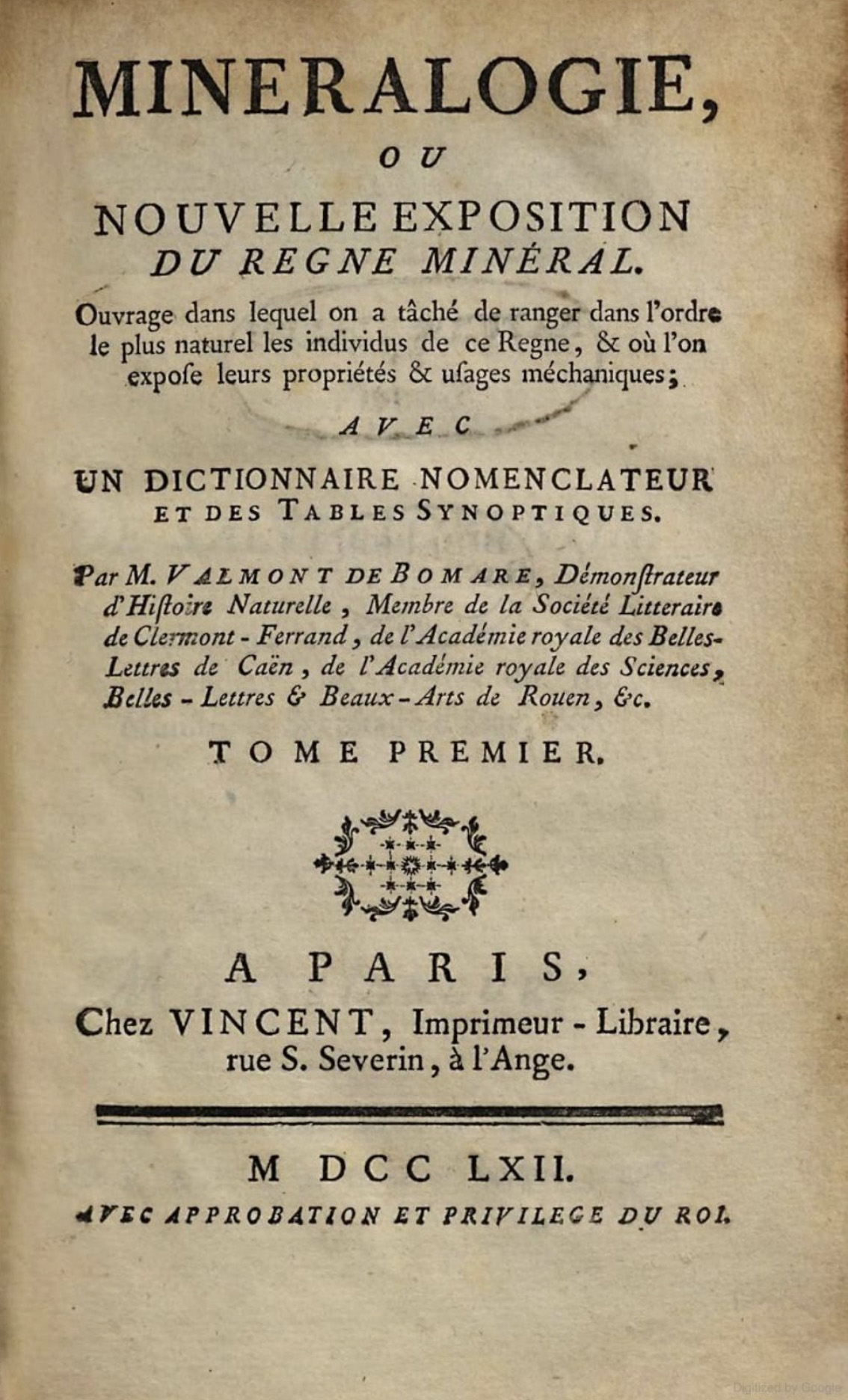
Minéralogie, ou nouvelle exposition du règne minéral
Mineralogy, or a New Exposition of the Mineral Kingdom
Book
Valmont de Bomare, J.-C. (1762) Minéralogie, ou nouvelle exposition du règne minéral. [Mineralogy, or a New Exposition of the Mineral Kingdom] Paris, Vincent, 365, 374 pp.
Record No. 29416  |  Sinkankas/Born No.: NIS/NIB  |  Language: in French  |  RWHL
A systematic survey of the mineral kingdom intended to arrange minerals in what Bomare regarded as the most natural order and to describe their physical properties and practical uses. The work treats earths, salts, stones, ores, metals, waters, and related mineral substances, with attention to color, transparency, hardness, fracture, crystallization, fusibility, occurrence, and uses. Gemologically important material is included under precious and ornamental stones, including quartz, crystal, chalcedony, jasper, ruby and other “Oriental” stones, together with discussion of crystal form and mineral nomenclature. The two volumes are supplemented by an alphabetical subject index, a nomenclatural dictionary, and folding synoptic tables intended to clarify the proposed classification. It is representative of mid-eighteenth-century mineralogy at the transition from descriptive natural history toward more systematic chemical and crystallographic classification.

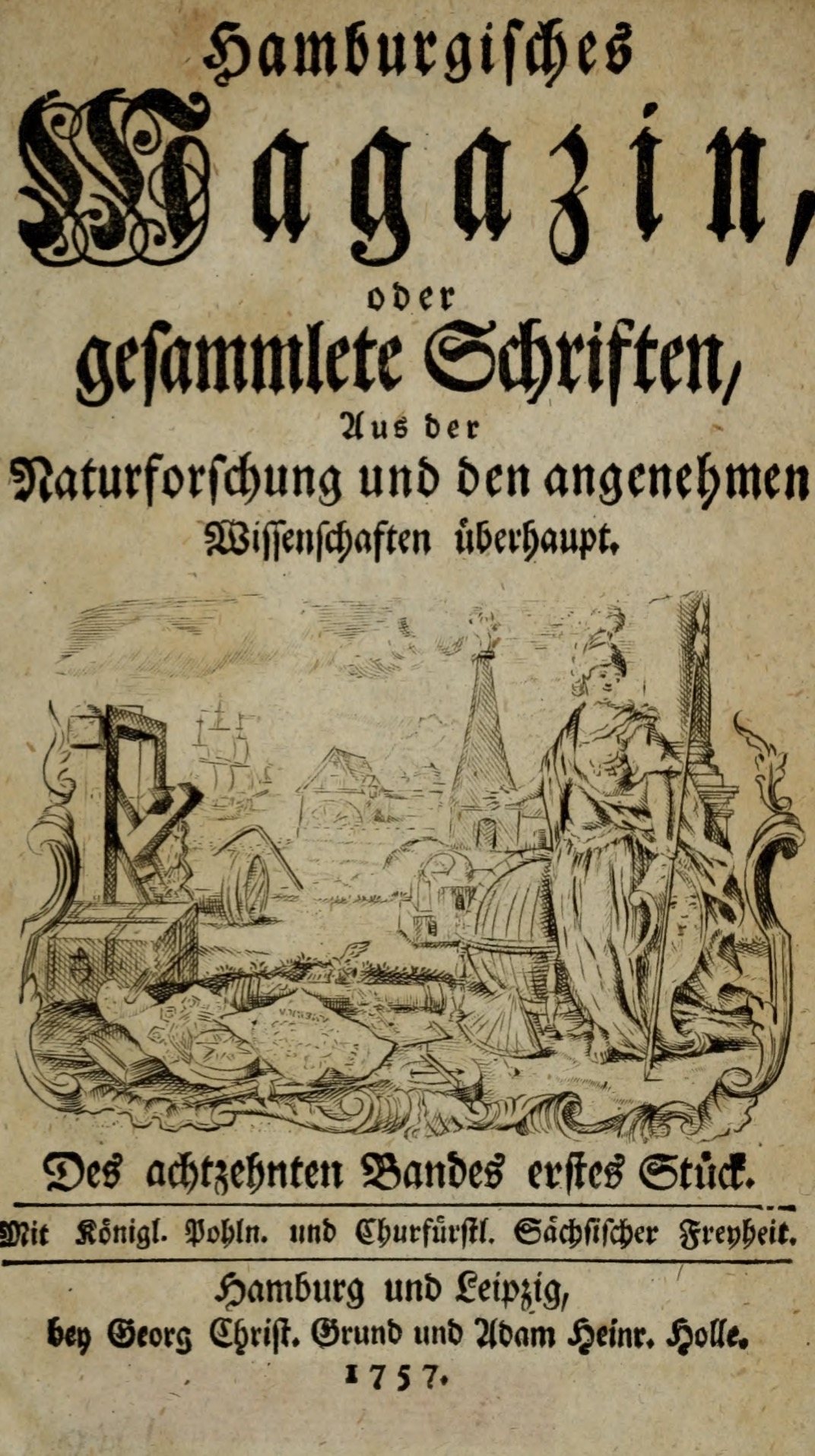
Geschichte von Edelgesteinen und den Vornehmsten Reichthümern in Ost- und Westindien

History of Precious Stones and the Principal Riches of the East and West Indies
Journal Article
Anonymous (1757) Geschichte von Edelgesteinen und den Vornehmsten Reichthümern in Ost- und Westindien. [History of Precious Stones and the Principal Riches of the East and West Indies] Hamburgisches Magazin, Vol. 18, pp. 500–543.
Record No. 29577  |  Sinkankas/Born No.: NIS / NIB  |  Language: in German  |  RWHL
German account of the principal precious stones, pearls, and other valuable products of the East and West Indies, compiled from earlier travel accounts and observations by travelers who had visited the mining regions. A substantial section is devoted to diamonds, describing their occurrence and mining in India and Borneo, including the celebrated mines of Golconda and surrounding districts, methods of working the deposits, labor, trading practices, currencies, and the valuation of stones. Colored gemstones are treated separately, with particular attention to the ruby and sapphire deposits of Pegu (Burma) and Ceylon. The Burmese stones are said to come from a mine called “Capelan,” twelve days’ journey northeast of Ava, producing rubies, yellow topazes, blue and white sapphires, and other colored stones. Fine rubies are described as scarce, with the best stones reserved for the king, and a schedule of ruby prices according to weight is given. Ceylon is described as another important source, where colored stones were recovered from river sands after the rainy season, including sapphires, topazes, garnets, and rock crystal. The work also discusses emeralds and their trade between the Americas, Europe, and Asia. An extensive section on pearls describes fisheries in the Persian Gulf, Ceylon, Japan, and the West Indies, together with diving, the opening of pearl oysters, pearl formation, grading, color, shape, size, and value, while rejecting older beliefs that pearls originated from heavenly dew. Coral and amber are also discussed, including the East Asian trade and consumption of amber. The article provides a valuable mid-eighteenth-century European synthesis of contemporary knowledge concerning gemstone sources, mining, commerce, valuation, and consumption in Asia and the Americas.

Exploring the Literature of Corundum

Ruby and sapphire research spans mineralogy, gem deposits, identification, treatments, synthesis and the history of the gem trade. Older publications can also be useful for tracing terminology, early observations and accounts of mining localities. Publication dates and the original source should be considered when using historical descriptions.

For an introduction to collecting books on this subject, read Ruby & Sapphire Books: Collecting the Literature of Corundum.

About Four Treasures

Four Treasures is Lotus Gemology's freely accessible gemological reference database. Use the full database to search by author, title or keyword and explore literature on gemology, mineralogy, jewelry and related fields. Where available, hyperlinks on titles may lead directly to the full publication.

Search the Complete Four Treasures Database