Ruby & Sapphire Bibliography

Ruby & Sapphire Bibliography

Explore books, articles and historical sources on ruby, sapphire and corundum in Four Treasures, the Lotus Gemology reference database. This bibliography brings together matching records from the collection, with publication details, abstracts and cover images where available.

Ruby & Sapphire References

The list below matches the terms ruby, rubies, sapphire or corundum in the database's searchable fields. Some references discuss these gems as part of a broader subject. Linked titles take you to external links where you may find the full reference.
4,021–4,040 of 4,671 matching references

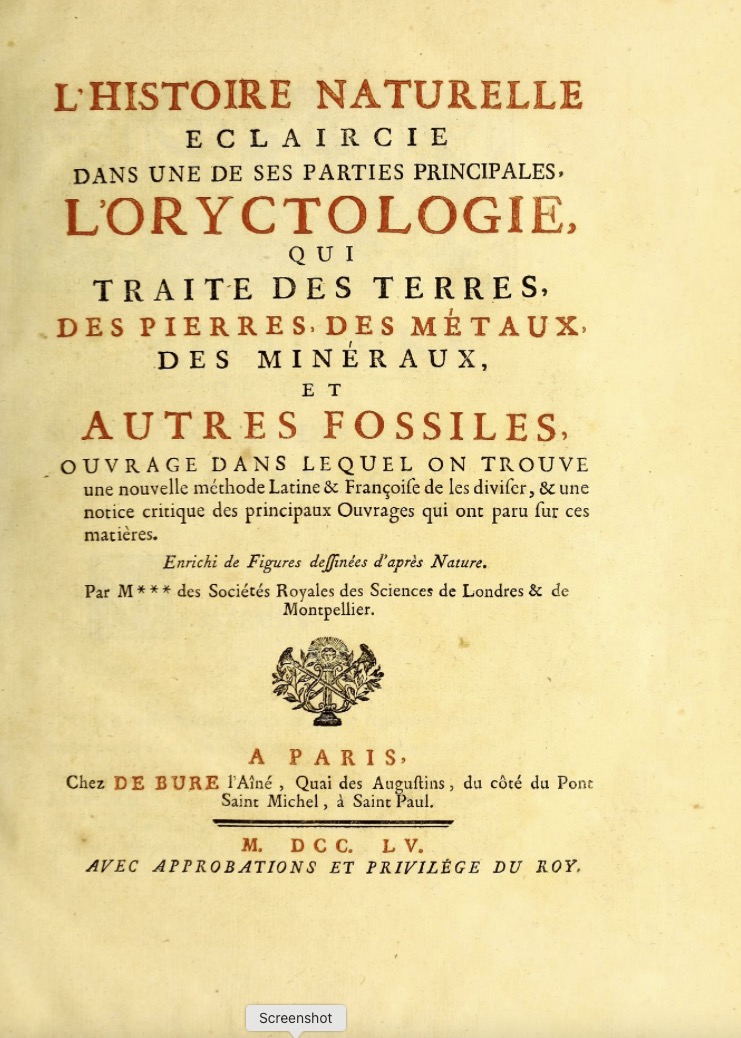
L’histoire naturelle éclaircie dans une de ses parties principales, l’oryctologie : qui traite des terres, des pierres, des métaux, des minéraux, et autres fossiles : ouvrage dans lequel on trouve un nouvelle méthode latine & françoise de les diviser, & une notice critique des principaux ouvrages qui ont paru sur ces matières
The Natural History Elucidated in One of Its Principal Parts, Oryctology: Which Deals with Earths, Stones, Metals, Minerals, and Other Fossils: A Work in Which a New Latin and French Method of Classifying Them Is Presented, Along with a Critical Review of the Principal Works Published on These Subjects
Book
Dezallier d’Argenville, A.J., Chedel, P.Q. and Collin de Vermont, H. (1755) L’histoire naturelle éclaircie dans une de ses parties principales, l’oryctologie : qui traite des terres, des pierres, des métaux, des minéraux, et autres fossiles : ouvrage dans lequel on trouve un nouvelle méthode latine & françoise de les diviser, & une notice critique des principaux ouvrages qui ont paru sur ces matières. [The Natural History Elucidated in One of Its Principal Parts, Oryctology: Which Deals with Earths, Stones, Metals, Minerals, and Other Fossils: A Work in Which a New Latin and French Method of Classifying Them Is Presented, Along with a Critical Review of the Principal Works Published on These Subjects] Paris, Chez De Bure l’aîné
Record No. 16708  |  Sinkankas/Born No.: NIS/NIB  |  Language: in French  |  RWHL
Dezallier d’Argenville’s L’histoire naturelle éclaircie… l’oryctologie (1755) is an important mid-eighteenth-century treatise on what would later develop into mineralogy and geology. The work systematically describes and classifies earths, stones, metals, minerals, and other substances then grouped under the broad category of “fossils,” presenting parallel Latin and French terminology and discussing the principal earlier literature on the subject. Of particular gemological interest are its descriptions and classification of precious and ornamental stones, including diamonds, rubies, sapphires, emeralds, topazes, garnets, opals, agates, jaspers, rock crystal, and other lapidary materials, with attention to their physical appearance, varieties, localities, and contemporary nomenclature. The volume is also notable for its engraved plates, drawn by Hyacinthe Collin de Vermont and engraved by Pierre Quentin Chedel, illustrating minerals, crystals, fossils, and related natural-history specimens. It provides a valuable picture of European mineralogical and gemological knowledge immediately before the major advances in chemical mineralogy and crystallography of the later eighteenth century.

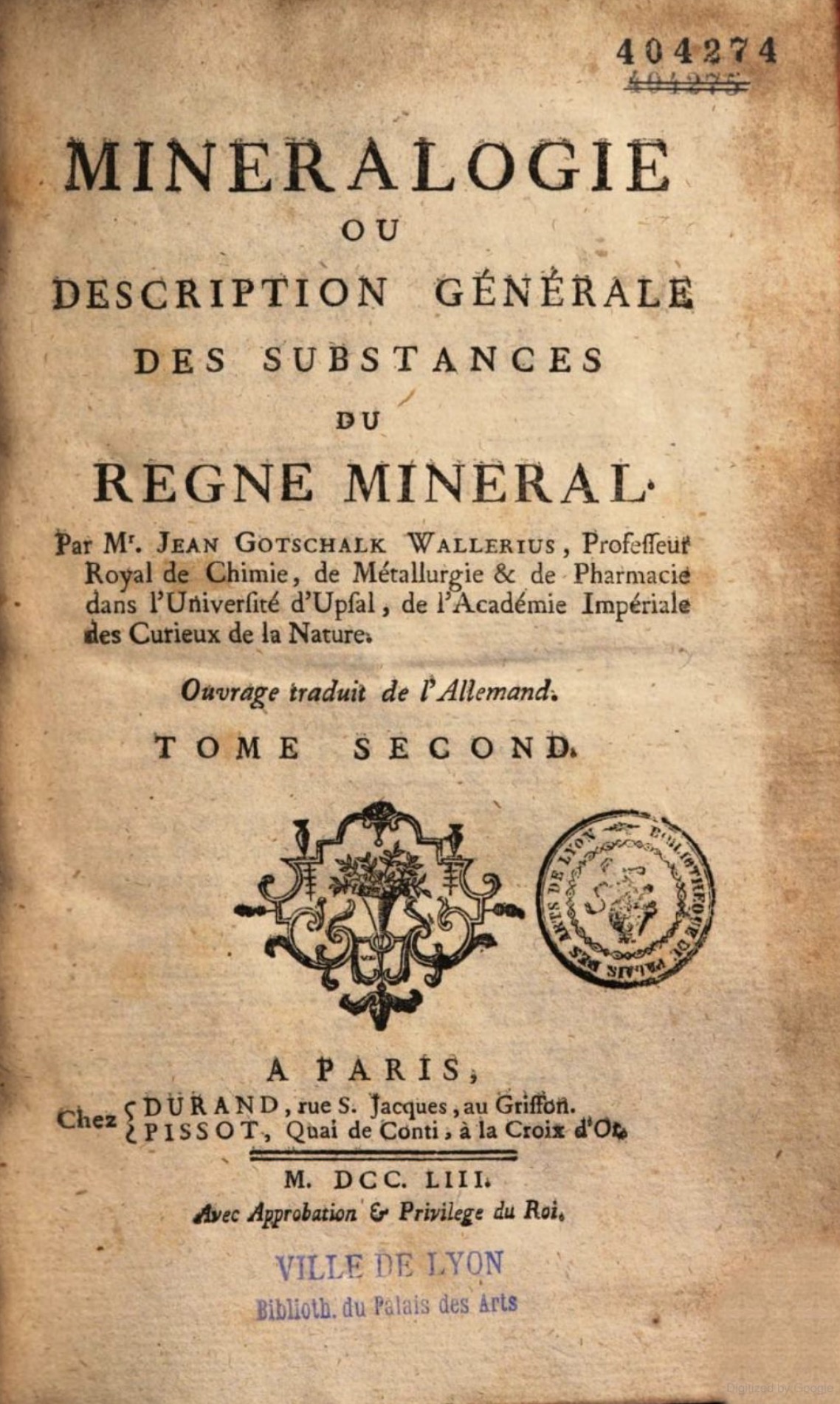
Minéralogie, ou description générale des substances du règne
Mineralogy, or General Description of the Substances of the Mineral Kingdom
Book
Wallerius, J.G. (1753) Minéralogie, ou description générale des substances du règne. [Mineralogy, or General Description of the Substances of the Mineral Kingdom] Paris, Durand / Pissot, 2 Vols., 591, 256 pp.
Record No. 29560  |  Sinkankas/Born No.: NIS / NIB  |  Language: in French  |  RWHL
This French translation of Wallerius’s influential Mineralogia presents an early systematic classification of the mineral kingdom, dividing it into earths, stones, minerals, and concretions, followed by preparations made from mineral substances. Minerals are distinguished through their composition, form, colour, transparency, hardness, specific gravity, geological occurrence, and behaviour under heat or chemical treatment. The extensive treatment of stones includes nephrite, rock crystal, agate, chalcedony, onyx, opal, jasper, lapis lazuli, and numerous ornamental materials. Precious stones are discussed separately, including diamond, ruby, sapphire, topaz, emerald, chrysolite, amethyst, garnet, hyacinth, and aquamarine. Wallerius describes their varieties, crystal forms, relative hardness, colours, host rocks, geographical sources, and response to fire, while also addressing false or coloured crystals, methods of artificial staining, and means of distinguishing genuine stones. Although many identifications and mineral relationships are now obsolete, the work represents an important transition from traditional lapidary nomenclature toward the systematic classification of minerals by observable physical and chemical properties.

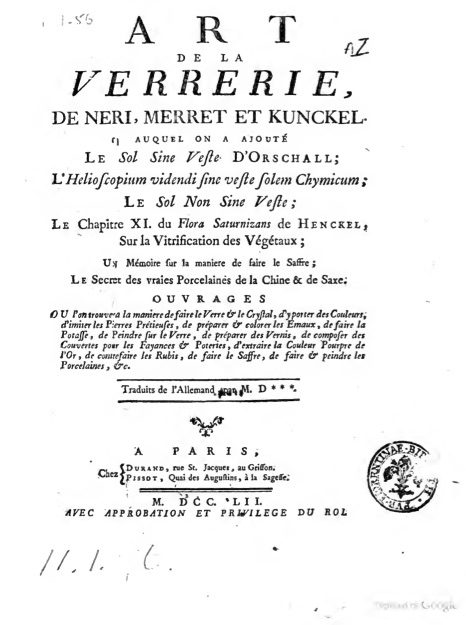
Art de la verrerie, de Neri, Merret et Kunckel
Ars Vitraria Experimentalis, or Perfect Glassmaking Art
Journal Article
Neri, A. (1752) Art de la verrerie, de Neri, Merret et Kunckel. [Ars Vitraria Experimentalis, or Perfect Glassmaking Art] lv, 629 [3] pp..
Record No. 7417  |  Sinkankas/Born No.: NIS/NIB  |  Language: in French  |  RWHL
An expanded French compilation of important seventeenth- and eighteenth-century writings on glassmaking and related chemical arts, centered on Antonio Neri’s L’Arte vetraria and incorporating the commentaries and additions of Christopher Merret and Johann Kunckel. The volume gives practical instructions for making glass and crystal, producing colored glass, preparing and coloring enamels, painting on glass and manufacturing glazes and varnishes. Of particular gemological interest are recipes for imitating precious stones and counterfeiting rubies, together with discussions of extracting the purple color of gold and the preparation of saffre, a cobalt-derived blue coloring material. Additional texts include Orschall’s Sol sine veste, Henckel on the vitrification of plants, Zimmermann on the manufacture of saffre, and material concerning Chinese and Saxon porcelain. The 1752 French edition was translated by Baron d’Holbach and contains 629 pages and 16 engraved plates.

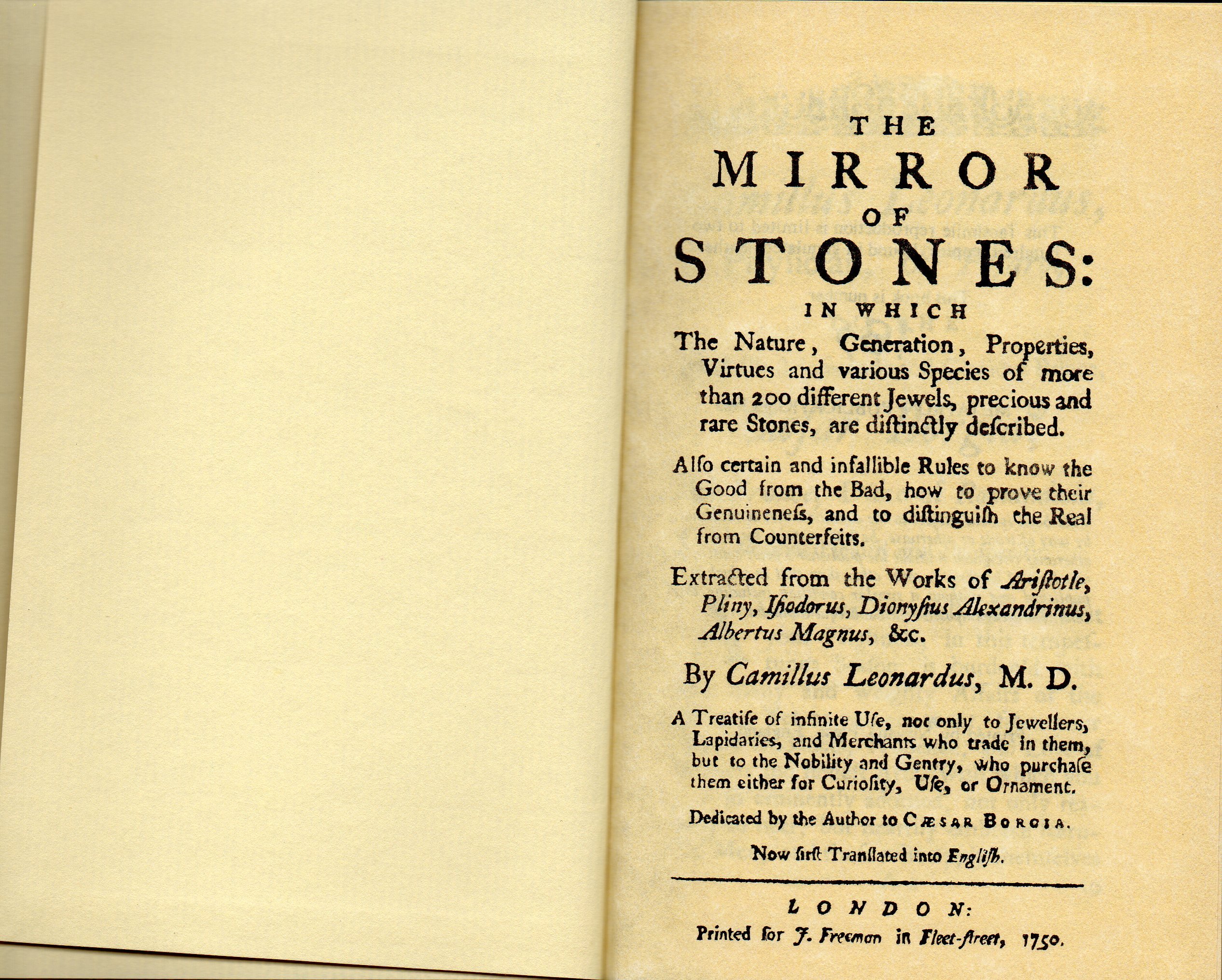
The Mirror of Stones

Book
Leonardus, C. (1750) The Mirror of Stones. London, J. Freeman, 240 pp.
Record No. 2819  |  Sinkankas/Born No.: 3896  |  RWHL
Schuh: Rare. In this famous lapidary, Leonardi classifies over 250 types of hard gems and stones according to their color, hardness, porosity, weight and transparency. A third of the book is devoted to an alphabetical listing and description of particular stones, while another third is occupied with astrological and magical images carved on gems and their occult significence. The author, physician to Caesar Borgia, had gathered his matierals from many of the older writers, but he shows some indications of having come under the influence of the newer methods of study which were about to be advoacted by Agricola and his followers, in that he treats of certain physical properties of minerals..." (Adams). Leonardo da Vinci is mentioned in a chapter on the masters in the art of gem cutting. Sinkankas: Straightforward translation but omitting the third book of the original in which graven images on gems are treated, because “but as nothing of this Kind suits the Taste of the more enlightened Moderns, we judged it wholly impertinent to trouble our Readers with Speculations not agreeable to right Reason, nor indeed consistent with our Religion. However, if the Curious … are desirous of knowing the Sentiments of the Ancients in these Matters … we will give them a Translation of this our Author’s Third Book, in a small volume by itself.” Such a separate work, however, never appeared. In addition to summarizing the contents, the translator (preface) provides a lively and amusing account of the rarity of previous editions and the lengths to which one English nobleman went to obtain a copy on the Continent."

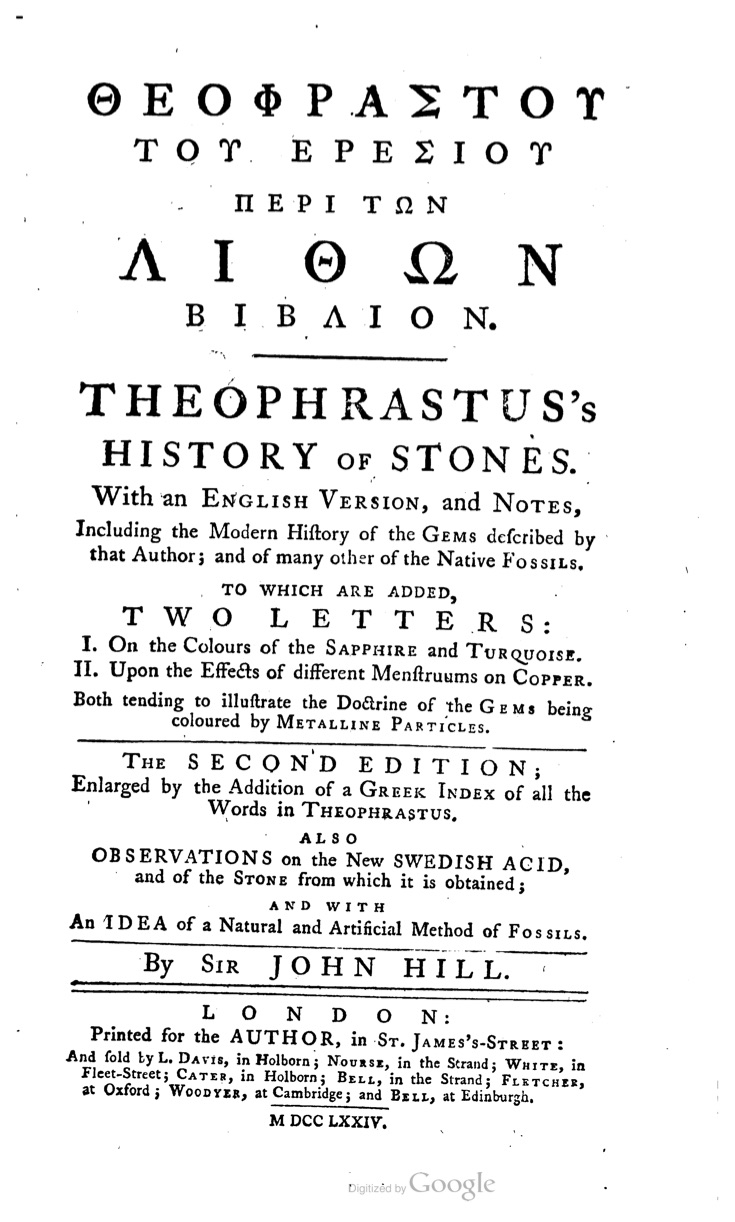
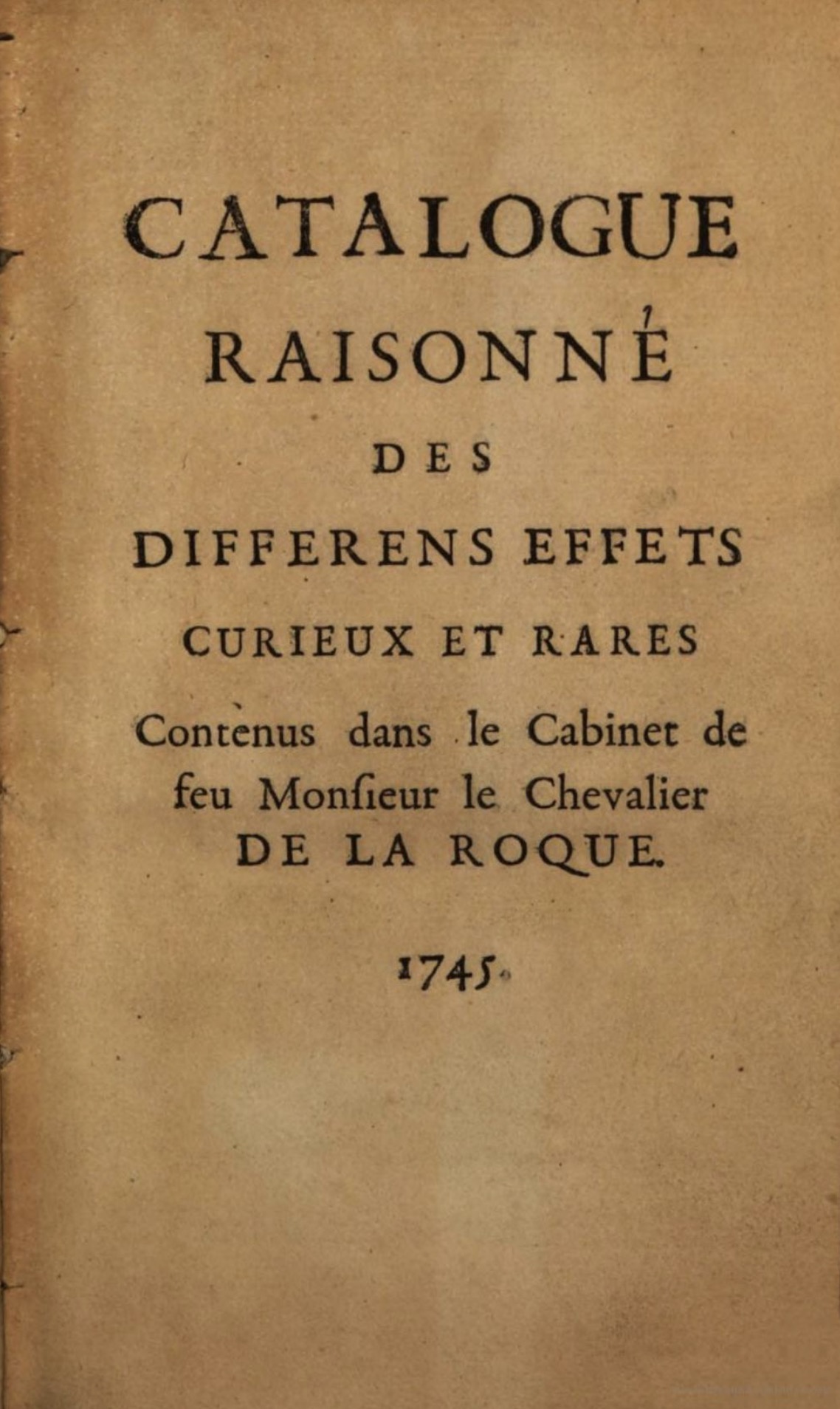
History of Stones. Theophrastus's History of stones. With an English version, and critical and philosophical notes, including the modern history of the gems, &c, described by that author, and of many other of the native fossils. By John Hill. To which are added, two letters: one to Dr. James Parsons, F.R.S., on the colours of the sapphire and turquoise. And the other, to Martin Folkes ... upon the effects of different menstruums on copper ...
Book
Theophrastus (1746) History of Stones. Theophrastus's History of stones. With an English version, and critical and philosophical notes, including the modern history of the gems, &c, described by that author, and of many other of the native fossils. By John Hill. To which are added, two letters: one to Dr. James Parsons, F.R.S., on the colours of the sapphire and turquoise. And the other, to Martin Folkes ... upon the effects of different menstruums on copper ... London, C. Davis, xxiii, 211 pp.
Record No. 7398  |  RWHL
The references to Theophrastus and the quotations from him, so frequent in the works of later writers on fossils, might lead one to believe that his treatise was universally known and perfectly understood. However, upon closer examination, it becomes apparent that, while he is often cited, he is rarely understood—and indeed, rarely read. Those who freely invoke his name have generally taken little effort to engage with his works, relying instead on secondhand references, many of which originate from Pliny. As for Pliny, anyone familiar with the works of earlier writers knows that, although he deserves credit for the vast repository of knowledge he compiled, his accuracy in quotations leaves much to be desired. It is therefore not surprising that the genuine work of Theophrastus on fossils has been so neglected. Anyone attempting to read even the best editions available today will encounter numerous obstacles: missing words, incomplete phrases, and sentences rendered unintelligible due to preserved errors or poorly executed editorial corrections. Such deficiencies make the treatise challenging to read without extraordinary effort, subject expertise, and frequent consultation of other ancient authors. This treatise, though filled with excellent material, has remained nearly unintelligible for these reasons. Theophrastus was known for his brevity, and where even some of those few words are missing, understanding his meaning becomes no easy task. To address this, I have painstakingly consulted other ancient authors to reconstruct what Theophrastus most likely intended, based on how they addressed the same topics. In these efforts, Pliny—when reliable—has been particularly helpful, as many of his passages are literal translations of Theophrastus, offering insight into how the original text was read before later errors rendered it unclear. In this work, I have employed two main methods to restore and understand the text: comparing Theophrastus’s descriptions with the actual substances he discusses, and cross-referencing his words with those of other ancient authors, particularly Pliny, to reconstruct missing or corrupted passages. With these methods and resources, I have undertaken to produce a new edition of the Greek text. While I have filled in the gaps and corrected errors to make the text clear, readable, and coherent, I have also documented every alteration in the notes—indicating where defects occurred and what changes I made. As for the English translation, my goal has been to make the work accessible to British readers. I have not limited myself to a strict, word-for-word translation; instead, I have aimed to convey both the words and the meaning of Theophrastus. In many instances, I have expanded a single word into a full sentence, adding brief recaps of previously mentioned ideas to maintain the logical flow of the text and ensure clarity. For this edition, I have also included a Greek index of all Theophrastus’s words, for which I am indebted to Mr. Newberry, an account of a newly discovered acid derived from a stone first identified in Sweden, and suggestions for new methods of categorizing fossils—a much-needed improvement in the field of natural history.

Catalogue raisonné des differens effets curieux & rares, contenus dans le Cabinet de seu Monsieur le Chevalier de la Roque
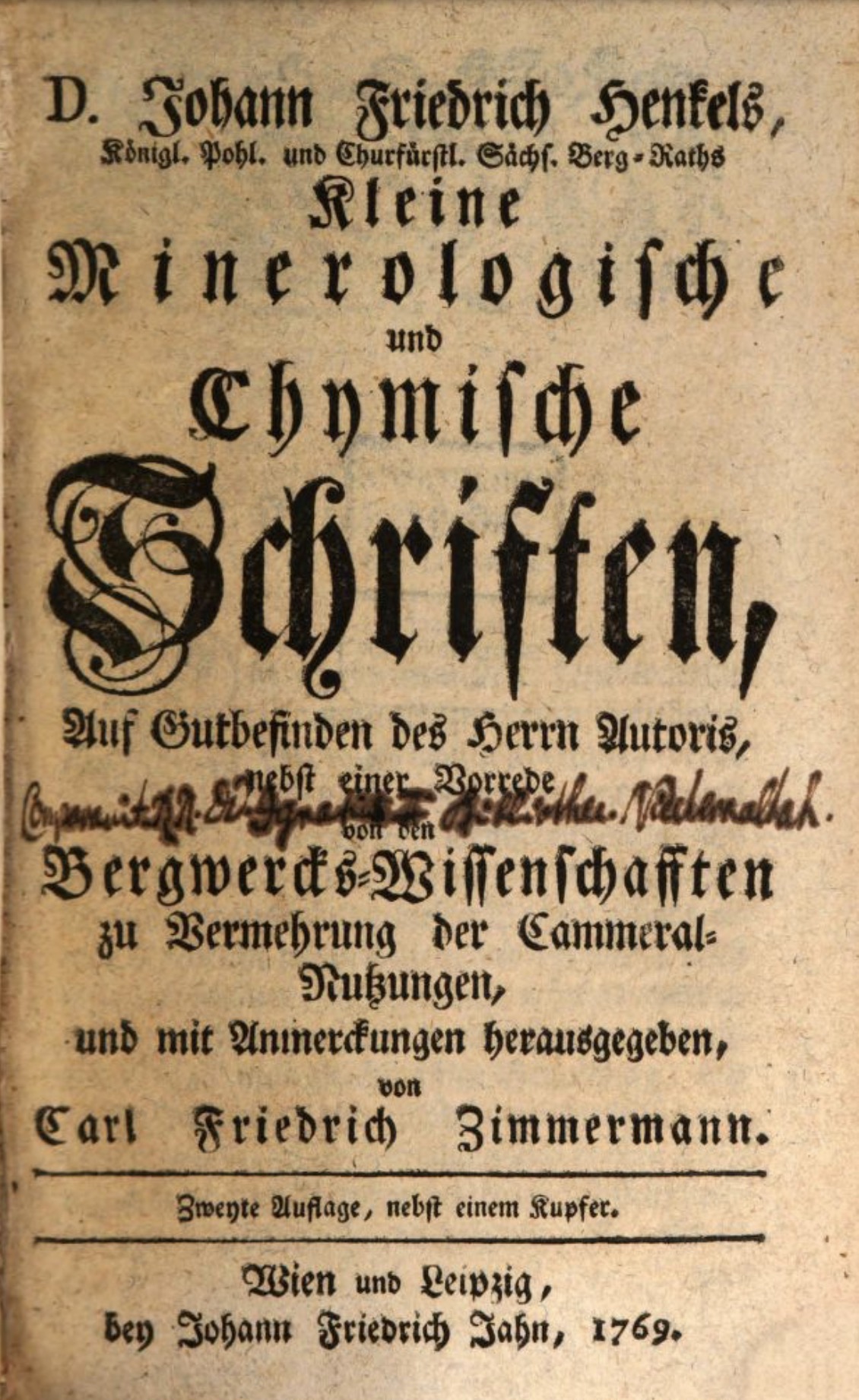
Annotated Catalog of the Various Curious and Rare Objects Contained in the Cabinet of the Late Monsieur Chevalier de La Roque
Book
Gersaint, E.-F. (1745) Catalogue raisonné des differens effets curieux & rares, contenus dans le Cabinet de seu Monsieur le Chevalier de la Roque. [Annotated Catalog of the Various Curious and Rare Objects Contained in the Cabinet of the Late Monsieur Chevalier de La Roque] Paris, Jaques Barois, 258 pp.
Record No. 29000  |  Sinkankas/Born No.: 2362  |  Language: in French  |  RWHL
Sinkankas: The collection of Jean, chevalier De La Roque (1661–1745). Pp. 109–147: “Pierreries, Agates, Pierres gravées … [etc.].” Includes diamonds, rubies, emeralds, oriental topaz, sapphire, oriental amethyst, turquoise, balas ruby, hyacinth, and others, not to mention the engraved gems (cameos, intaglios, mounted in rings, and loose). Mentioned by Mariette, Traité des pierres gravées, I, 458.

Kleine Mineralogische und Chymische Schrifften. Auf Gutbefinden des Herrn Autoris. Nebst einer Vorrede von den Bergwercks-Wissenschafften zu Vermehrung der Cammeral-Nutzungen, und mit Anmerckungen herausgegeben von Carl Friedrich Zimmermann
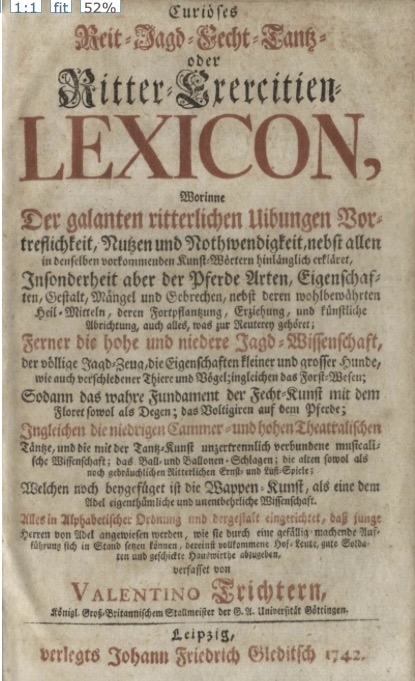
D. Johann Friedrich Henkel’s, Royal Polish and Electoral Saxon Mining Councillor, Small Mineralogical and Chemical Writings. Published with the approval of the author, together with a preface on the mining sciences for the increase of cameral (state fiscal) revenues, and with annotations by Carl Friedrich Zimmermann
Book
Henkel, J.F. (1744) Kleine Mineralogische und Chymische Schrifften. Auf Gutbefinden des Herrn Autoris. Nebst einer Vorrede von den Bergwercks-Wissenschafften zu Vermehrung der Cammeral-Nutzungen, und mit Anmerckungen herausgegeben von Carl Friedrich Zimmermann. [D. Johann Friedrich Henkel’s, Royal Polish and Electoral Saxon Mining Councillor, Small Mineralogical and Chemical Writings. Published with the approval of the author, together with a preface on the mining sciences for the increase of cameral (state fiscal) revenues, and with annotations by Carl Friedrich Zimmermann] Dresden, Friedrich Henkel, 619 pp.
Record No. 28994  |  Sinkankas/Born No.: 2883–2884  |  Language: in German  |  RWHL
Sinkankas: Henkel presents his views on the formation of minerals, including coral and gemstones, with extensive annotations by Zimmermann. He recognized five modes of formation: (1) congelation, (2) concretion, (3) vegetation (as in coral), (4) crystallization, and (5) petrifaction. Henkel believed that durable minerals—especially gemstones—were composed of minute particles that grew together into structurally continuous masses or crystals, producing transparency while excluding water. He discusses at length, as does Zimmermann, experiments by Robert Boyle, Francis I, and others on the effects of intense heat on gemstones, describing the behavior of diamond, emerald, ruby, and other gems. Additional topics include Saxon fossil resin (pp. 539–553), the celebrated Saxon topaz (pp. 554–565), and a green jasper bearing “hieroglyphic figures” (pp. 607–619), possibly referring to graphic granite. The work is described by John Ferguson in Bibliotheca Chemica (Vol. I, p. 386), which also notes later editions published in 1747 and in Vienna in 1769, together with biographical and bibliographical information on Henkel and his writings.

Edelgesteine

Gemstones
Book Section
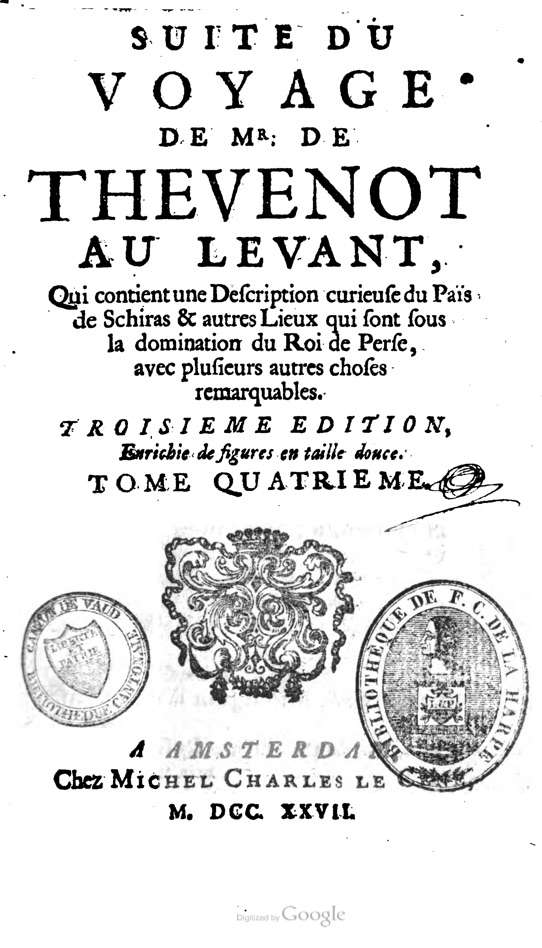
Trichter, V. (1742) Edelgesteine. [Gemstones] In: Curiöses Reit- Jagd- Fecht- Tantz- oder Ritter-Rxercitien-Lexicon, Leiipzig, pp. 575–576.
Record No. 8139  |  Language: in German  |  RWHL
Precious stones: These are those which are made valuable not only due to their rarity and beauty but also because nature has adorned them with a special light and radiance, making them, in a sense, noble—so that they sparkle like the finest stars and have always maintained a higher status than gold or silver. There are two types of precious stones: transparent and opaque. The transparent ones include amethyst, beryl, carbuncle, chrysolite, diamond, hyacinth, ruby, sapphire, and emerald. Among the opaque ones, though some are semi-transparent, are agate, carnelian, chalcedony, jasper, the so-called cat’s eye, lapis lazuli, nephrite, and gallstone, malachite and schreckstein, onyx, opal, turquoise, etc. These precious stones, especially the transparent ones, originate from water or moisture impregnated with mountain salt, which allows them to grow and develop into crystals. It is impossible for something to be transparent that has not first been in liquid form. Dense substances such as silver and lead, when dissolved in separating water or other acidic liquids, can easily grow into transparent crystals. Similarly, one often finds completely clear water droplets inside the most beautifully grown crystals, and in the hardest stones in India, the finest gemstones. Moreover, that there is some mountain salt mixed in is evident from the geometric shape of the precious stones, which are clearly recognizable as having the same structure as salt and saltpeter, as the mined crystals and diamonds, which differ only in hardness, grow entirely angular, often even with veins and such deposits, so that one can clearly see how the salty components have been layered on top of each other. Their charming colors come from a delicate metallic sulfur, similar to metals found in mines: for example, carbuncle, ruby, garnet, and amethyst from a gold-sulfur; sapphire from the tincture of silver; emerald and chrysolite from the greenish-sulfuric nature of copper; topaz and hyacinth from the sulfurous substance of iron, etc. However, this sulfur in precious stones is very volatile, so much so that the colors resulting from it can easily disappear and evaporate in the fire. But since these gemstones, when broken, are often irregular, or unclean and blotchy, even the most beautiful and purest stones do not shine as brightly as when they are cut, whereby the multiple facets reflect and play the light that falls on the foil or diamond ink all the more toward the eye. Therefore, those skilled in this art are called gem cutters, and they practice a free craft; however, they have been regulated by a noble order in Nuremberg for more than 100 years.

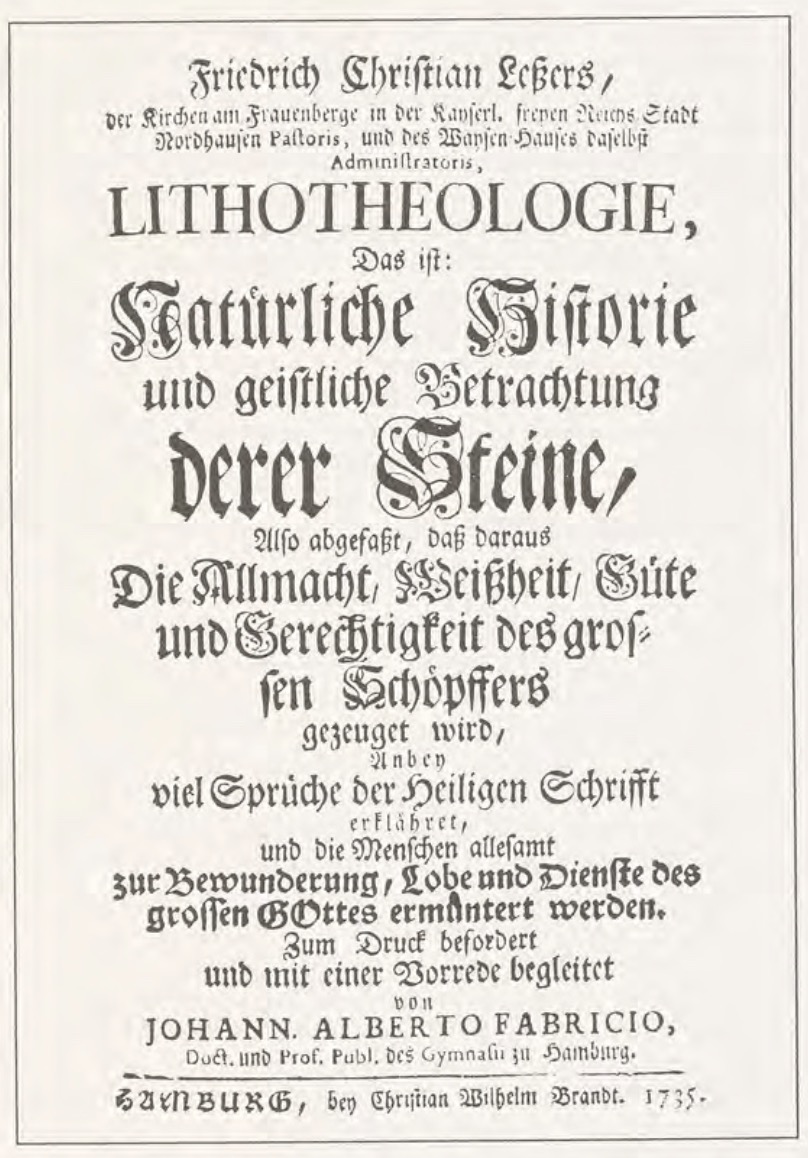
Lithotheologie, Das ist: Natürliche Historie und geistliche Betrachtung derer Steine, also abgefasst, dass daraus die Allmacht, Weisheit, Güte und Gerechtigkeit des grossen Schöpffers gezeuget wird, anbey viel Sprüche der Heiligen Schrifft erklähret und die Menschen allesamt zur Bewunderung, Lobe und Dienste des grossen Gottes ermuntert werden.
Lithotheologic, that is: Natural history and spiritual contemplation of stones, composed in such a way that from them the omnipotence, wisdom, goodness, and justice of the great Creator are demonstrated; together with explanations of many passages of Holy Scripture, and an exhortation to all mankind to admiration, praise, and service of the great God
Book
Lesser, F.C. (1735) Lithotheologie, Das ist: Natürliche Historie und geistliche Betrachtung derer Steine, also abgefasst, dass daraus die Allmacht, Weisheit, Güte und Gerechtigkeit des grossen Schöpffers gezeuget wird, anbey viel Sprüche der Heiligen Schrifft erklähret und die Menschen allesamt zur Bewunderung, Lobe und Dienste des grossen Gottes ermuntert werden. [Lithotheologic, that is: Natural history and spiritual contemplation of stones, composed in such a way that from them the omnipotence, wisdom, goodness, and justice of the great Creator are demonstrated; together with explanations of many passages of Holy Scripture, and an exhortation to all mankind to admiration, praise, and service of the great God] Hamburg, Christian Wilhelm, 1300 pp.
Record No. 28779  |  Sinkankas/Born No.: 3904  |  Language: in German  |  RWHL
Sinkankas: Utterly fascinating work in great detail and complexity, attempting to demonstrate the hand of God in every manifestation of the mineral kingdom. Lesser assembled an astounding fund of information culled from hundreds of ancient and modern sources and covering nearly every aspect of geology, mineralogy, paleontology, and gemology. So successful was he, and apparently so careful in his choices and interpretations, that the present work was very commonly quoted by later writers in earth sciences and mineralogy. It is divided into nine books, each with several parts and chapters. Book one explains fundamental interrelationships existing among the lithosphere, atmosphere, hydrosphere, and biosphere. Book two concerns the origin and formation of rocks and minerals. Book three treats occurrences or deposits of mineral materials, including gemstones. Book four discusses the properties of minerals and stones. Book five addresses “precious” and “non-precious” stones, with pp. 343–66 treating precious stones, though restricted to a limited number of the better-known species and varieties, the stones themselves being apportioned among transparent, translucent, and opaque kinds, i.e., diamond, ruby, garnet, hyacinth, sapphire, amethyst, emerald, topaz, opal, and chrysolite as transparent stones, and translucent stones such as carnelian, sard, and other varieties of chalcedony; opaque stones include turquoise, malachite, jasper, lapis lazuli, and jade. This book also contains descriptions of some famous diamonds and other large and valuable gems, as well as data on the precious stones mentioned in the Bible. Also among the stones in this book are those that display remarkable inclusions, fanciful portraits or scenes, fossils, and crystals, and other curious, if not marvelous, mineral materials. Book six treats architectural and monumental stones, and also includes brief discussions of engraved gems, seals, and ringstones, with pp. 832–46 describing and speculating on the true identities of the gemstones in the vestments and breastplate of the High Priest, suitably illustrated with diagrams showing their positions and identities. Book seven concerns the misuse of stones, ostentatious display of gemstones, superstitious belief in their powers, the use of birthstones and planetary stones, and other topics of this nature. Book eight treats artificial stones of all kinds, including gemstones. Book nine concerns “works of wonder” in stone, e.g., Lot’s wife turned into a pillar of salt!

Voyages de Mr. de Thevenot en Europe, Asie et Afrique
Book
Thevenot, J., de, (1727) Voyages de Mr. de Thevenot en Europe, Asie et Afrique., 5 Vols., Vol. 5 , see p. 297
Record No. 1716  |  Sinkankas/Born No.: NIS/NIB  |  RWHL
Jean de Thévenot’s Voyages en Europe, Asie et Afrique recounts his extensive travels during the mid-17th century through Europe, the Ottoman Empire, Egypt, the Holy Land, Persia, and India. Based substantially on firsthand observations, the work describes geography, peoples, religions, customs, cities, natural products, commerce, transportation, and political conditions across the regions visited. Thévenot’s travels in Persia and India are particularly valuable for their descriptions of contemporary trade and luxury commodities. Of gemological interest are references to diamonds, pearls, precious stones, mines, jewelry, and the commerce in gems, including observations on Indian and Persian sources and markets. The passage in Vol. 5, p. 297, contributes to the work’s documentation of precious materials and their trade, making Thévenot an important European eyewitness source for the Asian gem trade of the 17th century.

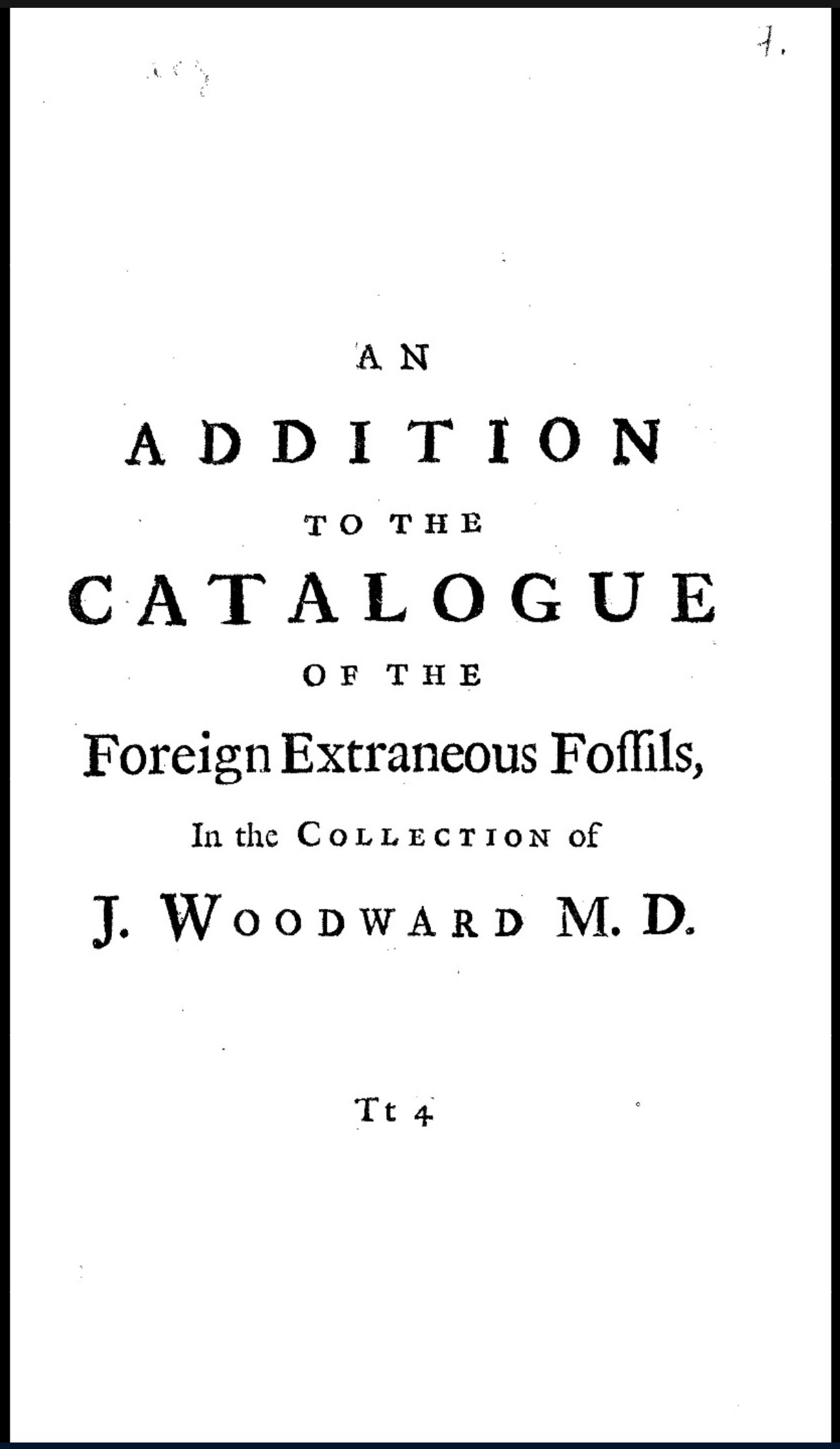
An Addition to the Catalogue of the Foreign Extraneous Fossils in the Collection of J. Woodward M.D.
Book
Woodward, J. (1725) An Addition to the Catalogue of the Foreign Extraneous Fossils in the Collection of J. Woodward M.D., 15 pp.
Record No. 28999  |  Sinkankas/Born No.: NIS/NIB  |  Language: in English and Latin  |  RWHL
John Woodward’s An Addition to the Catalogue of the Foreign Extraneous Fossils in the Collection of J. Woodward M.D. supplements the catalogue of the extensive geological and natural-history collection assembled by the English physician and geologist John Woodward. Using fossil in its contemporary broad sense for substances dug from the earth, the catalogue records specimens of minerals, rocks, ores, petrifactions, and related natural materials obtained from locations outside Britain. The entries document their names, characteristics, and geographical origins and reflect the growing systematic collection and classification of geological specimens in the early 18th century. Of interest to gemologists are records of crystalline, ornamental, and precious mineral materials, providing evidence for contemporary mineral terminology, specimen provenance, and the circulation of exotic minerals among European collectors.

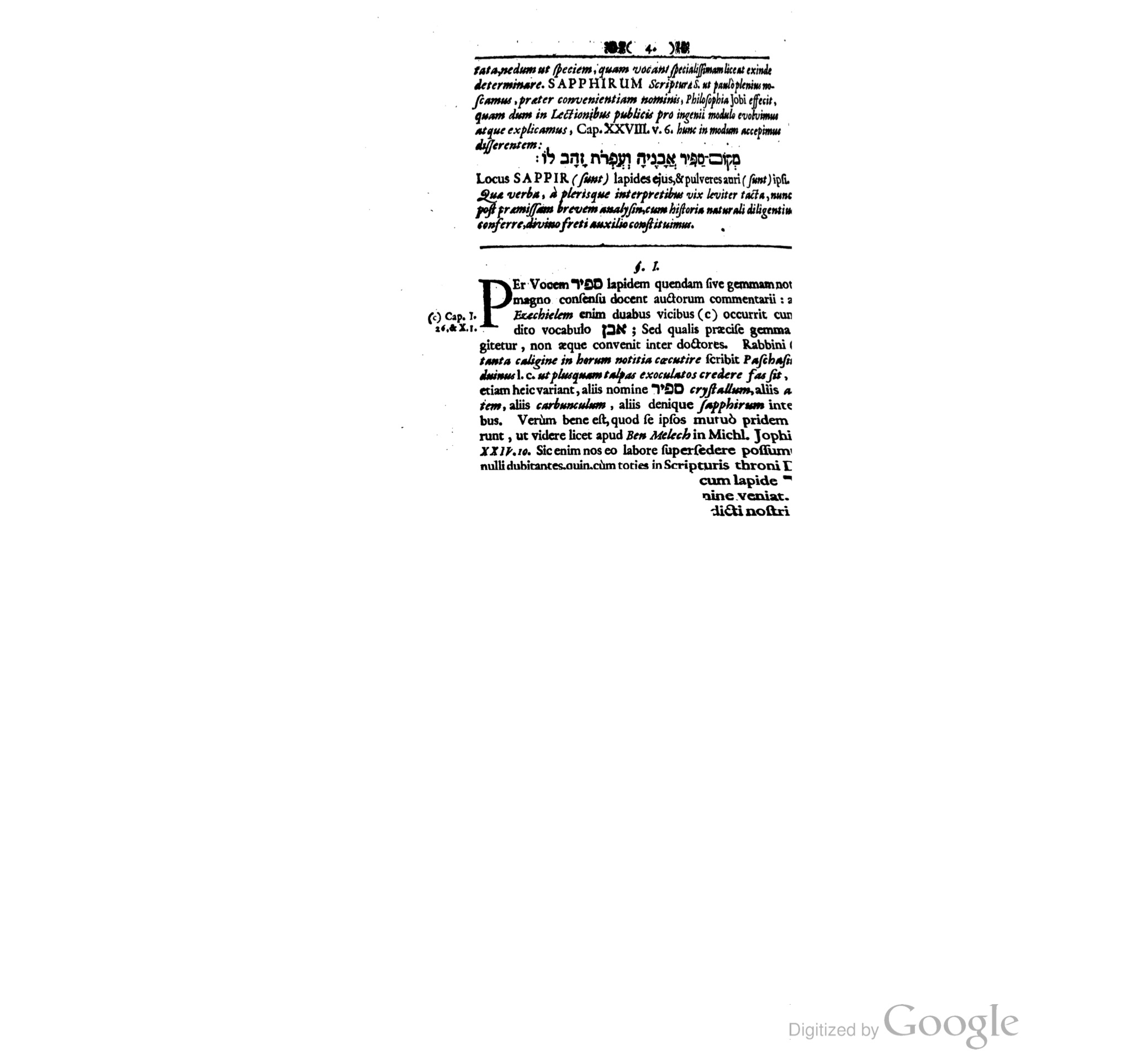
De Sapphiro Scripturaes

Book
Baier, J.W. (1705) De Sapphiro Scripturaes. Altdorf, 15 pp.
Record No. 2701  |  Sinkankas/Born No.: NIS/NIB  |  RWHL
Johann Wilhelm Baier’s De Sapphiro Scripturae is an early 18th-century Latin dissertation examining the “sapphire” mentioned in biblical scripture. The work considers passages containing sapphirus and related terms, drawing upon biblical texts, classical authorities, linguistic evidence, and contemporary knowledge of precious stones in an attempt to determine the identity and properties of the stone intended by ancient writers. Of particular interest to historians of gemology is its treatment of the difficulties involved in correlating ancient gemstone names with modern mineral species, especially the long-standing question of whether the biblical sapphire represented modern sapphire, lapis lazuli, or another blue stone. The dissertation illustrates the intersection of biblical scholarship, philology, mineralogy, and traditional lapidary literature in the early 18th century.

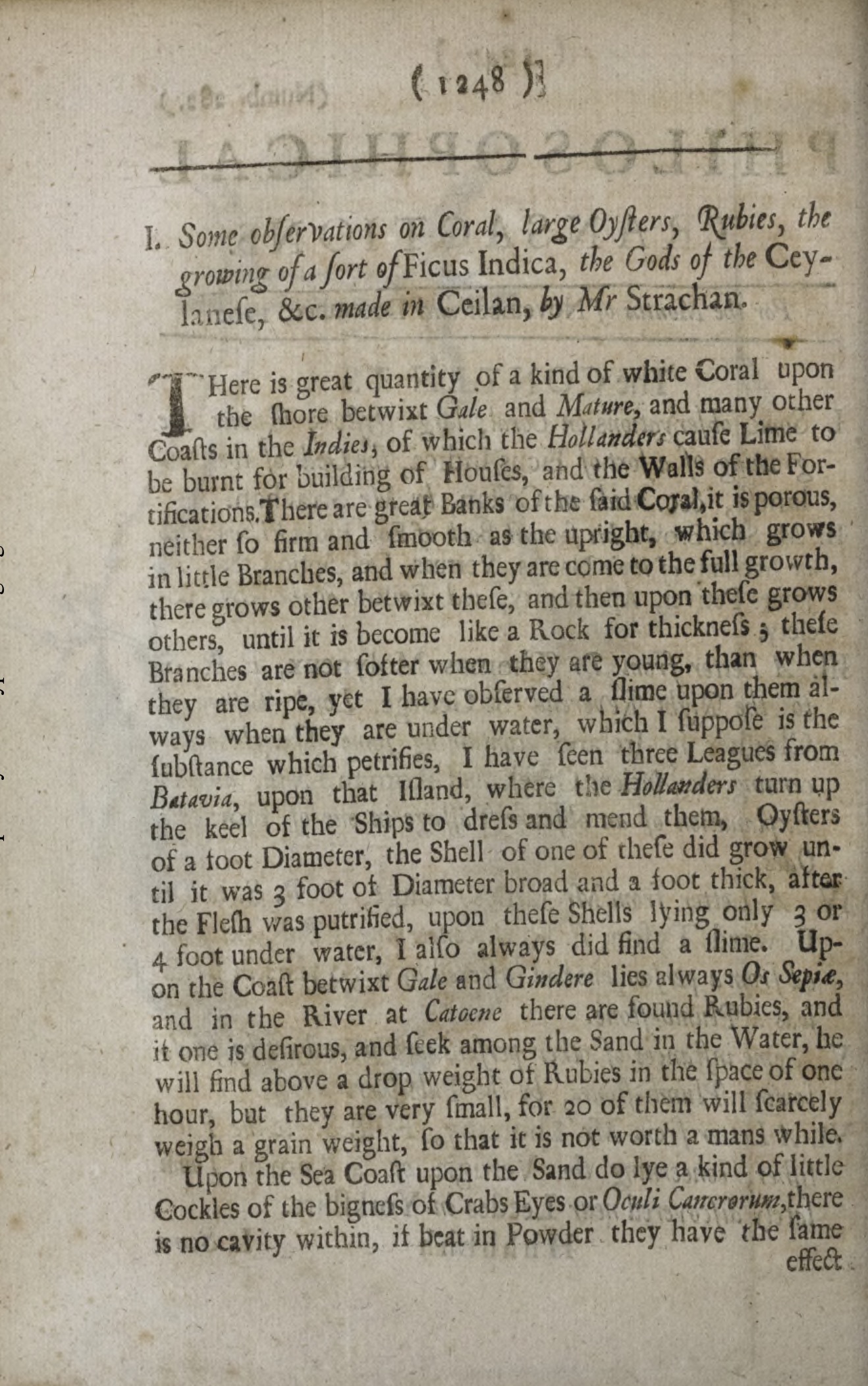
Some observations on coral, large oysters, rubies, the growing of a sort of Ficus Indica, the gods of the Ceylanese, &c. made in Ceilan, by Mr. Strachan
Journal Article
Strachan, D. (1702) Some observations on coral, large oysters, rubies, the growing of a sort of Ficus Indica, the gods of the Ceylanese, &c. made in Ceilan, by Mr. Strachan. Philosophical Transactions of the Royal Society of London, Abridged, Vol. 4, pp. 1248–1250.
Record No. 29440  |  DOI: https://doi.org/10.1098/rstl.1702.0032  |  Sinkankas/Born No.: NIS/NIB  |  RWHL
David Strachan’s “Some Observations on Coral, Large Oysters, Rubies, the Growing of a Sort of Ficus Indica, the Gods of the Ceylanese, &c.” is a short account of natural-historical and cultural observations made in Ceylon and communicated to the Royal Society. The paper discusses several subjects encountered on the island, including coral, unusually large oysters, rubies, the growth of a type of banyan or Ficus indica, and aspects of Ceylonese religion. Of particular interest to gemologists is Strachan’s contemporary account of rubies and their occurrence in Ceylon, placing gemstone observations alongside other natural products for which the island was noted. Published in the Philosophical Transactions, the paper illustrates the Royal Society’s early practice of collecting first-hand reports from travelers concerning the natural history, resources, and peoples of distant regions.

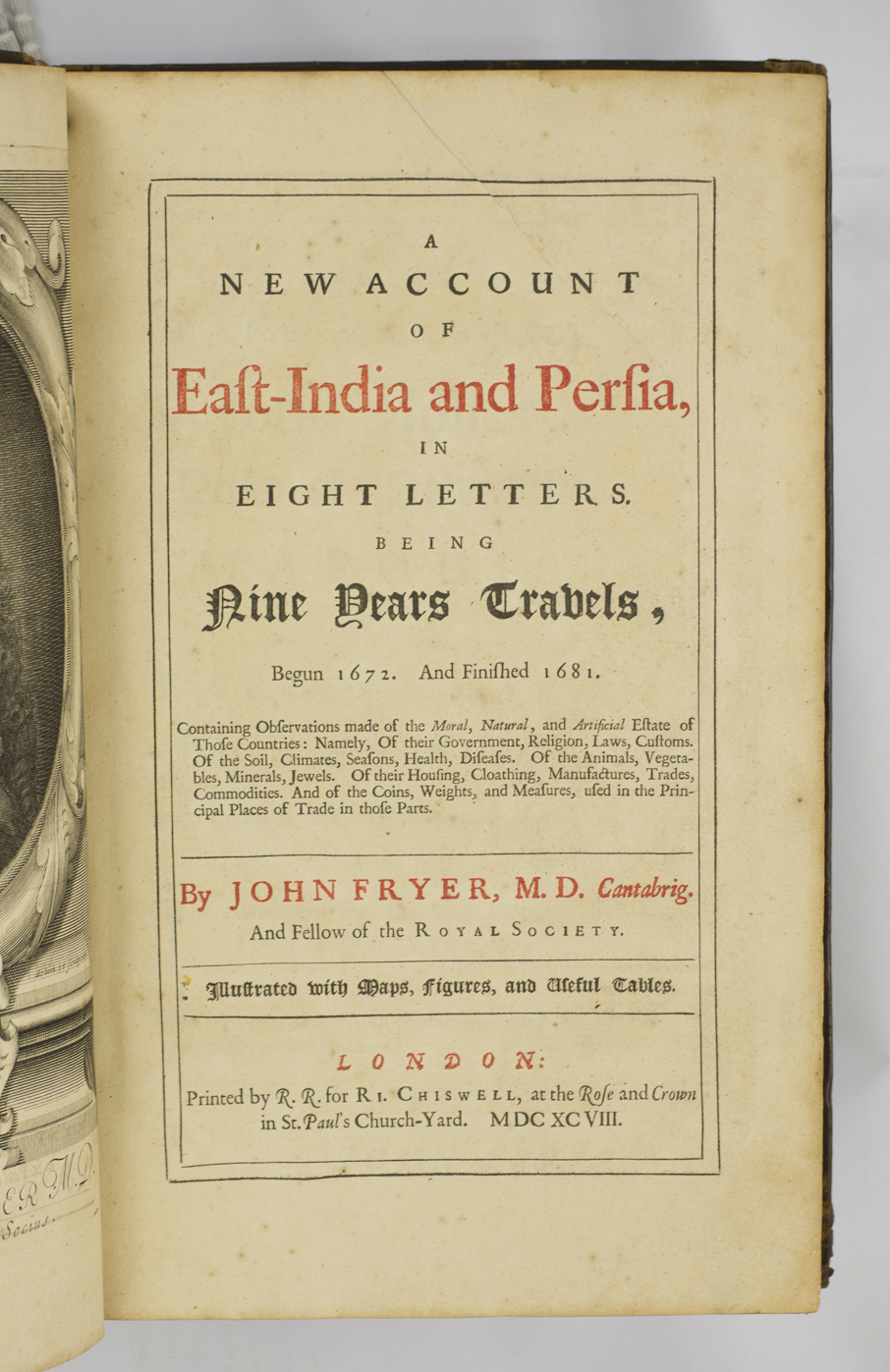
A New Account of East India and Persia being Nine Years’ Travels 1672–1681
Book
Fryer, J. (1698) A New Account of East India and Persia being Nine Years’ Travels 1672–1681. London, Hakluyt Society, 3 Vols., Vol. 2 contains material on gemstones , 353, 371, 271 pp.
Record No. 2767  |  Sinkankas/Born No.: NIS/NIB  |  RWHL
John Fryer’s A New Account of East India and Persia records his travels in India and Persia between 1672 and 1681 while serving as a surgeon to the English East India Company. The work describes ports, cities, peoples, governments, religions, natural history, medicine, manufactures, commerce, and commodities encountered along the western coast of India and in Persia. Of particular interest to gemologists are Fryer’s observations on diamonds, rubies, pearls, and other precious stones, including their sources, mining, cutting, valuation, and trade, with especially relevant material in Vol. 2. His firsthand descriptions provide valuable evidence for the organization of the Indian gem trade and the movement of precious stones through the commercial networks connecting India, Persia, and Europe during the late 17th century.

A Voyage to Suratt, 1689

Book
Ovington, J. (1696) A Voyage to Suratt, 1689. London
Record No. 2840  |  Sinkankas/Born No.: NIS/NIB  |  RWHL
John Ovington’s A Voyage to Suratt is an account of his journey to India as a chaplain of the English East India Company and of his residence at Surat in the late 17th century. The work describes the voyage, Surat and its inhabitants, religions, customs, commerce, natural products, foods, medicines, and the activities of European and Asian merchants. As Surat was one of the principal ports linking Mughal India with Persia, Arabia, and Europe, Ovington provides valuable observations on its international trade and luxury commodities. Of particular interest to gemologists are references to diamonds, precious stones, pearls, jewelry, and other valuable goods traded through India, providing contemporary evidence for the commercial networks through which gems moved from Indian producing regions to overseas markets.

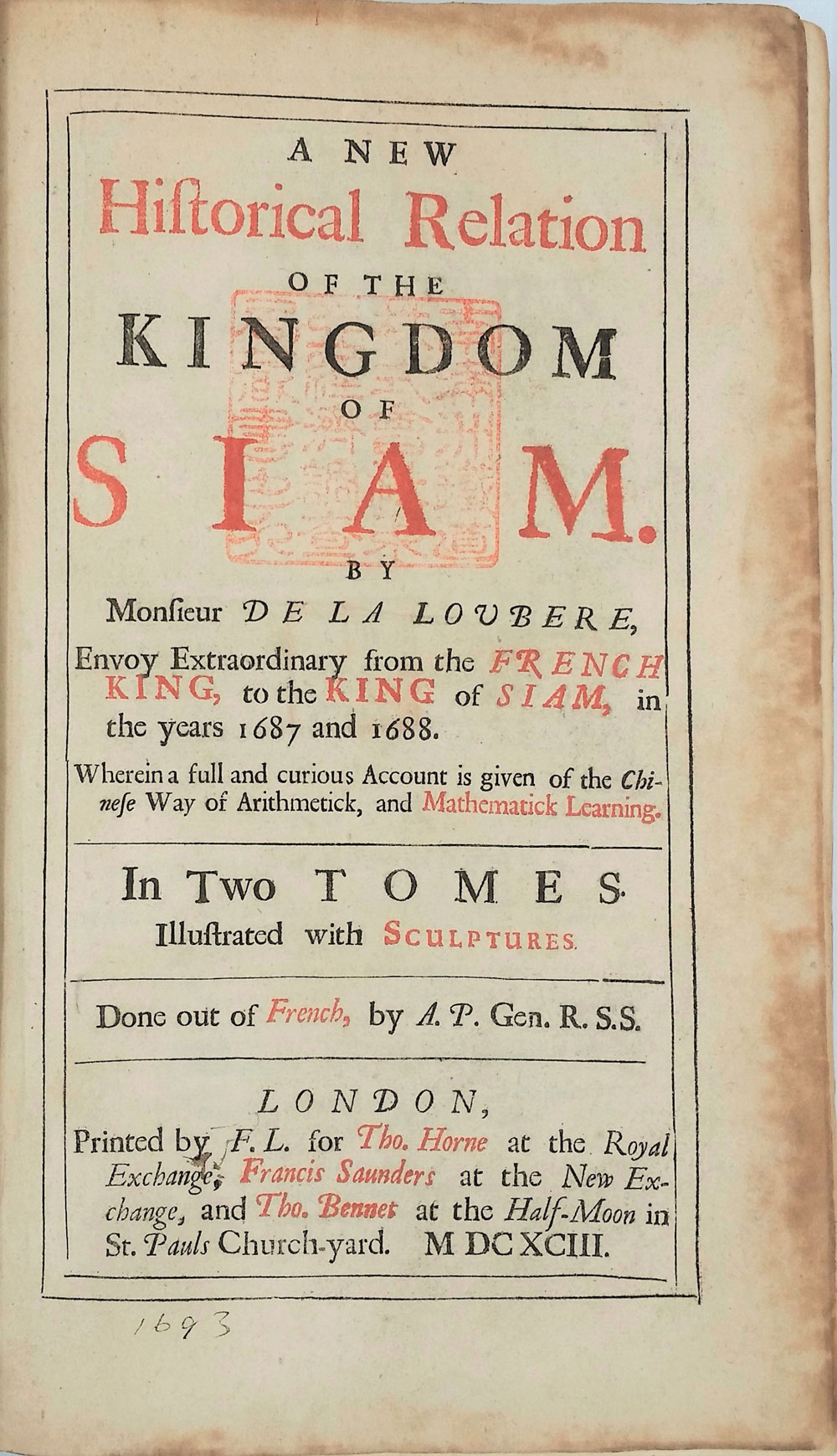
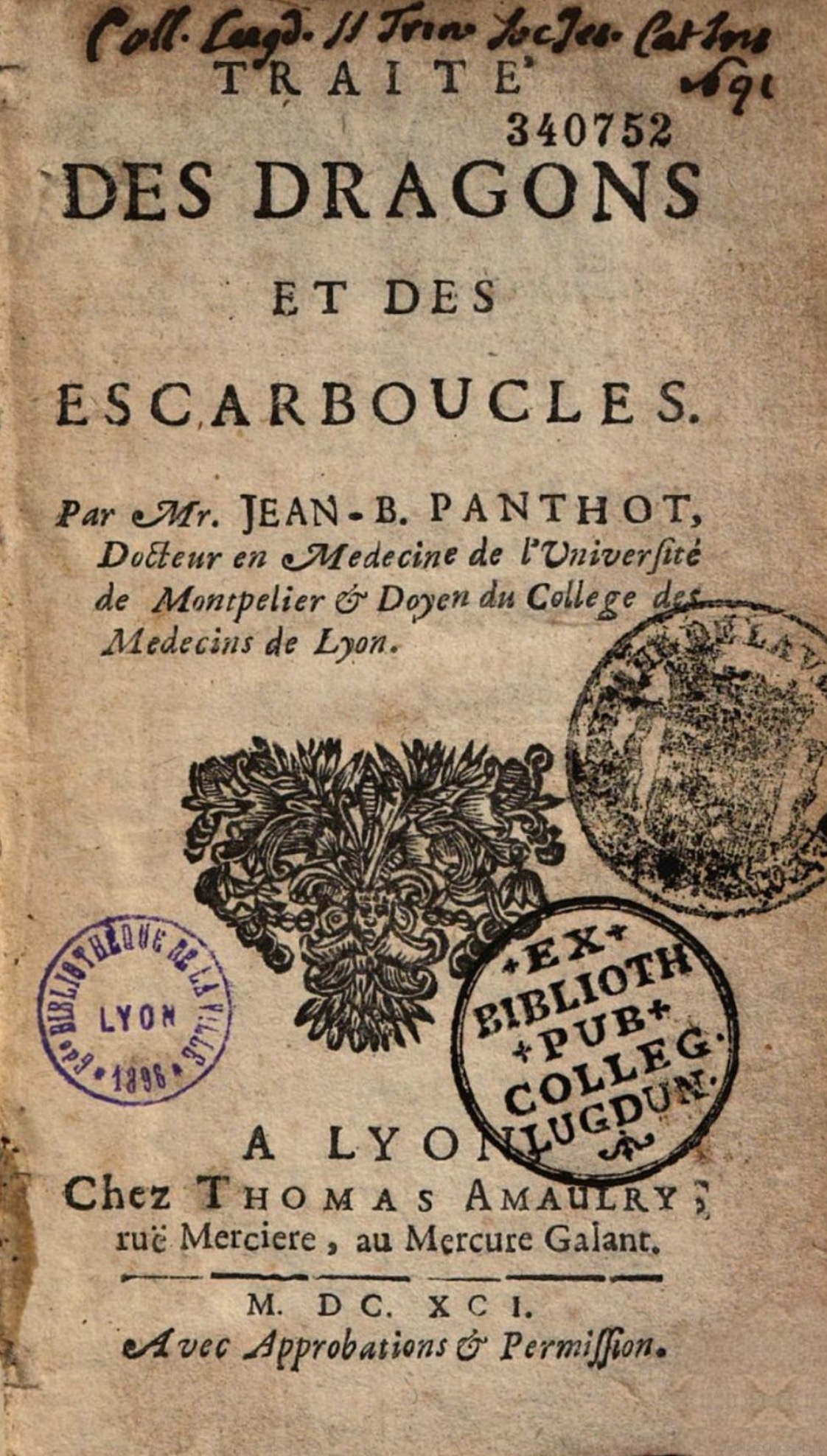
A New Historical Relation of the Kingdom of Siam
Book
Loubère, S., De la (1693) A New Historical Relation of the Kingdom of Siam. London, 286 pp.
Record No. 2822  |  Sinkankas/Born No.: NIS/NIB  |  RWHL
La Loubere was French ambassador to Siam from 1687 to 1688. In addition to the interesting account of Siam and the Siamese, this work contains many curious matters of information; The Life of Thevetat, Siamese Alphabet, Smoaking Instrument, Chess-Play of the Chinese, Relation of the Cape of Good Hope, with four cuts, Siamese Astronomy, Problem of Magical Squares, according to the Indians, Manners of the Chinese. This embassy was one of several sent form Louis XIV to Siam, all of which were accompanied by priests of the Jesuit order. Tachard made his second voyage with La Loubere. French interest in Siam seems to have declined after this visit" (Cox I, p. 329). Historically Loubere is probably best remembered for a mathematical solution he brought back with him. The 'De La Loubere Method' a very simple method to construct any size of n-odd magic squares (i.e. number squares in which the sums of all rows, columns and diagonals are identical). The method was brought to France in 1688 by the French mathematician and diplomat Simon de la Loubère, as he was returning from his 1687 embassy to the kingdom of Siam. The Siamese method makes the creation of magic squares easy, without resort to guesswork. The book contains brief mentions of gems in Thailand."

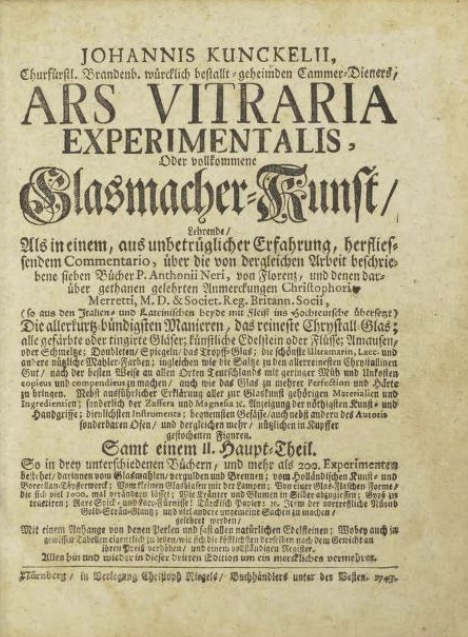
Traité des Dragons et des Escarboucles
Treatise on Dragons and Carbuncles
Book
Panthot, J.-B. (1691) Traité des Dragons et des Escarboucles. [Treatise on Dragons and Carbuncles] Lyon, Thomas Amaulry, 93 pp.
Record No. 6924  |  Sinkankas/Born No.: 4957  |  Language: in French  |  RWHL
Jean-Baptiste Panthot’s Traité des Dragons et des Escarboucles is a late 17th-century French treatise examining traditions concerning dragons and the legendary carbuncle, a brilliant precious stone believed to shine with its own light and sometimes said to occur in or upon the heads of dragons and other creatures. Panthot considers accounts from classical, medieval, and contemporary authorities and discusses whether such creatures and luminous stones could exist in nature. Of particular interest to historians of gemology, the work explores the carbuncle tradition and contemporary ideas concerning exceptionally luminous red gemstones, while illustrating the persistence of fabulous lapidary lore alongside increasingly critical approaches to natural history. It provides an unusual example of the intersection of gemology, zoology, folklore, medicine, and natural philosophy at the end of the 17th century.

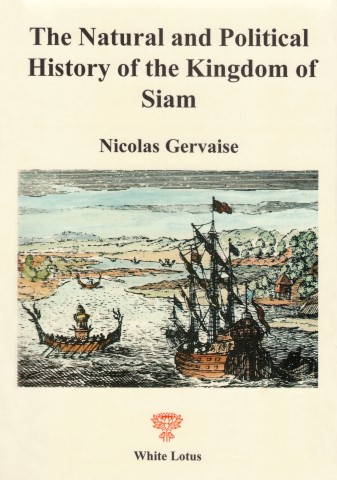
Ars vitraria experimentalis, oder vollkommene Glasmacher-Kunst : lehrende als in einem, aus unbetrüglicher Erfahrung, herfliessendem Commentario, über die von dergleichen Arbeit beschriebene sieben Bücher P. Anthonii Neri
Ars vitraria experimentalis, or perfect glassmaking art: teaching as in a commentario flowing from unmistakable experience, about the seven books described by such work P. Anthonii Neri
Book
Kunckel, J. (1689) Ars vitraria experimentalis, oder vollkommene Glasmacher-Kunst : lehrende als in einem, aus unbetrüglicher Erfahrung, herfliessendem Commentario, über die von dergleichen Arbeit beschriebene sieben Bücher P. Anthonii Neri. [Ars vitraria experimentalis, or perfect glassmaking art: teaching as in a commentario flowing from unmistakable experience, about the seven books described by such work P. Anthonii Neri] New York, Hildesheim, viii, 472  pp.
Record No. 7349  |  Sinkankas/Born No.: NIS/NIB  |  Language: in German  |  RWHL
Johann Kunckel’s Ars vitraria experimentalis, oder vollkommene Glasmacher-Kunst is an expanded German edition and experimental commentary on Antonio Neri’s L’Arte vetraria, incorporating Kunckel’s own extensive practical experience in glassmaking and chemistry. The work describes the preparation of glass, furnaces, raw materials, coloring agents, purification, crystal glass, enamels, artificial gems, and numerous specialized glass compositions, while critically testing and supplementing Neri’s recipes. Of particular interest to gemologists are its methods for producing colored glasses and imitations of precious stones, including materials intended to resemble ruby, sapphire, emerald, and other gems. Kunckel’s emphasis on experiment and reproducible workshop practice makes the work an important source for the history of glass technology, synthetic gem imitations, and the transition from alchemical craft traditions toward experimental chemistry in the late 17th century.

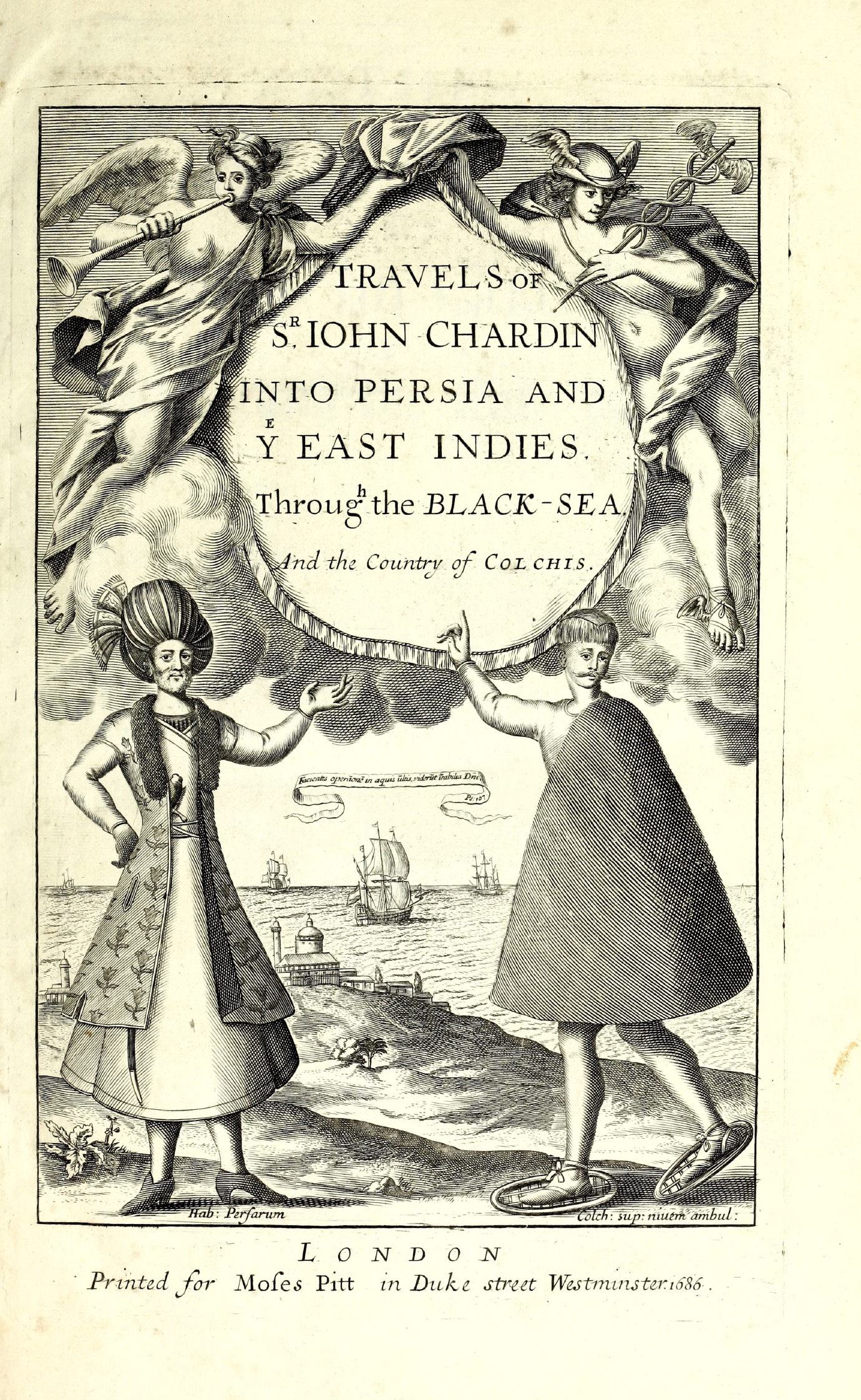
The Natural and Political History of the Kingdom of Siam A.D. 1688
Book
Gervaise, N. (1688) The Natural and Political History of the Kingdom of Siam A.D. 1688. Bangkok, White Lotus, 254 pp.
Record No. 2775  |  ISBN/ISSN: 9748495337  |  RWHL
The Natural and Political History of the Kingdom of Siam is the most authoritative of the numerous French accounts of Siam published in the last twenty years of the 17th century as a result of the establishment of formal diplomatic and commercial relations between Siam and France that led to an exchange of a series of embassies during the 1680s between the courts of Versailles and Ayutthaya and led to a spate of missionary activity, prompted chiefly by hopes that King Narai of Siam might be converted to Catholicism. 3 pp. of illustrations, 2 folded maps.

A New and Accurate Description of Persia

Book
Chardin, J. (1686) A New and Accurate Description of Persia. London, Moses Pitt, 2 Vols.
Record No. 29163  |  Sinkankas/Born No.: NIS/NIB  |  RWHL
Jean Chardin’s A New and Accurate Description of Persia is an English account of Safavid Persia based on the author’s extensive travels and residence there. Chardin describes the country’s geography, government, court, religion, customs, cities, architecture, manufactures, commerce, and natural products, drawing heavily on firsthand observation. As a trained jeweler and gem merchant, he provides particularly valuable information on precious stones, pearls, jewelry, goldsmithing, gem cutting, valuation, and the trade in luxury goods, including materials reaching Persia from India and other parts of Asia. His observations on gems and jewelry are among the most important 17th-century European accounts of the subject, combining a merchant’s practical knowledge with detailed descriptions of the Safavid court and international trade. The work is consequently a major source for the history of gemology, jewelry, and the gemstone trade in Persia and western Asia.

Exploring the Literature of Corundum

Ruby and sapphire research spans mineralogy, gem deposits, identification, treatments, synthesis and the history of the gem trade. Older publications can also be useful for tracing terminology, early observations and accounts of mining localities. Publication dates and the original source should be considered when using historical descriptions.

For an introduction to collecting books on this subject, read Ruby & Sapphire Books: Collecting the Literature of Corundum.

About Four Treasures

Four Treasures is Lotus Gemology's freely accessible gemological reference database. Use the full database to search by author, title or keyword and explore literature on gemology, mineralogy, jewelry and related fields. Where available, hyperlinks on titles may lead directly to the full publication.

Search the Complete Four Treasures Database