Ruby & Sapphire Bibliography

Ruby & Sapphire Bibliography

Explore books, articles and historical sources on ruby, sapphire and corundum in Four Treasures, the Lotus Gemology reference database. This bibliography brings together matching records from the collection, with publication details, abstracts and cover images where available.

Ruby & Sapphire References

The list below matches the terms ruby, rubies, sapphire or corundum in the database's searchable fields. Some references discuss these gems as part of a broader subject. Linked titles take you to external links where you may find the full reference.

4,081–4,100 of 4,671 matching references

Rubies and Kashans: Can you tell the difference?

Rubies and Kashans: Can you tell the difference?

Book
Kashan (n.d., ca. 1980) Rubies and Kashans: Can you tell the difference? Austin, TX, Kashan, promotional pamphlet, 10 pp.
Record No. 1080  |  Sinkankas/Born No.: NIS/NIB  |  RWHL

[Various promotional brochures]

Various promotional brochures
Book
J.O. Crystal Co. (n.d.) [Various promotional brochures]. Long Beach, CA, J.O. Crystal Co.
Record No. 1044  |  Sinkankas/Born No.: NIS/NIB  |  RWHL
Royal American Sapphire

Royal American Sapphire

Book
Intergem Inc. (n.d., ca. 1983) Royal American Sapphire. Aurora, CO, Intergem Inc., 12 pp.
Record No. 1039  |  Sinkankas/Born No.: NIS/NIB  |  RWHL

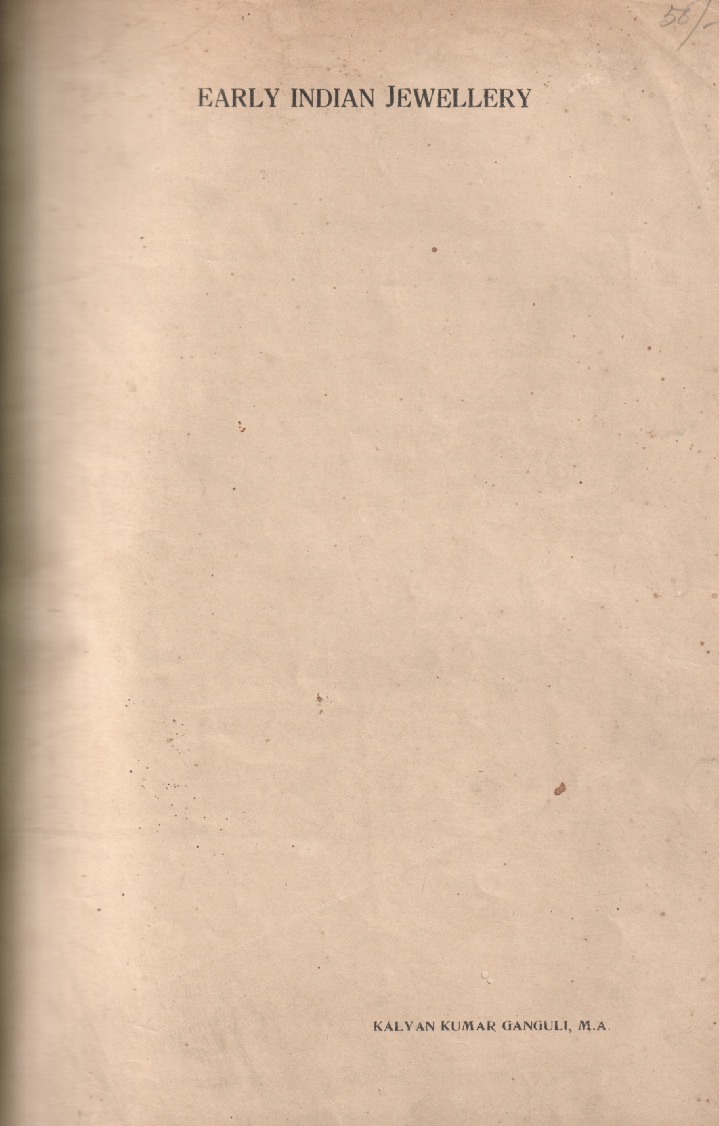
Early Indian Jewellery

Book
Ganguli, K.K. (n.d.) Early Indian Jewellery. no city, self-published, 33 pp.
Record No. 808  |  Sinkankas/Born No.: NIS/NIB  |  RWHL
Interesting discussion of the Indus Valley Culture period of Indian jewellery. Includes information on the iconography and various types of ornaments.
Mineral and Geological Study of Areas to be Inundated Under the Accelerated Mahaweli and other programs
Mineral and Geological Study of Areas to be Inundated Under the Accelerated Mahaweli and other programs

Report
Davidson, B. (n.d.) Mineral and Geological Study of Areas to be Inundated Under the Accelerated Mahaweli and other programs. Colombo: Corporate Finance and Management Services Ltd.,
Record No. 655  |  RWHL

Sri Lanka—A gemstone buyer’s dream

Journal Article
Coughlin, D.G. (n.d.) Sri Lanka—A gemstone buyer’s dream. Gemmology Canada, Special Edition, pp. 1–16.
Record No. 614  |  RWHL

[58.33 ct sapphire bracelet]

58.33 ct sapphire bracelet
Journal Article
Christie’s Magazine (ca. 1982–83) [58.33 ct sapphire bracelet]. Christie’s Magazine,
Record No. 570  |  RWHL

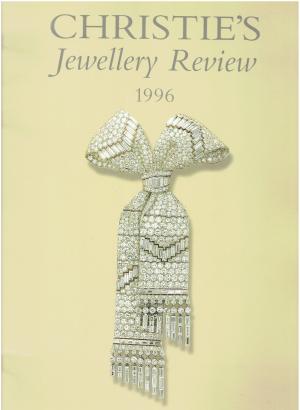
Christie’s Jewellery Review 1996

Book
Christie’s (n.d.) Christie’s Jewellery Review 1996. no city, Christie’s, 40 pp.
Record No. 569  |  Sinkankas/Born No.: NIS/NIB  |  RWHL

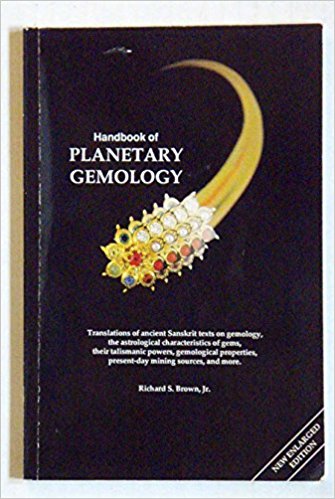
Handbook of Planetary Gemology

Book
Brown, R.S. (n.d., ca. 1988) Handbook of Planetary Gemology. Hong Kong, McKinney International (Publication Concepts), 88 pp.
Record No. 537  |  Sinkankas/Born No.: 969; NIB  |  RWHL
Sinkankas: This work presents translations of chapters 68–80 of the Sanskrit Garuḍa Purāṇa, which “elaborately describes the supernatural origin of gems and their mineralogical properties,” along with the Graha-cocāra Jyautiṣa, a text that “gives complete information on the astrological characteristics and effects of the principal gemstones” and “explains how auspicious gems help remove obstructions in various areas of life by appeasing planets that are having unfavorable effects.” The first thirteen chapters focus on planetary gemstones, offering summary translations of relevant Garuḍa Purāṇa passages concerning ruby, pearl, yellow sapphire, hessonite, emerald, diamond, cat’s-eye chrysoberyl, blue sapphire, coral, red garnet, jade (including jadeite), rock crystal, and bloodstone. Secondary planetary gemstones, or uparatnas, such as red spinel, moonstone, yellow topaz, citrine, hyacinth, peridot, tsavorite, green tourmaline, white zircon, turquoise, goshenite, amethyst, apatite cat’s-eye, blue spinel, tanzanite, lapis lazuli, and carnelian, are not directly traced to specific textual sources, and some—like tsavorite, goshenite, and tanzanite—were unknown to the ancients, suggesting these may have been included at the authors’ discretion. Each gemstone description includes its properties and modern sources, and although there is no bibliography, a valuable feature of the work is its inclusion of alternative Sanskrit names for the gemstones.
Northern Pakistan: Principal mining locations

Northern Pakistan: Principal mining locations

Map
Blauwet, D. (n.d.) Northern Pakistan: Principal mining locations. No city: Morphogenesis.
Record No. 473  |  RWHL
Blue gahnites, blue, yellow and green sapphires and brown zircons from Nigeria
Blue gahnites, blue, yellow and green sapphires and brown zircons from Nigeria

Journal Article
Bank, H. (ca. 1986) Blue gahnites, blue, yellow and green sapphires and brown zircons from Nigeria. Call Idar-Oberstein, p. 13.
Record No. 430  |  RWHL

Thrones, Tents and their Furniture used by the Indian Mughuls

Book
Aziz, A. (n.d.) Thrones, Tents and their Furniture used by the Indian Mughuls. Lahore, privately published, 145 pp.
Record No. 400  |  Sinkankas/Born No.: NIS/NIB  |  RWHL
Aziz’s Thrones, Tents and their Furniture Used by the Indian Mughuls examines the ceremonial furnishings and portable splendour of the Mughal court in India. Drawing on contemporary chronicles, travellers’ accounts and other historical sources, the work describes imperial thrones, richly appointed tents, canopies, carpets, cushions and related furnishings used in palaces, encampments and public ceremonies. Particular attention is given to the materials, decoration and costly workmanship of these objects, including the extensive use of gold, silver, textiles, enamel and precious stones. The celebrated jewelled thrones of the Mughal emperors form an important part of the study, illustrating the extraordinary quantities of diamonds, rubies, emeralds, pearls and other gems employed in imperial display. The book shows how thrones, tents and their furnishings transformed both permanent and temporary settings into expressions of Mughal sovereignty, wealth and magnificence.
Feasibility Study, Sapphire Project

Feasibility Study, Sapphire Project

Report
Ariesen, F.H. (n.d.) Feasibility Study, Sapphire Project. River Kwai Sapphire Company Ltd., n.d.,
Record No. 386  |  RWHL
History of Rock Creek sapphires

History of Rock Creek sapphires

Journal Article
Anonymous (n.d.) History of Rock Creek sapphires. Unpublished article manuscript, 8 pp..
Record No. 378  |  RWHL
Kashmir ruby and tourmaline to debut at Tucson

Kashmir ruby and tourmaline to debut at Tucson

Report
American Gemological Laboratories (n.d., ca. 1992) Kashmir ruby and tourmaline to debut at Tucson. American Gemological Laboratories,
Record No. 232  |  RWHL
Defects associated with Sn (±Ti) and H in corundum (Al₂O₃)
Defects associated with Sn (±Ti) and H in corundum (Al₂O₃)

Journal Article
Jollands, M.C., Bishop, K., Smith, T., Jin, S. and Balan, E. (2025) Defects associated with Sn (±Ti) and H in corundum (Al₂O₃). Materialia, Vol. 41,
Record No. 28636  |  ISBN/ISSN: ISSN 2589-1529  |  DOI: https://doi.org/10.1016/j.mtla.2025.102434  |  Sinkankas/Born No.: NIS/NIB  |  not seen
The mechanisms by which H is incorporated into corundum crystals containing elevated concentrations of Sn is studied using a combination of experimental infrared spectra and density functional theory (DFT) calculations. The spectra (both bulk and spatially resolved), along with trace element concentrations, were recorded from samples passing through the laboratories of the Gemological Institute of America. We propose that bands in the FTIR spectra of corundum at 3197, 3235, 3249, 3262 and 3285 cm-1 can all be attributed to OH stretching associated with defects including one or two Sn4+, H+ and Al-site vacancies. Some of the defects also include Ti4+, i.e. are mixed Sn-Ti defects. Specifically, we attribute the following bands to these defects: 3197 and 3235 cm-1: (SnAl•VAl″′OHo•)′ (two configurations); 3249 cm-1: (SnAl•SnAl•VAl″′OHo•)×; 3262 and 3285 cm-1: (SnAl•TiAl•VAl″′OHo•)× (two configurations). All bands show similar polarization behavior, with the strongest absorption when the electric vector is perpendicular to the c-axis.

Orange luminescence of α-Al₂O₃ related to clusters consisting of F centers and divalent cations
Journal Article
Vigier, M., Massuyeau, F. and Fritsch, E. (2024) Orange luminescence of α-Al₂O₃ related to clusters consisting of F centers and divalent cations. Luminescence, Vol. 39, No. 5,, 5/1/24 e4757.
Record No. 28182  |  ISBN/ISSN: 1522-7235  |  DOI: https://doi.org/10.1002/bio.4757  |  Sinkankas/Born No.: NIS/NIB  |  not seen
The orange luminescence of α-Al₂O₃ under UV excitation is characterized by a 2.07-eV orange broadband emission that has not yet been elucidated. This emission is present in natural and synthetic crystals and powders, as well as in Be-treated samples. All orange-luminescent materials have low Fe concentration (mostly < 1000 ppm) with traces of divalent cations, mostly Mg, or Be in Be-diffused material (dozens of ppm). Mg²⁺, Mn²⁺, and Be²⁺ cations substitute for trivalent Al. To accommodate the charge deficit, several defects are created, including oxygen vacancies also called F centers. Indeed, our excitation spectra revealed the presence of several different F centers (F, F⁺, and clustered F₂, F₂⁺, F₂²⁺) in those samples. However, the thermal stability and the measured luminescence lifetimes do not match previously reported characteristics of isolated F centers. Based on our experiments, we suggest that a complex aggregate of two F centers (F₂²⁺) trapped at divalent cations is a major cause of this uncommon microsecond lifetime emission, even if a variety of other defects, including Cr³⁺, V³⁺, or interstitial Al³⁺, are present.

Trace element geochemistry and U-Pb dating of zircon inclusions in sapphire from Southern Vietnam: Indicator of basalt-related sapphire formation
Journal Article
Thi Anh Vu, D., Fanka, A. and Sutthirat, C. (2023) Trace element geochemistry and U-Pb dating of zircon inclusions in sapphire from Southern Vietnam: Indicator of basalt-related sapphire formation. Journal of Asian Earth Sciences, Vol. 245,, 2023/04/15/ 105537.
Record No. 7848  |  ISBN/ISSN: 13679120  |  DOI: https://doi.org/10.1016/j.jseaes.2022.105537  |  not seen
Trace element geochemistry of zircon inclusion in sapphire from Southern Vietnam shows a large variation in Hf (1.1 to 2.7 wt%), Y (779 – 4220 ppm), Th (329 – 5199 ppm), U (224 – 3587 ppm), and ∑REE (706 – 2710 ppm) abundances with clearly positive Ce and mildly negative Eu anomalies observed in chondrite-normalized REE patterns. These characteristics suggest that the majority of the host sapphires were crystallized from evolved felsic melt at the lower crustal levels. The U-Pb zircon dating yields the ages ranging between 35.5 ± 1.6 Ma and 14.7 ± 0.29 Ma for Krong Nang sapphire, 5.9 ± 0.13 Ma for Binh Thuan sapphire, 5.6 ± 0.07 Ma for Dak Nong sapphire, and 5.5 ± 0.08 Ma for Di Linh sapphire. Except the Krong Nang sapphire, these ages are coeval with the alkali basalt eruptions in Southern Vietnam. This implies the crystallization of sapphire during early stages of the basaltic magmatism. Sapphire and associated minerals were extensively transported from different depths to the surface during the later stages of basalt magmatism (≤5 Ma).

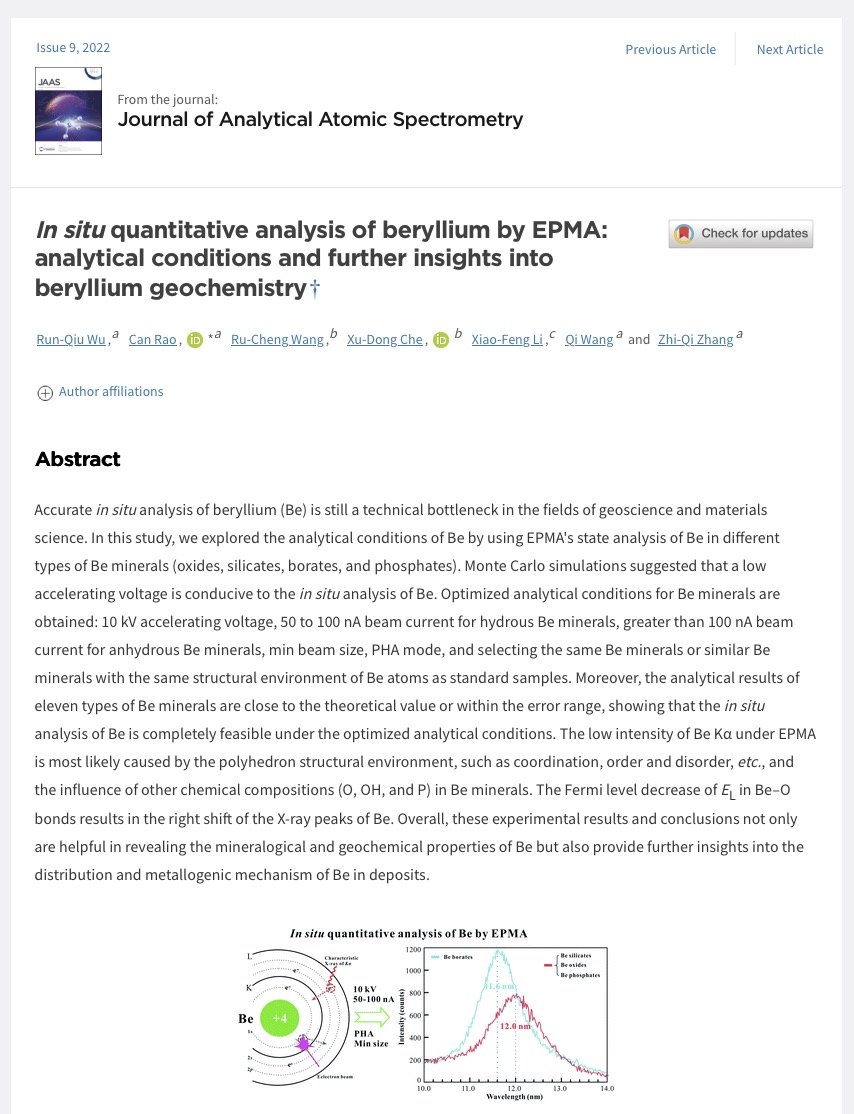
In situ quantitative analysis of beryllium by EPMA: analytical conditions and further insights into beryllium geochemistry
Journal Article
Wu, R.-Q., Rao, C., Wang, R.-C., Che, X.-D., Li, X.-F., Wang, Q. and Zhang, Z.-Q. (2022) In situ quantitative analysis of beryllium by EPMA: analytical conditions and further insights into beryllium geochemistry. Journal of Analytical Atomic Spectrometry, Vol. 37, No. 9, pp. 1824–1834.
Record No. 27014  |  ISBN/ISSN: 2679477  |  DOI: http://dx.doi.org/10.1039/D2JA00103A  |  Sinkankas/Born No.: NIS/NIB  |  not seen
Accurate in situ analysis of beryllium (Be) is still a technical bottleneck in the fields of geoscience and materials science. In this study, we explored the analytical conditions of Be by using EPMA's state analysis of Be in different types of Be minerals (oxides, silicates, borates, and phosphates). Monte Carlo simulations suggested that a low accelerating voltage is conducive to the in situ analysis of Be. Optimized analytical conditions for Be minerals are obtained: 10 kV accelerating voltage, 50 to 100 nA beam current for hydrous Be minerals, greater than 100 nA beam current for anhydrous Be minerals, min beam size, PHA mode, and selecting the same Be minerals or similar Be minerals with the same structural environment of Be atoms as standard samples. Moreover, the analytical results of eleven types of Be minerals are close to the theoretical value or within the error range, showing that the in situ analysis of Be is completely feasible under the optimized analytical conditions. The low intensity of Be Kα under EPMA is most likely caused by the polyhedron structural environment, such as coordination, order and disorder, etc., and the influence of other chemical compositions (O, OH, and P) in Be minerals. The Fermi level decrease of EL in Be–O bonds results in the right shift of the X-ray peaks of Be. Overall, these experimental results and conclusions not only are helpful in revealing the mineralogical and geochemical properties of Be but also provide further insights into the distribution and metallogenic mechanism of Be in deposits.

La luminescence orange des corindon, une origine pas classique pour les gemmologues – Partie II

Orange luminescence of corundum, an atypical origin for gemmologists – Part II
Journal Article
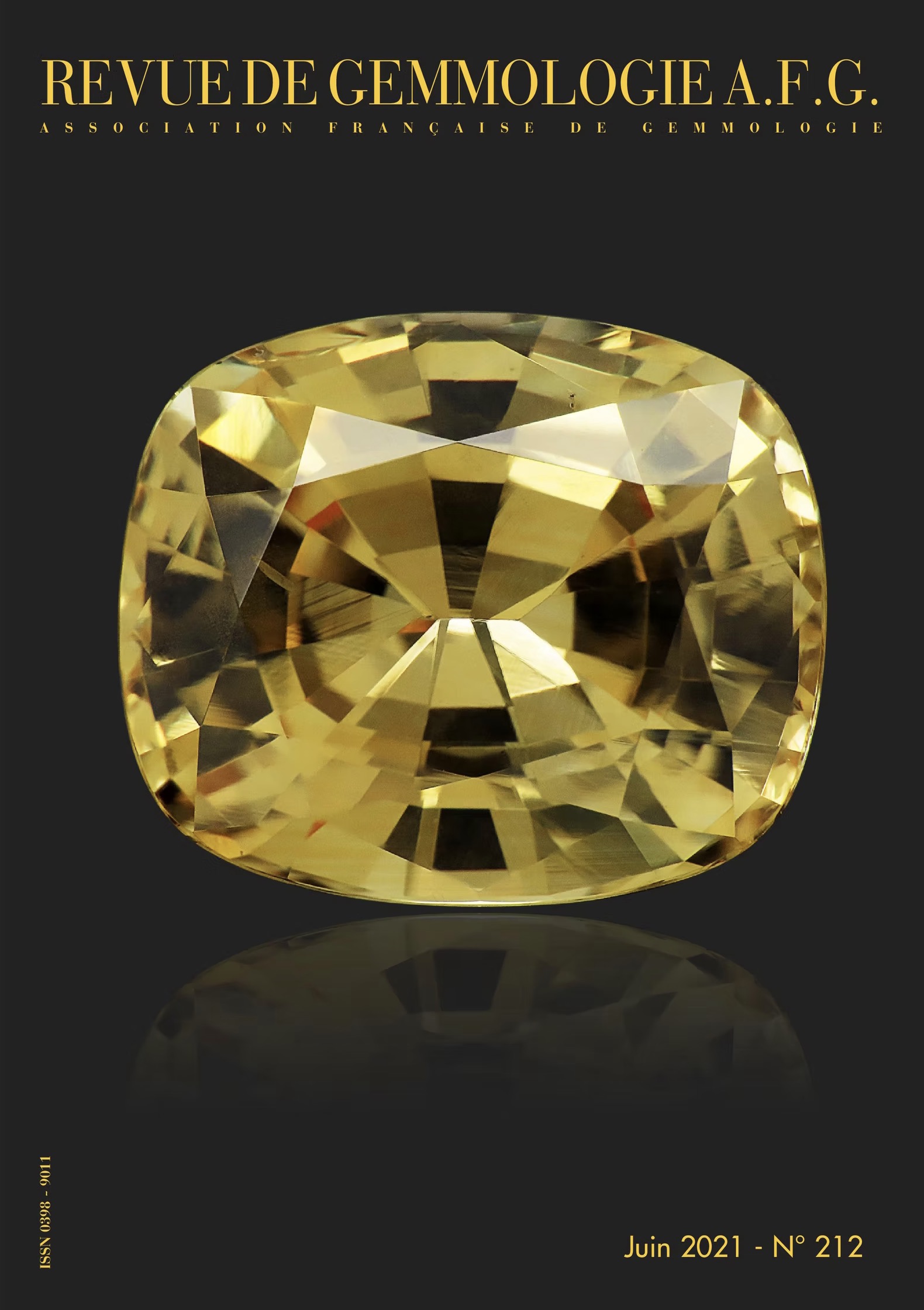
Vigier, M., Fritsch, E. and Segura, O. (2021) La luminescence orange des corindon, une origine pas classique pour les gemmologues – Partie II. [Orange luminescence of corundum, an atypical origin for gemmologists – Part II] Revue de Gemmologie A.F.G., No. 212, pp. 13–19.
Record No. 28183  |  Sinkankas/Born No.: NIS/NIB  |  Language: in French  |  not seen
The second part of a study of apricot" orange luminescence in corundum, examining a luminescence mechanism that differs from those more commonly encountered by gemologists. The authors discuss the origin of this unusual orange emission and its relationship to the chemical and spectroscopic characteristics of corundum, with implications for interpreting fluorescence and luminescence observations in gemological testing."

Exploring the Literature of Corundum

Ruby and sapphire research spans mineralogy, gem deposits, identification, treatments, synthesis and the history of the gem trade. Older publications can also be useful for tracing terminology, early observations and accounts of mining localities. Publication dates and the original source should be considered when using historical descriptions.

For an introduction to collecting books on this subject, read Ruby & Sapphire Books: Collecting the Literature of Corundum.

About Four Treasures

Four Treasures is Lotus Gemology's freely accessible gemological reference database. Use the full database to search by author, title or keyword and explore literature on gemology, mineralogy, jewelry and related fields. Where available, hyperlinks on titles may lead directly to the full publication.

Search the Complete Four Treasures Database