Ruby & Sapphire Bibliography

Ruby & Sapphire Bibliography

Explore books, articles and historical sources on ruby, sapphire and corundum in Four Treasures, the Lotus Gemology reference database. This bibliography brings together matching records from the collection, with publication details, abstracts and cover images where available.

Ruby & Sapphire References

The list below matches the terms ruby, rubies, sapphire or corundum in the database's searchable fields. Some references discuss these gems as part of a broader subject. Linked titles take you to external links where you may find the full reference.

4,121–4,140 of 4,671 matching references

Prediction of exploration target areas for gem deposits in Mogok Stone Tract, northern Myanmar, by integrating remote sensing and geoscience data
Prediction of exploration target areas for gem deposits in Mogok Stone Tract, northern Myanmar, by integrating remote sensing and geoscience data

Journal Article
Oo, T.K. (2010) Prediction of exploration target areas for gem deposits in Mogok Stone Tract, northern Myanmar, by integrating remote sensing and geoscience data. Advances in Geosciences, Vol. 26, pp. 181–198.
Record No. 3025  |  not seen
The Mogok Stone Tract area has long been known for world-famous finest ruby since 1597. The Mogok area lies in northern Myanmar and is located at about 205.99 km northeast from Mandalay, the second largest city of Myanmar. The Mogok Group of metasedimentary rocks is divided into four units: (1) Wabyudaung Marble, (2) Ayenyeinchantha Calc-silicate, (3) Gwebin Quartzite, and (4) Kabe Gneiss. Igneous rocks in the Mogok area are classified into two units: (1) Kabaing Granite and (2) Pingutaung Leucogranite. The Mogok area has a complex structure involving several folds and faults. Using marbles and calc-silicates as marker horizons, a series of anticline and syncline can be identified such as Mogok Syncline, Ongaing Anticline, Bawpadan Syncline, and Kyatpyin Anticline. All the foldings show a low-angle plunge to the south. The main precious stones of the Mogok area are ruby and sapphire; and the other important semi-precious stones are spinel, topaz, peridot, garnet, apatite, beryl, tourmaline (rubellite), quartz, diopside, fluorite, and enstatite. Geological and remote sensing data are processed to extract the indicative features of gem mineralized areas: lithology, structure, and hydrothermal alteration. Density slice version of Landsat ETM band ratios 5/7 is used to map clay alterations. Filtering Landsat ETM band 5 by using edge detection filter is applied for lineament mapping. Spatial integration of various geoscience and remote sensing data sets such as geological maps, Landsat ETM images, and the location map of gem mines show the distribution of alteration zones associated with the gem mineralization in the study area. Geographic Information System (GIS) model has been designed and implemented by ARCVIEW software package based on the overlay of lithologic, lineament, and alteration vector maps. This process has resulted in delineation of most promising areas of probable gem mineralized zones as on the output map.

Les gisements de saphirs et rubis associés aux basaltes alcalins de Madagascar: Caractéristiques géologiques et minéralogiques 1ère partie: caractéristiques géologiques des gisements
The sapphire and ruby deposits associated with alkaline basalts of Madagascar: Geological and mineralogical characteristics. Part 1: Geological characteristics of the deposits
Journal Article
Rakotosamizanany, S., Giuliani, G., Ohnenstetter, D., Rakotondrazafy, A.F.M. and Fallick, A.E. (2009) Les gisements de saphirs et rubis associés aux basaltes alcalins de Madagascar: Caractéristiques géologiques et minéralogiques 1ère partie: caractéristiques géologiques des gisements. [The sapphire and ruby deposits associated with alkaline basalts of Madagascar: Geological and mineralogical characteristics. Part 1: Geological characteristics of the deposits] Revue de Gemmologie A.F.G., No. 169, pp. 13–21.
Record No. 7748  |  Language: in French  |  not seen
Madagascar is one of the principal producers of gem corundums recovered from continental basaltic fields. The main deposits are the secondary deposits of Ambondromifehy from the Antsiranana Province in the northern part of the country (sapphire-bearing palaeoplacer and placer), Soamiakatra–Mandrosohasina from the Antananarivo Province in the central part (primary ruby deposit, and ruby and/or sapphire-bearing placer and palaeoplacer), and Vatomandry from the Toamasina Province in the eastern part of the island (ruby- and sapphire-bearing paleoplacer). Soamiakatra is the only known primary deposit where ruby is found in metagabbro and pyroxenite xenoliths, which were entrained and brought up to the upper crust by the Ankaratra volcanic event. Petrographic studies have demonstrated the existence of two different conditions of ruby formation at the boundary of the eclogite domain (HT ~1100 °C, HP ~20 kbar) and granulite facies (HT ~1100 °C, BP <15 kbar). In contrast, the sapphires originated from alkaline mafic magmatic chambers at the lower continental crust–mantle boundary. They occur within syenite and anorthoclasite xenoliths in the basalts or are associated with them. These alkali basalts transported corundum and their host rocks to the surface; they are linked with asthenosphere upwelling and thinning of the lithosphere underneath the Ankaratra Plateau during the Oligocene–Quaternary. The mineralogical study of ruby and sapphire permitted us to establish the relationships that exist between their chemical composition, their colour, and the nature of their solid inclusions. Iron is the main chromophore of sapphire, and the Fe²⁺/Fe³⁺ ratio in its structure, in addition to the quantity of titanium and chromium available in the fluid, determines the colour of the sapphire and the hue of the polychrome sapphires. Chromium is the second most important chromophore for pink, violet-blue, and some blue-green to light-blue sapphires. For ruby, chromium is the chromophore, but iron and vanadium interfere to produce red-brown to purplish-blue crystals. The deeply coloured, high-quality rubies are characterized by a Fe₂O₃/Cr₂O₃ ratio less than 1. The chemical diagrams used for the genetic classification of corundum indicate a metamorphic origin for all rubies from the central and eastern regions of Madagascar: rubies are hosted either by mafic and/or ultramafic rocks or by metasomatites formed by fluid–mafic rock alteration (“plumasite” or biotitite). Two processes have been identified to explain the origin of sapphires from the different regions: (i) a dominant magmatic process linked to syenites (anorthoclasite), and (ii) a metamorphic process (probably of skarn type). The oxygen isotopic compositions of the corundum corroborate these two origins. Solid inclusions such as pyrochlore, samarskite, uraninite, and anorthoclase in the sapphires confirm their syenitic origin. The presence of pentlandite, talc, sillimanite, titanite, and phlogopite in the rubies testifies to a metamorphic paragenesis.

Les gisements de saphirs et rubis associés aux basaltes alcalins de Madagascar: Caractéristiques géologiques et minéralogiques 2ème partie: Caractéristiques minéralogiques

Sapphire and ruby deposits associated to alkali basalts in Madagascar: Geological and mineralogical characteristics, Part 2: Mineralogical characteristics
Journal Article
Rakotosamizanany, S., Giuliani, G., Ohnenstetter, D., Rakotondrazafy, A.F.M. and Fallick, A.E. (2009) Les gisements de saphirs et rubis associés aux basaltes alcalins de Madagascar: Caractéristiques géologiques et minéralogiques 2ème partie: Caractéristiques minéralogiques. [Sapphire and ruby deposits associated to alkali basalts in Madagascar: Geological and mineralogical characteristics, Part 2: Mineralogical characteristics] Revue de Gemmologie A.F.G., No. 170, pp. 9–18 [in French]..
Record No. 7747  |  Language: in French  |  not seen
New geological origin: Ruby from Mozambique
New geological origin: Ruby from Mozambique

Journal Article
Kawano, J., Kitawaki, H., Abduriyim, A. and Okano, M. (2009) New geological origin: Ruby from Mozambique. Gemmology, Vol. 40, No. 483, pp. 13–15.
Record No. 7739  |  Language: in Japanese with English translation  |  not seen
Rubies have recently been discovered in northern Mozambique, specifically in Niassa Province (M’sawize village, Lichinga district) and Cabo Delgado Province (Montepuez area). These rubies display internal features such as twin planes, fluid-film inclusions, negative crystals, and crystalline inclusions. Many of the crystalline inclusions are colorless to green amphibole (possibly pargasite), along with confirmed apatite and fine needles producing “silk.” Some fractures contain material resembling hematite. Infrared spectra of unheated Mozambique rubies show a broad absorption band at 3309 and 3081 cm⁻¹, which disappears after heating; weak bands at 2074 and 1980 cm⁻¹, likely from diaspore, may also be present. EDXRF analysis reveals Cr contents of 0.3–0.8 wt.% and Fe contents of 0.2–0.5 wt.%, higher than typical non-basalt-related rubies but lower than basaltic rubies. Most Mozambique rubies have been heat-treated, often leaving flux residues in fissures.

Winza, ein neues Rubinvorkommen in Tansania
Winza, a new ruby deposit in Tanzania
Journal Article
Schmetzer, K., Radl, W. and Schwarz, D. (2009) Winza, ein neues Rubinvorkommen in Tansania. [Winza, a new ruby deposit in Tanzania] Lapis, Vol. 34, No. 5, pp. 41–46.
Record No. 5267  |  Language: in German  |  not seen
This article supplements previous work by D. Schwarz et al. (“Rubies and Sapphires from Winza, Central Tanzania,” Winter 2008 G&G, pp. 322–347). Along with a short description of the deposit and mining, it provides a detailed description of the crystal morphology. Based on their habits, the crystals could be divided into two groups: prismatic-tabular-rhombohedral and dipyramidal. In both groups, some unusual combinations of crystal faces occurred, such as pseudo-octahedral crystals (strongly resembling spinels) with negative rhombohedral faces as dominant forms.

The structure and chemical composition of trapiche blue sapphire from southern Vietnam and Cambodia
Journal Article
Khotchanin, K., Thanasuthipitak, P. and Thanasuthipitak, T. (2009) The structure and chemical composition of trapiche blue sapphire from southern Vietnam and Cambodia. Journal of the Gemmological Association of Hong Kong, Vol. 30, pp. 25–35.
Record No. 5263  |  not seen
While trapiche emerald is well known, trapiche corundum (especially blue sapphire) is considerably rarer. The authors examined 33 blue sapphires from Vietnam and 27 from Cambodia. The majority showed trapiche structure, but non-trapiche specimens were included for comparison. The trapiche sapphires typically featured a brown core and brown to yellowish brown arms separating the sections of blue crystal; dotted and needle-like inclusions were also seen. Iron and titanium were both present in the samples, but the iron was concentrated in the trapiche core while the titanium was evenly distributed for the most part. The authors also compared the visual characteristics of trapiche rubies and sapphires, as well as trapiche vs. star phenomena. The trapiche structure could point to a multi-stage growth process that starts at the core, with the arms and blue crystal segments growing concurrently but at different rates.

The oxygen isotopic composition as an indicator of the genesis of “basaltic” corundum

Journal Article
Vysotsky, S., Yakovenko, V., Ignat'ev, A. and Karabtsov, A. (2009) The oxygen isotopic composition as an indicator of the genesis of “basaltic” corundum. Russian Journal of Pacific Geology, Vol. 3, No. 1, February, pp. 64–68.
Record No. 5190  |  DOI: http://dx.doi.org/10.1134/S1819714009010060  |  not seen
Abstract This paper reports an oxygen isotopic study of corundums and associated minerals from the Yogo lamprophyres (Montana, US), plagioclase-corundum inclusions in alkali basalt (Tunkin depression, Russia), and from modern alluvium of Podgelbanochnyi alkaline basaltic volcano (Primorye, Russia). It is shown that all sapphires genetically related to mafic magmatic rocks have a similar oxygen isotopic composition (the variations of δ18O are within 2.5‰) with most values plotting between +4.5 and +7.0‰ SMOW. The oxygen isotopic ratios in the associated minerals (olivines, pyroxenes, mica, and others) and host rocks are plotted in the same interval. This indicates that the sapphire crystallized during evolution of the parental mafic magma. However, there are xenogenic corundums, which were only transported by basaltic magma to the Earth’s surface. They have a sharply distinct oxygen isotopic composition, which suggests their disequilibrium with the host lavas, and, correspondingly, a different genetic nature.
Geological Report on Sumcham Sapphire Mines area (Paddar) District Doda
Geological Report on Sumcham Sapphire Mines area (Paddar) District Doda

Unpublished Work
Raj, J. and Rana, R.S. (2008) Geological Report on Sumcham Sapphire Mines area (Paddar) District Doda. unpublished report.
Record No. 16883  |  not seen

Inside rubies

Journal Article
Smith, C.P., Beesley, C.R., Darenius, E.Q. and Mayerson, W.M. (2008) Inside rubies. Rapaport Diamond Report, Vol. 31, No. 47, December 5, pp. 140–149.
Record No. 5536  |  seen

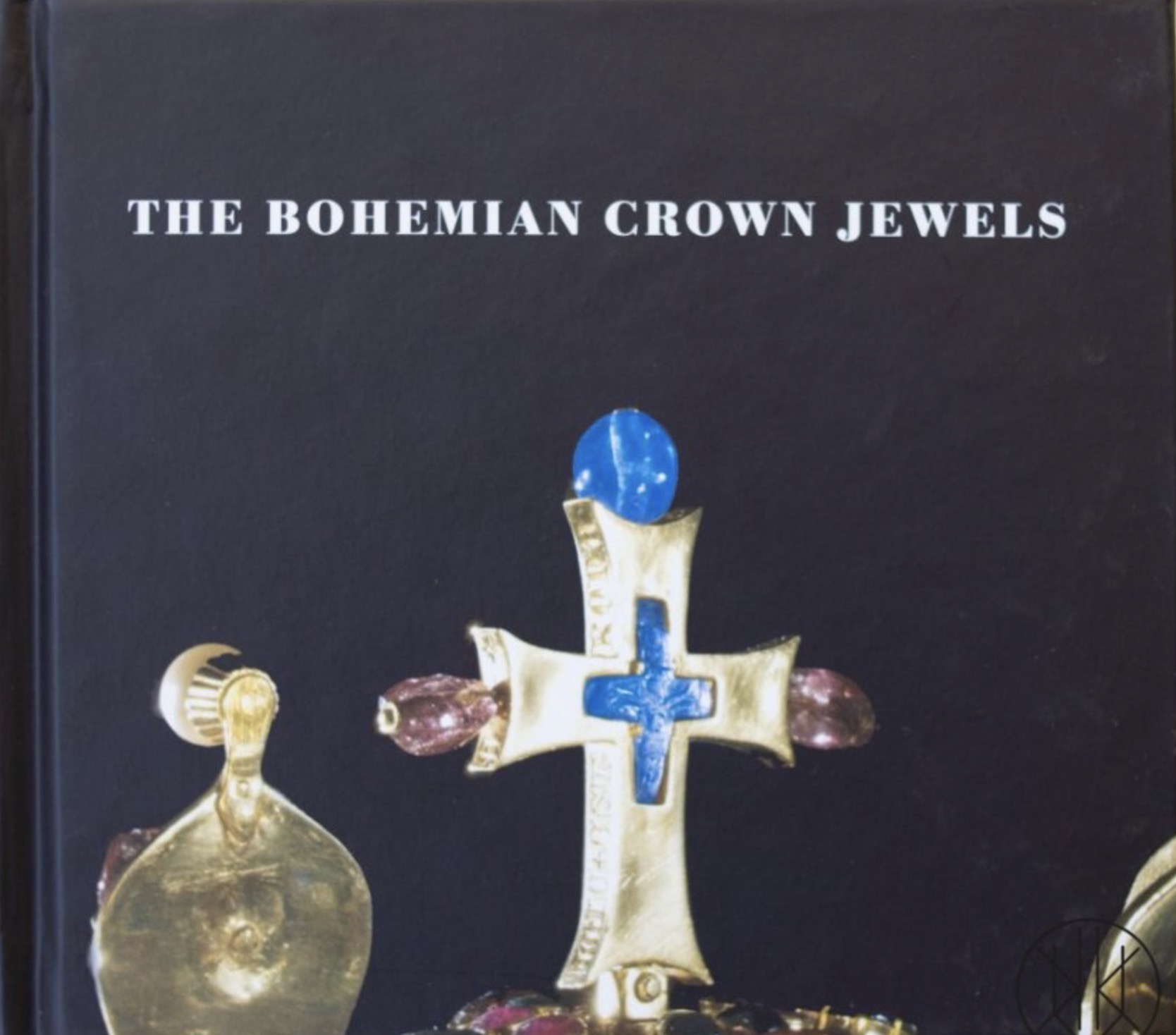
The Bohemian Crown Jewels

Book
Šumbera, A. (2008) The Bohemian Crown Jewels. Prague, self-published, 114 pp.
Record No. 4611  |  Sinkankas/Born No.: NIS/NIB  |  not seen
This pocket-sized work is a photo- graphic catalogue of the Crown Jewels of the Kingdom of Bohemia, which date from the reign of King Charles IV (1316–1378). The book is the product of gemological examinations conduct- ed in 1998 and 2003; a review of these examinations is also provided. Included is a CD-ROM with 600 additional photos.

Nouvelles des travaux sur le beryllium et les saphirs bleus
News on research regarding beryllium and blue sapphires
Journal Article
Pardieu, V. (2008) Nouvelles des travaux sur le beryllium et les saphirs bleus. [News on research regarding beryllium and blue sapphires] Revue de Gemmologie A.F.G., No. 163, pp. 7–9.
Record No. 2941  |  Language: in French  |  not seen

Gem corundum from the St. Arnaud district, Western Victoria, Australia
Journal Article
Birch, W.D. (2008) Gem corundum from the St. Arnaud district, Western Victoria, Australia. Australian Journal of Mineralogy, Vol. 14, No. 2, pp. 73–78.
Record No. 2871  |  not seen
Waterworn sapphire crystals (≤7 mm) showing a wide range of colors (green, dull blue, pale yellow, pink, purple, and pale brown) are found in concentrates from an alluvial gold mine in ferruginous gravel at Carapooee, near St. Arnaud in southeastern Australia. Chemical analysis by LA-ICP-MS suggests that these sapphires were derived from mainly metamorphic and metasomatic source rocks, with a smaller magmatic component, similar to the gem corundums from basalt-related Cenozoic goldfields in eastern Australia.

Gemstone and mineral mining in Pakistan’s mountains

Journal Article
Clanin, J. (2008) Gemstone and mineral mining in Pakistan’s mountains. InColor, Spring, pp. 19–25.
Record No. 2870  |  seen
The Himalayan Mountains in northern Pakistan, though geologically young, host a rich variety of gemstones including tourmaline, aquamarine, topaz, garnet, apatite, emerald, ruby, and sapphire. Mining activity is constrained by high altitudes and harsh weather, limiting operations to a short season. Most deposits are worked by small groups using basic, transportable equipment, often carried by hand or horseback. Notable marble-hosted ruby deposits occur at Ganesh, Gupa Nala, Dhorkan, and Hachinder in the Hunza Valley, where rubies are found in marbles of the Baltit Group, a sequence of metasedimentary rocks. These marbles typically contain phlogopite, margarite, muscovite, zircon, spinel, Mg-tourmaline, pyrite, rutile, and graphite. A newer deposit was also identified near Bisil in the Basha Valley. Pegmatites at Chumar Bakhoor (~4,800 m elevation) have yielded aquamarine and fluorite, while the Stak Nala pegmatites—with about 40 mines—are known for multicolored tourmaline. Hundreds of pegmatites line the steep cliffs along the Indus River, producing aquamarine, black tourmaline, topaz, apatite, and garnet from tunnels reaching depths of 150–180 m. Notably, glacial retreat due to global warming, especially at the Mani glacier, has exposed previously inaccessible gem sites. Pegmatite fields in the Shigar, Braldu, and Basha Valleys cover around 150 km² and lack even basic trails. The absence of modern mining technology, safety protocols, and training poses serious hazards. Rockfalls and landslides are leading causes of fatalities, and approximately 40,000 miners face additional risks such as silicosis and carbon monoxide poisoning. While long-term improvements require infrastructure and education, immediate steps such as using disposable dust masks, portable ventilation, basic first-aid training, and proper climbing gear could mitigate risks. Establishing local gem markets would also help improve selling prices and enhance economic benefits for miners and their communities.
The forms of Kukhilal (Tajikistan) noble spinel crystals and its genetic significance

The forms of Kukhilal (Tajikistan) noble spinel crystals and its genetic significance

Journal Article
Fayziev, A.R. (2007) The forms of Kukhilal (Tajikistan) noble spinel crystals and its genetic significance. Proceedings of the Russian Mineralogical Society, Vol. 136, pp. 363–365.
Record No. 29144  |  Sinkankas/Born No.: NIS/NIB  |  not seen
Minerageny of Sapphire- and Ruby-Bearing Metasomatites of the Southwestern Pamirs
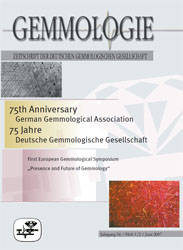
Minerageny of Sapphire- and Ruby-Bearing Metasomatites of the Southwestern Pamirs

и рубиноносные метасоматиты Юго-Западного Памира
Book
Litvinenko, A.K. (2007) Minerageny of Sapphire- and Ruby-Bearing Metasomatites of the Southwestern Pamirs. [и рубиноносные метасоматиты Юго-Западного Памира] Lipetsk, Lipetsk State Pedagogical University, 126 pp.
Record No. 29137  |  Sinkankas/Born No.: NIS/NIB  |  Language: in Russian  |  not seen

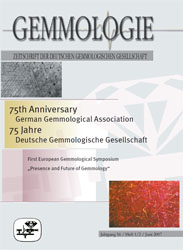
Gem corundums from Nan Khun-Nam Yuen, northeastern Thailand
Journal Article
Wathanakul, P., Atichat, W., Pisutha-Arnond, V., Sutthirat, C. and Schwarz, D. (2007) Gem corundums from Nan Khun-Nam Yuen, northeastern Thailand. Gemmologie: Zeitschrift der Deutschen Gemmologischen Gesellschaft, Vol. 56, No. 1/2, pp. 67–70.
Record No. 5354  |  not seen

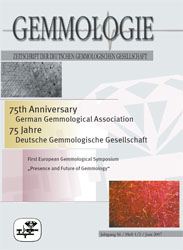
'New beryllium diffusion treatment' proves to be natural corundum surface-coated with cobalt
Journal Article
Smith, C.P. (2007) 'New beryllium diffusion treatment' proves to be natural corundum surface-coated with cobalt. Gemmologie: Zeitschrift der Deutschen Gemmologischen Gesellschaft, Vol. 56, No. 1/2, pp. 57–60.
Record No. 5353  |  not seen

Marble-type ruby deposits

Journal Article
Schwarz, D. and Ohnenstetter, D. (2007) Marble-type ruby deposits. Gemmologie: Zeitschrift der Deutschen Gemmologischen Gesellschaft, Vol. 56, No. 1/2, pp. 51–52.
Record No. 5352  |  not seen

Australian sapphires and rubies

Journal Article
Sutherland, F.L. and Webb, G.B. (2007) Australian sapphires and rubies. Rocks & Minerals, Vol. 82, No. 2, pp. 116–125.
Record No. 5292  |  not seen

Les alchimistes des temps modernes: A la rencontre des “chauffeurs de pierres thaïlandaid”

The alchemists of modern times: Meeting the “Thai stone chauffeurs”
Journal Article
Pardieu, V., Sammuang, K., Chinudompong, A., Somjainuek, T. and Juengsangunsit, M. (2006) Les alchimistes des temps modernes: A la rencontre des “chauffeurs de pierres thaïlandaid”. [The alchemists of modern times: Meeting the “Thai stone chauffeurs”] Revue de Gemmologie A.F.G., No. 156, pp. 10–19.
Record No. 17051  |  Language: in French  |  not seen

Exploring the Literature of Corundum

Ruby and sapphire research spans mineralogy, gem deposits, identification, treatments, synthesis and the history of the gem trade. Older publications can also be useful for tracing terminology, early observations and accounts of mining localities. Publication dates and the original source should be considered when using historical descriptions.

For an introduction to collecting books on this subject, read Ruby & Sapphire Books: Collecting the Literature of Corundum.

About Four Treasures

Four Treasures is Lotus Gemology's freely accessible gemological reference database. Use the full database to search by author, title or keyword and explore literature on gemology, mineralogy, jewelry and related fields. Where available, hyperlinks on titles may lead directly to the full publication.

Search the Complete Four Treasures Database