Ruby & Sapphire Bibliography

Ruby & Sapphire Bibliography

Explore books, articles and historical sources on ruby, sapphire and corundum in Four Treasures, the Lotus Gemology reference database. This bibliography brings together matching records from the collection, with publication details, abstracts and cover images where available.

Ruby & Sapphire References

The list below matches the terms ruby, rubies, sapphire or corundum in the database's searchable fields. Some references discuss these gems as part of a broader subject. Linked titles take you to external links where you may find the full reference.
4,141–4,160 of 4,671 matching references

Les saphirs multicolores de Sahambano et Zazafotsy, région granulitique d’Ihosy, Madagascar

Multicolored sapphires from Sahambano and Zazafotsy, granulitic region of Ihosy, Madagascar
Journal Article
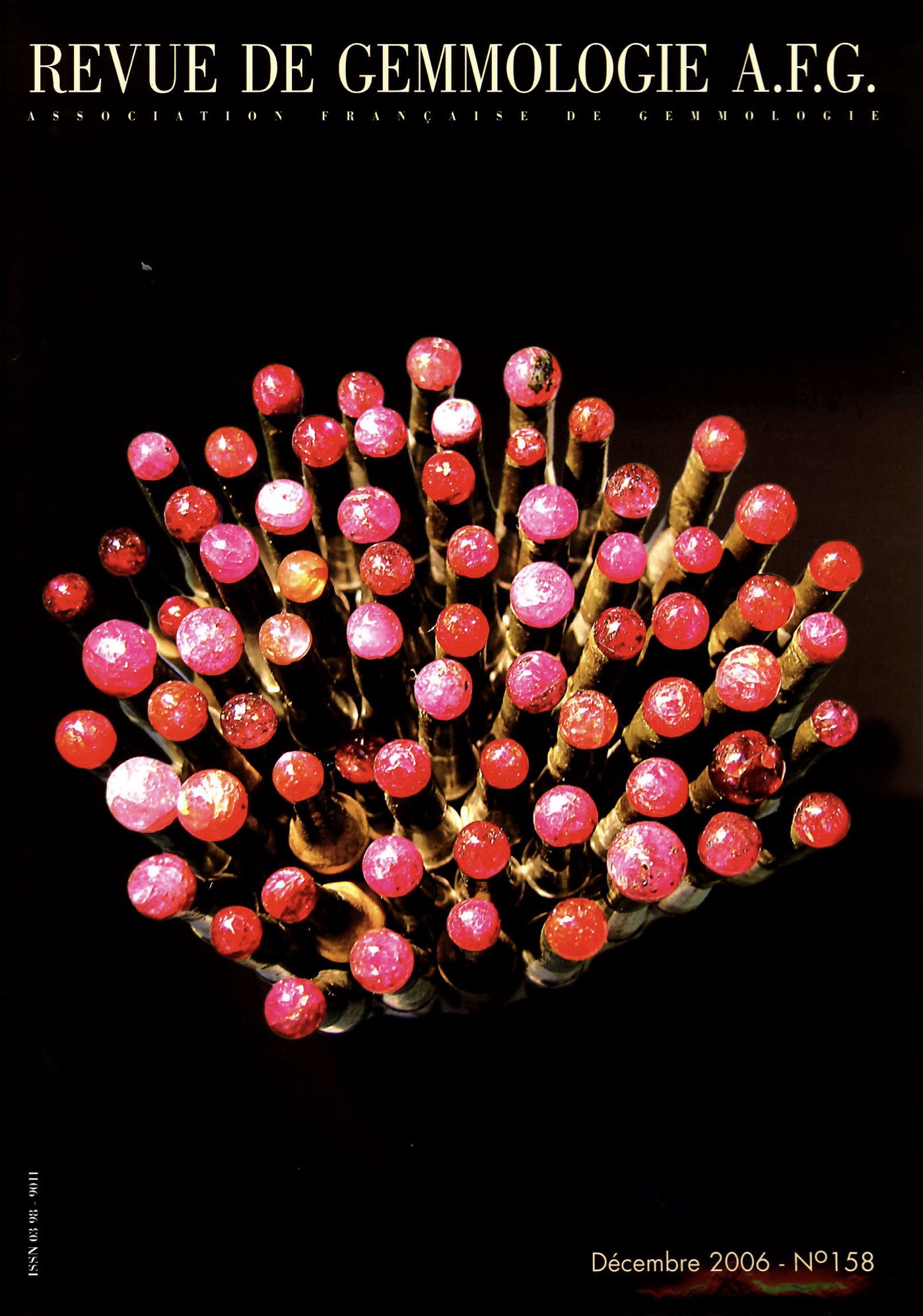
Ralantoarison, T., Andriamamonjy, A., Offant, Y., Giuliani, G., Rakotondrazafy, A.F.M., Ohnenstetter, D., Schwarz, D., Dunaigre, C., Razanatseheno, M., Rakotosamizanany, S., Moine, B. and Baillot, P. (2006) Les saphirs multicolores de Sahambano et Zazafotsy, région granulitique d’Ihosy, Madagascar. [Multicolored sapphires from Sahambano and Zazafotsy, granulitic region of Ihosy, Madagascar] Revue de Gemmologie A.F.G., No. 158, pp. 4–13; [in French with English abstract].
Record No. 7750  |  Language: in French  |  not seen
Discovery of corundum and its mineralogical properties in north Jiangsu
Discovery of corundum and its mineralogical properties in north Jiangsu

Journal Article
Sun, Y. and Yan, F. (2006) Discovery of corundum and its mineralogical properties in north Jiangsu. Jiangsu Geology, Vol. 30, No. 2, pp. 87–88.
Record No. 7746  |  not seen
Gem-quality ruby and sapphire are known from many localities in China, such as Shandong, Yunnan, Hainan, Heilongjiang, Qinghai, and Jiangsu Provinces. This article reports on a new source of ruby from northern Jiangsu. Field geologic surveys found that the ruby is hosted by an ultrabasic serpentine–garnet rock body measuring approximately 1000 × 180 × 250 m. Pyrope, ruby, augite, and some nickel-containing minerals are the major constituents. The ruby crystals (typically up to 3 mm) are purplish red and semitranslucent to transparent. The smaller their size, the more saturated the color. The ruby contains abundant fractures, has refractive indices of nₒ = 1.766 and nₑ = 1.757, and contains 0.37–0.56 wt.% Cr₂O₃. The authors indicate that the ruby formed due to hydrothermal alteration of the ultrabasic rock, and they suggest that additional ruby deposits might be found in northern Jiangsu and southern Shandong Provinces.

Surface analysis of heat-treated Mong Hsu rubies
Journal Article
Achiwawanich, S., Brack, N., James, B.D. and Liesegang, J. (2006) Surface analysis of heat-treated Mong Hsu rubies. Applied Surface Science, Vol. 252, No. 24,, 2006/10/15/ pp. 8646–8650.
Record No. 6331  |  ISBN/ISSN: 1694332  |  DOI: https://doi.org/10.1016/j.apsusc.2005.12.037  |  not seen
Mong Hsu rubies have been heat treated in air at 1100, 1200, 1300, 1400, 1500, and 1600 °C, with their visual appearance and surface composition (via XPS) monitored at each stage. The distinctive blue cores seen in untreated stones begin to fade at 1100 °C and vanish completely above 1500 °C. Initially, trace Na, Ca, Si, and Fe were detected on untreated surfaces, while Ti first appeared after heating to 1100 °C. Surface concentration plots show peak Fe at 1300 °C, and Ti peaks near 1300 and 1500 °C. These changes indicate that both the oxidation of Fe²⁺ to Fe³⁺ and the temperature-dependent diffusion of Fe and Ti ions reduce Fe²⁺–Ti⁴⁺ charge transfer, driving the observed color change.

The Silver Bow sapphire occurrence, Montana: Evidence for a volcanic bedrock source for Montana's alluvial sapphire deposits

Journal Article
Berger, A.L. and Berg, R.B. (2006) The Silver Bow sapphire occurrence, Montana: Evidence for a volcanic bedrock source for Montana's alluvial sapphire deposits. Economic Geology, Vol. 101, No. 3, pp. 679–684.
Record No. 5173  |  not seen
The first confirmed bedrock source of alluvial sapphire deposits in southwest Montana has been found 9 km west of Butte, Montana. The source rock of the Silver Bow occurrence is a sapphire-bearing felsic lapilli tuff of the Eocene Lowland Creek volcanic field. Such a felsic composition is atypical of known primary sapphire deposits and may represent a previously unrecognized deposit type. Mass wasting of this volcanic unit during the Quaternary resulted in the deposition of several debris flow deposits, which constitute the majority of the sapphire deposit. Two distinct populations of sapphires were recovered from the debris flow deposits: over 5,500 pastel sapphires and 54 dark blue sapphires. The pastel sapphires exhibit surfaces indicative of resorption and in some cases spinel reaction rims. Xenoliths of amphibolite facies corundum-bearing biotite-sillimanite schist, as well as grains of garnet and spinel were also recovered from the debris-flow deposits. Based on these observations, the pastel sapphires are interpreted to be refractory xenocrysts of metamorphic origin. The second population of dark blue sapphires show little if any evidence of resorption and have no adhering reaction minerals. Due to these differences, we postulate that the dark blue sapphires are magmatic phenocrysts, the source melt for which is represented by a fragment of igneous rock recovered from the debris-flow deposits containing phenocrysts of dark blue sapphire.
Las fuentes de jade azul: Nuevos descubrimientos del proyecto arqueológico del jade
Las fuentes de jade azul: Nuevos descubrimientos del proyecto arqueológico del jade

The sources of blue jade: New discoveries from the Jade Archaeological Project
Conference Paper
Hruby, Z., Romero, L.A. and Taube, K.A. (2005) Las fuentes de jade azul: Nuevos descubrimientos del proyecto arqueológico del jade. [The sources of blue jade: New discoveries from the Jade Archaeological Project] XVIII Simposio de Investigaciones Arqueológicas, 21 July, Guatemala City: Ministerio de Cultura y Deportes, Instituto de Antropología e Historia,
Record No. 28510  |  Sinkankas/Born No.: NIS/NIB  |  Language: in Spanish  |  not seen

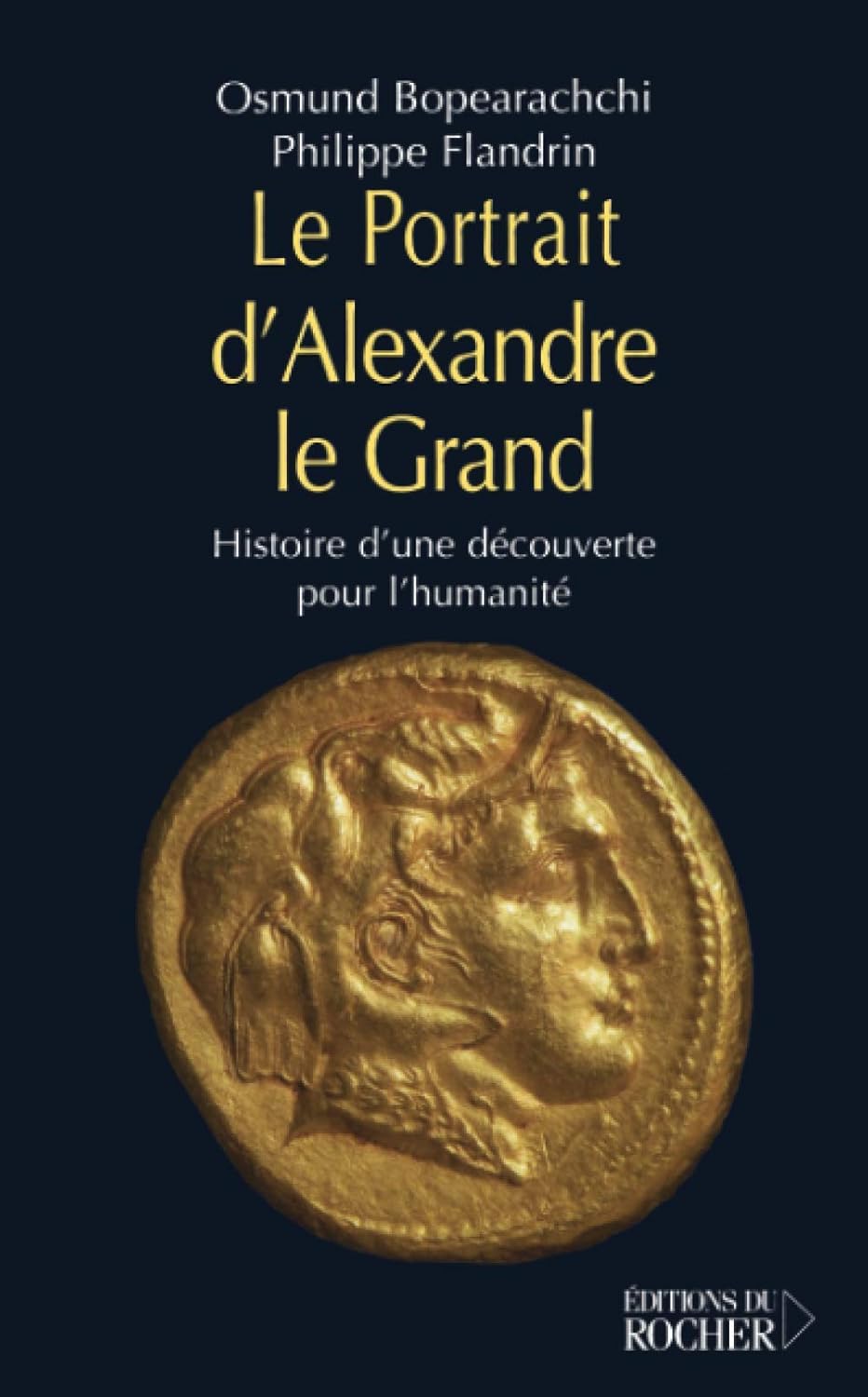
Le Portrait d'Alexandre le Grand

The Portrait of Alexander the Great
Book
Bopearachchi, O., de (2005) Le Portrait d'Alexandre le Grand. [The Portrait of Alexander the Great] Monaco, Éditions du Rocher, 279 pp.
Record No. 17197  |  ISBN/ISSN: 9782270000000  |  Sinkankas/Born No.: NIS/NIB  |  Language: in French  |  not seen
The Portrait of Alexander the Great recounts the story of a remarkable treasure hunt. From Europe to Japan, by way of the banks of the Indus, the authors set out in search of the treasure of Mir Zakah, unearthed by villagers in Afghanistan. In the summer of 1992, four tons of gold, silver, and bronze coins emerged from a spring—along with a profusion of jewelry, ornaments, votive plaques, and gemstones, struck or engraved, dating from the golden age of the Achaemenid Empire in the 5th century BCE to the decline of the Kushan Empire. Warlords, bandits, and traffickers seized this national treasure and sold it at auction to billionaire collectors. In 2004, a gold medal bearing the likeness of Alexander the Great appeared in London, in the hands of a man from Peshawar, Pakistan. Osmund Bopearachchi realized the historical importance of this exceptional piece—quite possibly the only portrait of the conqueror made during his lifetime. In 326 BCE, after conquering the Persian Empire, Alexander crossed the Indus and defeated King Porus’s elephant cavalry. This marked the beginning of Greek rule in Central Asia and India, which would last four centuries. On this victory medal, Alexander, wearing the scalp of an elephant as a headdress, appears as the equal of Zeus. He gave rare examples of it to his generals. Unknown to the wider public, this magnificent gift has resurfaced, allowing one of the most glorious chapters in world history to be written.
Corundum xenocrysts in basalt from the Bo Phloi gem field, Kanchanaburi, western Thailand
Corundum xenocrysts in basalt from the Bo Phloi gem field, Kanchanaburi, western Thailand

Conference Paper
Pisutha-Arnond, V., Intasopa, S., Wathanakul, P., Griffin, W.L., Atichat, W. and Sutthirat, C. (2005) Corundum xenocrysts in basalt from the Bo Phloi gem field, Kanchanaburi, western Thailand. Geoindo: Proceedings of the International Conference on Geology, Geotechnology and Mineral Resources of Indochina, Khon Kaen, Thailand pp. 338–344.
Record No. 7764  |  not seen

Another constraint on Thai-corundum genesis: New evidence from ruby-bearing xenoliths from the eastern gem field, Thailand
Conference Paper
Chualaowanich, T., Sutthirat, C., Harzenberger, C. and Pisutha-Arnond, V. (2005) Another constraint on Thai-corundum genesis: New evidence from ruby-bearing xenoliths from the eastern gem field, Thailand. Geoindo: Proceedings of the International Conference on Geology, Geotechnology and Mineral Resources of Indochina, Khon Kaen, Thailand pp. 345–351.
Record No. 5342  |  not seen

Geologie und Petrographie des Saphir- und Rubinvorkommens van Chimwadzulu Hill, (W. Malawi)

Geology and petrography of the sapphire and ruby deposits of Chimwadzulu Hill, (W. Malawi)
Journal Article
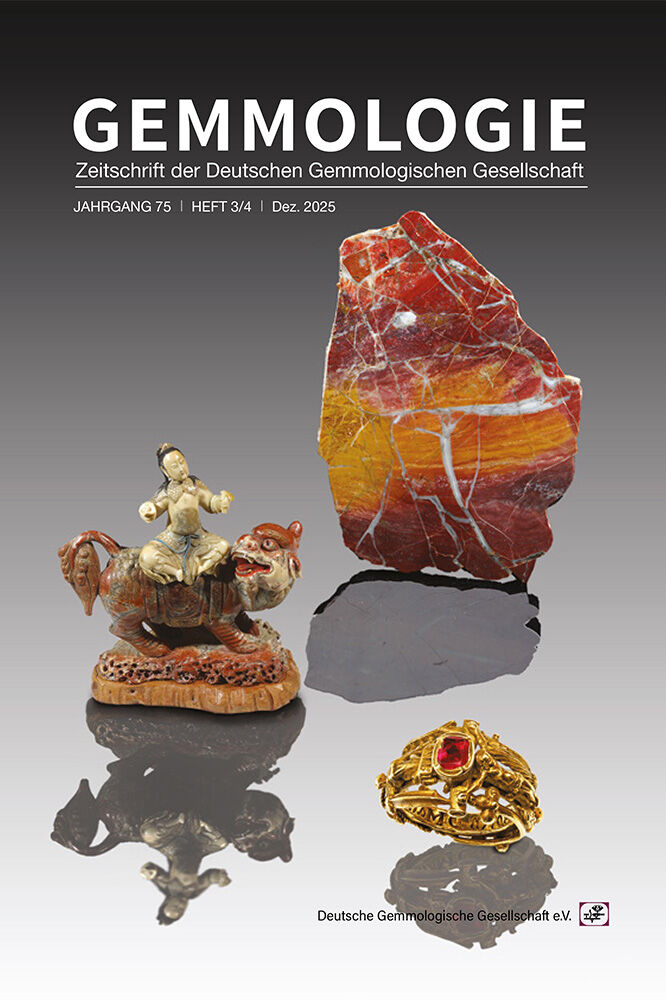
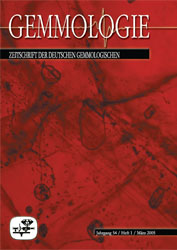
Dill, H.G. (2005) Geologie und Petrographie des Saphir- und Rubinvorkommens van Chimwadzulu Hill, (W. Malawi). [Geology and petrography of the sapphire and ruby deposits of Chimwadzulu Hill, (W. Malawi)] Gemmologie: Zeitschrift der Deutschen Gemmologischen Gesellschaft, Vol. 54, No. 1, pp. 7–20.
Record No. 3269  |  Language: In German  |  not seen
Nuristan–South Pamir province of Precambrian gemstones

Nuristan–South Pamir province of Precambrian gemstones

Journal Article
Litvinenko, A.K. (2004) Nuristan–South Pamir province of Precambrian gemstones. Geology of Ore Deposits [Геология рудных месторождений], Vol. 46, No. 4, pp. 305–312.
Record No. 29136  |  Language: in Russian  |  not seen
Meaning of ions diffusion coefficient in sapphire diffusion heat treatment

Meaning of ions diffusion coefficient in sapphire diffusion heat treatment

Journal Article
Yang, R., Yu, D. and Zhao, J. (2004) Meaning of ions diffusion coefficient in sapphire diffusion heat treatment. Journal of Tongji University (Natural Science), Vol. 32, No. 9, pp. 1145–1148.
Record No. 7736  |  Sinkankas/Born No.: NIS/NIB  |  Language: in Chinese  |  not seen
Blue color enhancement of sapphire by surface-diffusion processes at high temperatures has been reported since the 1980s. However, most treatment processes are based on “trial and error.” In this article, the diffusion coefficients of Fe and Ti ions in sapphire crystals calculated during various treatment conditions are presented. Colorless and light blue sapphires were treated with (unspecified) Fe- and Ti-containing chemicals in an aluminum oxide crucible at a temperature of 1,800–1,900 °C for up to 72 hours at a Thai jewelry company. The thickness of the diffusion layer was measured from samples cut into 0.8 mm thick plates. The concentrations of Fe and Ti in different layers, starting from the outer surface of the samples, were determined by electron-microprobe analysis. The diffusion coefficients of Fe and Ti in sapphire are mainly controlled by temperature, duration of the treatment, thickness of the diffused layer, and the initial concentrations of Fe²⁺ and Ti⁴⁺ ions in the chemical additives. However, at certain temperatures, the diffusion coefficients of Fe and Ti ions were essentially constant, regardless of variations in the duration. The diffusion coefficient of Ti ions was much greater than that of Fe ions, being 6.57 × 10⁻⁹ cm²·s⁻¹ and 1.62 × 10⁻⁹ cm²·s⁻¹, respectively. Using these coefficients in conjunction with specified temperatures and duration times, it is possible to control the thickness of the diffusion layer in sapphire. These coefficients may also be useful toward lightening dark-colored sapphires, such as those from Shandong, China.
Spectroscopy of Thai Corundum

Spectroscopy of Thai Corundum

Thesis
Khunkaew, Y. (2004) Spectroscopy of Thai Corundum., Chiang Mai, Thailand: Chiang Mai University, 137 pp.
Record No. 6957  |  not seen
Spectroscopy of Lao Corundum

Spectroscopy of Lao Corundum

Thesis
Singbamroong, S. (2004) Spectroscopy of Lao Corundum., Chiang Mai, Thailand: Chiang Mai University, 137 pp.
Record No. 6956  |  not seen

Les placers à corindon gemme

Gem corundum placers
Journal Article
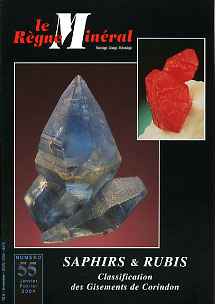
Garnier, V., Giuliani, G., Ohnenstetter, D. and Schwarz, D. (2004) Les placers à corindon gemme. [Gem corundum placers] Le Règne Minéral, No. 55, pp. 36–47.
Record No. 5325  |  Language: in French  |  not seen

Minerals and Their Localities

Book
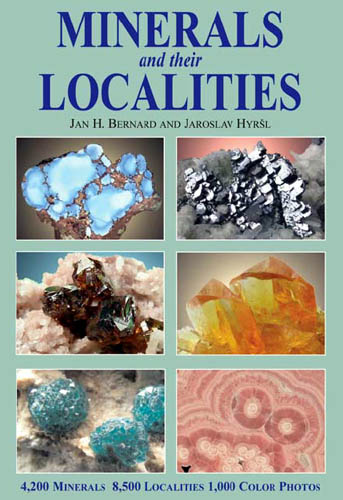
Bernard, J.H. and Hyrsl, J. (2004) Minerals and Their Localities. Prague, Granit SRO, 808 pp.
Record No. 5170  |  ISBN/ISSN: 8072960393  |  Sinkankas/Born No.: NIS/NIB  |  not seen
Study to establish characteristic attributes of the marble-hosted type of Vietnam ruby and sapphire deposits – the basis for modelling of this type of deposits
Study to establish characteristic attributes of the marble-hosted type of Vietnam ruby and sapphire deposits – the basis for modelling of this type of deposits

Journal Article
Khoi, N.N. (2004) Study to establish characteristic attributes of the marble-hosted type of Vietnam ruby and sapphire deposits – the basis for modelling of this type of deposits. Journal of Earth Sciences, Vol. 26, pp. 333–342.
Record No. 3009  |  Language: in Vietnamese  |  not seen
Primary and secondary deposits in the Tan Huong-Truc Lau area of northern Vietnam's Yen Bai Province have supplied rubies (especially star rubies) and some sapphires-mostly of cabochon quality-for more than a decade. The gems are typically translucent to semitransparent and pink to purplish or brownish red, with rare color zoning. The most distinctive features of this corundum after polishing include growth zoning and asterism. The samples contain relatively high amounts of Fe and variable Ti and Cr. The geologic origin and gemological properties of this corundum are distinct from that of the adjacent Khoan Thong-An Phu area.

Nga Mauk: The fabulous Myanmar ruby

Book Section
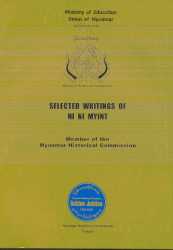
Ni Ni Myint (2004) Nga Mauk: The fabulous Myanmar ruby. In: Selected Writings of Ni Ni Myint, Yangon: Myanmar Historical Commission, pp. 1–15.
Record No. 2572  |  Sinkankas/Born No.: NIS/NIB  |  not seen

Recent discoveries of large sapphires in Sri Lanka
Journal Article
Dharmaratne, P.G.R. (2003) Recent discoveries of large sapphires in Sri Lanka. Gemmologie - Zeitschrift der Deutschen Gemmologischen Gesellschaft, Vol. 52, No. 1, pp. 37–40.
Record No. 29119  |  Sinkankas/Born No.: NIS/NIB  |  not seen

Les villes du nord-ouest du sous-continent indien des Indo-Grecs aux Kouchans
The cities of the north-western Indian subcontinent from the Indo-Greeks to the Kushans.
Book Section
Callieri, P. (2003) Les villes du nord-ouest du sous-continent indien des Indo-Grecs aux Kouchans. [The cities of the north-western Indian subcontinent from the Indo-Greeks to the Kushans.] In: De l'Indus à l'Oxus. Archéologie de l'Asie Centrale. Catalogue de l'exposition, Montpellier: Musée de Lattes, pp. 211–212.
Record No. 27664  |  ISBN/ISSN: 9782950000000  |  Sinkankas/Born No.: NIS/NIB  |  Language: in French  |  not seen
Presented here is the publication of a great many objects from the Indo-Iranian borderlands, dating primarily from the period between the Greeks and the Kushans, but more broadly covering the entire pre-Islamic history of the region. Especially well represented are coins and Buddhist representations from India or Afghanistan. The illustrations are of very high quality. Priority is given to the object entries over the accompanying texts, which are concise and written by leading specialists, ranging from “The Civilization of Central Asia in the Bronze and Iron Ages” (H.-P. Francfort) to “Christianity in Herat” (Ph. Gignoux), including “Indo-Greeks, Indo-Scythians, Indo-Parthians” (O. Bopearachchi) and “The Coinage of the ‘Iranian Huns.’” Contains ruby and two diamonds in ring from Ai Khanoum.

De l'Indus à l'Oxus. Archéologie de l'Asie Centrale. Catalogue de l'exposition

From the Indus to the Oxus: Archaeology of Central Asia. Exhibition catalogue
Book
Bopearachchi, O., de, Landes, C., Sachs, C., Cayzac, N. and Millet, F. (2003) De l'Indus à l'Oxus. Archéologie de l'Asie Centrale. Catalogue de l'exposition. [From the Indus to the Oxus: Archaeology of Central Asia. Exhibition catalogue] Montpellier, Musée de Lattes, 419 pp.
Record No. 27469  |  ISBN/ISSN: 9782950000000  |  Sinkankas/Born No.: NIS/NIB  |  Language: in French  |  not seen
Presented here is the publication of a great many objects from the Indo-Iranian borderlands, dating primarily from the period between the Greeks and the Kushans, but more broadly covering the entire pre-Islamic history of the region. Especially well represented are coins and Buddhist representations from India or Afghanistan. The illustrations are of very high quality. Priority is given to the object entries over the accompanying texts, which are concise and written by leading specialists, ranging from “The Civilization of Central Asia in the Bronze and Iron Ages” (H.-P. Francfort) to “Christianity in Herat” (Ph. Gignoux), including “Indo-Greeks, Indo-Scythians, Indo-Parthians” (O. Bopearachchi) and “The Coinage of the ‘Iranian Huns.’” Contains ruby and two diamonds in ring from Ai Khanoum.

Exploring the Literature of Corundum

Ruby and sapphire research spans mineralogy, gem deposits, identification, treatments, synthesis and the history of the gem trade. Older publications can also be useful for tracing terminology, early observations and accounts of mining localities. Publication dates and the original source should be considered when using historical descriptions.

For an introduction to collecting books on this subject, read Ruby & Sapphire Books: Collecting the Literature of Corundum.

About Four Treasures

Four Treasures is Lotus Gemology's freely accessible gemological reference database. Use the full database to search by author, title or keyword and explore literature on gemology, mineralogy, jewelry and related fields. Where available, hyperlinks on titles may lead directly to the full publication.

Search the Complete Four Treasures Database