Explore books, articles and historical sources on ruby, sapphire and corundum in Four Treasures, the Lotus Gemology reference database. This bibliography brings together matching records from the collection, with publication details, abstracts and cover images where available.
Ruby & Sapphire References
The list below matches the terms ruby, rubies, sapphire or corundum in the database's searchable fields. Some references discuss these gems as part of a broader subject. Linked titles take you to external links where you may find the full reference.
Xi, B., Xu, R., Gao, H. and Guan, X. (2001) LRM spectrum characteristic of filled glass in heat-treatment [sic] rubies.Journal of Gems & Gemmology, Vol. 3, No. 4, pp. 5–7.
Record No. 7752 | not seen
Reference copied to clipboard!
corundum, treatments.6, inclusions.5, gems
Natural rubies are usually enhanced by heat treatment in a flux, and secondary glasses may be formed that then remain in the gems. These fluxes are commonly similar in appearance to glass inclusions found in flux-grown synthetic rubies. To differentiate between these two types of glasses, the chemical compositions and structural characteristics of both types were determined using electron microprobe and laser Raman microspectrometry (LRM) techniques.. Four types of glasses were found in the heat-treated natural rubies: sodic aluminosilicate glass, Na-P-Al glass, B-Na-Al glass, and aluminosilicate glass. Chemically, these glasses are significantly different from flux inclusions found in synthetic rubies. They differ not only in major elements, but also in trace elements. For example, Pb, W, Mo, and Bi present in synthetic rubies were not detectable in the glasses. The Raman spectra of the two materials also are distinct.TL
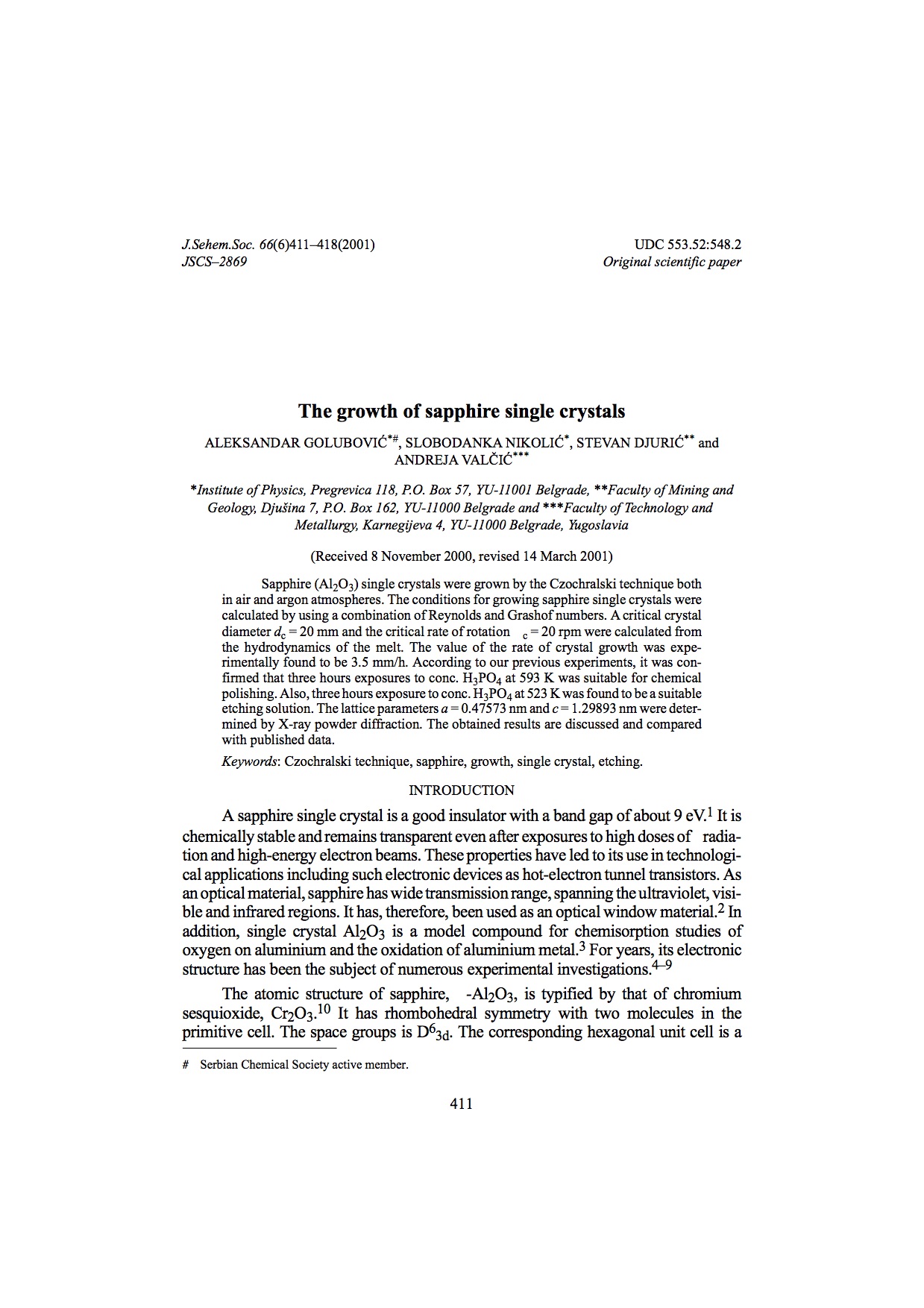
Golubovic, A., Nikolic, S., Djuric, S. and Valcic, A. (2001) The growth of sapphire single crystals.Journal of the Serbian Chemical Society, Vol. 66, No. 6, pp. 411–418.
Record No. 5345 | seen
Reference copied to clipboard!
corundum, synthetic corundum.7, gems
Sapphire (Al₂O₃) single crystals were grown using the Czochralski technique in both air and argon atmospheres, with growth conditions calculated through Reynolds and Grashof numbers; a critical crystal diameter of 20 mm and a critical rotation rate of 20 rpm were determined from melt hydrodynamics, while the experimentally established growth rate was 3.5 mm/h; chemical polishing was effectively achieved with concentrated H₃PO₄ at 593 K for three hours, and etching at 523 K for the same duration proved suitable; X-ray powder diffraction gave lattice parameters of a = 0.47573 nm and c = 1.29893 nm, and the results were discussed in comparison with existing literature.
Zwölftstrahliger Sternsaphir aus Bang-kha-cha, Thailand
Twelve-rayed star sapphire from Bang-kha-cha, Thailand
Journal Article
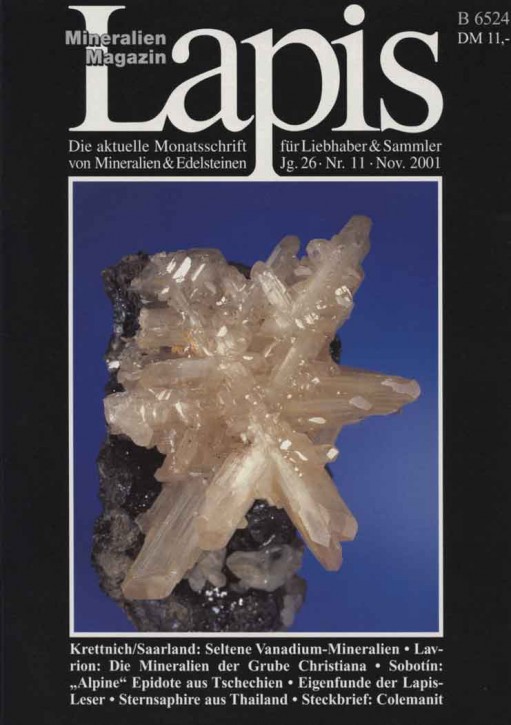
Schmetzer, K. and Glas, M. (2001) Zwölftstrahliger Sternsaphir aus Bang-kha-cha, Thailand. [Twelve-rayed star sapphire from Bang-kha-cha, Thailand]Lapis, Vol. 26, No. 11, pp. 40–42, 54.
Record No. 5337 | Language: in German | seen
Reference copied to clipboard!
corundum, inclusions.5, Thailand.12, Chantaburi, star sapphire, gems
After a brief overview of some basic facts concerning asterism, the characteristics of black star sapphires from Thailand are described. As in star corundums from other sources, these stars were found to be diffraction phenomena created by needles or lamellae of rutile or hematite-ilmenite. These inclusions can be oriented either parallel or perpendicular to the second-order prism faces.. Six-rayed star sapphires from Bang-kha-cha [also spelled Bang Kacha] show bluish white or, less commonly, “golden” yellow stars. The bluish white stars are caused by Ti-bearing hematite (as are similar black stars from Australia), whereas the nature of the mineral(s) forming the yellow stars is unknown. In the bluish white stars, the band of light (chatoyancy) can be oriented both parallel and perpendicular to the second-order prisms, but they are always parallel to these prisms in the yellow stars.. Rarely, both colors of stars are combined in the same specimen and form 12-rayed star sapphires. The authors studied nine such sapphires and found that the bluish white stars were always oriented perpendicular to the prism faces, whereas the yellow stars were parallel to these faces. The article is illustrated with four excellent photographs and two diagrams, which make the rather complicated phenomena easily understandable.
High temperature treatment of natural corundum
Conference Paper
Häger, T. (2001)High temperature treatment of natural corundum. International Workshop on Material Characterization by Solid State Spectroscopy: The Minerals of Vietnam, Hanoi
Gübelin, E.J. (2001)Comparison of inclusions in corundum from the new mines in Tanzania and on Madagascar. XXVIII International Gemmological Conference, Madrid, Spain
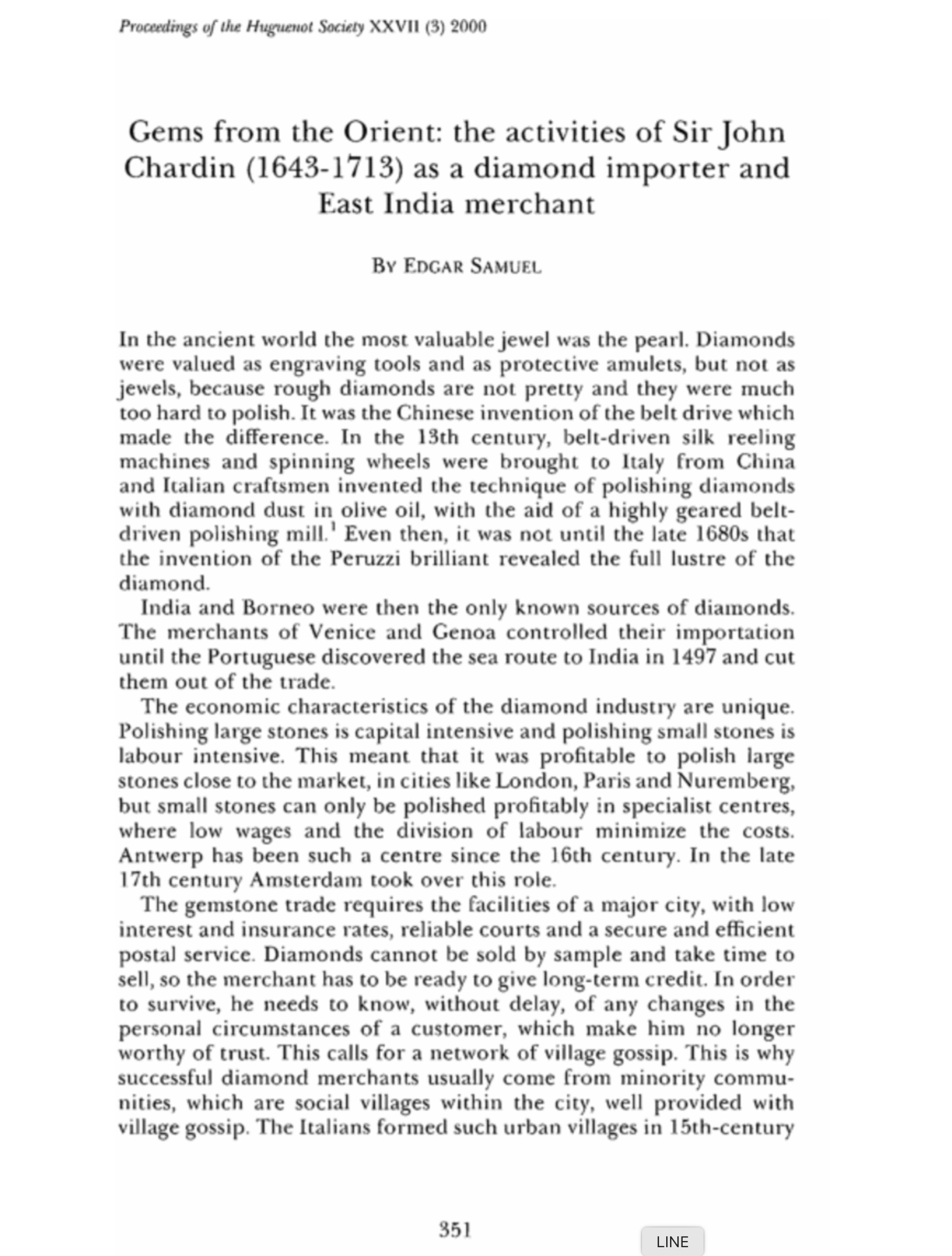
Samuel, E. (2000) Gems from the Orient: The activities of Sir John Chardin (1643-1713) as a diamond importer and East India merchant.Huguenot Society Journal, Vol. 27, No. 3, pp. 351–368.
gems, gem trade in Asia, gem business, trade between Europe and Asia, diamonds, rubies, pearls, corundum, Persia, Chardin
Characteristic mineralizations of metamorphic-metasomatic gemstone deposits in northern Vietnam
Conference Paper
Tien, D.P., Hofmeister, W. and Quang, V.X. (2000)Characteristic mineralizations of metamorphic-metasomatic gemstone deposits in northern Vietnam. 6th International Congress on Applied Mineralogy, 17–19 July, Göttingen, Germany: A.A. Balkema, pp. 281–283.
Record No. 7745 | ISBN/ISSN: 9789060000000 | not seen
Reference copied to clipboard!
corundum, Vietnam.12, gems
The Defect Chemistry of Metal Oxides
Book
Smyth, D.M. (2000)The Defect Chemistry of Metal Oxides. New York, Oxford University Press, 304 pp.
Record No. 3171 | Sinkankas/Born No.: NIS/NIB | JLEL
Reference copied to clipboard!
corundum, color.4, treatments.6, gems
The Defect Chemistry of Metal Oxides is a unique introduction to the equilibrium chemistry of solid inorganic compounds with a focus on metal oxides. Accessible to students with little or no background in defect chemistry, it explains how to apply basic principles and interpret the related behavior of materials. Topics discussed include lattice and electronic defects, doping effects, nonstoichiometry, and mass and charge transport. The text distinctly emphasizes the correlation between the general chemical properties of the constituent elements and the defect chemistry and transport properties of their compounds. It covers the types of defects formed, the effects of dopants, the amount and direction of nonstoichiometry, the depths of acceptor and donor levels, and more. Concluding chapters present up-to-date and detailed analyses of three titanium dioxide, cobalt oxide and nickel oxide, and barium titanate. The Defect Chemistry of Metal Oxides is the only book of its kind that incorporates sample problems for students to solve. Suitable for a variety of courses in materials science and engineering, chemistry, and geochemistry, it also serves as a valuable reference for researchers and instructors.
Sapphire fever
Journal Article
Gubb, L. (2000) Sapphire fever.Life,, March pp. 28–30, 33.
Record No. 2946 | not seen
Reference copied to clipboard!
corundum, sources.12. Madagascar.12, gems
In this pictorial, photographer Louise Gubb captures the drama of the sapphire boom that has drawn an estimated 100,000 prospectors to Ilakaka, Madagascar. The miners dig by hand, under difficult and dangerous conditions, and sell the sapphires to middlemen (some of them heavily armed), who in turn sell the gems to foreign buyers. According to American buyer Tom Cushman, “There are robberies and shootings just about every night.” The sapphire market, meanwhile, continues to thrive.. Stuart D. Overlin
Cao, D. (2000) The geological characteristics of a sapphire deposit in South Laos. [老挝南部某蓝宝石矿床地质特征]Yunnan Geology 云南地质, Vol. 19, No. 1, pp. 46–52.
Record No. 2914 | Sinkankas/Born No.: NIS/NIB | Language: in Chinese | not seen
Reference copied to clipboard!
corundum, Laos.12, gems
This saphire deposit is occurred in the Holocene alluvium. The saphire is characterized by blue colour, coarse grain, good transparency, less flaw and easy processing. Its quality is higher by one grade than that in China. And it is possible to find out the saphire with grade A in this ore-field.
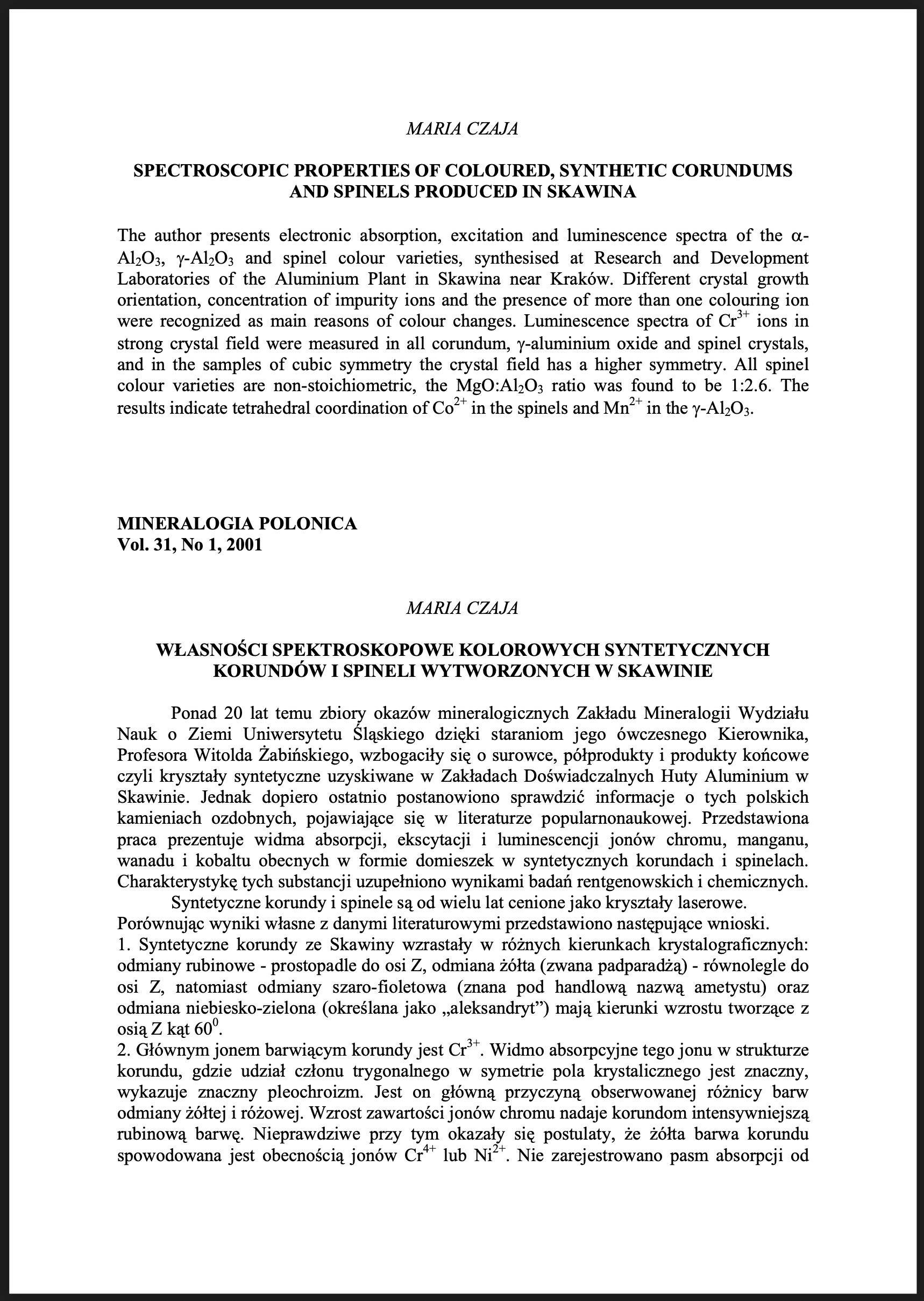
Czaja, M. (2000) Spectroscopic properties of coloured, synthetic corundums and spinels produced in Skawina.Mineralogica Polonica, Vol. 31, No. 1, pp. 55–68.
Record No. 2896 | not seen
Reference copied to clipboard!
corundum, synthetic corundum.7, gems
Electronic absorption, excitation, and luminescence spectra are presented for synthetic α-Al₂O₃ (corundum with a trigonal structure), synthetic α-Al₂O₃ (not occurring naturally and lacking a trigonal structure), and synthetic spinels of various colors grown at the Research and Development Laboratories of the Aluminum Plant at Skawina, near Kraków, Poland. Different crystal growth orientations, concentrations of impurity ions, and the presence of more than one chromophore were established as the main reasons for the variations in color. All of the colored spinel varieties were found to be non-stoichiometric, with an MgO:Al₂O₃ ratio of 1:2.6. The results indicate tetrahedral coordination of Co²⁺ in the synthetic spinels and Mn²⁺ in synthetic α-Al₂O₃.
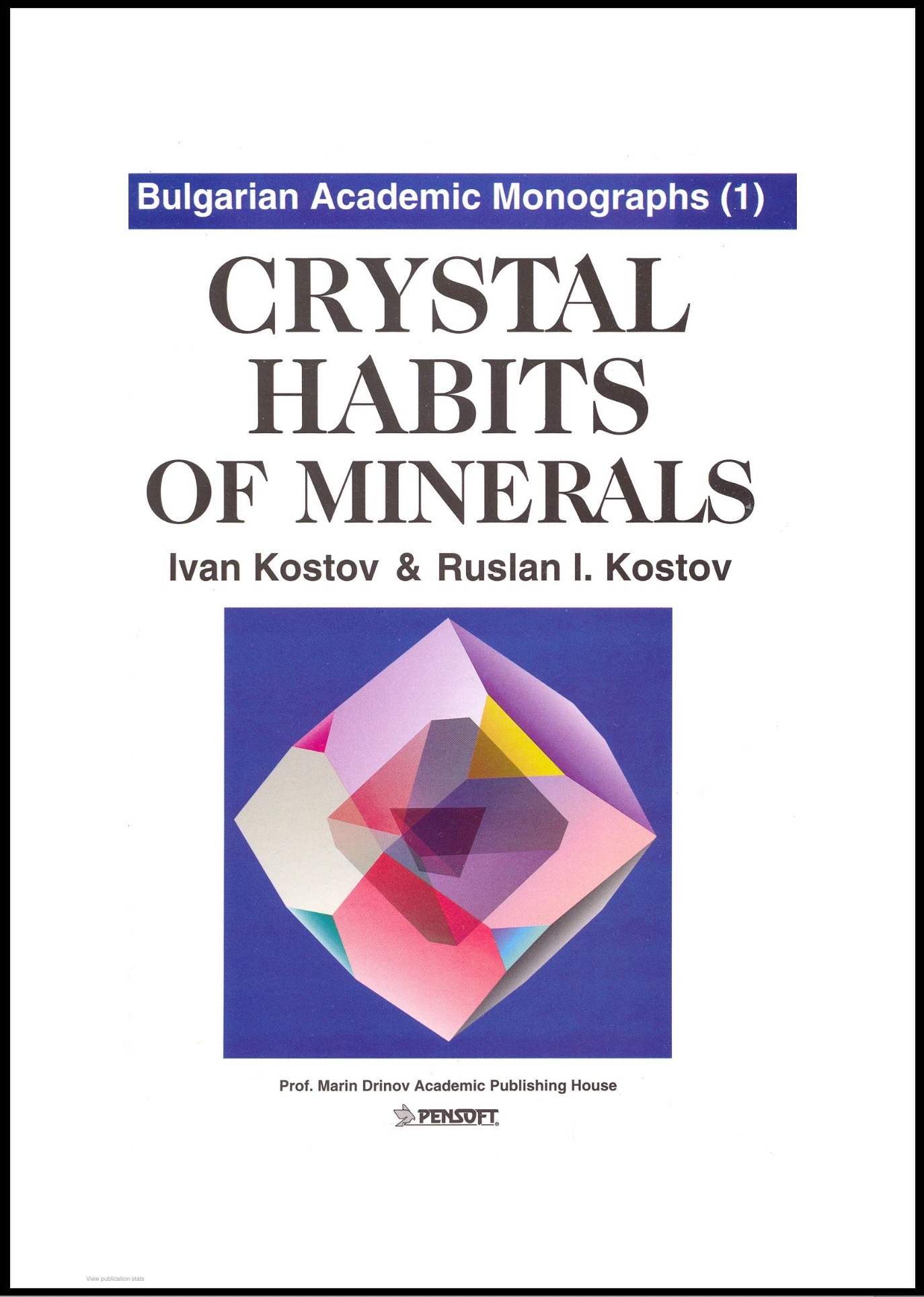
Kostov, R.I. (1999)Crystal Habits of Minerals. Sofia, Pensoft Publishers, 415 pp.
Record No. 27595 | ISBN/ISSN: 9789550000000 | Sinkankas/Born No.: NIS/NIB | not seen
Reference copied to clipboard!
gems, corundum, chemistry.2, crystallography
This volume offers a comprehensive crystallogenetic overview on the morphology of minerals based on the authors' original ideas. Theories of crystal growth are briefly dealt with, attenetion being paid to the classical layer-by-layer and dislocation mechanisms. The modification of crystal forms of the most important rock-forming and ore-forming minerals, presented by their principal crystal habits, is checked by both observation in their natural occurences and laboratory experiments. Crystal growth by accretion of clusters and/or submicroscopic crystallites under specific natural environments is also discussed. The examples used illustrate crystallization and variation in the crystal habits of minerals in magnetic, pegmatitic, hydrothermal, weathering, sedimentary and metamorphic environments. The trends of crystal habit variation have been used for genetic interpretations and for outlining corresponding morphological zonalities.
Sapphire Mine Paddar District Doda, Jammu and Kashmir
Unpublished Work
Mir, A.B.M. (1999)Sapphire Mine Paddar District Doda, Jammu and Kashmir. unpublished report.
Terekhov, E.N., Kruglov, V.A. and V. I. Levitskii, V.I. (1999) Rare earth elements in corundum-bearing metasomatic and related rocks of the eastern Pamirs.Geochemistry International, Vol. 37, No. 3, pp. 202–212.
Record No. 7765 | not seen
Reference copied to clipboard!
corundum, geology.11, Tajikistan.12, gems
Corundum-bearing rocks containing ruby, sapphire, and pink sapphire are found in the Kukurt gemstone field, in the Pamir Mountains of southern Tajikistan. The authors used rare-earth-element (REE) data and other geochemical characteristics of rocks in this region to study the processes and conditions of corundum formation. This research, and related work by other scientists, suggests that the oldest rocks in the Kukurt area under-went a major metamorphic event more than 500 million years (m.y.) ago. Corundum mineralization occurred. much more recently, about 20 m.y. ago, during the formation of the Himalayas. Most of the corundum occurrences are related to linear geologic structures such as shear zones and lithologic contacts; they are found in several different rock types, mainly marble and gneiss. According to the authors, geochemical enrichments in REE, Al, Ti, and several trace elements—as well as the association of minerals rich in Cl, B, and F in the corundum-bearing rocks—suggest that gem corundum mineralization was caused by through-flowing volatile-rich fluids that possibly originated in a deep-seated mantle source. Fluid movement was facilitated by the active deformation associated with mountain-building events. Since these events were regional in character, other commercially viable corundum deposits may be found through the application of these models to geologically similar areas in the high mountain ranges of Central Asia. JL
Miarolitic pegmatites of the Kurkurt Group of gemstone deposits, central Pamirs: The evolution of physical conditions in the Amazonitovaya vein
Journal Article
Peretyazhko, L.S., Zagorsky, V.E., Prokof'ev, V.Y. and Gantimurova, T.P. (1999) Miarolitic pegmatites of the Kurkurt Group of gemstone deposits, central Pamirs: The evolution of physical conditions in the Amazonitovaya vein.Geochemistry International, Vol. 37, No. 2, pp. 108–127.
Srithai, B. and Rankin, A.H. (1999) Fluid inclusion characteristics of sapphires from Thailand.Mineral Deposits: Processes to Processing, Proceedings of the 5th Biennial SGA Meeting and the 10th Quadrennial IAGOD Symposium, London, pp. 107–111.
Record No. 5363 | not seen
Reference copied to clipboard!
corundum, sources.12, Thailand.12, Bo Ploi, inclusions.5, gems
Three main types of fluid inclusions occur in Bo Ploi sapphires: (1) vapor-rich CO₂ with a density up to about 0.86 g/cm³; (2) multiphase inclusions containing several daughter minerals, hypersaline brine, and a CO₂-rich vapor phase; and (3) (silicate?)-melt inclusions with immobile vapor bubbles in an isotropic or weakly anisotropic phase of low relief, with bubbles becoming mobile when heated above 800 °C. These observations suggest a magmatic origin for the sapphires, although they did not crystallize as phenocrysts within the basalts that transported them to the surface.
Sapphires are a Girl’s Best Friend
Book
Heady, S. (1999)Sapphires are a Girl’s Best Friend. Edison, NJ, Chartwell Books, Inc., 96 pp.
Record No. 3865 | ISBN/ISSN: 9780790000000 | Sinkankas/Born No.: NIS/NIB | not seen
Reference copied to clipboard!
corundum. quality.10, gems
Neue Edelsteinvorkommen
New gem deposits
Journal Article
Henn, U. and Milisenda, C. (1998) Neue Edelsteinvorkommen. [New gem deposits]Uhren Juwelen Schmuck, pp. 51–53.
Record No. 7762 | Language: German | not seen
Reference copied to clipboard!
corundum, sources.12, Tanzania.12, gems
Tanzania emerged as a great producer of colored gemstones in the second half of this century. Most of the important localities (e.g., Longido, Lake Manyara, Merelani, and Umba) are in the northern part of the country; they produce a great variety of gems, the most impor-tant being tanzanite, corundum (ruby and fancy-color sapphires), garnet (particularly rhodolite and tsavorite), tourmaline, emerald, alexandrite, spinel, and quartz. Diamonds are mined from the Mwadui kimberlite pipe, also in the north. Historically, gemstone occurrences in the south have been rare.. In 1994, however, large and rich gem deposits were found in southern Tanzania in the vicinity of Tunduru, about 80 km north of the border with Mozambique. An estimated 80,000 “illegals” have been working the alluvial deposits in the vicinity of the Muhuwesi and Mtetesi Rivers, mostly by primitive methods. Although the primary sources of the gem minerals have not been found, the fact that some crystals are only slightly rounded indicates short transport distances. This article discusses the history of the discovery and the development of gemstone trade in this area, the geologic setting of the deposits (in the Proterozoic Ubendian-Usagaran System of metamorphic rocks), and the most important gem materials found to date. These include blue and fancy-color sapphires, ruby, many colors of spinel, garnet (rhodolite, hessonite, and color-change), and chrysoberyl (cat’s-eye and alexandrite).PB
Gem corundums and zircons from the Primorye placers
Journal Article
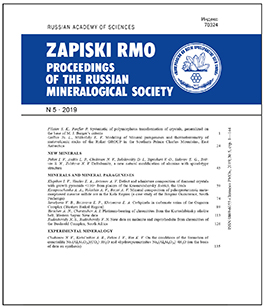
Ananyev, S.A., Ananyeva, T.A., Garanin, V.K. and Kudryavtseva, G.P. (1998) Gem corundums and zircons from the Primorye placers.Zapiski RMO (Proceedings of the Russian Mineralogical Society), Vol. 127, No. 4, pp. 120–124.
Record No. 7758 | not seen
Reference copied to clipboard!
corundum, sources.12, gems
Descriptions are given of gem-quality sapphire and “hyacinth” zircon—and the associated chrome spinel, magnetite, and enstatite—found at Primorye in heavy-mineral concentrates that were ultimately derived from alkali basalts. Transparent blue, blue-green, green, and occasional multicolored sapphires are found as rounded pebbles (2 to 30 mm in size); some star sapphires are recovered. Chemical analyses and visible absorption spectra show that the sapphire coloration is related to the presence of Fe (0.72–1.75 wt.% FeO) and Ti (0.02–0.20 wt.% TiO₂). Inclusions of hercynite and ferrocolumbite were identified in some of these corundums. The zircon also is found as rounded pebbles (1 to 25 mm in size). They are transparent orange, orange-yellow, or brown-red, and become colorless on heating. Their chemical compositions correspond to those of the rare zircon variety naegite, with 4.59–6.14 wt.% Ta₂O₅, 3.22–3.59 wt.% Nb₂O₅, and 3.98–4.09 wt.% ThO₂. [Editor’s note: The terms hyacinth and naegite are not used in most modern gemology and mineralogy references in English.]
Tairus hydrothermal synthetic ruby
Journal Article
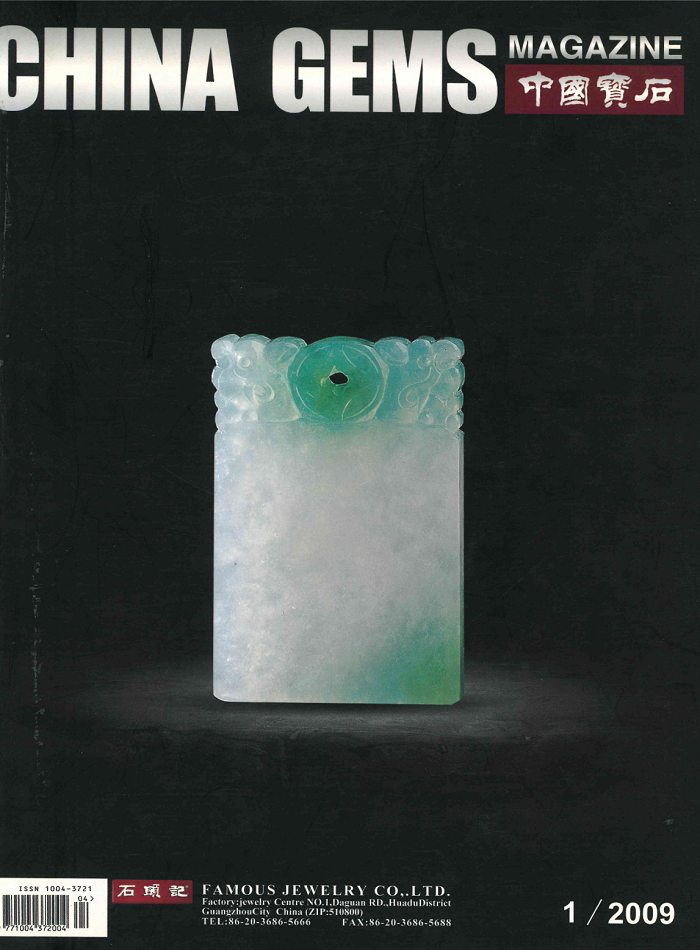
Qi, L. and Lin, S. (1998) Tairus hydrothermal synthetic ruby.China Gems, Vol. 7, No. 1, pp. 122–124.
Record No. 7757 | not seen
Reference copied to clipboard!
corundum, synthetic corundum.7, gems
Gemological investigations of Tairus hydrothermal synthetic ruby revealed characteristic microscopic features, including solid alloy inclusions consisting mainly of copper–iron alloys and wavy growth lines. Chemical analysis by microprobe showed that the chromium concentration in the area of the growth lines averaged 3.81 wt.% Cr₂O₃, as compared to 1.53 wt.% Cr₂O₃ in the remainder of the stone. Characteristic infrared absorption peaks are 3308, 3233, and 3186 cm⁻¹.
Exploring the Literature of Corundum
Ruby and sapphire research spans mineralogy, gem deposits, identification, treatments, synthesis and the history of the gem trade. Older publications can also be useful for tracing terminology, early observations and accounts of mining localities. Publication dates and the original source should be considered when using historical descriptions.
Four Treasures is Lotus Gemology's freely accessible gemological reference database. Use the full database to search by author, title or keyword and explore literature on gemology, mineralogy, jewelry and related fields. Where available, hyperlinks on titles may lead directly to the full publication.

![LRM spectrum characteristic of filled glass in heat-treatment [sic] rubies](/media/publications/1112449024_book.jpg "LRM spectrum characteristic of filled glass in heat-treatment [sic] rubies")