Ruby & Sapphire Bibliography

Ruby & Sapphire Bibliography

Explore books, articles and historical sources on ruby, sapphire and corundum in Four Treasures, the Lotus Gemology reference database. This bibliography brings together matching records from the collection, with publication details, abstracts and cover images where available.

Ruby & Sapphire References

The list below matches the terms ruby, rubies, sapphire or corundum in the database's searchable fields. Some references discuss these gems as part of a broader subject. Linked titles take you to external links where you may find the full reference.
4,201–4,220 of 4,671 matching references

A note on Buttala and Okkampitiya gem fields in Sri Lanka

Journal Article
Chandrajith, R., Dissanayake, C.B. and Tobschall, H.J. (1998) A note on Buttala and Okkampitiya gem fields in Sri Lanka. Gemmologie: Zeitschrift der Deutschen Gemmologischen Gesellschaft, Vol. 47, No. 2, pp. 69–76.
Record No. 7756  |  not seen
The adjacent Buttala and Okkampitiya gem-producing areas in southeastern Sri Lanka are relatively small and have received little geologic or mineralogic attention. Geologically, they are located near the boundary between two metamorphic terrains, the Highland-Southwest Complex (which contains most of the gem deposits in Sri Lanka) and the Vijayan Complex. This preliminary report indicates their present gem production and future potential.. Both areas produce a wide variety of fine-quality gems, including blue, yellow, and pink sapphires, as well as spinel, hessonite and other garnets, and tourmaline. There is also some geuda (heat-treatable) sapphire. The gems are mined from “residual” deposits that are characterized by layers of alternating sands, clays, and laterites containing large boulders of marble. The authors note that expansion of mining activities for such residual deposits has increased the damage to forest reserves on the island.MM

Ruby-bearing mineralization in Sljudjansky complex of the south-western Baikal region

Journal Article
Levitsky, V.I. and Pavlova, L.A. (1998) Ruby-bearing mineralization in Sljudjansky complex of the south-western Baikal region. Zapiski RMO (Proceedings of the Russian Mineralogical Society), Vol. 127, No. 6, pp. 84–88.
Record No. 5366  |  not seen
Ruby-bearing rocks are hosted by dolomite marbles in two separate areas of the Sljudjansky complex in Siberia. Near the town of Sljudjanka, corundum has been found locally within zoned magnesian skarns, where it is associated with forsterite, spinel, phlogopite, amphibole, and calcite. Two varieties of corundum are recognized: (1) translucent pink and grayish pink, and (2) “water-clear” pink and ruby-red. In the Tunkinsky district (Buryat Republic), corundum-bearing rocks occur as vein-like and pocket-like bodies with rare disseminated forsterite, red and pink spinel, and “water-clear” pink and red corundum. At both localities, the spinel is characterized by low amounts of iron and appreciable Cr₂O₃ and V₂O₃ contents. Electron microprobe analyses are reported for 10 spinels, five rubies (Cr₂O₃ 0.01–0.22 wt.%, TiO₂ 0.01–0.08 wt.%, V₂O₅ 0.01–0.15 wt.%), and a single phlogopite sample. In general, the ruby mineralization is related to postmetamorphic alteration of the precursor skarns and calc-silicate rocks by deep (mantle) fluids.

Physics of Solid-State Laser Materials
Book
Powell, R.C. (1998) Physics of Solid-State Laser Materials. New York, Springer-Verlag, 423 pp.
Record No. 3241  |  Sinkankas/Born No.: NIS/NIB  |  JLEL

The death of Kashan

Journal Article
Weldon, R. (1998) The death of Kashan. Professional Jeweler, Vol. 1, No. 6, p. 46.
Record No. 2959  |  seen
Kashan flux-grown synthetic rubies first appeared about 30 years ago and were highly regarded for their fine quality. Nevertheless, the Dallas-based company went out of business in the mid-1980s. Three years ago, Kashan Created Ruby was revived, but once again it has ceased production because of competition from now-abundant (especially in smaller sizes) natural rubies from Mong Hsu (Myanmar), as well as the preference among manufacturers for the less-expensive flame-fusion synthetics. Over its 30-year history, Kashan produced 44,528 carats of cut rubies; Mong Hsu churns out 45,000 carats of rough rubies daily. In addition, there are more than 40 other active ruby mines worldwide.

Mined in America: Five stones to watch (Part Two)

Journal Article
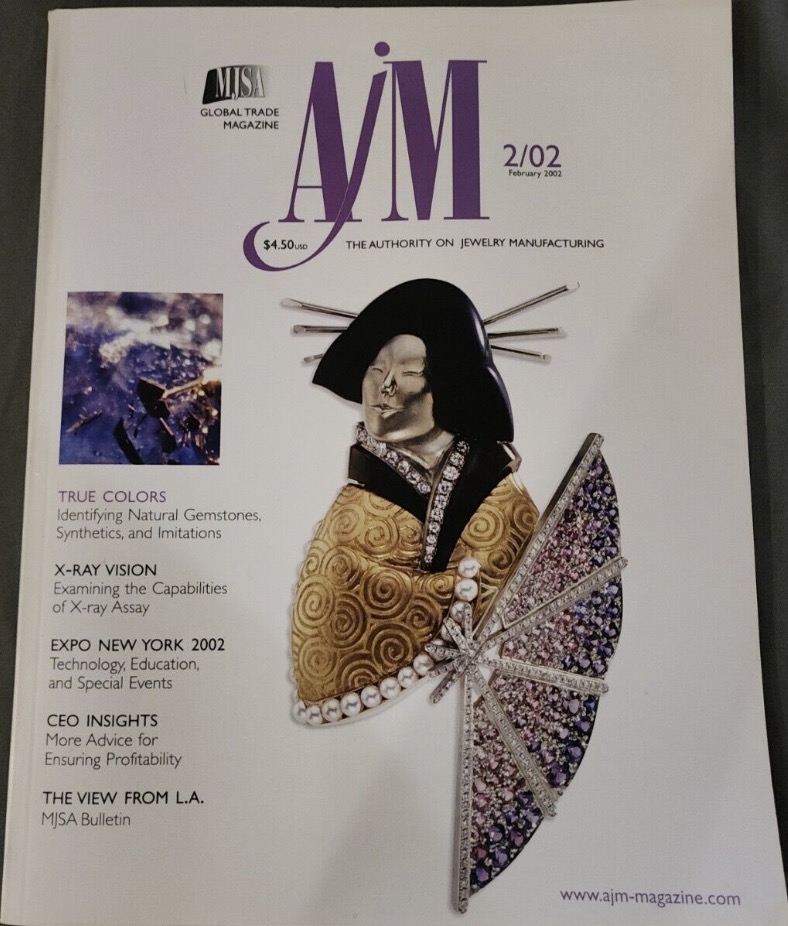
Yonick, D. (1998) Mined in America: Five stones to watch (Part Two). American Jewelry Manufacturer, Vol. 43, No. 12, pp. 18–19, 21.
Record No. 2949  |  not seen
Part two of this series focuses on Arizona “Anthill” garnet and Montana sapphire. (Part one, published in October 1998, featured Oregon sunstone, California benitoite, and Utah red beryl.) Red pyrope garnet is mined from an alluvial deposit on Navajo land in northeast Arizona, with 90% of the material marketed by Tucker Gems of Homedale, Idaho. The mine could produce about 1 million carats of rough a year. However, there is a limited supply of cut material over 1 ct. Meanwhile, American Gem Corp. (AGC) of Helena, Montana is expected to achieve full-scale production of Montana blue and fancy-colored sapphires from its alluvial deposits in southwestern Montana in 1999. Once plagued by financial difficulties, environmental liabilities, and internal problems, the company restructured in 1997. By the end of 1998, AGC had processed about 2 million carats of rough, which is expected to yield approximately 200,000 carats of cut stones. MM

Madagascar rubies debut

Journal Article
Roskin, G. (1998) Madagascar rubies debut. Jewelers’ Circular Keystone, Vol. 169, No. 8, pp. 40, 42.
Record No. 2948  |  seen
Strongly saturated, slightly purplish red rubies that have yielded cut stones up to 3 ct have been found recently in Madagascar. Characteristic inclusions are rounded transparent crystals, “treacle” type graining, and nests of short, flat, acicular 60° needles. The rubies contain uneven, strong, parallel growth lines and fingerprint-like veils, similar to those seen in both Burmese and Thai material. The color is somewhat dark in tone, and the ruby fluoresces moderate red to long-wave UV radiation. A dealer in Pittsburgh, Pennsylvania, is distributing the faceted material in the U.S.

Gemstone bonanza at Yogo Gulch

Journal Article
Voynick, S.M. (1998) Gemstone bonanza at Yogo Gulch. Wild West, Vol. 11, No. 1, pp. 36–41, 81.
Record No. 2947  |  not seen
This article describes the historical events and fascinating people involved in sapphire mining at Yogo Gulch, Montana. It travels in time from Jake Hoover’s discovery of the translucent blue stones at Yogo Creek in 1895, through the mine’s numerous British and American owners, to the current owner, Roncor Inc. Dr. George F. Kunz, of Tiffany & Co., originally confirmed the identity of the blue pebbles from Jake Hoover’s sluice box as “sapphires of unusual quality.” Jake Hoover stayed involved, eventually taking on partners, until 1897, when he sold his quarter share to his partners for $5,000 so he could join the Alaskan gold rush. Two months later, British interests purchased his share for $100,000.. Production at Yogo started in 1896 and continued almost without interruption until July 1923, when a flash flood destroyed the mine infrastructure. From 1898 through 1923, the Yogo dike yielded 16 million carats of rough sapphire, resulting in 675,000 carats of fine blue cut sapphire worth $25 million. Charles T. Gadsden, appointed mine supervisor in 1902, resided at Yogo from 1903 until his death in 1954, even though the mine (locally known as the English mine) had been inactive for more than 30 years.. In 1956, Yogo returned to American ownership. Since then there has been only minor, intermittent production, by a variety of American owners and lessees, none of which has had significant success. While mining has never progressed deeper than 250 feet (about 77 m), it is believed that the dike exceeds a mile (1.6 km) in depth and contains reserves estimated at 40 million carats of gem-quality rough sapphire. [Editor’s note: For further details, see K. A. Mychaluk, “The Yogo sapphire deposit,” Spring 1995 Gems & Gemology, pp. 28–41.]. Kim Thorup
Mine evaluation constraints of gemstone mining
Mine evaluation constraints of gemstone mining

Conference Paper
Kambani, S.M. (1998) Mine evaluation constraints of gemstone mining. Mine Planning and Equipment Selection 1998: Proceedings of the Seventh International Symposium on Mine Planning and Equipment Selection, Calgary, Canada: A.A. Balkema, pp. 329–336.
Record No. 2913  |  not seen

Corundum in the gem gravels of Sri Lanka
Journal Article
Hapuarachchi, D.J.A.C. (1998) Corundum in the gem gravels of Sri Lanka. Gondwana Research, Vol. 1, No. 3–4, pp. 415–416.
Record No. 2875  |  ISBN/ISSN: 1342937X  |  DOI: https://dx.doi.org/10.1016/s1342-937x(05)70861-3  |  not seen

Australian sapphire production falls

Journal Article
Beard, M. (1998) Australian sapphire production falls. Colored Stone, Vol. 11, No. 4, p. 4.
Record No. 2670  |  seen

Geology of the Axum area

Book
Tadesse, T. (1997) Geology of the Axum area., 184 pp.
Record No. 26722  |  Sinkankas/Born No.: NIS/NIB  |  not seen

The geological features of a ruby deposit in Yunnan
Journal Article
Qian, T. and Xiong, J. (1997) The geological features of a ruby deposit in Yunnan. Yunnan Geology 云南地质, Vol. 16, No. 4, pp. 386–393.
Record No. 7734  |  not seen
This ruby deposit in Yunnan is discovered first in China and the only marble type ruby deposit with development beneflt. The ruby deposit of marble type is an important industrial type of metamorphic ruby deposit and the predominant source of high quality decoration ruby in the world today. The ruby deposits (or mineral occurrence) of thls type are few and distributed mainly in the Alpine-Himalaya fold belt along the north margin of South Asia subCbntinent. This ruby deposit in Yunnan, however, is occurred in the inland orogenic belt of the west margin of Yangzi Landmass. Therefore, the discovery of this deposit probabl indicates a new gem mineralizatlon belt. This ruby marble is occurred in an old metamorphic complex of dynamothermal metamorphism zone in-low amphibolite facies. And the ore body is occurred at the structural place relatlvely far from the interse strain zone. The mother rock containing ore is characterized by rich in Al and poor in Si, high Ca and low Mg, large alumina-alkali ratio in geochemistry.

Neue Edelsteinvorkommen in Tansania: Die region Tunduru-Songea

New gemstone deposits in Tanzania: The Tunduru-Songea region
Journal Article
Henn, U. and Milisenda, C. (1997) Neue Edelsteinvorkommen in Tansania: Die region Tunduru-Songea. [New gemstone deposits in Tanzania: The Tunduru-Songea region] Gemmologie: Zeitschrift der Deutschen Gemmologischen Gesellschaft, Vol. 16, No. 1, pp. 29–43.
Record No. 7731  |  Language: In German  |  not seen
Synthetic gems and minerals: Markets, developments, trends
Synthetic gems and minerals: Markets, developments, trends

Book
Business Communications Co. (1997?) Synthetic gems and minerals: Markets, developments, trends. Norwalk, CT, Business Communications Co., viii, 130 pp.
Record No. 7354  |  Sinkankas/Born No.: NIS/NIB  |  not seen

Physical Ceramics

Book
Chiang, Y.-M., Birnie, D.P., III and Kingery, W.D. (1997) Physical Ceramics. New York, John Wiley & Sons, 522 pp.
Record No. 5509  |  Sinkankas/Born No.: NIS/NIB  |  JLEL
Geological Report, Independent geological, gemmological and mining experts' report for Asia Sapphire Limited covering exploration concession ages and mining areas in northwest Laos
Geological Report, Independent geological, gemmological and mining experts' report for Asia Sapphire Limited covering exploration concession ages and mining areas in northwest Laos

Report
Senior, B.R. and Coenraads, R.R. (1997) Geological Report, Independent geological, gemmological and mining experts' report for Asia Sapphire Limited covering exploration concession ages and mining areas in northwest Laos. Asia Sapphire Limited,
Record No. 5251  |  not seen

Gem River resumption

Journal Article
Anonymous (1997) Gem River resumption. Mining Journal, London, Vol. 329, No. 8437, p. 27.
Record No. 2962  |  not seen
Gem River Corporation has resumed mining for sapphires at Lower Dry Cottonwood Creek in Montana for the 1997 season. Gem River produced 975,000 carats in 1996, and 1.5 million carats are anticipated in 1997.. MLJ

Sapphire agreement

Journal Article
Anonymous (1997) Sapphire agreement. Mining Journal, London, Vol. 326, No. 8416, p. 136.
Record No. 2961  |  not seen
Montana sapphire producer Gem River Corporation entered into an agreement with Landstrom’s Original Black Hills Gold Creations™, in which Landstrom will purchase between $1 million and $3 million in cut and polished sapphire over one year, beginning February 12th, 1997. For the first six months of that period, Landstrom was not to sell or market any of these sapphires. The agreement set prices for various colors, styles, sizes, and quality grades of sapphires, which were to average $55 per carat. Most stones were projected to be under 1 ct in weight. The stones were to be marketed as “Gem River Sapphires” and “Montana Sapphires” (both terms trade-marked).. Gem River has identified proven reserves of 4 million carats. However, the company owns freehold over “substantial” ground around the deposits and was confident that adequate ore reserves could be proved to sustain mining.MLJ

La géologie des gisements de saphirs

The geology of sapphire deposits
Journal Article
Simonet, C. (1997) La géologie des gisements de saphirs. [The geology of sapphire deposits] Revue de Gemmologie A.F.G., No. 132, pp. 21–23.
Record No. 2956  |  Language: in French  |  seen
On the basis of a literature survey, the author has classified corundum deposits into three types according to their geologic origin.. 1. Volcanic (primary) deposits. Corundum in this category is brought to the surface by magma from sources at depth. The large deposits in Australia, China, and Southeast Asia—as well as the deposits in Rwanda, northern Kenya, and Nigeria—belong to this category.. 2. Metamorphic (primary) deposits. Corundum in metamorphic rocks is found in formations high in aluminum and low in silicon. Two subtypes are recognized: (1) isochemical (i.e., the bulk chemical composition of the host rock does not change during metamorphism); and (2) metasomatic (i.e., during metamorphism, the chemical composition of the host rock changes due to chemical reactions with the neighboring rock formations or fluids). Examples of corundum localities of the first subtype are Sri Lanka, Russia (Ural Mountains), Afghanistan, Pakistan (Kashmir ruby), and Tanzania (Longido). Important examples of the second subtype are found in Pakistan (Kashmir sapphire), Madagascar, Tanzania (Umba Valley), Sri Lanka, Myanmar, and Kenya.. 3. Sedimentary (secondary) deposits. Most of this corundum is retrieved from alluvial and eluvial deposits; no further details are supplied.. Application of this classification to exploration for corundum is briefly discussed.PRB

Mughals, Maharajas and the Mahatma

Book
Swamy, K.R.N. (1997) Mughals, Maharajas and the Mahatma. New Delhi, Harper Collins, 265 pp.
Record No. 2895  |  Sinkankas/Born No.: NIS/NIB  |  not seen
Sinkankas: This is a collection of 39 fascinating episodes in Indian history, 12 of which concern famous gems and diamonds, royal treasuries, and gem-encrusted thrones. Many of the remaining episodes revolve around the British Raj, Mahatma Gandhi, politics, and wars. The contributions to the history of Indian treasures, diamonds, and jewels make this book easily worth its price for the gem and jewelry enthusiast.

Exploring the Literature of Corundum

Ruby and sapphire research spans mineralogy, gem deposits, identification, treatments, synthesis and the history of the gem trade. Older publications can also be useful for tracing terminology, early observations and accounts of mining localities. Publication dates and the original source should be considered when using historical descriptions.

For an introduction to collecting books on this subject, read Ruby & Sapphire Books: Collecting the Literature of Corundum.

About Four Treasures

Four Treasures is Lotus Gemology's freely accessible gemological reference database. Use the full database to search by author, title or keyword and explore literature on gemology, mineralogy, jewelry and related fields. Where available, hyperlinks on titles may lead directly to the full publication.

Search the Complete Four Treasures Database