Explore books, articles and historical sources on ruby, sapphire and corundum in Four Treasures, the Lotus Gemology reference database. This bibliography brings together matching records from the collection, with publication details, abstracts and cover images where available.
Ruby & Sapphire References
The list below matches the terms ruby, rubies, sapphire or corundum in the database's searchable fields. Some references discuss these gems as part of a broader subject. Linked titles take you to external links where you may find the full reference.
4,641–4,660 of 4,678 matching references
To the Gem Pits, Ratnapura, Ceylon
Book
Hayward, J. (1888)To the Gem Pits, Ratnapura, Ceylon. No place, no publ., 18 pp.
Record No. 2786 | not seen
Reference copied to clipboard!
corundum, Sri Lanka.12, gems
Burmah. A series of one hundred photographs, illustrating incidents connected with the British Expeditionary Force to that country
Book
Wallace, H.W. (1887)Burmah. A series of one hundred photographs, illustrating incidents connected with the British Expeditionary Force to that country. London, Bangalore and Calcutta, J.A. Lugard, C.G. Brown and Thacker, Spink & Co.
Record No. 3301 | Sinkankas/Born No.: NIS/NIB | not seen
Reference copied to clipboard!
corundum, Burma.12, gems
Wallace’s Burmah is a photographic record of the British military expedition to Upper Burma following the Third Anglo-Burmese War and the deposition of King Thibaw. Comprising one hundred photographs, the work documents the expeditionary force, military operations and encampments, landscapes, towns, buildings, transportation, and people encountered during the British occupation.
The mineral resources of India and Burmah, being a lecture delivered at the Colonial and Indian Exhibition on the 5th June 1886
Journal Article
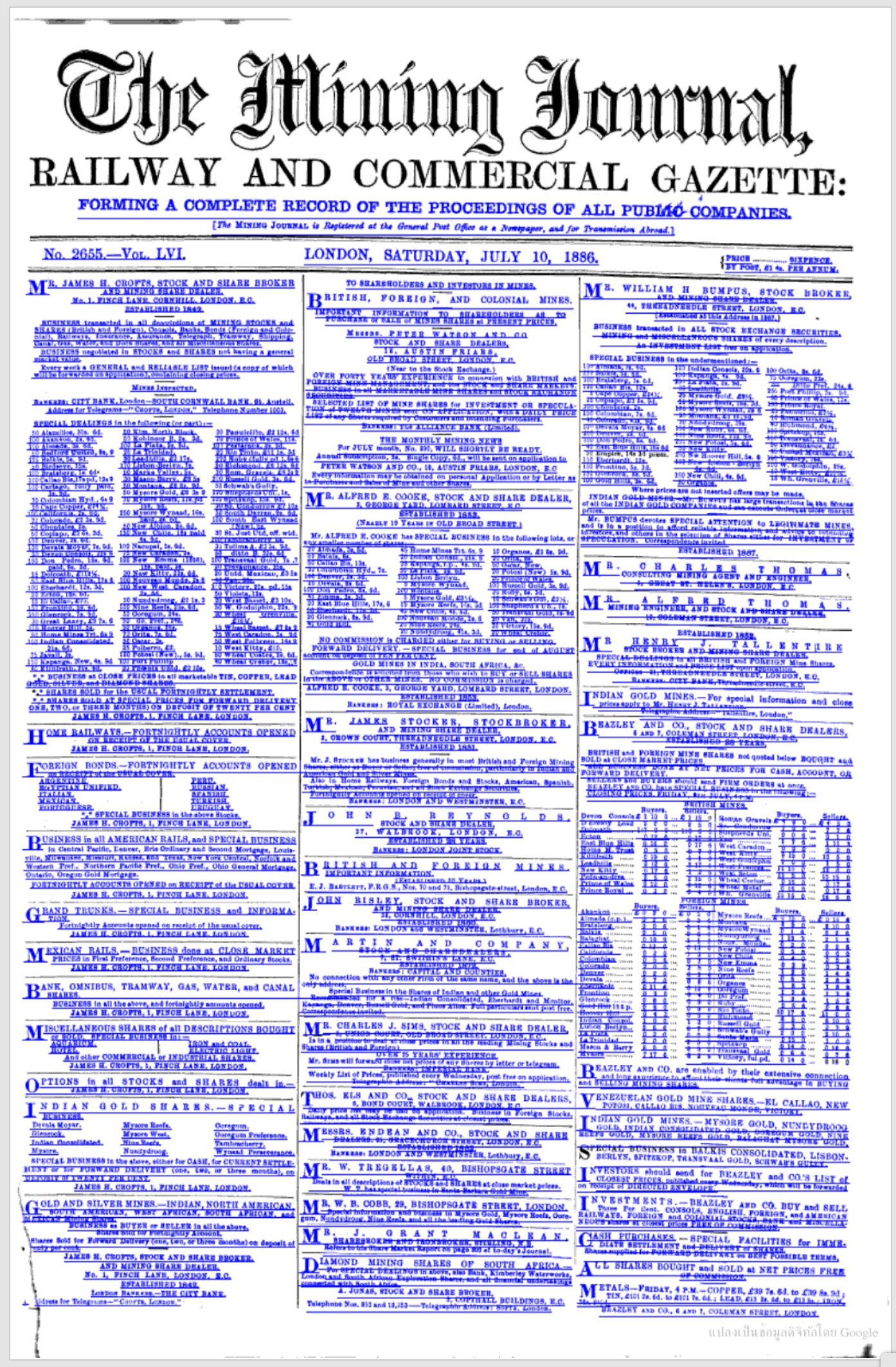
Ball, V. (1886) The mineral resources of India and Burmah, being a lecture delivered at the Colonial and Indian Exhibition on the 5th June 1886.The Mining Journal, Railway & Commercial Gazette, Vol. 56, pp. 674–675.
Record No. 407 | Sinkankas/Born No.: NIS/NIB | not seen
Reference copied to clipboard!
Burma.12, India.12, corundum, gems
Report of a lecture delivered by Valentine Ball at the Colonial and Indian Exhibition on 5 June 1886, surveying the known mineral resources of India and the recently annexed territories of Burma and considering their commercial development. The subsequent discussion emphasized inadequate mining regulations, resulting in a resolution urging the revision of mining laws throughout British India, Burma and the princely states.
[Kashmir sapphire mines]
Kashmir sapphire mines
Newspaper Article
Civil and Military Gazette (1883) [Kashmir sapphire mines].Civil and Military Gazette, Nov. 2, Lahore
Doyle, P. (1879)A Contribution to Burman Mineralogy. Calcutta, 15 pp.
Record No. 2841 | Sinkankas/Born No.: NIS/NIB | not seen
Reference copied to clipboard!
corundum, Burma.12, gems
A short survey by mining engineer Patrick Doyle of the mineralogy of Burma, published at Calcutta in 1879. The pamphlet was reprinted with modifications from articles in the Rangoon Gazette and runs to 15 pages. It belongs to the early literature attempting to bring together contemporary knowledge of Burmese minerals before the more systematic geological investigations undertaken after the British annexation of Upper Burma. The work is of historical value for documenting nineteenth-century interest in Burma’s mineral resources and their potential exploitation.
[Founding of Yogo Town]
Founding of Yogo Town
Newspaper Article
Rocky Mountain Husbandman (1879) [Founding of Yogo Town].Rocky Mountain Husbandman, Sept. 1, Nov. 20, Dec. 11, Diamond City, MT
Record No. 1488 | not seen
Reference copied to clipboard!
corundum, USA.12, Montana.12, gems
[French correspondence on Burma ruby mines]
French correspondence on Burma ruby mines
Journal Article
France Ministère des Affaires étrangères (1879–1886) [French correspondence on Burma ruby mines].Correspondance politique des consuls, Angleterre, Calcutta, Vol. 60, pp. 97–98.
Record No. 255 | not seen
Reference copied to clipboard!
corundum, Burma.12, gems
A small group of French diplomatic documents preserved in the Correspondance politique Angleterre relating to the ruby mines of Burma during the period of increasing French commercial interest in the kingdom. The correspondence belongs to the broader context of French attempts in the early 1880s to obtain concessions from King Thibaw’s government, including proposals involving the celebrated ruby mines, developments that were watched closely by British officials in India. The documents may therefore be valuable primary evidence for the political and commercial history of the Mogok ruby mines immediately before the British annexation of Upper Burma in 1885. Contemporary evidence independently confirms French negotiations concerning Burmese ruby-mine concessions during this period.
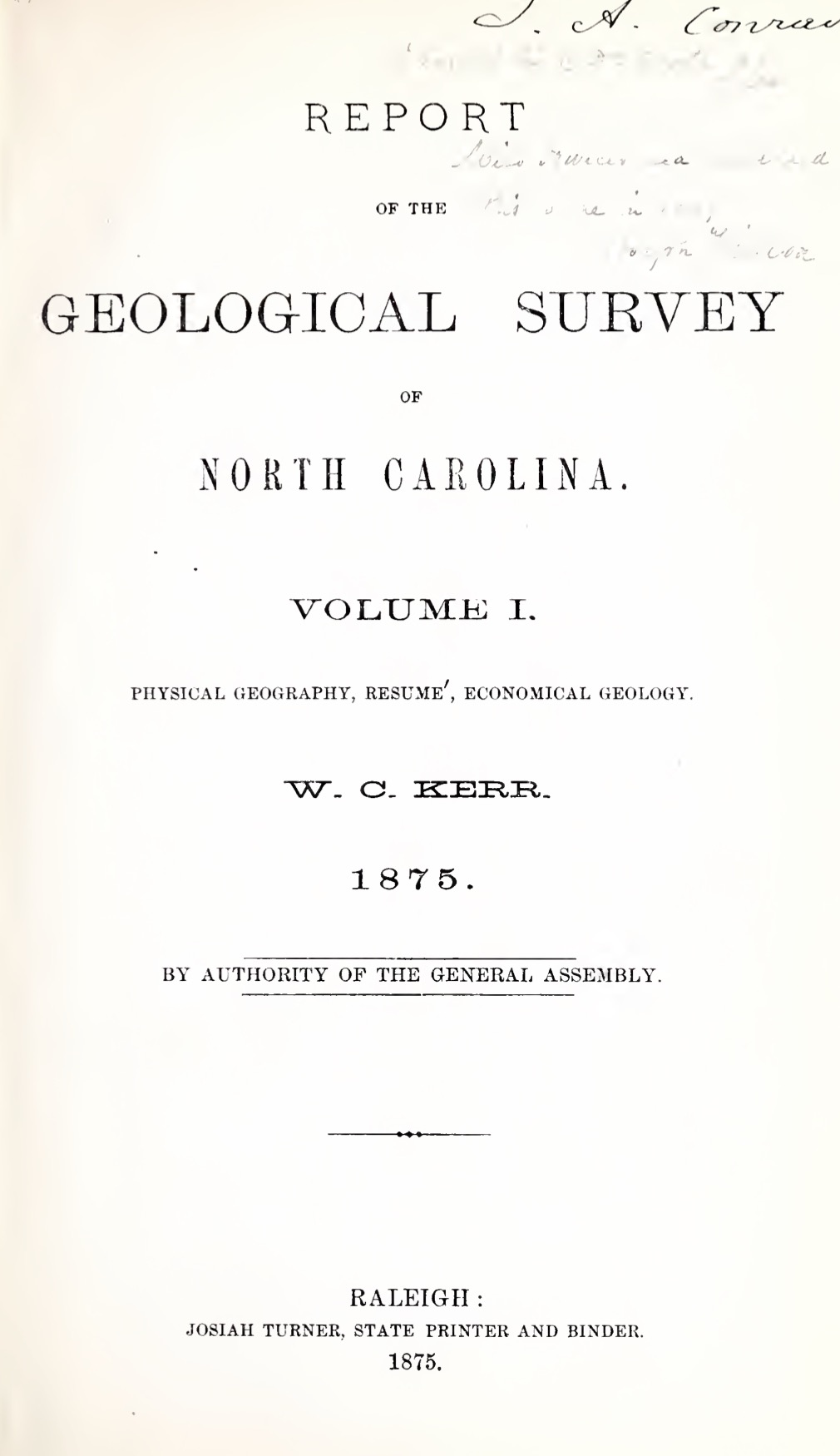
North Carolina State Geologist (1875)Report of the geological survey of North Carolina. Vol. I. Physical geography, resumé, economical geology. Raleigh, NC, J. Turner, xviii, 325, 120 p.
Record No. 7380 | not seen
Reference copied to clipboard!
Geology North Carolina., North Carolina Description and travel., gems
The report presents a comprehensive survey of the physical geography and economically important geological resources of North Carolina, describing the state’s principal geological regions, rocks, soils, minerals, ores, and mining districts. It reviews resources of commercial importance, including gold, iron, copper, coal, building stones, and other mineral products, and summarizes contemporary knowledge of their occurrence and potential exploitation. Of particular gemological interest are the state’s corundum deposits and associated occurrences of ruby and sapphire, as well as other minerals suitable for ornamental or industrial use. The volume provides an important nineteenth-century account of North Carolina’s mineral resources during the period when its corundum deposits were attracting considerable scientific and commercial attention.
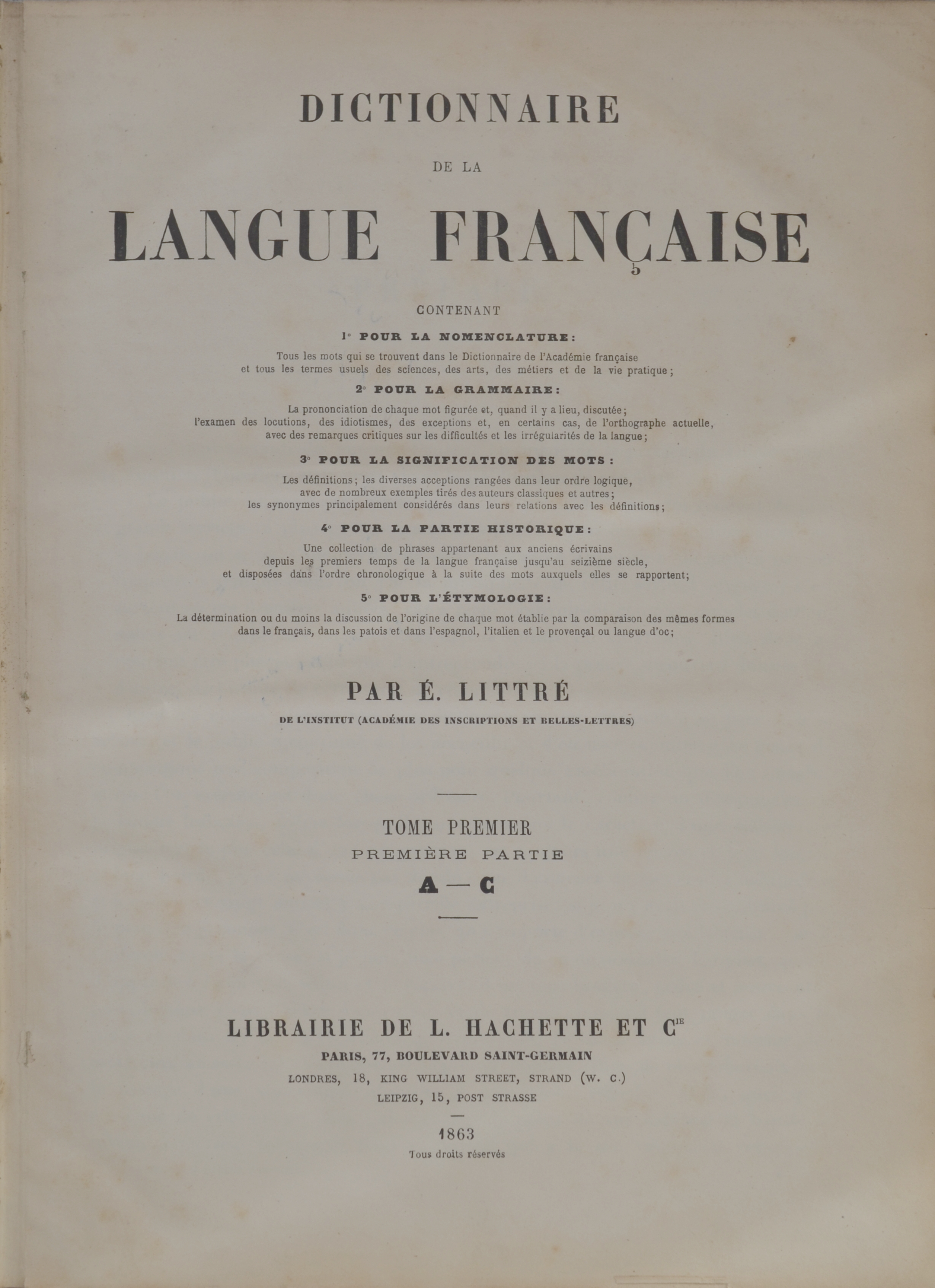
Littré, É. (1872–1877)Dictionnaire de la Langue Française. [Dictionary of the French Language.] Paris, Hachette, 4 Vols.
Record No. 2820 | Sinkankas/Born No.: NIS/NIB | Language: in French | seen
Reference copied to clipboard!
corundum, history.1, gems
Littré’s monumental Dictionnaire de la langue française provides definitions, etymologies, historical usages, pronunciation, grammatical information, and numerous literary citations illustrating the development of French vocabulary. Compiled from an extensive range of texts from the Middle Ages through the nineteenth century, it traces changes in meaning and usage and records technical as well as ordinary language. Of particular value to gemological and mineralogical research are entries for precious stones, minerals, jewelry, lapidary terminology, colors, and related technical terms, often accompanied by etymological information and quotations demonstrating their historical use. The work remains an important source for interpreting French mineralogical, gemological, and lapidary terminology in historical texts.
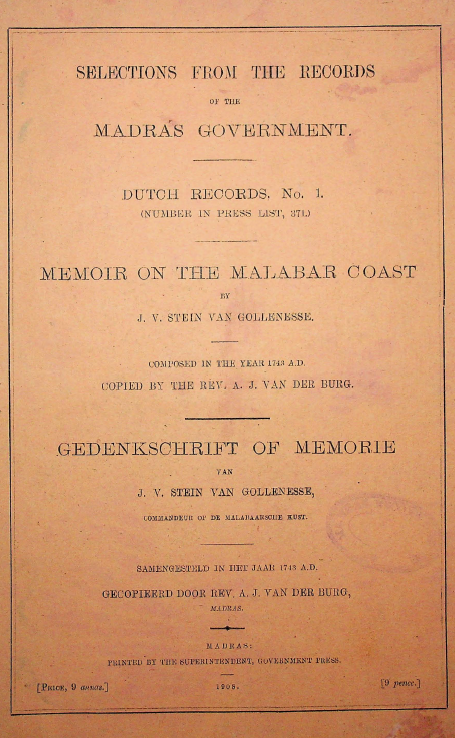
Report upon the Government Central Museum and the Local Museums in the Provinces, for 1855–56; with Appendices
Journal Article
Balfour, E. (1857) Report upon the Government Central Museum and the Local Museums in the Provinces, for 1855–56; with Appendices.Selections from the Records of the Madras Government, No. 39, p. 94.
Record No. 29500 | Sinkankas/Born No.: NIS/NIB | not seen
Reference copied to clipboard!
gems, corundum, India.12,
Discusses the occurrence of corundum in Travancore.
Notes on the productive capacities of the Shan countries, North and East of Ava, their arts and manufactures; with a short account of the town of Bamo, as seen in January, 1836, and its trade with China and the lower Irrawaddy
Book Section
Hannay, S.F., Capt. (1857) Notes on the productive capacities of the Shan countries, North and East of Ava, their arts and manufactures; with a short account of the town of Bamo, as seen in January, 1836, and its trade with China and the lower Irrawaddy. In: Selections from the Records of the Bengal Government, Calcutta, 1853–1900, Calcutta: Calcutta Gazette Office, pp. 9–19, jade see p. 11.
Record No. 29475 | Sinkankas/Born No.: NIS/NIB | not seen
An account of the economic resources, arts, manufactures, and commerce of the Shan territories north and east of Ava in Burma (Myanmar), based on Captain S. F. Hannay’s travels and observations, including his visit to Bhamo in January 1836. Hannay describes local products, industries, trade routes, and the important commerce between Bhamo, China, and the lower Irrawaddy. Of particular gemological interest is the reference on p. 11 to precious stones and mineral products among the commodities and resources of the region. The paper provides valuable firsthand evidence for nineteenth-century trade networks linking the mineral- and gem-producing regions of northern Burma with China and the wider Burmese economy.
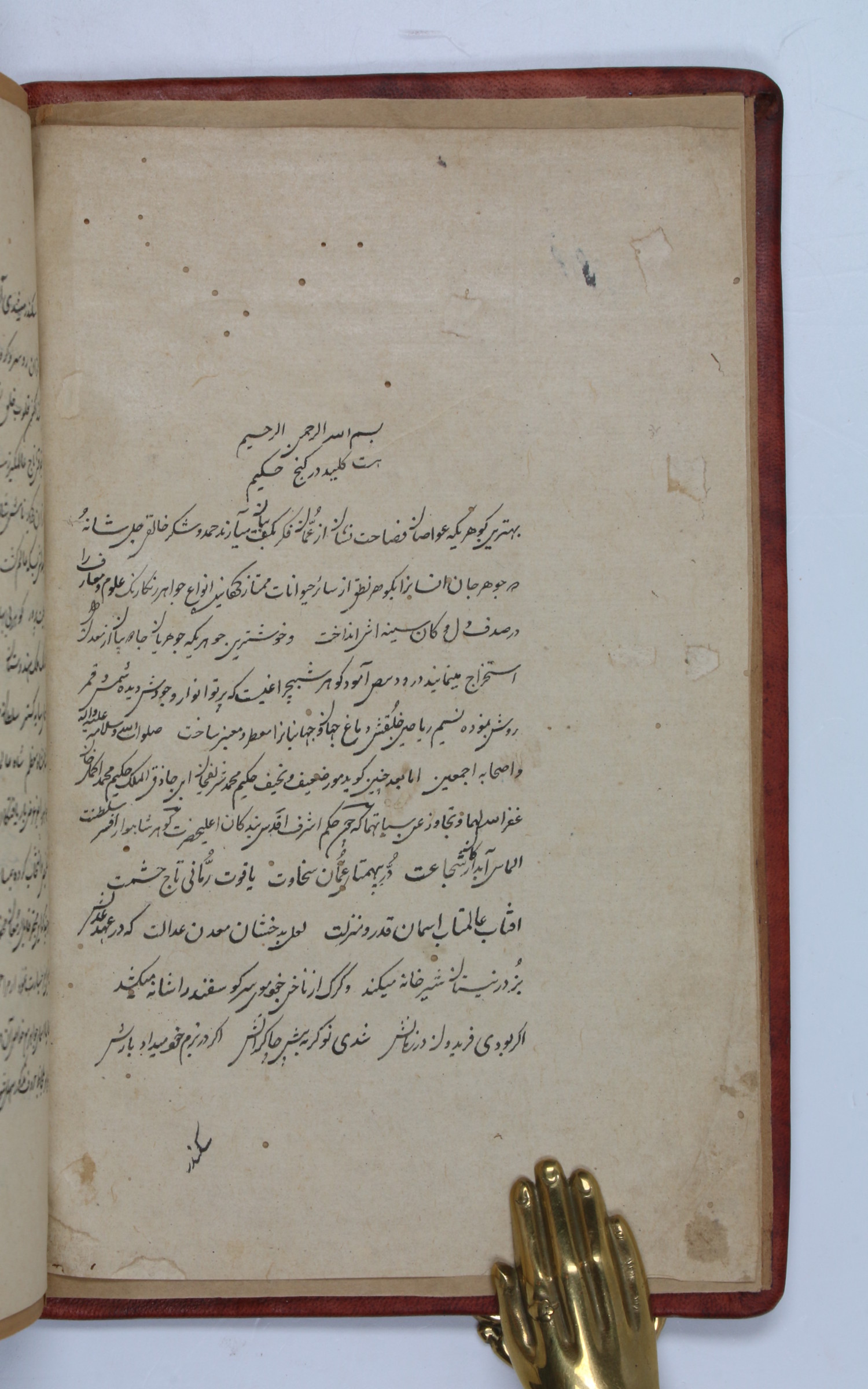
Sharifi, H.M. (1845)Khawas al-Jawahir. [The properties of gemstones] Persia, 12 folio Persian manuscript
Record No. 17055 | Language: in Persian | not seen
Reference copied to clipboard!
gems, Arabic mineralogy
A treatise on the properties of popular gemstones, including diamonds, rubies, emeralds, aqeeq (a stone of particular importance to Islam), and several others, attributed to a famous Muslim physician in the Mughal court, Hakim Muhammad Sharifi (1722–1807). The author details the physical attributes of each gem, then goes on to describe their spiritual properties and how each affect health and mood, can work to cure disease, and how one might use gemstones in alchemy. Works on the properties of gemstones were quite popular across the Muslim world as an offshoot of both science and folk medicine; their use in alchemy, the precursor to modern chemistry, was popular. Here, gemstones can guard against miscarriage, prevent internal pain, bad luck, or a fearful disposition.
Thunberg, C.P. (1784) Description of the mineral and precious stones of Ceylon.Academy of Sciences (Stockholm), 1st Quarter, pp. 70–81.
Record No. 1723 | not seen
Reference copied to clipboard!
corundum, Sri Lanka.12, gems
Thunberg describes the minerals and precious stones of Ceylon, drawing upon observations and specimens associated with his travels on the island in the late eighteenth century. He discusses gemstones for which Ceylon was celebrated, including sapphires, rubies and related corundum, cat’s-eyes, garnets, zircons, and other minerals, with observations on their appearance, occurrence, and local importance. The paper represents an early European scientific account of Sri Lanka’s exceptionally diverse gem resources and contributes to the historical documentation of the island as one of the world’s major sources of colored gemstones.
A foundational work in descriptive mineralogy by Abraham Gottlob Werner, establishing a systematic vocabulary for identifying minerals from their observable external characteristics. Werner describes such properties as color, lustre, transparency, crystal form, fracture, cleavage, hardness, specific gravity and tactile characteristics, and provides standardized terminology for recording them. Rather than being a catalogue of mineral species, the book sets out a practical method for their description and recognition, including precious stones and other minerals then commonly termed “fossils.” The work was highly influential in European mineralogy and helped establish careful macroscopic observation as a fundamental method of mineral identification before chemical analysis and crystallography became dominant.
Shi Dian Zaji (Miscellaneous Notes on a Mission to Yunnan)
使滇雜記
Book
Xu, J. (1687–1688)Shi Dian Zaji (Miscellaneous Notes on a Mission to Yunnan). [使滇雜記], 1 juan (scroll)
Record No. 16779 | Sinkankas/Born No.: NIS/NIB | Language: in Chinese | not seen
Xu Jiong’s Shi Dian Zaji [使滇雜記; Miscellaneous Notes on a Mission to Yunnan] is a short record compiled from observations made during his official journey to Yunnan in 1687–1688 during the early Qing dynasty. The single-juan work records places, routes, local customs, products, natural resources, and other matters encountered during the mission, providing a contemporary view of Yunnan and its connections with regions farther southwest. It is of particular interest to the history of gems because Yunnan, especially the routes through Tengyue toward Burma, subsequently became the principal Chinese gateway for Burmese jadeite and other precious materials. The work is therefore useful as an early Qing source for the geographical and commercial setting in which the Yunnan–Burma gem trade developed. Sun Licheng: Contains a brief comment on gems produced in Burma. Xu Jiong was sent by the Qing emperor to Yunnan in 1687–1688. The Shi Dian Zaji is a compilation of his travel notes.
Ratna Pariksha
Gem Testing
Book
Pheru, T. (1316)Ratna Pariksha. [Gem Testing] Jodhpur, Institute of Oriental Research
Record No. 3123 | Language: in Sanskrit | not seen
Reference copied to clipboard!
corundum, history.1, India.12, gems, Indian lapidary
Ratna Pariksha [रत्नपरीक्षा; Gem Testing], composed in 1316 by the Jain scholar and administrator Thakkura Pheru, is a medieval Indian treatise devoted to the identification, classification, evaluation, and valuation of precious stones. Written in Apabhraṃśa, it discusses important gems encountered in the Indian trade, including diamonds, pearls, rubies, sapphires, emeralds, and other precious materials, describing their varieties, desirable and undesirable qualities, defects, weights, and commercial values. The work is particularly important to the history of gemology because Pheru drew upon practical experience with gems, weights, measures, and monetary calculations rather than treating precious stones solely within the religious and astrological traditions characteristic of many earlier Indian lapidaries. It consequently provides valuable evidence for the terminology, testing practices, grading criteria, and economics of the gem trade in early 14th-century India.
A Short Treatise on the Identification of Precious Stones
Mukhtaṣar dar bayān-i shinākhtan-i jawāhir [مختصر در بیان شناختن جواهر
Manuscript
Jāmī, Z.a.-D.M. (15th century)A Short Treatise on the Identification of Precious Stones. [Mukhtaṣar dar bayān-i shinākhtan-i jawāhir [مختصر در بیان شناختن جواهر]
Record No. 29535 | Sinkankas/Born No.: NIS/NIB | Language: in Persian | not seen
Reference copied to clipboard!
gems, Arabic lore, history, Arabic mineralogy,
Composed for Shāh-Rukh Bahādur Khān, the work is divided into 12 chapters. Storey associates it with an abridged Jawāhir-nāmah dealing with diamond, yāqūt, ruby, emerald, pearl, turquoise, bezoar, amber, lapis lazuli, coral, carnelian, and jasper, describing their mines, properties, supposed influences, and values and frequently referring to European jewelers.
Selections/Abridgment of the Book of Precious Stones
Muntakhab [or Mukhtaṣar]-i Jawāhir-nāmah [منتخب
Manuscript
al-Jauharī, A.i.ʿ.a.-ʿ. (date unknown)Selections/Abridgment of the Book of Precious Stones. [Muntakhab [or Mukhtaṣar]-i Jawāhir-nāmah [منتخب]
Record No. 29526 | Sinkankas/Born No.: NIS/NIB | Language: in Persian | not seen
Reference copied to clipboard!
gems, Arabic lore, history, Arabic mineralogy,
Probably an abridgment of a work composed by Zain al-Dīn Muḥammad Jāmī for Shāh-Rukh Bahādur Khān. Its 12 chapters treat diamond, yāqūt, ruby, emerald, pearl, turquoise, bezoar, amber, lapis lazuli, coral, carnelian, and jasper, giving information on their mines, properties, supposed influences, and values in florins, with frequent references to European jewelers. A related Kapurthala manuscript dated 1747 adds musk and rock crystal.
A Short Account of Yunnan
典销记
Book
Ni, T. (after 1719)A Short Account of Yunnan. [典销记]
Record No. 16780 | Sinkankas/Born No.: NIS/NIB | Language: in Chinese | not seen
Reference copied to clipboard!
gems, Burma, Myanmar, amber, ruby, jade
Sun Laichen: Contains relatively detailed descriptions of the precious stones from Mengmi, amber from Mengyang, and the travel routes from Yunnan to Burma. Written after 1719.
Exploring the Literature of Corundum
Ruby and sapphire research spans mineralogy, gem deposits, identification, treatments, synthesis and the history of the gem trade. Older publications can also be useful for tracing terminology, early observations and accounts of mining localities. Publication dates and the original source should be considered when using historical descriptions.
Four Treasures is Lotus Gemology's freely accessible gemological reference database. Use the full database to search by author, title or keyword and explore literature on gemology, mineralogy, jewelry and related fields. Where available, hyperlinks on titles may lead directly to the full publication.


![[Kashmir sapphire mines]](/media/publications/05681815043540299520book.jpg "[Kashmir sapphire mines]")
![[Burma ruby mines production]](/media/publications/070465996880100-Years-Ago-1.jpg "[Burma ruby mines production]")