Ruby & Sapphire Bibliography

Ruby & Sapphire Bibliography

Explore books, articles and historical sources on ruby, sapphire and corundum in Four Treasures, the Lotus Gemology reference database. This bibliography brings together matching records from the collection, with publication details, abstracts and cover images where available.

Ruby & Sapphire References

The list below matches the terms ruby, rubies, sapphire or corundum in the database's searchable fields. Some references discuss these gems as part of a broader subject. Linked titles take you to external links where you may find the full reference.
321–340 of 4,671 matching references

Laboratory analysis of an extraordinary artifact: A sapphire tiara found during the excavations in Colonia (Rome)
Journal Article
Butini, E. and Butini, F. (2017) Laboratory analysis of an extraordinary artifact: A sapphire tiara found during the excavations in Colonia (Rome). Rivista Italiana di Gemmologia – Italian Gemological Review, No. 1, pp. 37–43.
Record No. 5968  |  RWHL*
In 2011, in Colonna (a small town not far from Rome), the excavation for the foundations of a private building led to the discovery of a monumental tomb from the Roman era. The sarcophagus found inside the tomb contained the mummified remains of a woman and an astonishing golden tiara enriched by sapphires.

Gemological applications of UV-Vis-NIR spectroscopy
Journal Article
Scarani, A. and Åström, M. (2017) Gemological applications of UV-Vis-NIR spectroscopy. Rivista Italiana di Gemmologia – Italian Gemological Review, No. 1, pp. 32–35.
Record No. 5967  |  RWHL*
UV-Vis-NIR (Ultra Violet-Visible-Near Infrared) Spectroscopy allows to analyse the interaction between matter and electromagnetic radiation in the Ultraviolet, Visible and Near Infrared wavelength range. The spectral range of these instruments, depending on the model, can go from 200 nanometers (nm) of the C-Ultraviolet until 1100 nm of the Near Infrared and it’s quite broader than the visible region (400-700 nm) available by using the optical spectroscope. The theoretical principles, which will not been elaborated in this article, refer to the optical spectroscopy: every single material subjected to radiation reacts in a specific way by absorbing portions of such radiation. If these absorption bands are presented as a chart, they can provide an effective material identification method. Absorption and transmission are directly linked to the chemical composition and crystal structure of the gem. About the visible spectral range, when comparing directly observed spectra we are familiar with to the ones recorded by spectrophotometers, it is important to underline that the sensitivity of human is not constant for the whole visible range. The sensitivity of the human eye is at maximum at about 550 nm and gradually decreases towards both longer and shorter wavelength directions. This fact leads to reduced perception of the bands closer to the visible range ends, while the CCD sensors equipping the modern UV-Vis-NIR units perform in a far more efficient way.

Culture et Histoire: Le talisman de Charlemagne: nouvelles decouvertes historiques et gemmologiques
Culture and History: Charlemagne’s talisman: New historical and gemological discoveries
Journal Article
Panczer, G., Riondet, G., Forest, L., Krzemnicki, M.S. and Faure, F. (2017) Culture et Histoire: Le talisman de Charlemagne: nouvelles decouvertes historiques et gemmologiques. [Culture and History: Charlemagne’s talisman: New historical and gemological discoveries] Revue de Gemmologie A.F.G., No. 199, March, pp. 18–25.
Record No. 5927  |  Sinkankas/Born No.: NIS/NIB  |  Language: in French  |  RWHL*
Panczer and colleagues re-examine the celebrated Talisman of Charlemagne, combining historical research with modern gemological investigation to clarify the history, materials, and possible provenance of this important Carolingian jewel. The study discusses the talisman’s traditional association with Charlemagne, its subsequent history and transmission, and the uncertainties surrounding its original function and contents. Detailed examination of the gemstones and construction provides new information on the nature and characteristics of the central stone and surrounding gems, while comparison with historical sources and related objects helps reassess earlier interpretations of the jewel. By integrating gemology with documentary and art-historical evidence, the authors refine the understanding of the talisman’s chronology and history and illustrate how scientific examination can contribute to the study of an exceptional medieval jeweled object.

Inclusions in natural, synthetic and treated sapphire
Journal Article
Renfro, N., Koivula, J.I., Muyal, J., McClure, S.F., Schumacher, K. and Shigley, J.E. (2017) Inclusions in natural, synthetic and treated sapphire. Gems & Gemology, Vol. 53, No. 2, Summer, pp. 213–214.
Record No. 5884  |  ISBN/ISSN: 0016626X  |  RWHL*
This is the second chart in G&G’s series focused on micro-features often observed in natural, treated, and synthetic gems. Sapphire (figure 1) was chosen because of its enduring importance within the gem trade. Demand for this gem species has been the driving force behind the development of treat ment techniques to improve natural stones and the continued production of inexpensive synthetics. Natural sapphires, which originate in certain ig-neous or metamorphic geologic environments are commonly treated to improve their color or clarity. The most common processes involve heat treatment to improve color. Synthetic sapphires have been pro-duced for more than a century, mostly by melt, flux, or hydrothermal solution methods (Hughes, 2017). All of these materials are widely encountered in the jewelry trade.

Big Sky Country sapphire: Visiting Montana’s alluvial deposits
Journal Article
Hsu, T., Lucas, A., Kane, R.E., McClure, S.F. and Renfro, N.D. (2017) Big Sky Country sapphire: Visiting Montana’s alluvial deposits. Gems & Gemology, Vol. 53, No. 2, Summer, pp. 215–227.
Record No. 5883  |  ISBN/ISSN: 0016626X  |  RWHL*
Sapphire has been mined in the western U.S. state of Montana for more than a century and a half. Historically, gem-quality sapphires have been mined commercially in four main areas in southwestern Montana, shown in figure 1: the upper Missouri River gravel bars (1865), Dry Cottonwood Creek (1889), Rock Creek (1892), and Yogo Gulch (1895). Today, the first two areas remain quite active, while operations in Yogo Gulch and Dry Cottonwood Creek have been suspended for many years. To better understand the characteristics of Montana sapphire and record current mining and commercial activities, GIA sent a team to visit the placer deposits at the upper Missouri River and Rock Creek areas in Au-gust 2015. Since the latter half of the 19th century, Montana’s history has been intertwined with gold, silver, and copper mining. Corundum was discovered dur-ing the course of gold mining activities in southwestern Montana. Before the 1940s, the state’s alluvial sapphire deposits were exploited mainly to supply the watch industry, but production fell dramatically with the use of synthetic sapphire in watch bearings (Emmett and Douthit, 1993). Among Montana’s secondary deposits, Rock Creek (figure 2) is the only area mined specifically for sapphire from its discovery in 1892 until World War II (Clabaugh, 1952). While Yogo Gulch is a primary deposit, the placer deposits at Rock Creek, Dry Cottonwood Creek, and the upper Missouri River near Helena have been a matter of speculation among researchers trying to work out the origin of these sapphire crystals. Research indicates that they were carried to the surface by volcanic activity, but their ultimate origin is still an open question, even after about 125 years of searching (e.g., Pratt, 1906; Clabaugh, 1952; Garland, 2002; Berg and Dahy, 2002; Berg, 2014; Zwaan et al., 2015). Due to the lack of significant sapphire bearing host rock outcrops in these areas, the search and discussion continue. The glamour of the sapphires, the mysteries of their origin, the area’s mining history, and the natural beauty of Big Sky country are an intriguing combination (figure 3).

Tectonic and metamorphic evolution of the Mogok Metamorphic and Jade Mines belts and ophiolitic terranes of Burma (Myanmar)
Book Section
Searle, M.P., Morley, C.K., Waters, D.J., Gardiner, N.J., U Kyi Htun, Than Than Nu and Robb, L.J. (2017) Tectonic and metamorphic evolution of the Mogok Metamorphic and Jade Mines belts and ophiolitic terranes of Burma (Myanmar). In: Myanmar: Geology, Resources and Tectonics, Geological Society, London, Memoirs, London: Geological Society, Vol. 48 , pp. 261–293.
Record No. 5741  |  Sinkankas/Born No.: NIS/NIB  |  RWHL*
The Mogok Metamorphic Belt is a north–south-aligned belt of mainly high-grade metamorphic rocks and granites that extends the length of Burma (Myanmar) along the western margin of the Sibumasu block from the Andaman Sea to the East Himalayan (Namche Barwa) Syntaxis (Figs 12.1 & 12.2). The Mogok metamorphic rocks host some of the world's finest rubies and sapphires, the former mainly from high-grade phlogopite + corundum marbles and the latter from a heterogeneous suite of syenite and charnockites that intrude the metamorphic rocks (Chhibber 1934a, b; Iyer 1953; Searle & Haq 1964; Bender 1983; Mitchell et al. 2007; Searle et al. 2007; Themelis 2008). Gem spinels are also found in forsterite-bearing marbles. Gemstones have been mined in the Mogok region since at least the mid-1800s (O'Connor 1888; Gübelin 1965a, b; Keller 1982, 1983; Kane & Kammerling 1992). Together with the adjacent Mergui Slate Belt these rocks lie to the west of the Shan Scarp and the Paung Laung-Mawchi Zone, interpreted by Mitchell et al. (2012) as a possible suture zone. We refer to this entire zone of metamorphic rocks, plus the Slate Belt and pre-collisional granites east of the Sagaing Fault and west of the Paung Laung-Mawchi Zone, as the Mogok–Mandalay–Mergui (MMM) Belt; the metamorphic rocks are referred to solely as the Mogok Metamorphic Belt (MMB).

Accurate reporting of key trace elements in ruby and sapphire using matrix-matched standards
Journal Article
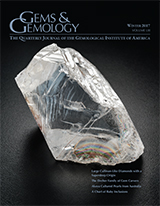
Stone-Sundberg, J., Thomas, T., Sun, Z., Guan, Y., Cole, Z., Equall, R. and Emmett, J.L. (2017) Accurate reporting of key trace elements in ruby and sapphire using matrix-matched standards. Gems & Gemology, Vol. 53, No. 4, Winter, pp. 438–451.
Record No. 5737  |  ISBN/ISSN: 0016626X  |  RWHL*

Inclusions in natural, synthetic and treated ruby
Journal Article
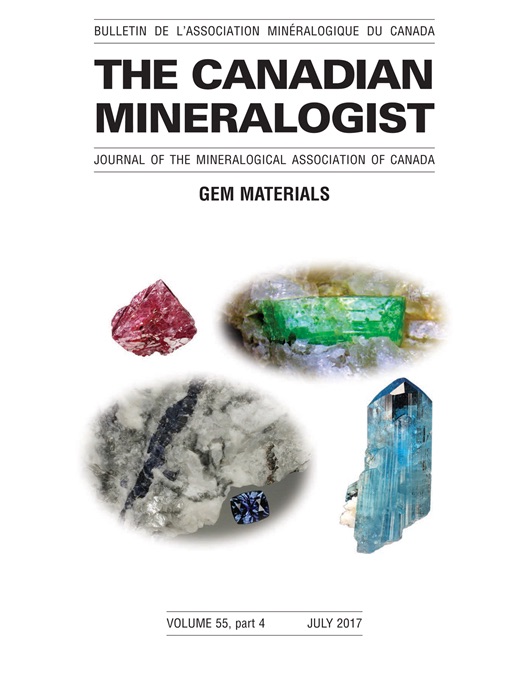
Renfro, N., Koivula, J.I., Muyal, J., McClure, S.F., Schumacher, K. and Shigley, J.E. (2017) Inclusions in natural, synthetic and treated ruby. Gems & Gemology, Vol. 53, No. 4, Winter, pp. 457–458.
Record No. 5736  |  ISBN/ISSN: 0016626X  |  RWHL*

Why are some crystals gem quality? Crystal growth considerations on the “gem factor”
Journal Article
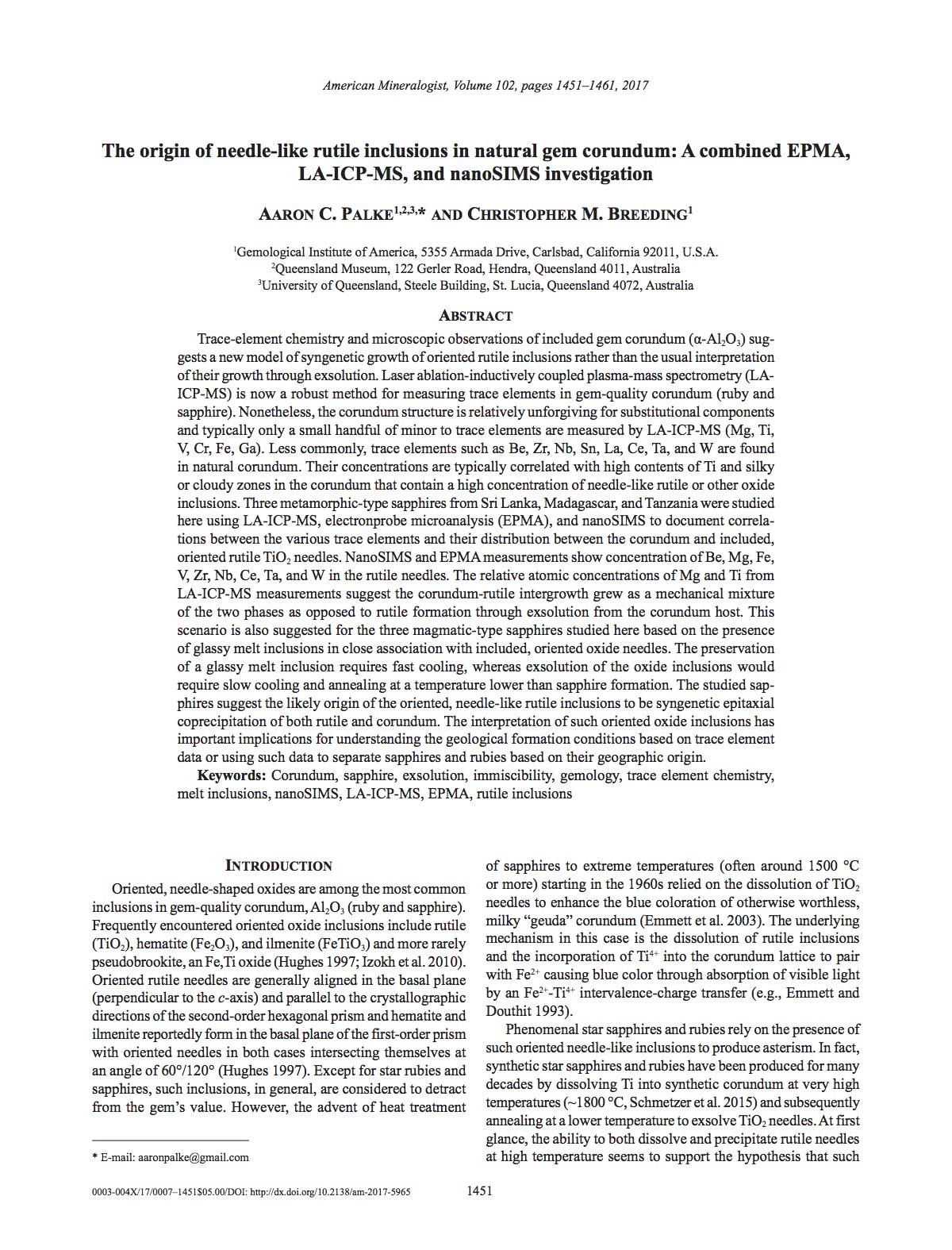
Fritsch, E., Rondeau, B., Devouard, B., Pinsault, L. and Latouche, C. (2017) Why are some crystals gem quality? Crystal growth considerations on the “gem factor”. Canadian Mineralogist, Vol. 55, pp. 521–533.
Record No. 5667  |  RWHL*
The purpose of this work is to investigate the crystal growth parameters necessary or sufficient to obtain a crystal specifically of gem quality. We assume adequate chemistry is available. First, nucleation must occur with only a limited number of nuclei, otherwise too many crystals will be produced, and they will be too small to be faceted into a gem. Two growth mechanisms are readily documented for gems: Most commonly there is slow growth, driven by a spiral growth mechanism, leading to large single individuals. There are only a few examples of fast growth leading to gem-quality edifices: examples include ‘‘gota de aceite’’ Colombian emerald or the dendritic ‘‘pseudo cube’’ for gem diamonds. We have not documented the intermediate conditions between these two extremes in the Sunagawa diagram, which would correspond to 2D nucleation growth. The presence of inclusions is to be limited to desirable ones. Thus, in general, a good stability of the growth interface is the best guarantee of good clarity in the final gem. As for the interface, in general, growth conditions must be relatively stable over the period necessary to achieve growth. Perhaps surprisingly, it has become well documented that gem-quality near-colorless diamonds may have experienced quite a complex growth history. Therefore, the term stability has to be re-defined for each system producing a given gem. The length of time it takes to achieve crystallization of the gem has rarely been studied or estimated. Scientific evidence from experimental petrology and the growth of synthetic gems indicates that it does not take millions of years to grow a gem, but that this exercise may be achieved in a week to, arguably, a few years at the most. Available free space to grow does not appear always necessary, but it helps. Otherwise deformation, inclusions, and other negative effects may occur. Finally, no dramatic post-growth events, such as fracturing or etching, should affect the gem crystal.

The origin of needle-like rutile inclusions in natural gem corundum: A combined EPMA, LA-ICP-MS, and nanoSIMS investigation
Journal Article
Palke, A. and Breeding, C.M. (2017) The origin of needle-like rutile inclusions in natural gem corundum: A combined EPMA, LA-ICP-MS, and nanoSIMS investigation. American Mineralogist, Vol. 102, No. 7, pp. 1451–1461.
Record No. 5666  |  RWHL*

A Study of Rubies from Cambodia & Thailand
Report
Sangsawong, S., Vertriest, W., Saeseaw, S. and Pardieu, V. (2017) A Study of Rubies from Cambodia & Thailand. GIA News From Research, Bangkok: Gemological Institute of America, August 7, Version 3, 37 pp.
Record No. 5659  |  Sinkankas/Born No.: NIS/NIB  |  Language: in english  |  RWHL*
Rubies in Thailand and Cambodia are found in the border area of both countries, in the areas of Pailin (Cambodia) and Chanthaburi-Bo Rai-Trat (Thailand). Although being recovered for over 100 years, Thai and Cambodian rubies have been mined intensively in the 1960’s-1990’s. Those were large-scale mechanized operations. Production today has dropped drastically, but small scale and artisanal miners are still finding rubies. These are mainly on the Cambodian side of the border. For this study, 41 samples were analyzed at the GIA laboratory in Bangkok. Internal features were documented with a focus on mineral inclusions, fingerprints and twinning planes. Advanced techniques such as UV-VIS-NIR spectroscopy were used to analyze the color of these rubies. Trace element chemistry was measured using LA-ICP-MS to support the spectroscopy and to compare this data with rubies from other deposits.

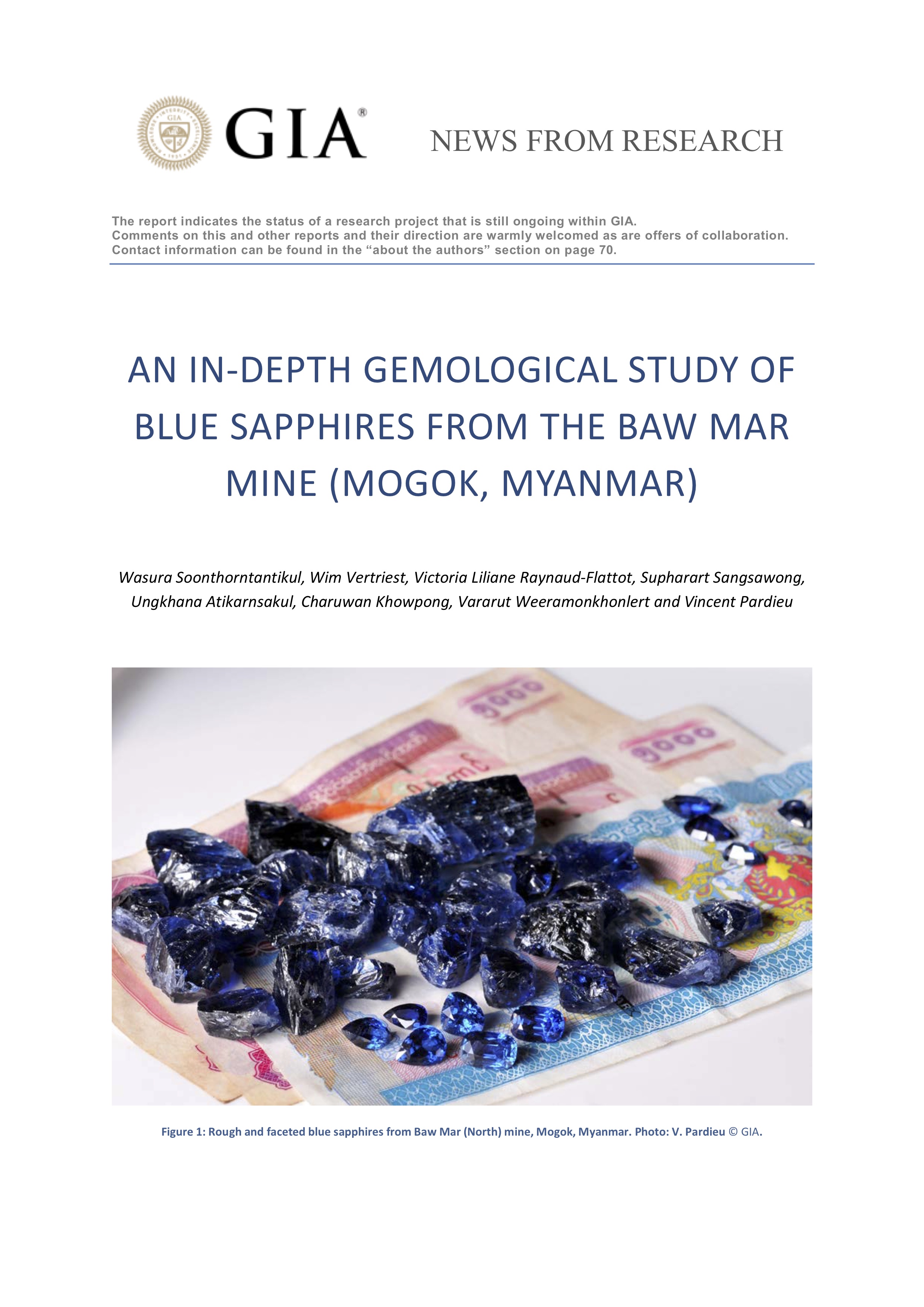
An in-depth gemological study of blue sapphires from the Baw Mar mine (Mogok, Myanmar)
Report
Soonthorntanikul, W., Vertriest, W., Raynaud-Flattot, V.L., Sangsawong, S., Atikarnsakul, U., Khowpong, C., Weeramonkhonlert, V. and Pardieu, V. (2017) An in-depth gemological study of blue sapphires from the Baw Mar mine (Mogok, Myanmar). GIA News from Research, Gemological Institute of America, 87 pp.
Record No. 5655  |  RWHL*
High quality blue sapphires have been mined in Myanmar for centuries (Kane & Kammerling 1992, Themelis 2001, Hughes 1997). Until the end of the 20th Century, sapphires were mined from the Mogok Stone Tract, mainly in the western area near Kyatpin and around Mogok town. Towards the end of the 20th Century blue sapphire mining extended to the west around Kyauk Pya That, Kabaing and Kin, to the north around Barnard Myo and in the Chaung Gyi valley, and in the east around Peint Pyit village (Themelis 2008, Hughes 2016). Between 2011 and 2016 new production from Baw Mar area started to reach the market and attracted the attention of gemologists visiting the region (Phyo Kan Nyunt et al., 2013). GIA field gemologists visited Baw Mar operations in 2013, 2014, and 2015. It was evident the mine was not only the highest altitude mine in the whole of the Mogok area but also one of Mogok’s largest mining operations. Its sapphire production is interesting and challenging for gemologists as, its sapphire characteristics (chemistry and internal features) are slightly different from the classic Burmese sapphires. The aim of this research project is to expand our knowledge of these gemstones which can be a challenge in terms of origin determination. During the field expeditions and subsequent laboratory work it became clear that even within the same mine, sapphires can look different to one another depending on the area where they are mined; samples from the southern area are generally lighter in color than the sapphires recovered from the northern part of the mine. In this study, we analyzed samples collected at the office (located near the mining site where the production was sorted) during two separate expeditions. The samples were mined from opposite parts of the mine, southern and northern, respectively. The general gemological characteristics; inclusions, UV-VIS and IR spectra and trace element chemistry are covered. A description of the mine, mining techniques employed and preliminary geological observations are also provided. Most of the data collected reveals sufficient information to differentiate between the two sampled areas within the same mine. It is clear that the Baw Mar sapphires formed in a complex geological environment with the potential to produce a range of qualities (high to low), various inclusion scenes and variable trace element concentrations.

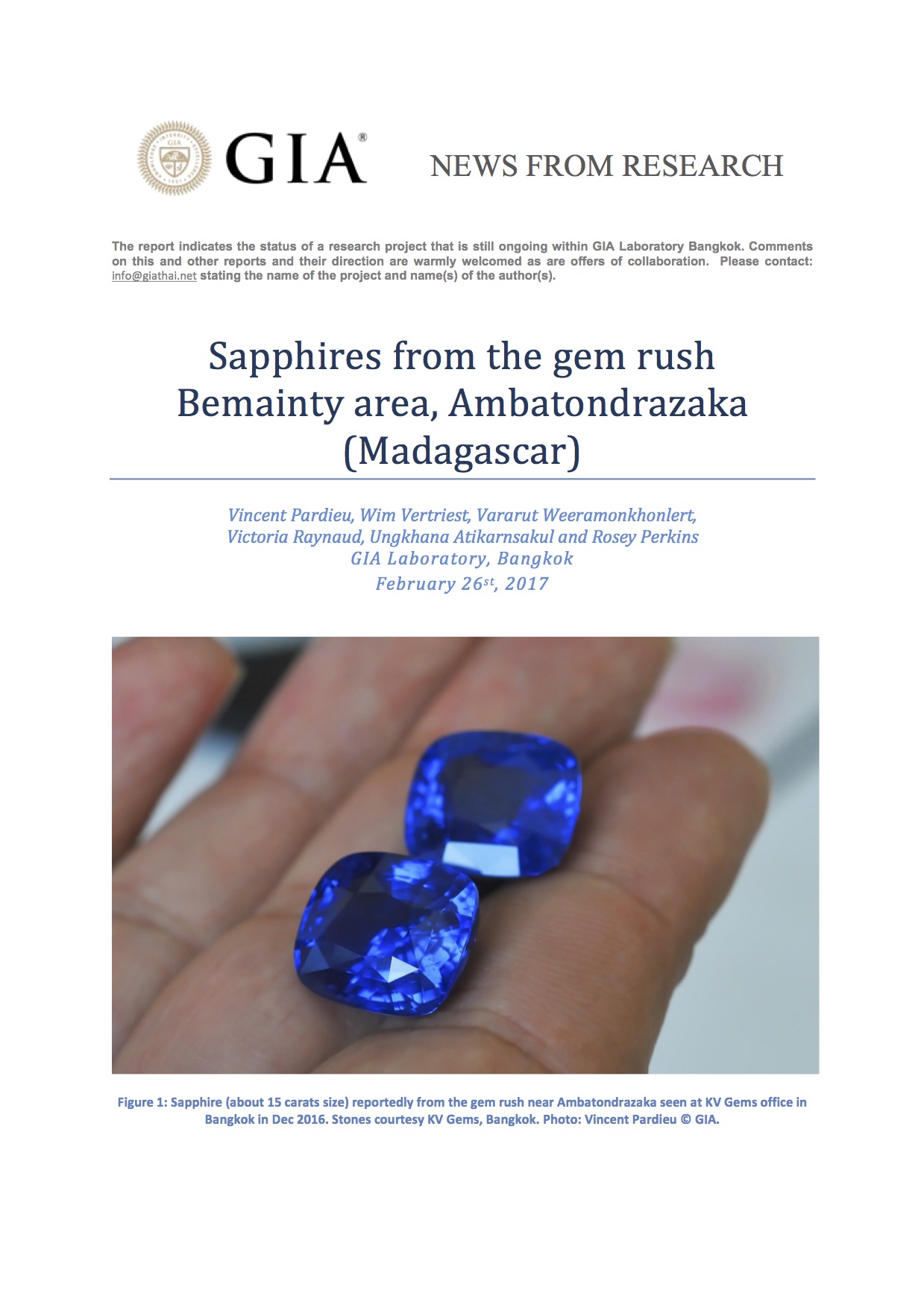
Sapphires from the gem rush Bemainty area, Ambatondrazaka (Madagascar)
Report
Pardieu, V., Vertriest, W., Weeramonkhonlert, V., Raynaud, V., Atikarnsakul, U. and Perkins, R. (2017) Sapphires from the gem rush Bemainty area, Ambatondrazaka (Madagascar). GIA News from Research, Gemological Institute of America, 45 pp.
Record No. 5654  |  RWHL*
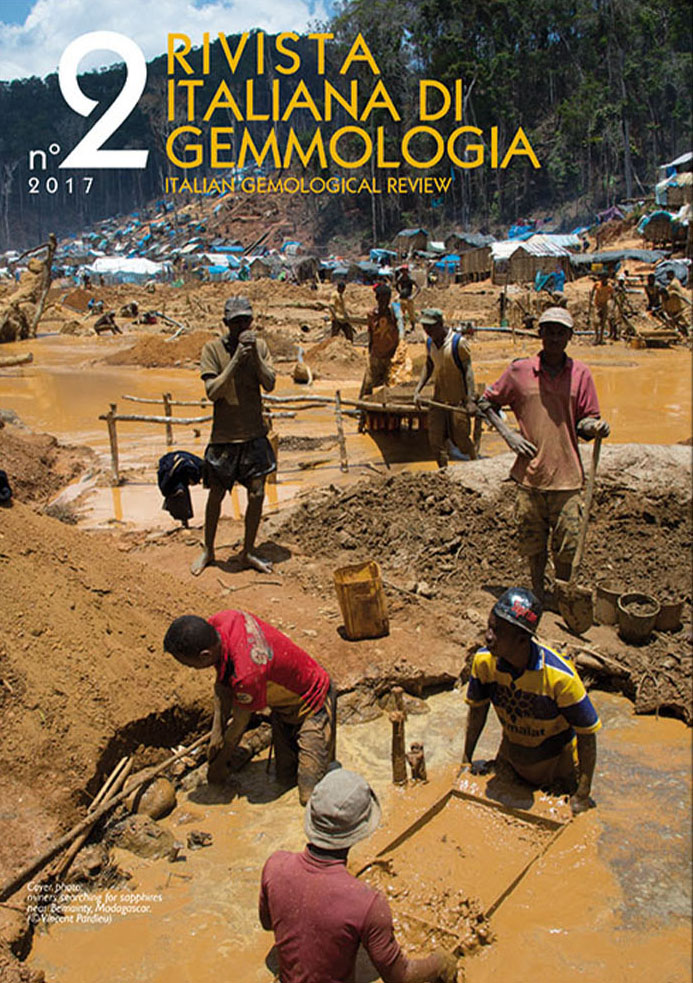
A sapphire rush escalating to approximately 50,000 unlicensed small-scale miners started in October 2016 about 35 km east of Ambatondrazaka, Madagascar. It is taking place in the Corridor Ankeniheny-Zahamena (CAZ), which is a new protected area legally designated in 2015 and managed by “Conservation International,” one of the world’s largest conservation groups, on behalf of the Malagasy Government. The discovery of many fine quality sapphires in this area is opening a new chapter in the conflict between conservation and gem mining in northeastern Madagascar. The present report will introduce the new discovery, which was visited by author Rosey Perkins in October 2016, and provides a complete gemological description of these sapphires done at the GIA Laboratory based on samples acquired by author Vincent Pardieu. This preliminary study might enable GIA (and other gemological laboratories) to better identify stones produced from this new deposit.

The corundum stone and crystallographic chemistry
Journal Article
Irish, S.T. (2017) The corundum stone and crystallographic chemistry. Ambix, Vol. 64, No. 4,, 10/2/17 pp. 301–325.
Record No. 4630  |  ISBN/ISSN: 26980  |  DOI: https://dx.doi.org/10.1080/00026980.2017.1413163  |  RWHL*
This article presents a detailed history and exegesis of the 1798 paper by Charles Greville and Jacques-Louis Count de Bournon, “On the Corundum Stone from Asia,” which marked the first published argument that corundum was related to—or identical with—ruby and sapphire. It also introduced crystallography, recently developed in France, to a British scientific audience for the first time. René Just Haüy’s theory of the three-dimensional structure of minerals represented a novel extension of chemistry into the solid state. The case of corundum exemplifies the sophisticated mineralogy emerging in the late eighteenth century and the global scope of natural history as shaped by trade and empire. It also highlights how mineralogical debates began to transition from the private spheres of mining schools and elite collectors into broader public scientific discourse.

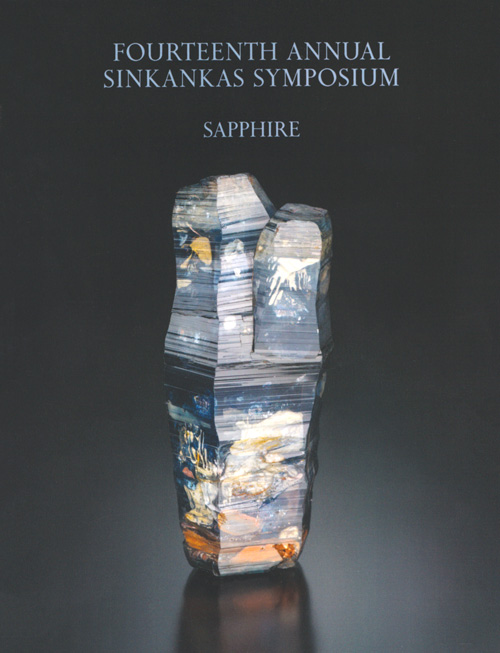
Fourteenth Annual Sinkankas Symposium • Sapphire
Conference Proceedings
Various Authors (2017) Fourteenth Annual Sinkankas Symposium • Sapphire. John Sinkankas Symposium, 8 April 2017, Carlsbad, CA: Gemological Society of San Diego/Gemological Institute of America, 136 pp..
Record No. 4296  |  ISBN/ISSN: 9780990000000  |  RWHL*

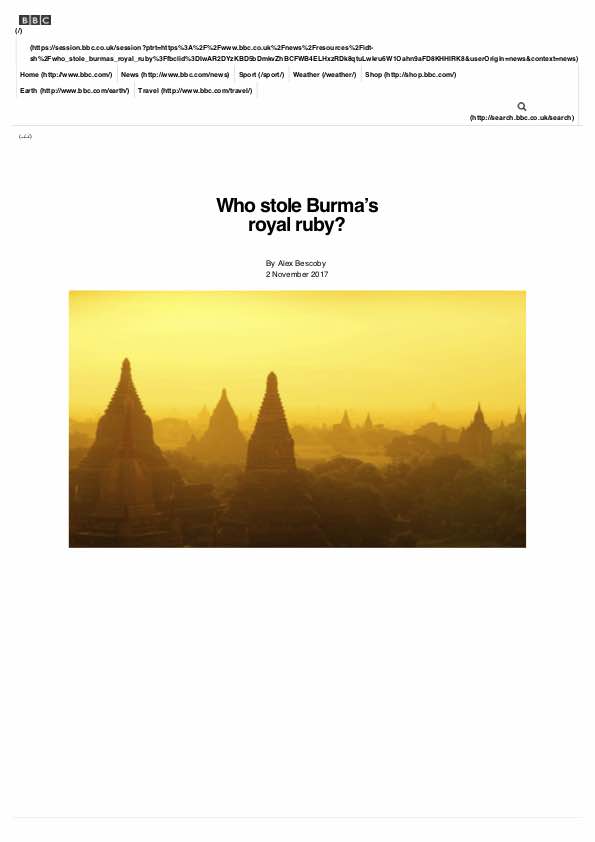
Who stole Burma’s royal ruby?

Web Page
Bescoby, A. (2017) Who stole Burma’s royal ruby? BBC News, <https://www.bbc.co.uk/news/resources/idt-sh/who_stole_burmas_royal_ruby?fbclid=IwAR2DYzKBD5bDmkvZhBCFWB4ELHxzRDk8qtuLwkru6W1Oahn9aFD8KHHlRK8>
Record No. 4234  |  RWHL*
When British soldiers conquered Burma in 1885, they gave the last king hours to pack. Many of his treasures - heirlooms from a millennium of monarchy- were seized and sent to Britain. But the most precious, an enormous ruby, disappeared. Who took it, and where is it now?

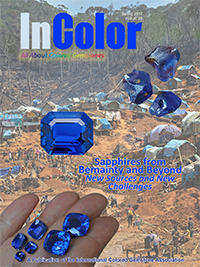
Gem mining and conservation in Mozambique and Madagascar
Journal Article
Pardieu, V. (2017) Gem mining and conservation in Mozambique and Madagascar. Rivista Italiana di Gemmologia – Italian Gemological Review, No. 2, pp. 31–41.
Record No. 4101  |  RWHL*

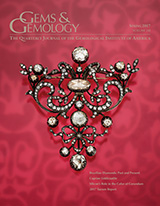
Bemainty sapphire deposit in Madagascar faces multiple challenges
Journal Article
Pardieu, V. (2017) Bemainty sapphire deposit in Madagascar faces multiple challenges. InColor, No. 35, Spring, pp. 24–31.
Record No. 3942  |  RWHL*
The discovery in Bemainty is not the rst one in the region. In 2015, rubies were discovered near Ambo-divoangy in Zahamena National Park and, in 2012, another rush took place at Ambohybe near Didy. In all cases, the trade was surprised with the quantity and the quality of the gems found since, previously, the region was mainly known for the ruby and sapphire deposit located east of Andilamena, which was the principal source of the lead-glass-lled rubies that ooded the market after. The trade has welcomed these new discoveries as they provided signi cant quantities of ne-looking gems. Yet, it is also realizing that the existence of these deposits could become a huge public-relations challenge for the indus-try because they are located in the Corridor Ankeniheny-Zahamena (CAZ), a protected area under the manage-ment of Conservation International (CI), one of the most powerful environental conservation groups in the USA with strong links to Hollywood celebrities (see Sidebar). This article summarizes eld expeditions undertaken by the author in the region since 2005. It describes the area’s deposits and highlights the challenges presented by illegal artisanal gem mining in areas set aside for conservation.

The role of silicon in the color of corundum
Journal Article
Emmett, J.L. (2017) The role of silicon in the color of corundum. Gems & Gemology, Vol. 53, No. 1, Spring, pp. 42–47.
Record No. 3383  |  ISBN/ISSN: 0016626X  |  RWHL*

Les Pierres du Moyen Âge | Anthologie des lapidaires médiévaux

Book
Gontero-Lauze, V. (2016) Les Pierres du Moyen Âge | Anthologie des lapidaires médiévaux. Paris, Belles Lettres, 226 pp.
Record No. 28042  |  Sinkankas/Born No.: NIS/NIB  |  RWHL*
The Middle Ages believed in the powers of precious stones: their medicinal and magical virtues were recorded in encyclopedic treatises known as lapidaries. This knowledge, inherited from Antiquity, endured for centuries: diamond grants invincibility; sapphire frees prisoners; emerald heals vision problems; amethyst protects against drunkenness; hematite stops bleeding, and so on. The powers attributed to stones operate by analogy—a mode of thinking that prevailed throughout the medieval period. This anthology of medieval lapidaries offers, for the first time, a bilingual edition of these long-dismissed and still largely unknown texts, with a selection of excerpts in Old and Middle French accompanied by their translation.

Exploring the Literature of Corundum

Ruby and sapphire research spans mineralogy, gem deposits, identification, treatments, synthesis and the history of the gem trade. Older publications can also be useful for tracing terminology, early observations and accounts of mining localities. Publication dates and the original source should be considered when using historical descriptions.

For an introduction to collecting books on this subject, read Ruby & Sapphire Books: Collecting the Literature of Corundum.

About Four Treasures

Four Treasures is Lotus Gemology's freely accessible gemological reference database. Use the full database to search by author, title or keyword and explore literature on gemology, mineralogy, jewelry and related fields. Where available, hyperlinks on titles may lead directly to the full publication.

Search the Complete Four Treasures Database