Gemology Books Bibliography

Gemology Books Bibliography

Explore books on gems, gemology, jewelry and mineralogy in Four Treasures, the Lotus Gemology reference database. This bibliography brings together matching book records from the collection, with publication details, abstracts and cover images where available.

Gemology Book References

The list below matches books concerning gemology and related subjects in the database's searchable fields. Some works cover several branches of gems, jewelry or mineralogy.
3,181–3,200 of 3,598 matching references

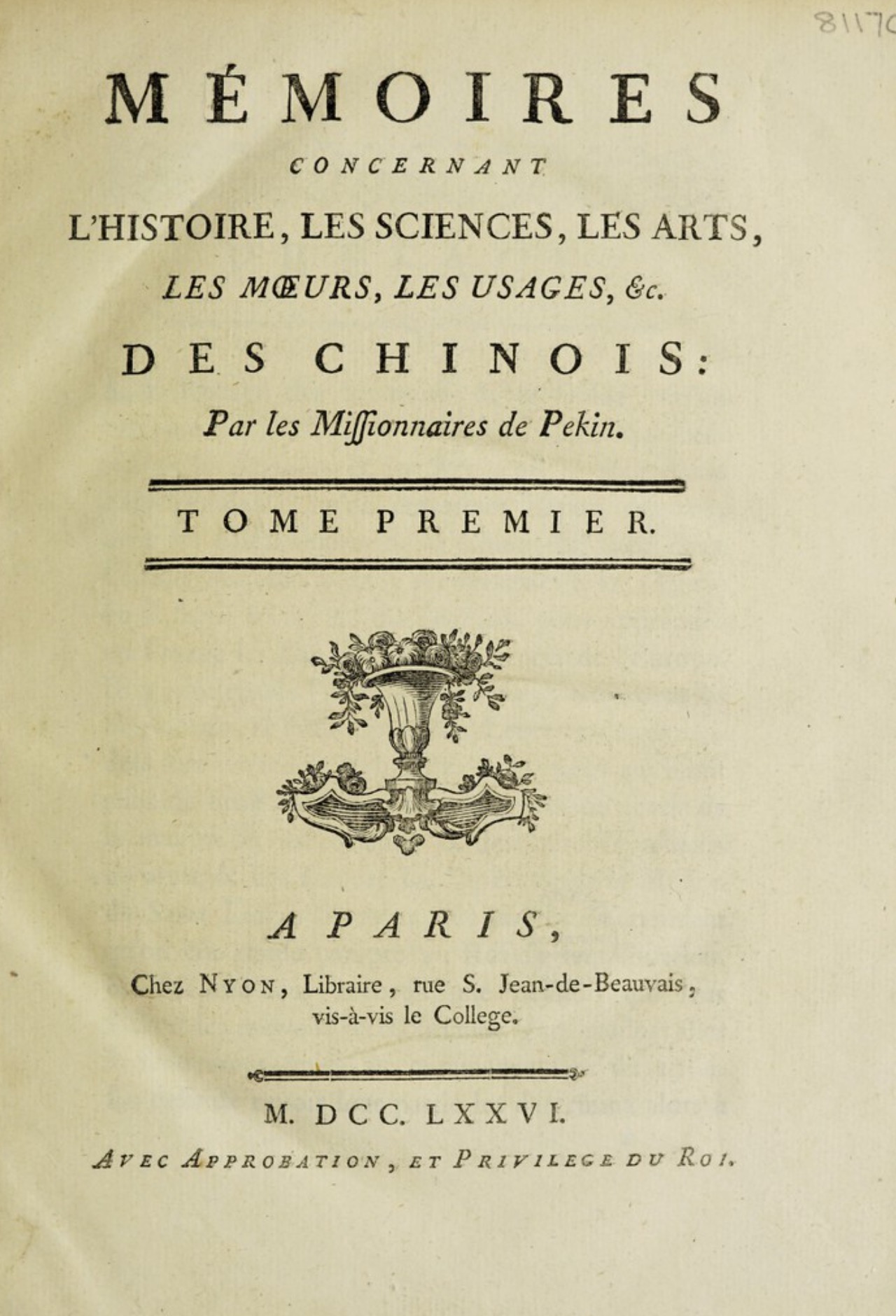
Mémoires concernant l'histoire, les sciences, les arts, les mœurs, les usages, etc. des Chinois par les Missionaires de Pekin
Memoirs concerning the history, science, arts, mores, customs, etc. of the Chinese by the Missionaries of Beijing
Edited Book
Batteux, C., editor (1776–1814) Mémoires concernant l'histoire, les sciences, les arts, les mœurs, les usages, etc. des Chinois par les Missionaires de Pekin. [Memoirs concerning the history, science, arts, mores, customs, etc. of the Chinese by the Missionaries of Beijing]. Paris, Chez Nyon, 17 Vols.
Record No. 7504  |  Sinkankas/Born No.: NIS/NIB  |  Language: in French  |  RWHL
A major collection of reports and studies on China sent to Europe by Jesuit missionaries in Beijing and published in Paris in sixteen volumes between 1776 and 1814. The Mémoires cover Chinese history, geography, government, philosophy, religion, language, literature, sciences, technology, agriculture, natural history, medicine, arts and customs, often drawing upon Chinese texts as well as the missionaries’ own observations. Richly illustrated in places, the series became an important vehicle for transmitting detailed knowledge of China to late eighteenth-century Europe. Of particular relevance to gemological research are discussions of Chinese minerals and precious materials, including jade, together with information on their terminology, sources, working and cultural significance. The collection remains an important primary source for European understanding of Chinese material culture and natural history during the Qing dynasty.

Abhandlung von Edelsteinen

Treatise on Gemstones
Book
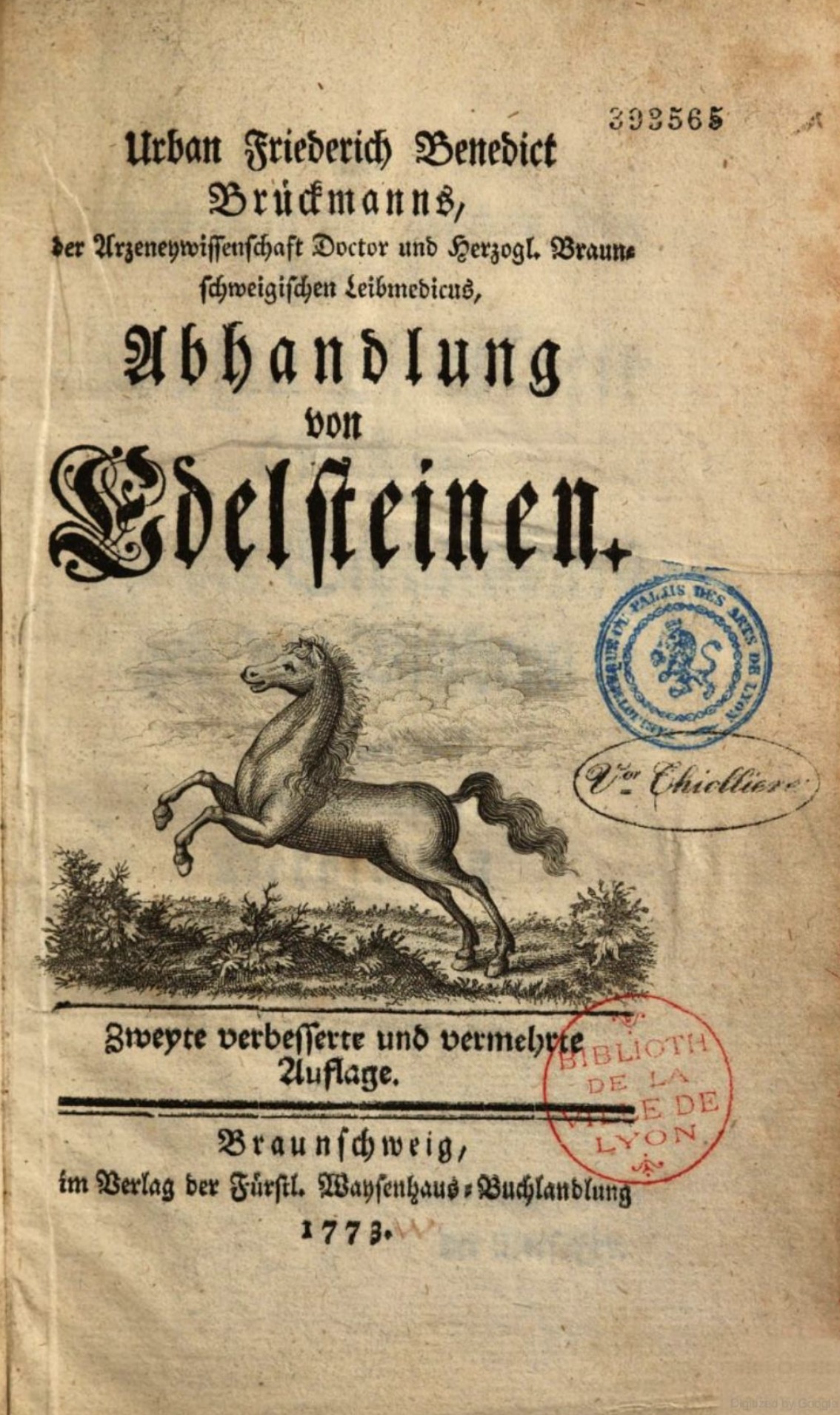
Brückmann, U.F.B. (1773) Abhandlung von Edelsteinen. [Treatise on Gemstones] Braunschweig, Verlag der Fürstl, 415 pp.
Record No. 7941  |  Sinkankas/Born No.: 974; NIB  |  Language: in German  |  RWHL
A substantial eighteenth-century treatise devoted specifically to gemstones by the German physician and mineralogist Urban Friedrich Benedict Brückmann. The work surveys precious and ornamental stones and discusses their names, varieties and distinguishing characteristics, drawing together contemporary mineralogical knowledge and earlier gemological literature. The 1773 edition is the second, substantially revised and enlarged edition, expanding the original 1757 work from 143 to 415 pages. Particularly valuable is an appendix on the obscure gemstone names used by earlier writers, effectively providing a glossary of historical gemological and mineralogical terminology. It is an important source for European gemstone knowledge and nomenclature in the period immediately preceding the development of modern systematic mineralogy.

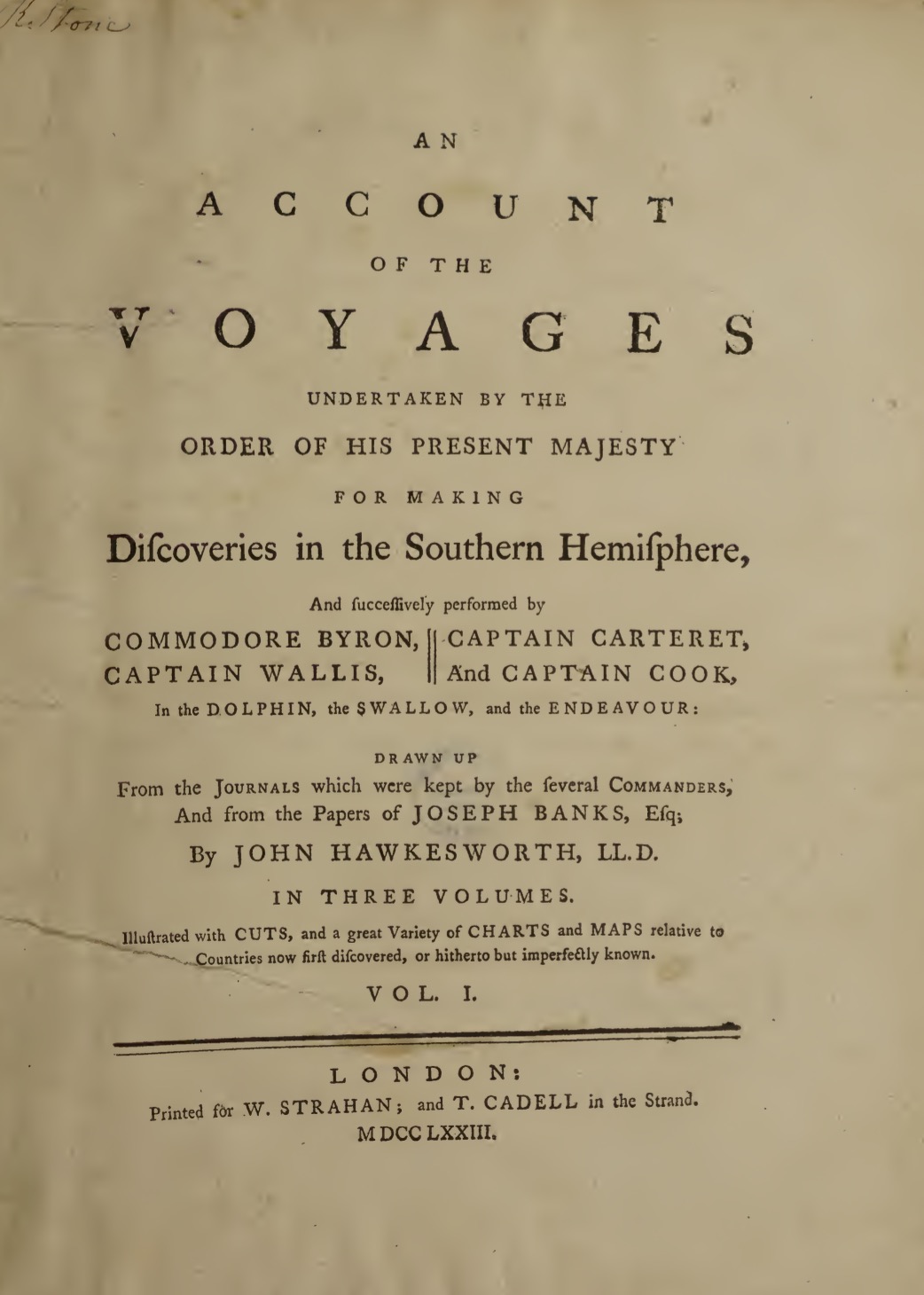
An Account of the Voyages Undertaken by the Order of His Present Majesty for Making Discoveries in the Southern Hemisphere, and successively performed by Commodore Byron, Captain Wallis, Captain Carteret, and Captain Cook, in the Dolphin, the Swallow, and the Endeavor, drawn up from the Journals kept by the several Commanders, and from the Papers of Joseph Banks, Esq
Book
Hawkesworth, J. (1773) An Account of the Voyages Undertaken by the Order of His Present Majesty for Making Discoveries in the Southern Hemisphere, and successively performed by Commodore Byron, Captain Wallis, Captain Carteret, and Captain Cook, in the Dolphin, the Swallow, and the Endeavor, drawn up from the Journals kept by the several Commanders, and from the Papers of Joseph Banks, Esq. London, W. Strahan and T. Cadell, 3 Vols.
Record No. 7066  |  Sinkankas/Born No.: NIS/NIB  |  RWHL
A three-volume compilation of British voyages of exploration in the Pacific, prepared by John Hawkesworth from the journals of Commodore John Byron, Samuel Wallis, Philip Carteret and James Cook, together with papers supplied by Joseph Banks. The work records voyages undertaken between 1764 and 1771 and includes Cook’s first voyage in the Endeavour, with extensive descriptions of Tahiti, New Zealand, Australia and other Pacific islands. It contains observations on geography, Indigenous peoples and customs, natural history, trade and natural resources, supplemented by maps and engraved illustrations. Of particular gemological and ethnographic interest are descriptions of the greenstone (nephrite/pounamu) ornaments, tools and weapons of the Māori of New Zealand, including their manufacture, use and high value in Māori society. The work was an important early European source of information on New Zealand jade and Pacific material culture.

Histoire Civile et Naturelle du Royaume de Siam
Civil and Natural History of the Kingdom of Siam
Book
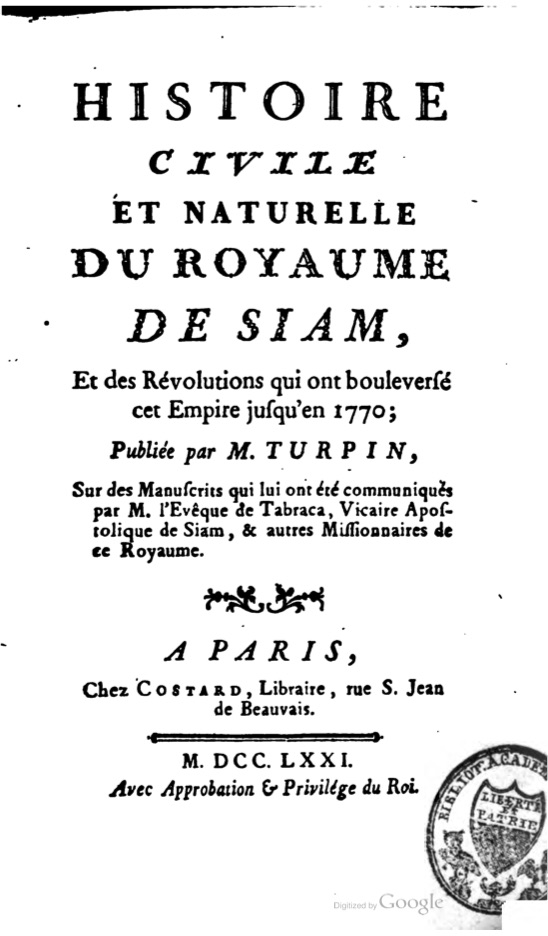
Turpin, F.H. (1771) Histoire Civile et Naturelle du Royaume de Siam. [Civil and Natural History of the Kingdom of Siam] Paris, Chez Costard, Vol. 1 (450 pp.).
Record No. 2649  |  Sinkankas/Born No.: NIS/NIB  |  Language: in French  |  RWHL
A historical and natural account of the Kingdom of Siam by François-Henri Turpin, compiled from earlier European sources rather than from personal travel in the country. The work describes Siam’s geography, government, religion, customs, commerce and natural products, drawing particularly upon seventeenth-century French accounts produced during the reign of Louis XIV and King Narai. Of interest to gemological research are its notices of the mineral and commercial resources of Siam, including precious materials and luxury goods traded in the kingdom. The book provides a useful eighteenth-century synthesis of European knowledge of Siam, although its statements should be treated as derivative rather than eyewitness observations.

Dictionnaire universel des fossiles propres, et des fossiles accidentels
Universal Dictionary of Native and Accidental Fossils
Book
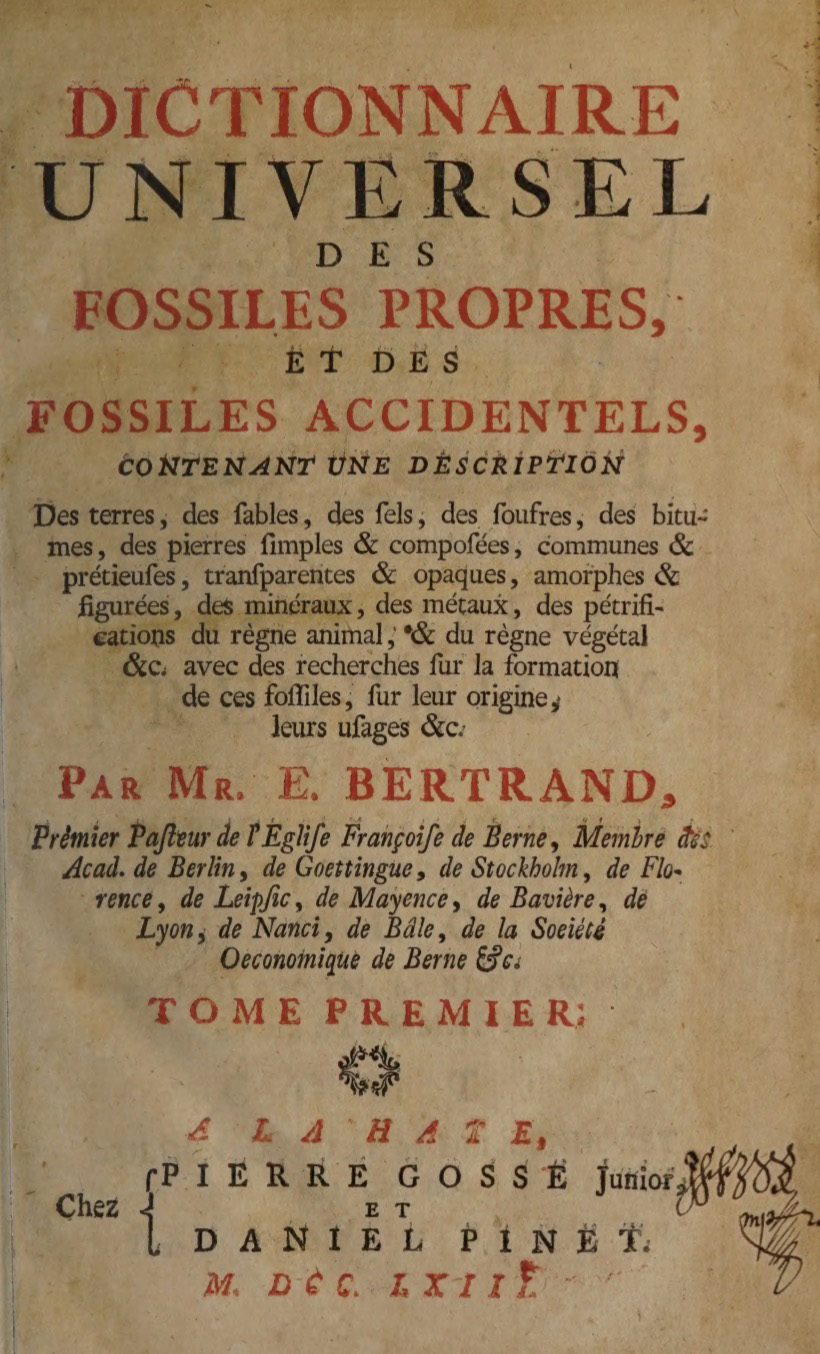
Bertrand, É. (1763) Dictionnaire universel des fossiles propres, et des fossiles accidentels. [Universal Dictionary of Native and Accidental Fossils] The Hague, Pierre Gosse Junior & Daniel Pinet, 2 Vols., 284, 256 pp.
Record No. 29417  |  Sinkankas/Born No.: 601; NIB  |  Language: in French  |  RWHL
An alphabetically arranged mineralogical and oryctological dictionary covering what eighteenth-century authors broadly termed “fossils,” meaning substances dug from the earth rather than fossils in the modern restricted sense. Entries include earths, sands, salts, sulphurs, bitumens, simple and compound stones, common and precious stones, transparent and opaque minerals, metals, and petrified remains of plants and animals. Bertrand discusses their names, descriptions, occurrence, formation, origins, properties, and uses, drawing together contemporary mineralogical and natural-historical literature. Gemological material is dispersed throughout the dictionary under individual stones and mineral substances, making the work useful for tracing eighteenth-century terminology and contemporary ideas concerning precious stones, crystal form, mineral classification, and the relationship between gems and the broader mineral kingdom.

Minéralogie, ou nouvelle exposition du règne minéral
Mineralogy, or a New Exposition of the Mineral Kingdom
Book
Valmont de Bomare, J.-C. (1762) Minéralogie, ou nouvelle exposition du règne minéral. [Mineralogy, or a New Exposition of the Mineral Kingdom] Paris, Vincent, 365, 374 pp.
Record No. 29416  |  Sinkankas/Born No.: NIS/NIB  |  Language: in French  |  RWHL
A systematic survey of the mineral kingdom intended to arrange minerals in what Bomare regarded as the most natural order and to describe their physical properties and practical uses. The work treats earths, salts, stones, ores, metals, waters, and related mineral substances, with attention to color, transparency, hardness, fracture, crystallization, fusibility, occurrence, and uses. Gemologically important material is included under precious and ornamental stones, including quartz, crystal, chalcedony, jasper, ruby and other “Oriental” stones, together with discussion of crystal form and mineral nomenclature. The two volumes are supplemented by an alphabetical subject index, a nomenclatural dictionary, and folding synoptic tables intended to clarify the proposed classification. It is representative of mid-eighteenth-century mineralogy at the transition from descriptive natural history toward more systematic chemical and crystallographic classification.

Rapport de Quelques Experiences faites sur la Pierre qu'on Nomme Lapis Lazuli
Report on some experiments conducted on the stone known as lapis lazuli
Journal Article
Margrraf, A.S. (1758) Rapport de Quelques Experiences faites sur la Pierre qu'on Nomme Lapis Lazuli. [Report on some experiments conducted on the stone known as lapis lazuli] Histoire de l'Académie Royale des Sciences et des Belles Lettres de Berlin, Vol. 21, pp. 10–19.
Record No. 29160  |  Sinkankas/Born No.: NIS/NIB  |  Language: in French  |  RWHL
Lapis lazuli is a blue stone, tending towards violet, of moderate hardness, marked with white veins and most often with mineral-metallic points which resemble gold, but which, when examined more closely, prove to be a sulphur marcasite in its cubic form. One also often finds bright white spots in it; but these likewise, when examined more attentively, are nothing other than a fine and shining talc. Some parts of this stone, when struck against steel, give off sparks, while the rest do not. It is otherwise neither too hard nor too soft; it can be moderately well polished; some parts of it effervesce with aqua fortis, while others do not. According to some authors, gold is found in it; something which I would not absolutely deny either: but I do not believe that it is always present, and in every species of this stone. When it is of a beautiful blue, it is regarded as something rare; it is used for various mechanical works, and is an ingredient in medicine entering into what is called Confection of Alkermes. Painters also praise it for the preparation of that beautiful ultramarine blue, which is the most durable of all.

Spectacle de la Nature: or, Nature Delineated; being Philosophical Conversations
Book
Pluche, N.-A. (1757) Spectacle de la Nature: or, Nature Delineated; being Philosophical Conversations. London, James Hodges, 8 Vols., 318 pp.
Record No. 28992  |  Sinkankas/Born No.: NIS/NIB  |  RWHL
The Spectacle de la Nature (1732–1750) by the Abbé Antoine Noël Pluche. In eight volumes, the Abbé discussed current issues in natural philosophy, such as Newtonianism, the origin of fossils, artisan techniques, natural history, machines, gardening or insect collection in a polite conversation format. It was translated into English (1735), Dutch (1737), Italian (1737), German (1746) and Spanish (1753). But the four Spanish editions were very different from their European counterparts. In Spain, it was delivered in 16 carefully printed and extensively commented volumes. In Pluche’s original, there was a concern for the young gentleman’s education, new pedagogical methods and an enthusiastic defence of experimental knowledge. However, Le Spectacle in Spain was conceived as a useful tool for modernizing the country, it served political and propagandist goals, defended Spanish culture and science (in particular with respect to American flora, fauna and geography) and the Jesuit contribution to science and aimed to harmonize experimental knowledge and scholastic tradition.

Geschichte von Edelgesteinen und den vornehmsten Reichthümern in Ost- und Westindien
History of Precious Stones and the Most Noble Riches in East and West India
Journal Article
Anonymous (1757) Geschichte von Edelgesteinen und den vornehmsten Reichthümern in Ost- und Westindien. [History of Precious Stones and the Most Noble Riches in East and West India] Hamburgisches Magazin, Vol. 18, pp. 500–543.
Record No. 8081  |  Sinkankas/Born No.: NIS/NIB  |  Language: in German  |  RWHL
Believed to be a German translation of Samuel Chappuzeau’s Histoire des Joyaux et des principales richesses de l’Orient et de l’Occident from 1671. An eighteenth-century German article on precious stones and other valuable natural products associated with the East and West Indies. Published anonymously in the *Hamburgisches Magazin* in 1757, it discusses gemstones within the broader context of the natural riches and commodities of overseas regions. The work is of interest to the history of gemology as an example of the way information about precious stones, their sources and their economic importance was disseminated to German readers through mid-eighteenth-century periodical literature.

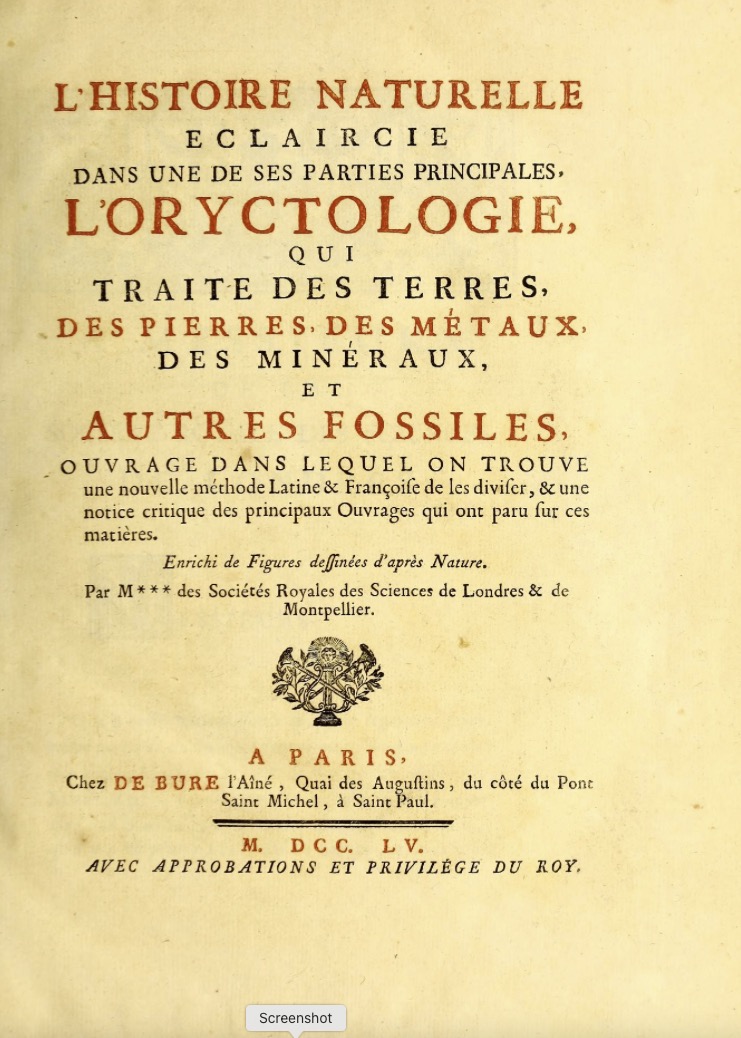
L’histoire naturelle éclaircie dans une de ses parties principales, l’oryctologie : qui traite des terres, des pierres, des métaux, des minéraux, et autres fossiles : ouvrage dans lequel on trouve un nouvelle méthode latine & françoise de les diviser, & une notice critique des principaux ouvrages qui ont paru sur ces matières
The Natural History Elucidated in One of Its Principal Parts, Oryctology: Which Deals with Earths, Stones, Metals, Minerals, and Other Fossils: A Work in Which a New Latin and French Method of Classifying Them Is Presented, Along with a Critical Review of the Principal Works Published on These Subjects
Book
Dezallier d’Argenville, A.J., Chedel, P.Q. and Collin de Vermont, H. (1755) L’histoire naturelle éclaircie dans une de ses parties principales, l’oryctologie : qui traite des terres, des pierres, des métaux, des minéraux, et autres fossiles : ouvrage dans lequel on trouve un nouvelle méthode latine & françoise de les diviser, & une notice critique des principaux ouvrages qui ont paru sur ces matières. [The Natural History Elucidated in One of Its Principal Parts, Oryctology: Which Deals with Earths, Stones, Metals, Minerals, and Other Fossils: A Work in Which a New Latin and French Method of Classifying Them Is Presented, Along with a Critical Review of the Principal Works Published on These Subjects] Paris, Chez De Bure l’aîné (560 pp.).
Record No. 16708  |  Sinkankas/Born No.: NIS/NIB  |  Language: in French  |  RWHL
Dezallier d’Argenville’s L’histoire naturelle éclaircie… l’oryctologie (1755) is an important mid-eighteenth-century treatise on what would later develop into mineralogy and geology. The work systematically describes and classifies earths, stones, metals, minerals, and other substances then grouped under the broad category of “fossils,” presenting parallel Latin and French terminology and discussing the principal earlier literature on the subject. Of particular gemological interest are its descriptions and classification of precious and ornamental stones, including diamonds, rubies, sapphires, emeralds, topazes, garnets, opals, agates, jaspers, rock crystal, and other lapidary materials, with attention to their physical appearance, varieties, localities, and contemporary nomenclature. The volume is also notable for its engraved plates, drawn by Hyacinthe Collin de Vermont and engraved by Pierre Quentin Chedel, illustrating minerals, crystals, fossils, and related natural-history specimens. It provides a valuable picture of European mineralogical and gemological knowledge immediately before the major advances in chemical mineralogy and crystallography of the later eighteenth century.

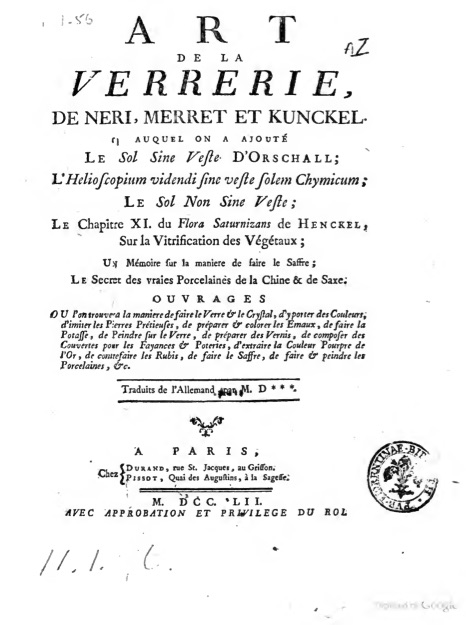
Art de la verrerie, de Neri, Merret et Kunckel
Ars Vitraria Experimentalis, or Perfect Glassmaking Art
Journal Article
Neri, A. (1752) Art de la verrerie, de Neri, Merret et Kunckel. [Ars Vitraria Experimentalis, or Perfect Glassmaking Art] lv, 629 [3] pp..
Record No. 7417  |  Sinkankas/Born No.: NIS/NIB  |  Language: in French  |  RWHL
An expanded French compilation of important seventeenth- and eighteenth-century writings on glassmaking and related chemical arts, centered on Antonio Neri’s L’Arte vetraria and incorporating the commentaries and additions of Christopher Merret and Johann Kunckel. The volume gives practical instructions for making glass and crystal, producing colored glass, preparing and coloring enamels, painting on glass and manufacturing glazes and varnishes. Of particular gemological interest are recipes for imitating precious stones and counterfeiting rubies, together with discussions of extracting the purple color of gold and the preparation of saffre, a cobalt-derived blue coloring material. Additional texts include Orschall’s Sol sine veste, Henckel on the vitrification of plants, Zimmermann on the manufacture of saffre, and material concerning Chinese and Saxon porcelain. The 1752 French edition was translated by Baron d’Holbach and contains 629 pages and 16 engraved plates.

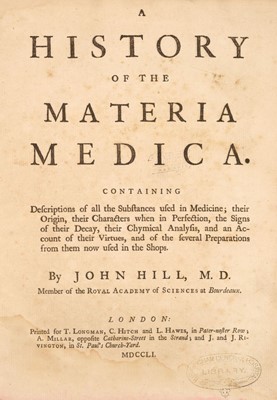
A History of the Materia Medica

Book
Hill, J. (1751) A History of the Materia Medica. London, T. Longman, C. Hitch, & L. Hawes, 895 pp. (jade see pp. 270–272).
Record No. 16449  |  Sinkankas/Born No.: NIS/NIB  |  RWHL
A systematic account of medicinal substances by the English botanist and apothecary John Hill, covering materials derived from the vegetable, animal and mineral kingdoms. Hill describes individual substances, their sources, physical characteristics, preparation and supposed medicinal properties and uses. Of gemological interest is the section on mineral substances, which includes precious stones and other minerals employed medicinally, reflecting the persistence in eighteenth-century European pharmacology of therapeutic uses traditionally attributed to gems. The work is useful for tracing the transition from older lapidary and pharmacological traditions toward increasingly empirical descriptions of natural substances.

Encyclopédie, ou dictionnaire raisonné des sciences, des arts et des métiers
Encyclopedia, or reasoned dictionary of sciences, arts and crafts
Edited Book
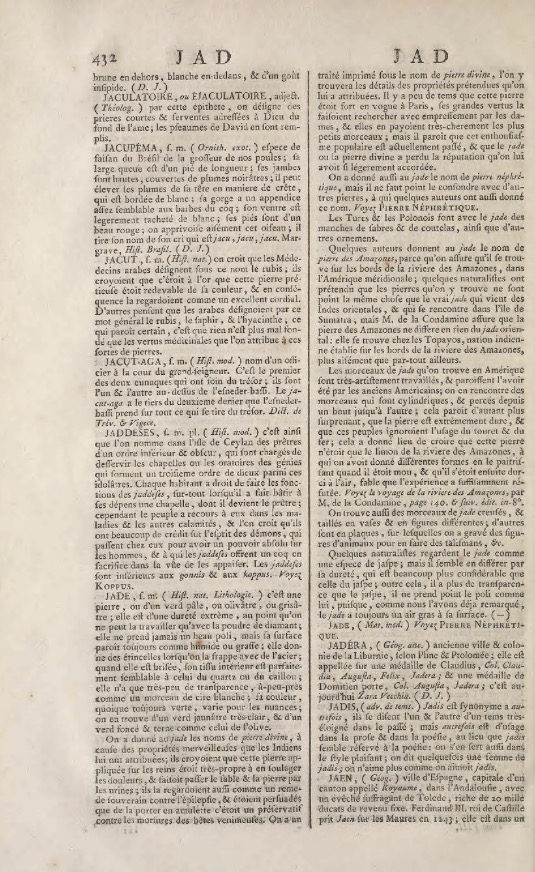
Diderot, D., editor (1751–1780) Encyclopédie, ou dictionnaire raisonné des sciences, des arts et des métiers. [Encyclopedia, or reasoned dictionary of sciences, arts and crafts]. Paris, Neuchâtel, 35 Vols., see Vol. 8, p. 432.
Record No. 8166  |  Sinkankas/Born No.: NIS/NIB  |  Language: in French  |  RWHL
A monumental French reference work edited principally by Denis Diderot and, for much of its early development, Jean le Rond d’Alembert. The Encyclopédie sought to assemble and critically organize contemporary knowledge of the sciences, arts, crafts and trades, combining theoretical articles with detailed descriptions and illustrations of practical processes. Of particular gemological interest are articles concerning precious stones, minerals, metals, jewelry, lapidary work and related terminology, while the plate volumes illustrate tools and techniques employed by jewelers, goldsmiths and other craftsmen. The work is an important source for understanding eighteenth-century European knowledge of gemstones and minerals and, especially, contemporary methods of cutting, polishing, setting and working precious materials.

Allgemeines Gelehrten-Lexicon

General Lexicon of Scholars
Book
Jöcher, C.G. (1750–51) Allgemeines Gelehrten-Lexicon. [General Lexicon of Scholars] Leipzig, Johann Friedrich Gleditschens Buchhandlung, 4 Vols.
Record No. 16482  |  Sinkankas/Born No.: NIS/NIB  |  Language: in German  |  RWHL
A major eighteenth-century German biographical and bibliographical reference work compiled by Christian Gottlieb Jöcher. The Allgemeines Gelehrten-Lexicon provides alphabetically arranged accounts of scholars and writers, giving biographical information together with lists or notices of their published works. Published at Leipzig in four volumes between 1750 and 1751, it covers authors from antiquity through Jöcher’s own time and became an important reference source for European intellectual and publishing history. For research into the history of gemology and mineralogy, it is particularly useful for identifying early authors, variant names, biographical details and bibliographical information concerning works cited in older scientific and lapidary literature.

Verzeichniss derjenigen Schriftsteller, die von Edelsteinen gehandelt haben
List of those writers who have written about gemstones
Book Section
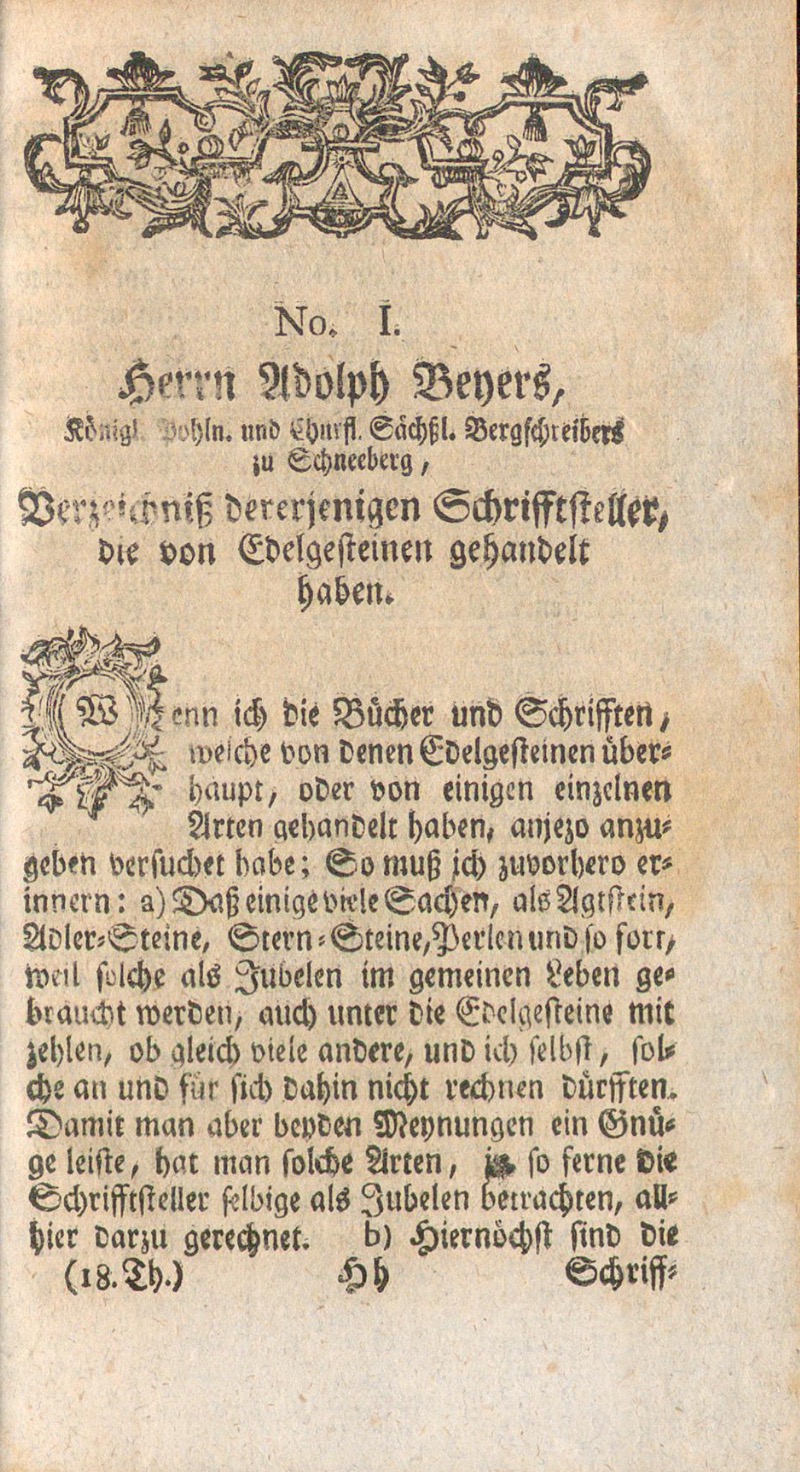
Beyer, A. (1750–1765) Verzeichniss derjenigen Schriftsteller, die von Edelsteinen gehandelt haben. [List of those writers who have written about gemstones] In: Neue Versuche nützlicher Sammlungen zu der Natur- und Kunstgeschichte, sonderlich von Ober-Sachsen, Vol. 18 , pp. 471–494.
Record No. 10937  |  Sinkankas/Born No.: NIS/NIB  |  Language: in German  |  RWHL
An early bibliography of writings on gemstones, published as a contribution to Christian Gottlob Grundig’s Neue Versuche nützlicher Sammlungen zu der Natur- und Kunstgeschichte, sonderlich von Ober-Sachsen. Beyer surveys authors who had written about precious stones, providing a useful guide to the gemological and lapidary literature known in the eighteenth century. The work is of particular historical value as an early attempt to gather references on gemstones into a dedicated bibliographical compilation, and as a record of the sources available to German scholars before mineralogy and gemology developed into more formally organized scientific disciplines.

Catalogue raisonné des differens effets curieux & rares, contenus dans le Cabinet de seu Monsieur le Chevalier de la Roque
Annotated Catalog of the Various Curious and Rare Objects Contained in the Cabinet of the Late Monsieur Chevalier de La Roque
Book
Gersaint, E.-F. (1745) Catalogue raisonné des differens effets curieux & rares, contenus dans le Cabinet de seu Monsieur le Chevalier de la Roque. [Annotated Catalog of the Various Curious and Rare Objects Contained in the Cabinet of the Late Monsieur Chevalier de La Roque] Paris, Jaques Barois, 258 pp.
Record No. 29000  |  Sinkankas/Born No.: 2362  |  Language: in French  |  RWHL
Sinkankas: The collection of Jean, chevalier De La Roque (1661–1745). Pp. 109–147: “Pierreries, Agates, Pierres gravées … [etc.].” Includes diamonds, rubies, emeralds, oriental topaz, sapphire, oriental amethyst, turquoise, balas ruby, hyacinth, and others, not to mention the engraved gems (cameos, intaglios, mounted in rings, and loose). Mentioned by Mariette, Traité des pierres gravées, I, 458.

Kleine Mineralogische und Chymische Schrifften. Auf Gutbefinden des Herrn Autoris. Nebst einer Vorrede von den Bergwercks-Wissenschafften zu Vermehrung der Cammeral-Nutzungen, und mit Anmerckungen herausgegeben von Carl Friedrich Zimmermann
D. Johann Friedrich Henkel’s, Royal Polish and Electoral Saxon Mining Councillor, Small Mineralogical and Chemical Writings. Published with the approval of the author, together with a preface on the mining sciences for the increase of cameral (state fiscal) revenues, and with annotations by Carl Friedrich Zimmermann
Book
Henkel, J.F. (1744) Kleine Mineralogische und Chymische Schrifften. Auf Gutbefinden des Herrn Autoris. Nebst einer Vorrede von den Bergwercks-Wissenschafften zu Vermehrung der Cammeral-Nutzungen, und mit Anmerckungen herausgegeben von Carl Friedrich Zimmermann. [D. Johann Friedrich Henkel’s, Royal Polish and Electoral Saxon Mining Councillor, Small Mineralogical and Chemical Writings. Published with the approval of the author, together with a preface on the mining sciences for the increase of cameral (state fiscal) revenues, and with annotations by Carl Friedrich Zimmermann] Dresden, Friedrich Henkel, 619 pp.
Record No. 28994  |  Sinkankas/Born No.: 2883–2884  |  Language: in German  |  RWHL
Sinkankas: Henkel presents his views on the formation of minerals, including coral and gemstones, with extensive annotations by Zimmermann. He recognized five modes of formation: (1) congelation, (2) concretion, (3) vegetation (as in coral), (4) crystallization, and (5) petrifaction. Henkel believed that durable minerals—especially gemstones—were composed of minute particles that grew together into structurally continuous masses or crystals, producing transparency while excluding water. He discusses at length, as does Zimmermann, experiments by Robert Boyle, Francis I, and others on the effects of intense heat on gemstones, describing the behavior of diamond, emerald, ruby, and other gems. Additional topics include Saxon fossil resin (pp. 539–553), the celebrated Saxon topaz (pp. 554–565), and a green jasper bearing “hieroglyphic figures” (pp. 607–619), possibly referring to graphic granite. The work is described by John Ferguson in Bibliotheca Chemica (Vol. I, p. 386), which also notes later editions published in 1747 and in Vienna in 1769, together with biographical and bibliographical information on Henkel and his writings.

Edelgesteine

Gemstones
Book Section
Trichter, V. (1742) Edelgesteine. [Gemstones] In: Curiöses Reit- Jagd- Fecht- Tantz- oder Ritter-Rxercitien-Lexicon, Leiipzig, pp. 575–576.
Record No. 8139  |  Sinkankas/Born No.: NIS/NIB  |  Language: in German  |  RWHL
Precious stones: These are those which are made valuable not only due to their rarity and beauty but also because nature has adorned them with a special light and radiance, making them, in a sense, noble—so that they sparkle like the finest stars and have always maintained a higher status than gold or silver. There are two types of precious stones: transparent and opaque. The transparent ones include amethyst, beryl, carbuncle, chrysolite, diamond, hyacinth, ruby, sapphire, and emerald. Among the opaque ones, though some are semi-transparent, are agate, carnelian, chalcedony, jasper, the so-called cat’s eye, lapis lazuli, nephrite, and gallstone, malachite and schreckstein, onyx, opal, turquoise, etc. These precious stones, especially the transparent ones, originate from water or moisture impregnated with mountain salt, which allows them to grow and develop into crystals. It is impossible for something to be transparent that has not first been in liquid form. Dense substances such as silver and lead, when dissolved in separating water or other acidic liquids, can easily grow into transparent crystals. Similarly, one often finds completely clear water droplets inside the most beautifully grown crystals, and in the hardest stones in India, the finest gemstones. Moreover, that there is some mountain salt mixed in is evident from the geometric shape of the precious stones, which are clearly recognizable as having the same structure as salt and saltpeter, as the mined crystals and diamonds, which differ only in hardness, grow entirely angular, often even with veins and such deposits, so that one can clearly see how the salty components have been layered on top of each other. Their charming colors come from a delicate metallic sulfur, similar to metals found in mines: for example, carbuncle, ruby, garnet, and amethyst from a gold-sulfur; sapphire from the tincture of silver; emerald and chrysolite from the greenish-sulfuric nature of copper; topaz and hyacinth from the sulfurous substance of iron, etc. However, this sulfur in precious stones is very volatile, so much so that the colors resulting from it can easily disappear and evaporate in the fire. But since these gemstones, when broken, are often irregular, or unclean and blotchy, even the most beautiful and purest stones do not shine as brightly as when they are cut, whereby the multiple facets reflect and play the light that falls on the foil or diamond ink all the more toward the eye. Therefore, those skilled in this art are called gem cutters, and they practice a free craft; however, they have been regulated by a noble order in Nuremberg for more than 100 years.

Essai sur l'histoire naturelle de la France Equinoxiale: Ou de'nombrement des plantes, des animaux & des minéraux, qui se trouvent dans l'isle de Cayenne, les isles de Remire, sur les côtes de la mer, & dans le continent de la Guyane
Essay on the Natural History of Equatorial France: Or, Enumeration of the Plants, Animals, and Minerals Found in the Isle of Cayenne, the Isles of Remire, on the Coasts of the Sea, and in the Continent of Guyana
Book
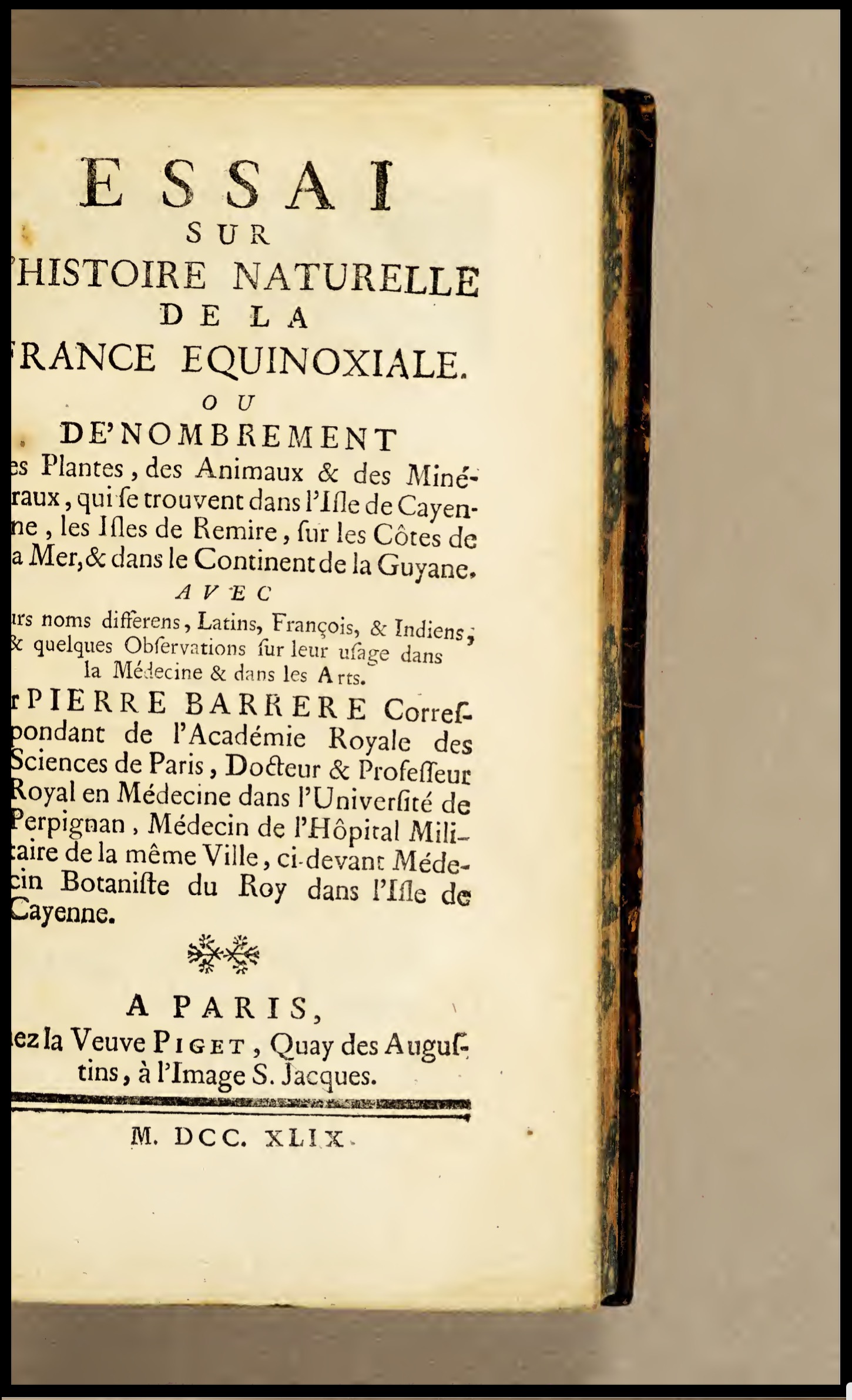
Barrère, P. (1741) Essai sur l'histoire naturelle de la France Equinoxiale: Ou de'nombrement des plantes, des animaux & des minéraux, qui se trouvent dans l'isle de Cayenne, les isles de Remire, sur les côtes de la mer, & dans le continent de la Guyane. [Essay on the Natural History of Equatorial France: Or, Enumeration of the Plants, Animals, and Minerals Found in the Isle of Cayenne, the Isles of Remire, on the Coasts of the Sea, and in the Continent of Guyana] Paris, Piget, xxiv + 215 pp.
Record No. 6902  |  Sinkankas/Born No.: NIS/NIB  |  Language: in French  |  RWHL
Barrère presents an early inventory of the plants, animals and minerals of Cayenne, the Rémire islands and mainland Guiana, recording Latin, French and Indigenous names alongside observations on their uses in medicine and the arts. The work brings together botanical and zoological descriptions with a much shorter account of mineral substances, including iron-bearing material, green jasper and clay. Its principal value lies in documenting the region’s natural productions and the terminology applied to them before the adoption of Linnaean nomenclature. For gemological research, the mineral notices require interpretation within eighteenth-century usage; the identification of a material as green jasper does not by itself establish that it was jade.

Exercitationes chymicae de sulphuribus metallorum, de auripigmento, de solutione corporum particulari, de terra foliata tartari, de acido vitrioli vinoso et de acido nitri vinoso

Chemical Exercises on the Sulphurs of Metals, Orpiment, the Solution of Particular Bodies, Foliated Tartar, Vinous Vitriolic Acid, and Vinous Nitric Acid
Book
Pott, J.H. (1738) Exercitationes chymicae de sulphuribus metallorum, de auripigmento, de solutione corporum particulari, de terra foliata tartari, de acido vitrioli vinoso et de acido nitri vinoso. [Chemical Exercises on the Sulphurs of Metals, Orpiment, the Solution of Particular Bodies, Foliated Tartar, Vinous Vitriolic Acid, and Vinous Nitric Acid] Berlin, Johann Andreas Rüdiger, 200 pp.
Record No. 29413  |  Sinkankas/Born No.: NIS/NIB  |  Language: in Latin  |  RWHL
Pott’s Exercitationes chymicae is a collection of previously issued chemical dissertations, revised and enlarged with additional notes, experiments, and discussion. It treats the sulphurs of metals; orpiment; the selective dissolution of substances; terra foliata tartari; and preparations involving the acids of vitriol and nitre with spirit of wine. Of particular gemological and mineralogical interest is the dissertation on orpiment (auripigmentum), in which Pott discusses its names, occurrence, physical appearance, composition, preparation, reactions, and distinction from related arsenical sulphides. He describes natural orpiment as a mineral composed of arsenic and sulphur and notes that material could be fraudulently substituted for native cinnabar; he also reviews chemical and alchemical treatments involving orpiment, while critically testing claims made by earlier authors. The work is representative of early eighteenth-century experimental chemistry, combining mineralogical description with laboratory operations such as sublimation, solution, precipitation, distillation, and fixation.

Building a Gemological Library

Gemological books range from general identification manuals and textbooks to specialized works on individual gems, mineralogy, jewelry, treatments, synthesis, history and gem-producing regions.

For a curated selection of particularly useful books, read The Gemologist's Core Library — Classic Books on Gemology, Jewelry and Mineralogy.

About Four Treasures

Four Treasures is Lotus Gemology's freely accessible gemological reference database. Use the full database to search by author, title or keyword and explore literature on gemology, mineralogy, jewelry and related fields. Where available, hyperlinks on titles may lead directly to the full publication.

Search the Complete Four Treasures Database