Explore books, articles and historical sources on inclusions in gemstones in Four Treasures, the Lotus Gemology reference database. This bibliography brings together matching records from the collection, with publication details, abstracts and cover images where available.
Gemstone Inclusion References
The list below matches the terms inclusion or inclusions in the database's searchable fields. Some references discuss inclusions as part of a broader subject.
1,221–1,240 of 1,247 matching references
Synthetische Rubine mit Edelsteinqualität, isometrischem Habitus und hoher Zahl unbeschädigter Kristallflächen
Synthetic rubies with gemstone quality, isometric habit, and a high number of undamaged crystal faces
Journal Article
Gübelin, E.J. and Knischka, P.O. (1980) Synthetische Rubine mit Edelsteinqualität, isometrischem Habitus und hoher Zahl unbeschädigter Kristallflächen. [Synthetic rubies with gemstone quality, isometric habit, and a high number of undamaged crystal faces]Zeitschrift der Deutschen Gemmologischen Gesellschaft, Vol. 29, No. 3/4, pp. 155–185.
Record No. 5046 | Sinkankas/Born No.: NIS/NIB | Language: In German | not seen
Reference copied to clipboard!
corundum, synthetic corundum.7, gems
Gübelin and Knischka describe a new gem-quality synthetic ruby produced by Paul O. Knischka using a proprietary “gradient technique” involving supersaturation and controlled cooling. The resulting crystals have an unusual nearly isometric or pseudocubic habit and exceptionally numerous well-developed, undamaged crystal faces, with examples possessing 32 or 38 faces. The authors compare several types of Knischka synthetic ruby with natural and Verneuil synthetic ruby, examining crystal morphology, trace-element chemistry, optical and gemological properties, fluorescence, and inclusions. In color and general appearance the material closely resembles natural ruby, although it tends toward a more violet red; refractive index, birefringence, and other standard properties offer little assistance in separation. Microscopic features include folded or feather-like inclusions, color zoning, two-phase inclusions, negative crystals, and occasional metallic platelets, some of which can resemble features in natural stones. The study emphasizes the increasing difficulty of distinguishing high-quality synthetic ruby from natural material and the potential diagnostic value of inclusions and trace-element composition.
Natur und Bedeutung der Mineral-Einschlüsse im natürlichen Diamanten: Eine Uebersicht
Nature and significance of mineral inclusions in natural diamonds: An overview
Journal Article
Gübelin, E.J. (1978) Natur und Bedeutung der Mineral-Einschlüsse im natürlichen Diamanten: Eine Uebersicht. [Nature and significance of mineral inclusions in natural diamonds: An overview]Zeitschrift der Deutschen Gemmologischen Gesellschaft, Vol. 27, No. 2, pp. 61–101.
Record No. 2134 | Sinkankas/Born No.: 2586; NIB | Language: In German | not seen
Reference copied to clipboard!
diamond, inclusions, gems
Gübelin reviews the nature and significance of mineral inclusions in natural diamond, considering included minerals as evidence bearing on diamond formation and its geological environment. The paper surveys the principal types of mineral inclusions recognized in diamonds and discusses their mineralogical relationships and importance for understanding the conditions and processes of diamond genesis.
Grüner Vanadium-Grossular, Kenja
Green vanadium grossular, Kenya
Journal Article
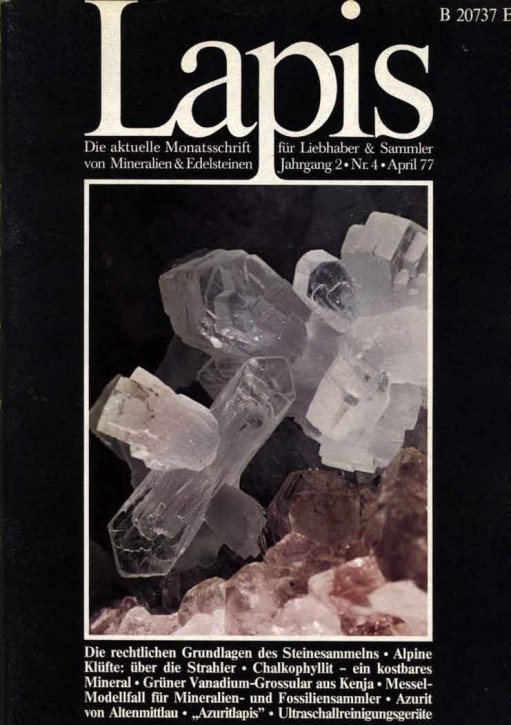
Gübelin, E.J. and Weibel, M. (1977) Grüner Vanadium-Grossular, Kenja. [Green vanadium grossular, Kenya]Lapis, Vol. 2, No. 4, April, pp. 17–21.
Record No. 5044 | Sinkankas/Born No.: NIS/NIB | Language: in German | not seen
Reference copied to clipboard!
tsavorite, grossular, Kenya, gems
Describes vanadium-bearing green grossular from the Lualenyi mine in Kenya’s Taita district, comparing its occurrence with material from Tanzania’s Lalatema Hills and Merelani, where grossular accompanies blue zoisite. The green colour is attributed to vanadium, with approximately 3% V₂O₃ reported. Internal features include probable byssolite inclusions and trails of minute liquid droplets.
Schwarze Einschlüsse in Diamanten
Black inclusions in diamonds
Journal Article
Gübelin, E.J. (1974) Schwarze Einschlüsse in Diamanten. [Black inclusions in diamonds]Zeitschrift der Deutschen Gemmologischen Gesellschaft, No. 2,
Record No. 2108 | Sinkankas/Born No.: NIS/NIB | Language: In German | not seen
Reference copied to clipboard!
diamond, inclusions, gems
Gübelin discusses black inclusions occurring in diamonds and their appearance under gemological examination. The article concerns the nature and identification of these dark internal features and their significance as inclusions in natural diamond.
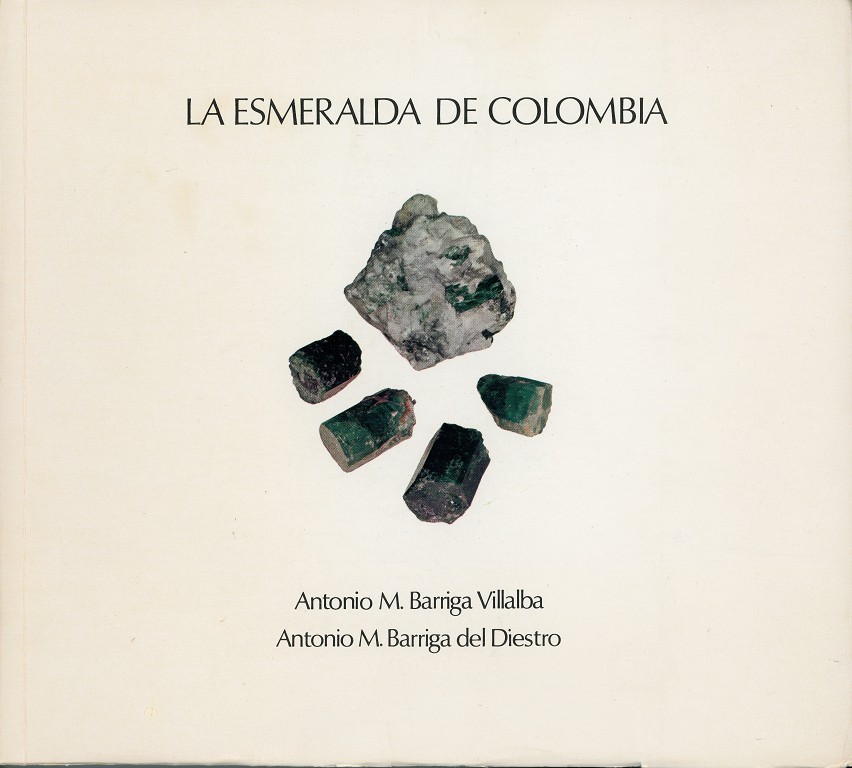
The Emerald of Colombia: Description and Properties
Book
Barriga Villalba, A.M. and Barriga del Diestro, A.M. (1973)La esmeralda de Colombia: Descripción y Propiedades. [The Emerald of Colombia: Description and Properties] Bogotá, Colegio Mayor de Nuestra Señora del Rosario, Departamento de Publicaciones, 100 pp.
Record No. 5444 | Sinkankas/Born No.: 414; NIB | Language: in Spanish | not seen
Reference copied to clipboard!
beryl, emerald, Colombia, gems
Barriga Villalba and Barriga del Diestro present a monographic study of Colombian emerald, describing its principal characteristics and properties. The work considers emerald as a mineral and gemstone, with attention to its physical and optical properties, characteristic color and inclusions, and the features associated with Colombian material. It also discusses the geological occurrence and principal emerald-producing areas of Colombia, particularly the deposits of the Eastern Cordillera, and addresses aspects of mining and the evaluation of emeralds. The volume provides a contemporary Colombian account of the country’s most important gemstone and its distinguishing gemological and geological characteristics.
Neueste Feststellungen am synthetischen Schmuckdiamanten der GE. Co.
Latest findings on the GE synthetic gem diamonds
Journal Article
Gübelin, E.J. (1972) Neueste Feststellungen am synthetischen Schmuckdiamanten der GE. Co. [Latest findings on the GE synthetic gem diamonds]Schweizer Goldschmied, March,
Record No. 2104 | Sinkankas/Born No.: NIS/NIB | Language: in German | not seen
Reference copied to clipboard!
synthetic diamond, General Electric, gems
Examines the cutting behaviour and identifying properties of General Electric’s early gem-quality synthetic diamonds. Cutting trials by Lazare Kaplan & Sons produced well-polished stones but revealed strong directional differences in polishing resistance and substantial weight loss in brilliant cuts. Microscopic dust-like inclusions, ultraviolet fluorescence and phosphorescence, and electrical conductivity provide evidence for distinguishing the colourless, yellow and blue synthetics from natural diamonds. Comparative tables summarize their properties.
Inclusions: Clues to gem growth
Journal Article
Gübelin, E.J. (1972) Inclusions: Clues to gem growth.Jewelers’ Circular-Keystone, October,
Record No. 2103 | Sinkankas/Born No.: NIS/NIB | not seen
Reference copied to clipboard!
inclusions, gems
Die Natur der Mineraleinschlüsse in Edelsteinen
On the nature of mineral inclusions in gemstones
Journal Article
Gübelin, E.J. (1969) Die Natur der Mineraleinschlüsse in Edelsteinen. [On the nature of mineral inclusions in gemstones]Deutsche Goldschmiede-Zeitung, March, April, June,
Record No. 2098 | Sinkankas/Born No.: NIS/NIB | Language: in German | not seen
Reference copied to clipboard!
inclusions, gems
Gübelin examines the nature and significance of mineral inclusions in gemstones, treating inclusions as evidence of the geological conditions and processes under which their host crystals formed. He discusses the morphology, identification, orientation, and genetic relationships of included minerals and shows how inclusion assemblages and their relationships to other internal features can assist in gemstone identification and provide information on genesis and, in favorable cases, origin. Particular emphasis is placed on systematic microscopic observation and on interpreting inclusions as records of a gemstone’s crystallization and subsequent geological history.
Die Natur der Mineraleinschlüsse in Edelsteinen
The nature of mineral inclusions in gemstones
Journal Article
Gübelin, E.J. (1968) Die Natur der Mineraleinschlüsse in Edelsteinen. [The nature of mineral inclusions in gemstones]Schweizer Goldschmied, mit fortsetzungen,
Record No. 2096 | Sinkankas/Born No.: 2574; NIB | Language: in German | not seen
Reference copied to clipboard!
inclusions, gems
First comprehensive article on the determination of inclusions in gemstones by means of the electron microprobe. Techniques are described and results explained. Fine color illustrations. Essentially the same article appeared in Journal of Gemmology, 11(5), 1969, pp. 149–192, with 80 color photographs, 3 figures, and 49 references.
Black star corundum
Journal Article
Peterson, H. (1968) Black star corundum.Rocks & Minerals, Vol. 43, pp. 492–493.
Record No. 1420 | Sinkankas/Born No.: NIS/NIB | not seen
Reference copied to clipboard!
corundum, Canada.12, gems
Peterson discusses black star corundum, a dark variety of corundum that displays asterism when cut en cabochon. The article describes the appearance and gemological characteristics of the material and the inclusions responsible for the star effect, produced by oriented needle-like inclusions that reflect light along crystallographically controlled directions. It considers the relationship between the dark body color, inclusions, and visibility of the star, as well as the orientation required in cutting to display the phenomenon effectively. The brief account provides a practical description of black star corundum and the optical phenomenon responsible for its distinctive appearance.
Inclusions in jade
Journal Article
Bergsten, L.J. (1964) Inclusions in jade.Lapidary Journal, Vol. 17, No. 11 (February), pp. 1076–1078; No. 12 (March), pp. 1080, 1196–1199.
Record No. 2227 | Sinkankas/Born No.: NIS/NIB | not seen
Gübelin, E.J. (1964) Zwei neue synthetische Smaragde. [Two new synthetic emeralds]Zeitschrift der Deutschen Gesellschaft für Edelsteinkunde, Spring, No. 47,
Record No. 2082 | Sinkankas/Born No.: NIS/NIB | Language: In German | not seen
Reference copied to clipboard!
synthetic beryl, emerald, gems
Describes synthetic emeralds produced by W. Zerfass in West Germany and Pierre Gilson in northern France, comparing their properties with Chatham and IG Farben synthetics. Lower physical constants and characteristic lace-like inclusions distinguish these products from natural emeralds, while differences in inclusions and ultraviolet response help identify their manufacturers. Comparative tables and detailed descriptions provide practical diagnostic criteria.
Ekanit: Ein neuer metamikter Edelstein aus Ceylon
Ekanite: A new metamict gemstone from Ceylon
Journal Article
Gübelin, E.J. (1962) Ekanit: Ein neuer metamikter Edelstein aus Ceylon. [Ekanite: A new metamict gemstone from Ceylon]Zeitschrift der Deutschen Gesellschaft für Edelsteinkunde, No. 40,
Record No. 2076 | Sinkankas/Born No.: NIS/NIB | Language: In German | not seen
Reference copied to clipboard!
ekanite, gems
Gübelin gives a detailed gemological account of ekanite, a newly recognized metamict gem mineral from Ceylon, named for F. L. D. Ekanayake, who first recognized its unusual character. The material occurs in the gem gravels near Ellawala, northeast of Ratnapura, and is typically greenish-brown to yellowish-green, transparent to translucent, and sometimes displays chatoyancy or asterism caused by oriented clouds of minute inclusions. Gübelin describes its gemological properties, including its singly refractive character, refractive index of about 1.595, specific gravity of about 3.28, and weak absorption bands, together with microscopic features and inclusions. Chemical investigation showed calcium, thorium, silicon, aluminium, and lead, while measurements demonstrated significant radioactivity associated particularly with thorium. The destruction of the original crystal lattice through radioactive decay accounts for its metamict condition. Gübelin also discusses its probable original crystalline state, chemical composition, and age as estimated by thorium-lead dating, establishing ekanite as an unusual new addition to the gem minerals of Ceylon.
Beryll mit synthetischem Smaragdüberzug
Beryl with synthetic emerald coating
Journal Article
Gübelin, E.J. (1962) Beryll mit synthetischem Smaragdüberzug. [Beryl with synthetic emerald coating]Zeitschrift der Deutschen Gesellschaft für Edelsteinkunde, No. 37,
Record No. 2075 | Sinkankas/Born No.: NIS/NIB | Language: In German | not seen
Reference copied to clipboard!
synthetic beryl, emerald, gems
Gübelin examines a series of “Emerita” stones produced by Johann Lechleitner, consisting of natural beryl cores coated with a synthetic emerald overgrowth. The specimens demonstrate that even differently colored beryls, including blue aquamarine and yellow heliodor, can acquire essentially the same emerald-green appearance when covered by a sufficiently thick synthetic layer. Conventional physical constants may fail to distinguish these composite stones from natural emerald, making microscopic examination particularly important. Gübelin describes the boundary between the natural beryl core and synthetic emerald mantle and the characteristic inclusions and growth features within the coating, illustrating them with photomicrographs. The study emphasizes the gemological identification problems created by synthetic emerald overgrowth and demonstrates that recognition depends chiefly on careful observation of the coating and its microscopic structural features.
Rubin mit synthetischen hydrothermalem Ueberzug
Ruby with synthetic hydrothermal coating
Journal Article
Gübelin, E.J. (1961) Rubin mit synthetischen hydrothermalem Ueberzug. [Ruby with synthetic hydrothermal coating]Zeitschrift der Deutschen Gesellschaft für Edelsteinkunde, Spring, No. 36,
Record No. 883 | Sinkankas/Born No.: NIS/NIB | Language: in German | not seen
Reference copied to clipboard!
corundum, synthetic corundum.7, gems
Describes ruby specimens consisting largely of natural cores covered by thin synthetic layers, reportedly grown hydrothermally. Their physical constants match natural ruby, and inclusions within the cores can make identification misleading. Minute gas bubbles in the coating and a sharp boundary between core and overgrowth reveal their composite nature; the observed features suggest growth from a melt rather than a hydrothermal process.
Mikroskopische Erkennungsmerkmale der Granate
Microscopic identification features of garnets
Journal Article
Gübelin, E.J. (1960) Mikroskopische Erkennungsmerkmale der Granate. [Microscopic identification features of garnets]Zeitschrift der Deutschen Gesellschaft für Edelsteinkunde, Spring, No. 31, pp. 7–11.
Record No. 2067 | Sinkankas/Born No.: NIS/NIB | Language: In German | not seen
Reference copied to clipboard!
inclusions, garnet, gems
Discusses microscopic features useful in identifying garnets.
Safiras do Rio Coxim, Mato Grosso
Sapphires of the Coxim River, Mato Grosso
Journal Article
Souza Campos, J.E., de (1960) Safiras do Rio Coxim, Mato Grosso. [Sapphires of the Coxim River, Mato Grosso]Gemologia, Vol. 6, No. 21, pp. 1–8.
Record No. 1629 | Sinkankas/Born No.: NIS/NIB | Language: in Portuguese | not seen
Reference copied to clipboard!
corundum, Brazil.12, gems
Describes sapphire crystals from the Coxim River area of Mato Grosso, Brazil, noting unusual rounded inclusions resembling the gas bubbles commonly associated with synthetic corundum.
Einschlüsse in Diamanten
Inclusions in diamond
Journal Article
Gübelin, E.J. (1957) Einschlüsse in Diamanten. [Inclusions in diamond]Gold + Silber,
Record No. 2053 | Sinkankas/Born No.: NIS/NIB | Language: in German | not seen
Reference copied to clipboard!
diamond, inclusions, gems
Reviews inclusions in diamond.
Das Phasenkontrast-Verfahren nach Zernike zur Untersuchung von Inhomogenitäten in Edelsteinen
The phase contrast method according to Zernike for the examination of inhomogeneities in gemstones
Journal Article
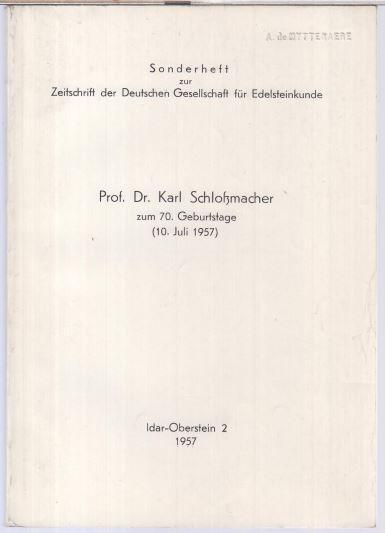
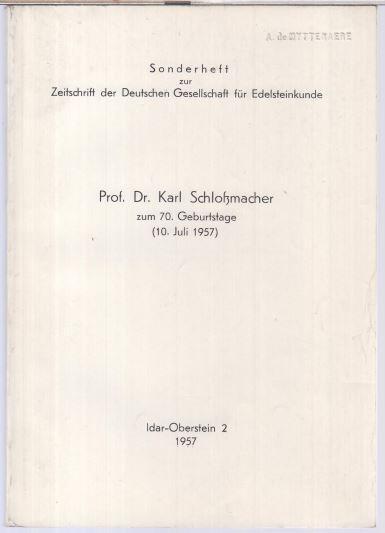
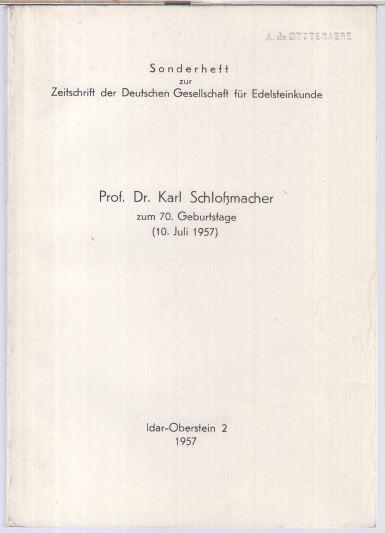
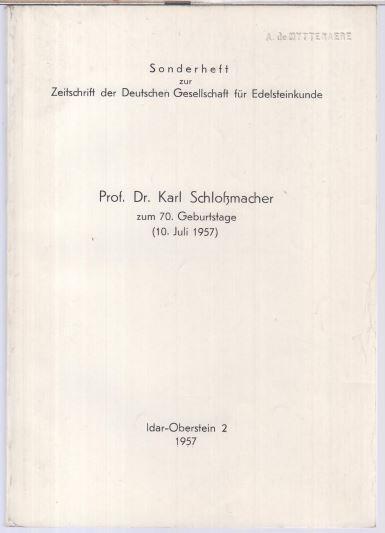
Gübelin, E.J. (1957) Das Phasenkontrast-Verfahren nach Zernike zur Untersuchung von Inhomogenitäten in Edelsteinen. [The phase contrast method according to Zernike for the examination of inhomogeneities in gemstones]Zeitschrift der Deutschen Gesellschaft für Edelsteinkunde, (Festschrift zur Vollendung des 70. Lebensjahres von Professor Dr. Schlossmacher), No. 20, Summer, pp. 43–52.
Record No. 2052 | Sinkankas/Born No.: NIS/NIB | Language: in German | not seen
Reference copied to clipboard!
phase-contrast microscopy, gems
Explains the application of Zernike’s phase contrast microscopy to reveal subtle internal features in gemstones. By converting differences in optical path into visible brightness contrasts, the method enhances thin, transparent inclusions and structures whose refractive indices closely resemble those of their hosts. Specially adapted equipment permits examination within gemstones, revealing exsolution, alteration and healed fractures that are difficult to distinguish under ordinary illumination.
Schmuck- Und Edelsteinkundliches Taschenbuch
Jewelry and Gemstone Pocket Handbook
Book
Chudoba, K.F. and Gübelin, E.J. (1953)Schmuck- Und Edelsteinkundliches Taschenbuch. [Jewelry and Gemstone Pocket Handbook] Bonner, Verlag Bonner Universitäts-Buchdruckerei, xii + 158 pp.
Record No. 5041 | Sinkankas/Born No.: NIS/NIB | Language: in German | not seen
Reference copied to clipboard!
gems, gemology,
Chudoba and Gübelin provide a compact practical reference to gemology intended both for identifying gemstones and for standardizing the often confusing terminology used in the German gem trade. The principal gemstones and ornamental materials are arranged alphabetically and characterized by their chemical, crystallographic, and physical properties, important localities, trade names, and diagnostic features. Separate sections treat inclusions in natural gemstones, synthetic stones, doublets and triplets; tables of gemological constants; coated stones; synthetic gems and other imitations; the gemological microscope; and practical identification tables. Particular emphasis is placed on simple tests that can be performed with readily available gemological instruments and on microscopic inclusions as a means of distinguishing natural stones from synthetics and assembled or imitation materials. Conceived as a concise working handbook rather than a comprehensive mineralogical treatise, it became the basis for the substantially enlarged second edition of 1966, retitled Edelsteinkundliches Handbuch, and a further expanded third edition in 1974.
Exploring the Literature of Gemstone Inclusions
The literature of gemstone inclusions covers identification, origin determination, treatments, synthesis, mineral inclusions, fluid inclusions and other internal features of natural and synthetic gems.
Four Treasures is Lotus Gemology's freely accessible gemological reference database. Use the full database to search by author, title or keyword and explore literature on gemology, mineralogy, jewelry and related fields. Where available, hyperlinks on titles may lead directly to the full publication.