Jade Bibliography

Jade Bibliography

Explore books, articles and historical sources on jade in Four Treasures, the Lotus Gemology reference database. This bibliography brings together matching records from the collection, with publication details, abstracts and cover images where available.

Jade References

The list below matches the terms jade, jadeite, nephrite or Fei Cui in the database's searchable fields. Some references discuss these materials as part of a broader subject.
3,681–3,700 of 3,768 matching references

Chinese art (introductory article)

Journal Article
Rienaecker, V. (1943) Chinese art (introductory article). Apollo, Vol. 38, December, pp. 157–160.
Record No. 6571  |  Sinkankas/Born No.: 5471  |  not seen
First part in a multipart series of articles on Chinese art. Articles on Chinese jade begin with the tenth article in the series.

Hunting jade in Wyoming

Journal Article
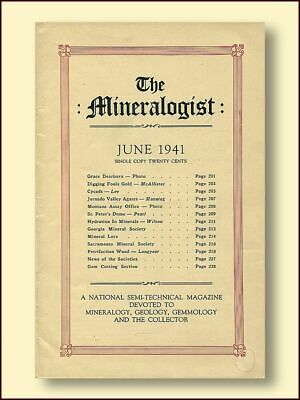
Rhoads, B.A. (1943) Hunting jade in Wyoming. The Mineralogist, Vol. 11, pp. 371–373.
Record No. 4383  |  Sinkankas/Born No.: NIS/NIB  |  not seen
The Evolution of Technique in Chinese Jade Carving
The Evolution of Technique in Chinese Jade Carving

Thesis
Hansford, S.H. (1942) The Evolution of Technique in Chinese Jade Carving. London University, 197 pp.
Record No. 7143  |  Sinkankas/Born No.: NIS/NIB  |  not seen

Jade in Wyoming • New discoveries

Journal Article
Dake, H.D. (1942) Jade in Wyoming • New discoveries. The Mineralogist, Vol. 10, No. 9, September, pp. 275–276.
Record No. 4382  |  Sinkankas/Born No.: NIS/NIB  |  not seen

The Story of Jade — Jade, the Jewel that grants all desires in this world and the next.""
Book
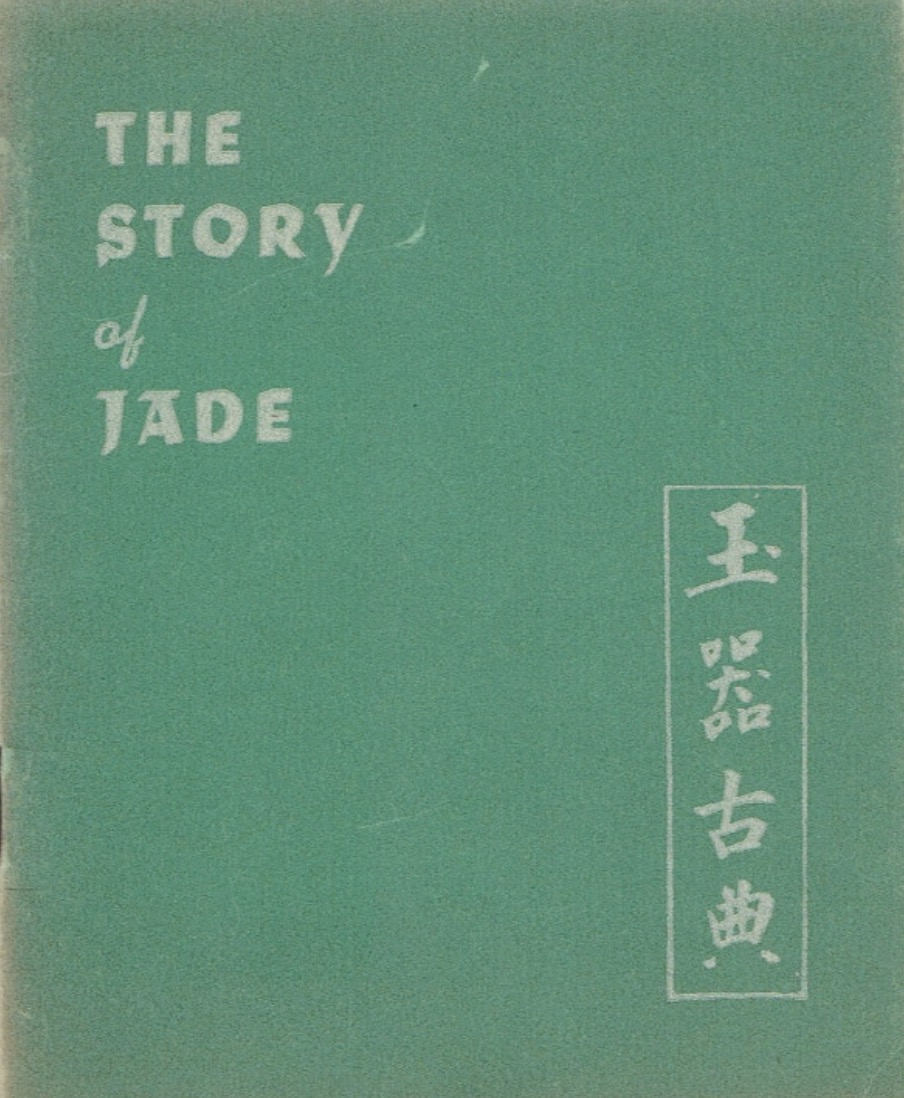
Morgan, H.T. (1941) The Story of Jade — Jade, the Jewel that grants all desires in this world and the next."". Los Angeles, H.T. Morgan, 16 pp.
Record No. 28796  |  Sinkankas/Born No.: 4595  |  not seen
Sinkankas: Short, general history, with illustrations of carvings and meant for free distribution by Quon-Quon Company, 843 South Los Angeles Street, Los Angeles, California. Born, [242–3]; Yang [1702, 1703].

Illustrated Catalog of Ancient Chinese Jade
支那古玉圖錄
Book
Umehara, S. (1941–1955) Illustrated Catalog of Ancient Chinese Jade. [支那古玉圖錄] Kyoto, Kuwana Bunseidō, 8, 5, 13 pp. (110 leaves of plates)
Record No. 7397  |  Sinkankas/Born No.: 6746; Born: 327  |  Language: mostly in Japanese  |  not seen
An illustrated catalog of ancient Chinese jade objects, presenting a substantial collection of plates with accompanying text. It documents carved jades as archaeological and artistic objects, providing visual material for comparative study of their forms and decoration.

The Use and Variety of Tama in the Nara Period
Book
Ishida, M. (1941) The Use and Variety of Tama in the Nara Period. Tokyo, Central Federation of Nippon Culture, 25 pp.
Record No. 7153  |  Sinkankas/Born No.: NIS/NIB  |  not seen

Jade found in Wyoming

Journal Article
Branham, A.W. (1941) Jade found in Wyoming. The Mineralogist, Vol. 9, No. 3, March, pp. 79–80.
Record No. 4379  |  Sinkankas/Born No.: NIS/NIB  |  not seen

Part I. Report on selected beads from Harappa

Book Section
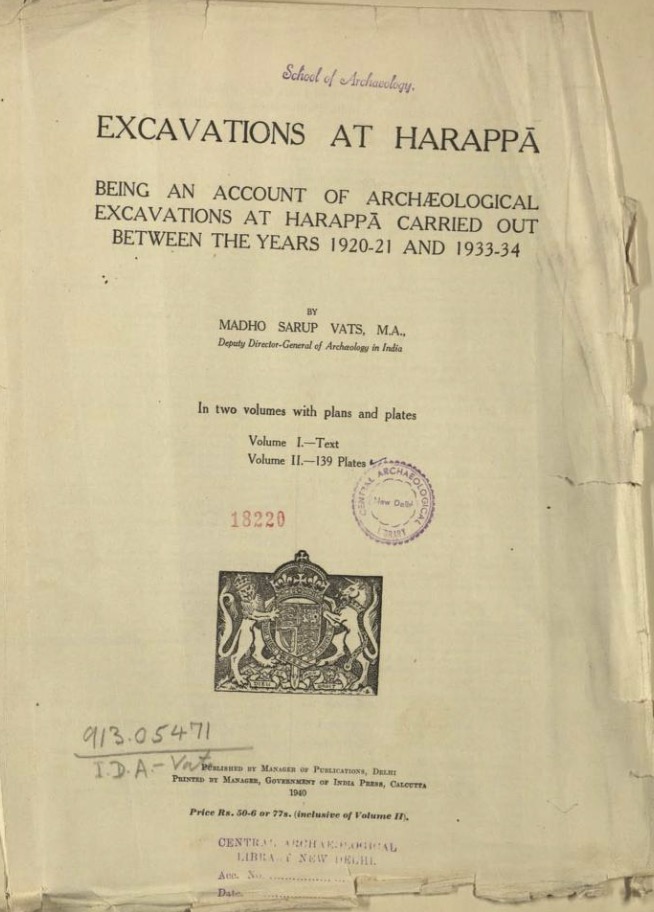
Beck, H.C. (1940) Part I. Report on selected beads from Harappa. In: Excavations at Harappa: Being an Account of Archaeological Excavations at Harappa Carried Out Between the Years 1920–21 and 1933–34, Delhi: Government of India Press, 2 Vols., Vol. 1 , pp. 392–431.
Record No. 24714  |  Sinkankas/Born No.: NIS/NIB
At the request of Mr. Madho Sarup Vats, Deputy Director General of Archaeology in India, I have undertaken to write a chapter on selected beads from Harappa. The fact that I cannot examine the entire collection has made it difficult to assess the likelihood of foreign importation, but Mr. Vats has been of great assistance in providing details on whether each specimen is unique, rare, or common, as well as information on the stratigraphic layer in which it was found. This data, combined with a close examination of the beads, has revealed some interesting possibilities regarding connections with other civilizations, particularly the Sumerian civilization in Mesopotamia. Since there appears to be little variation among the beads from different layers—many types occurring across several layers—I have chosen to group the beads by material rather than by stratigraphy. Several plates accompany the text for clarification. The first two are diagrammatic and show the beads arranged by shape according to the Beck Method of classification. Plate CXXIX illustrates beads in Group I, those with circular transverse sections, while Plate CXXX shows beads with non-circular transverse sections. Some plates also consist of microphotographs showing internal structure. One especially notable feature of the Harappa beads is the remarkably large number made from steatite. Nowhere else has such a high proportion of beads been found in this material. Moreover, the variety of treatment applied to the steatite is quite exceptional. While some beads are in natural stone, the vast majority have undergone heat treatment that whitens the surface. These are referred to as “burnt” steatite beads. Although I cannot be certain that intense heat was used in every instance, I have adopted the term nonetheless.
Jade: Imperial gem

Jade: Imperial gem

Journal Article
Torresani, U. (1940–41) Jade: Imperial gem. Marco Polo, Vol. 2, December, pp. 105–115.
Record No. 3985  |  Sinkankas/Born No.: NIS/NIB  |  not seen
An Illustrative Study Of Ancient Jades
An Illustrative Study Of Ancient Jades

古玉圖譜研究
Book
Liang, W.M. (1939) An Illustrative Study Of Ancient Jades. [古玉圖譜研究] Hong Kong, Asiatic Litho, 47 leaves, 35 glossy plates
Record No. 28780  |  Sinkankas/Born No.: 3948; Born: p. 213–214  |  Language: in Chinese  |  not seen
Sinkankas: “The author … spent fifteen years in the collection and study of ancient jades, especially … the six ritual jades, namely bi 璧, cong 琮, gui 圭, zhang 璋, hu 琥, and huang 璜.” The plate explanations identify the objects and give brief comments on coloration and age. The plates are fair in quality, with colors corresponding well to those of real nephrites, the author stating, f. [8], “this volume is an attempt to publish a part of my own collection in its natural colors so as to give those who are interested in ancient jades a basis for further study, because old Chinese treatises on ancient jades were printed in black and white and thus afford the reader little knowledge on the color and texture of the jades. Using the lithographic process in this venture is the first of its kind in China.” Summary from G. M. Born, pp. 213–14.

Nephrite in Wyoming

Journal Article
Anonymous (1939) Nephrite in Wyoming. Rocks & Minerals, Vol. 14, No. 7, pp. 210–211.
Record No. 4385  |  Sinkankas/Born No.: NIS/NIB  |  not seen

What One Should Know About jade

Book
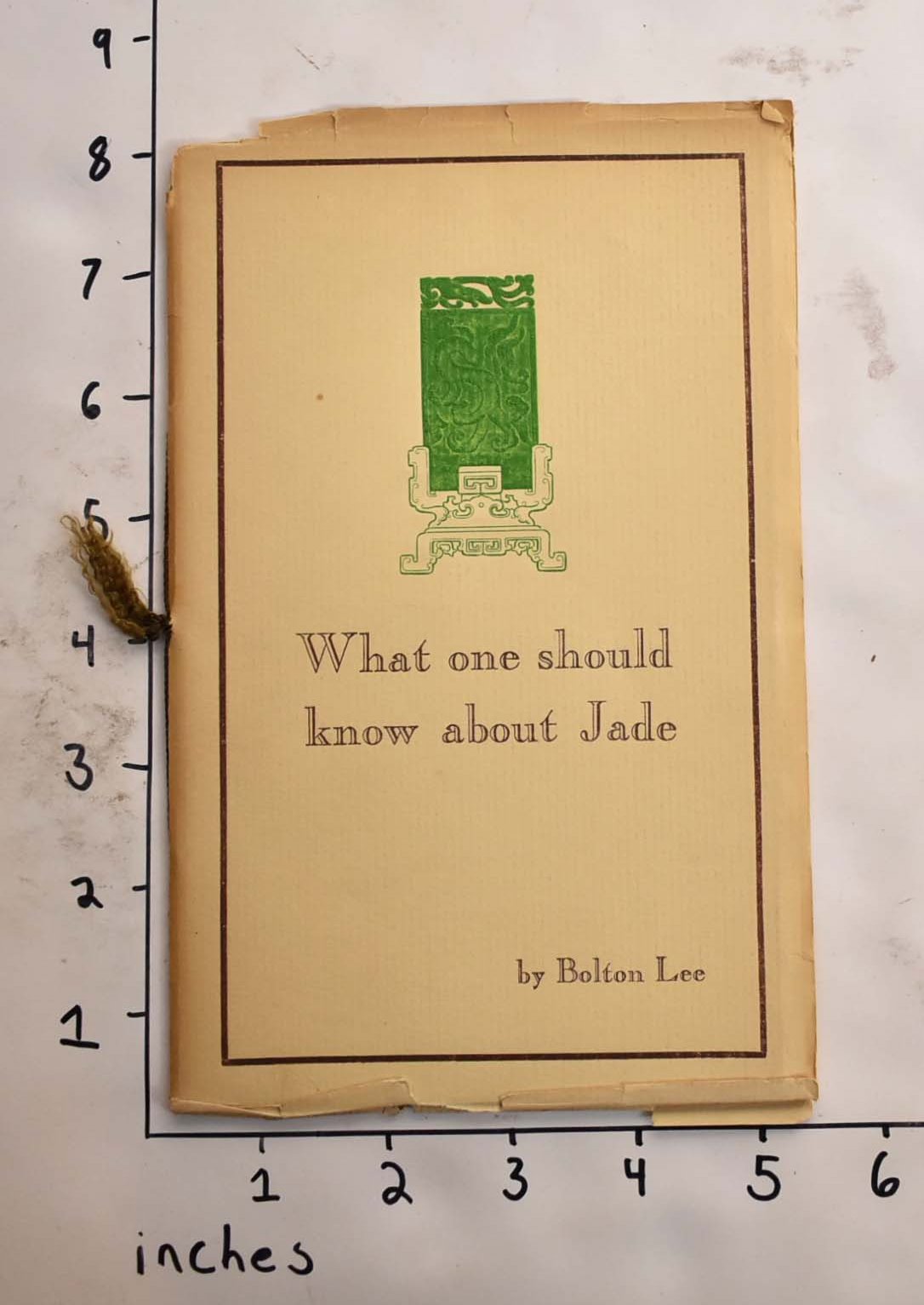
Lee, B. (1939) What One Should Know About jade. Shanghai, The Jade Store, 23 pp.
Record No. 3955  |  Sinkankas/Born No.: 3832; Born: p. 210  |  not seen
A small booklet published by this establishment in Shanghai, and presumably distributed to current and potential customers and clients. Sinkankas: A general treatise on Chinese jade by a well-known purveyor of same, with an introduction by Arthur de Carle Sowerby, noted student of Chinese culture. Topics: origin & uses of jade, importance to the Chinese, production, Han jade, white jade, “stone” jade, “water” jade, “jasper” jades, identification. Summary, G. M. Born, 210.

First Collection of Ancient Chinese Yu
古玉圖錄初集 Guyu Tulu Chuji
Book
Huang, J. (1939) First Collection of Ancient Chinese Yu. [古玉圖錄初集 Guyu Tulu Chuji] Beijing, Zun gu zhai, 4 Vols., 55, 50, 50, 53 sheets
Record No. 3840  |  Sinkankas/Born No.: NIS/NIB  |  Language: in Chinese  |  not seen
Huang Jun’s four-volume catalogue records a large body of ancient Chinese jades that passed through or were known to his Zunguzhai antiquities business in Beijing. The objects range broadly from archaic ritual and ceremonial forms to ornaments and figurative carvings attributed at the time from the early dynastic period through the Qin and Han. The catalogue is principally visual rather than analytical: objects are reproduced in exceptionally clear collotype photographs and rubbings, generally with little or no identification or commentary, making the work primarily a documentary record of important jades circulating in Chinese and international collections during the early twentieth century. Among the pieces illustrated are cong, bi and notched discs, gui, axes and dagger-axes, human and animal ornaments, inscribed pieces, and elaborately carved jades. Many objects subsequently entered major Western museum and private collections, giving the catalogue continuing importance for provenance research and for tracing the modern collecting history of early Chinese jade.

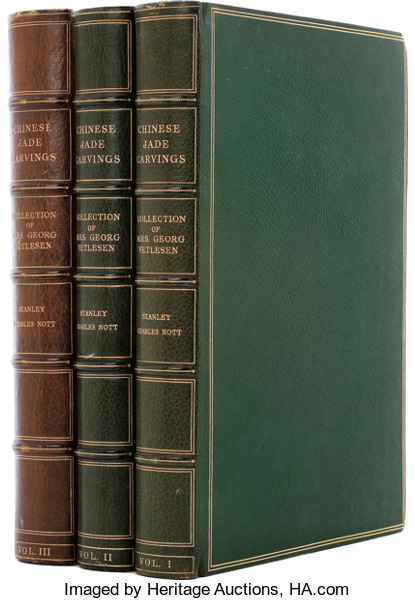
Chinese Jade Carvings of the XVIth to the XIXth Century in the Collection of Mrs. Georg Vetlesen
Book
Nott, S.C. (1939–1940) Chinese Jade Carvings of the XVIth to the XIXth Century in the Collection of Mrs. Georg Vetlesen. London, privately printed, limited to 100 numbered sets, 3 Vols., xxvi, 284; xii, 307; x, 304 pp.
Record No. 3612  |  Sinkankas/Born No.: 4799  |  seen
Sinkankas: The Vetlesen Catalog is one of the most lavish and substantial publications of its kind, featuring thick, high-quality handmade paper, elegant letterpress, attractive plates, and a splendid leather binding befitting its prestigious content. The collection, consisting primarily of large spinach-green jade carvings along with jadeites and hardstones, was formally presented by the heirs of Maude Monell Vetlesen to the Smithsonian Institution in Washington, D.C., on February 5, 1959, and housed in a special room adjacent to the Gem Hall in the Natural History Museum. In his introduction to Volume I, Nott asserts that no other collection can match its comprehensiveness in jade carvings from the 16th to early 19th centuries, a claim open to debate but supported by the collection’s impressive 134 specimens, all carefully cataloged with descriptions, dimensions, provenances, and symbolic interpretations. The first volume includes Nott’s essays on the collection’s formation, while the second is strictly a catalog, and the third resumes with an extensive 136-page essay on the symbolism of Chinese jade carvings, deeply rooted in tradition, religion, and mythology—so substantial that it could stand alone as a separate work. The production cost was reportedly around $500 per set, but by 1985, a set in London sold for 18 times that amount. Mrs. Vetlesen began collecting these jades during her first marriage to Ambrose Monell, founder of International Nickel and developer of the stainless alloy “Monel” metal, which found widespread industrial and domestic use. After her second marriage to the wealthy Norwegian George Vetlesen and her passing, her three children lacked the space to properly store and display the collection, leading to its donation to the Smithsonian (Washington Post & Times Herald, Feb. 6, 1959). Reviews appeared in Connoisseur (1939, 1940), and later auction records note a sale price of £6,500 at Han-Shan Tang, London, in 1985.

Chinese Jade: 300 years of master craftsmanship
Journal Article
Davidson, M. (1938) Chinese Jade: 300 years of master craftsmanship. The Art News, Vol. 36, Annual, pp. 118–132.
Record No. 7129  |  Sinkankas/Born No.: 1591  |  not seen

Handbuch der regional Geologie: Mittelamerika
Central America: Handbook of Regional Geography
Book
Sapper, K.T. (1937) Handbuch der regional Geologie: Mittelamerika. [Central America: Handbook of Regional Geography] Heidelburg, Vol. 8, Part 4 , 160 pp.
Record No. 28318  |  Sinkankas/Born No.: NIS/NIB  |  Language: in German  |  not seen
Regional geology that contains a map of the serpentinite deposits associated with fei cui in Guatemala.

Illustrations of Jades in the Taoshai Collection
匋齋古玉圖 T’ao Chai Kü Yu T’u
Book
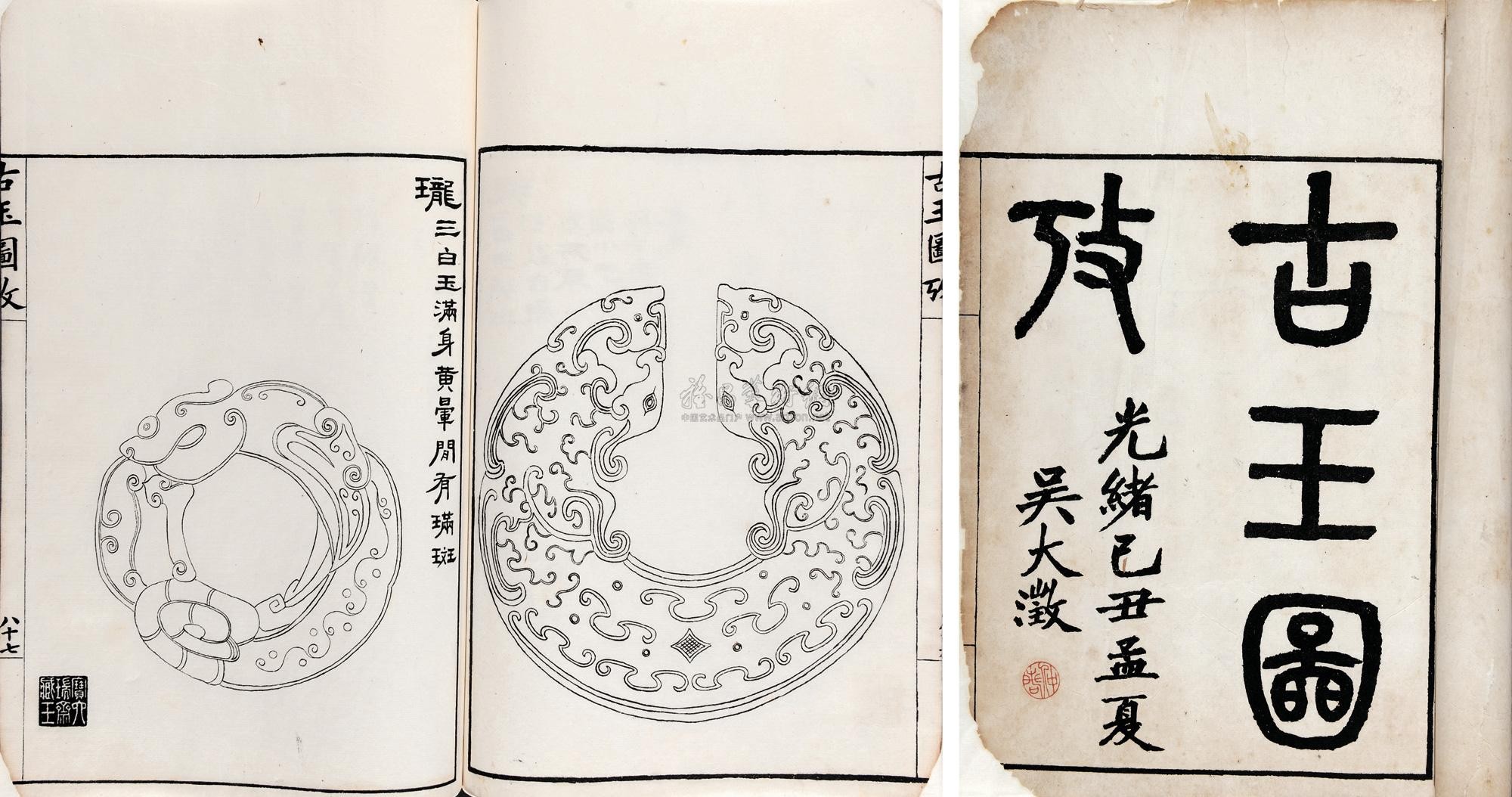
Wang Ta-Lung (Wang Dalong) (1936) Illustrations of Jades in the Taoshai Collection. [匋齋古玉圖 T’ao Chai Kü Yu T’u] Shanghai, 2 Vols., 294 pp.
Record No. 8049  |  Sinkankas/Born No.: 7004; Born:  p. 22; Yang: 919  |  Language: in Chinese  |  not seen
This voluminous book was purportedly claimed to be a catalogue of jades from the imperial collection of the Emperor Xiaozong 孝宗 (1127-1194) of the Southern Song dynasty, but it is considered by scholars as a forgery published by Jiang Chun 江春 in 1779. Although this multi-volume set contains some incorrect information, it includes a detailed description for each object and thus is still regarded as a useful reference book for the study of Chinese jades. Taozhai guyu tu 匋齋古玉圖 (also written Taozhai guyu tu 陶齋古玉圖) is a catalogue on ancient jades compiled during the late Qing period 清 (1644-1911) by Duanfang 端方 (1861-1911), courtesy name Wuqiao 午橋, style Taozhai 匋齋, from the Manchu clan Tohoro (Ch. Tuohuoluo 託濶羅) and a member of the the Plain White Banner (Manzhou zhengbai qi 满洲正白旗). The catalogue was begun as a register of Duanfang's own collection of antiques, but was unfinished when he was killed in the pre-revolutionary unrest in Sichuan. The manuscript was sold on the book market, where Yang Shouqi 楊壽棋 found and acquired it in 1936. Together with the Shanghai librarian Wang Dalong 王大隆 (1901–1966) he edited the fragmentary text and published it in the Laiqingge Press 來青閣書局 in Shanghai. Each of the 150 object in the publication are descibed as to their features and origins.Sinkankas: Also given in Han-Shan Tang, London, List 28, 1985, no. 99 as Taozhai Guyu Tu [Illustrations of Jades in the Taoshai Collection]. Shanghai, 1936. 2 vols, 294 pages, many woodblock illustrations, 33 x 22 cm. Stitched, in cloth case. See also S.H. Hansford, Chinese Jade Carving, p. 138: “Illustrations and catalogue of 150 ancient Chinese jades in the collection of Viceroy Tuan Fang.” Loehr & Huber, Ancient Chinese Jades, p. 437, gives this as “Illustrated catalogue of ancient jades in the T’ao-chai collection.” Born, 22; Yang, 919. See: Wilson, Ming. What Do Books Tell Us about Their Buyers—A Case Study of the Guyu Tupu." In The Art of the Book in China, edited by Ming Wilson and Stacey Pierson, 105 –15. London: Percival David Foundation of Chinese Art, 2006."

Jade

Journal Article
Arnold, J.H. (1936) Jade. Asia, Vol. 36, January, pp. 14–21.
Record No. 6682  |  Sinkankas/Born No.: Born, p. 65  |  not seen

The Wong Collection of Ancient Chinese Jades

Catalog
Wong, K.C. (1936) The Wong Collection of Ancient Chinese Jades. London: Bluett & Sons, 35 pp., 16 plates.
Record No. 4272  |  Sinkankas/Born No.: 7314; Born: p. 355  |  not seen
The work comprises a catalogue of 527 specimens in the author's col­lection of ancient Chinese jades ranging from the Sung to the Ch'ing Dynasties. The nucleus of the collection, inherited from his ancestors, was used as material for Investigations into Ancient Jades With Illustra­tions, published in 1889 by Wu Ta-Ch'eng. A portion of the collection came from the estate of a brother, Wong Jui Hsum, and the remainder was assembled by K.C. Wong over a 30-year period. He points out that since the articles in nearly every instance exhibit some form of sym­bolism with significance in religion, myth or folk-lore, appreciation of the object demands acquaintance with the ceremonial and social customs of the people. The author explains the relationship of jade to the cosmic deities, and elucidates the role of the dragon used in jade carv­ing. The catalogue gives dates assigned by Wong only when he is certain. In some instances he has chosen not to date a piece, especially if that type of object was carved during so long a period, that it is difficult to be precise. The illustrations are chosen to show the scope of the collection. Given for each article of jade is the designation, Chinese equivalent in Roman type, color, size (in inches) and period. A glossary of Chinese terms relating to jades is appended.

Exploring the Literature of Jade

Jade literature spans gemology, mineralogy, archaeology, art history, mining, carving and connoisseurship, and includes works on both jadeite and nephrite from around the world.

For an introduction to collecting books on this subject, read Hidden Treasure — Collecting the Literature of Jade.

About Four Treasures

Four Treasures is Lotus Gemology's freely accessible gemological reference database. Use the full database to search by author, title or keyword and explore literature on gemology, mineralogy, jewelry and related fields. Where available, hyperlinks on titles may lead directly to the full publication.

Search the Complete Four Treasures Database