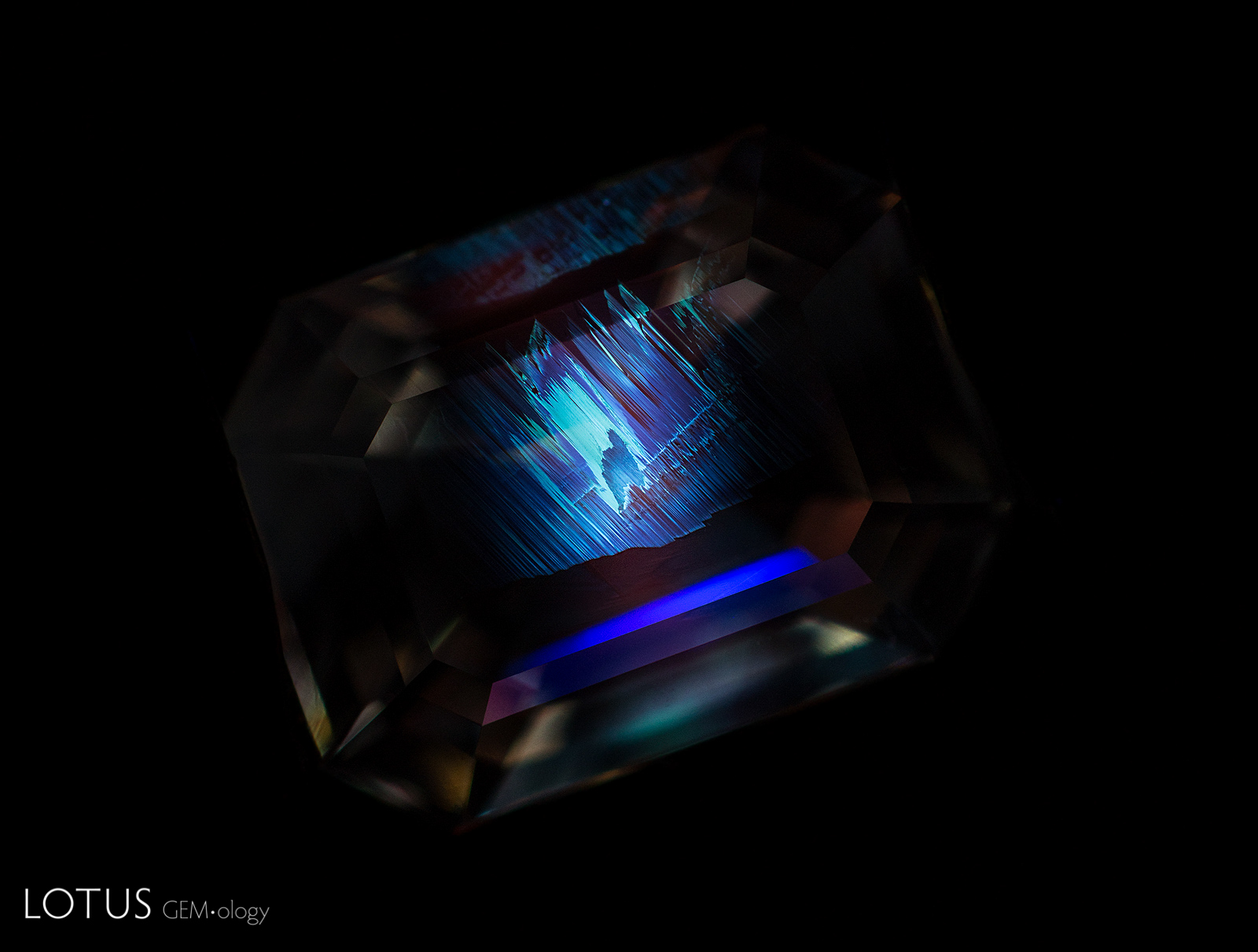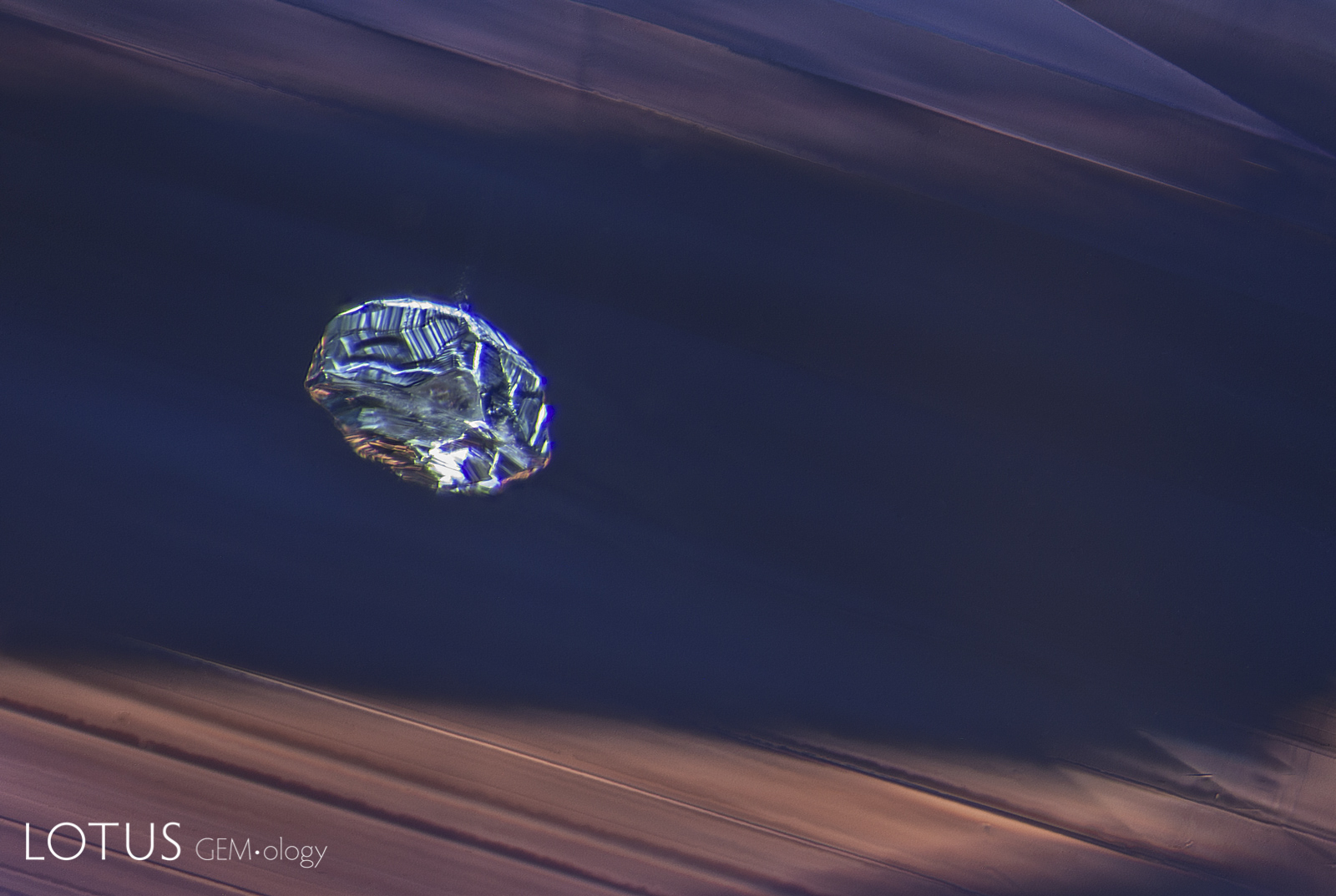
Sapphire Inclusions
Explore sapphire inclusions in Hyperion, the Lotus Gemology inclusion database. Hyperion contains photomicrographs of inclusions and internal features in natural sapphire, documented with information on geographic origin, treatment, lighting conditions, field of view, photographer and published references.
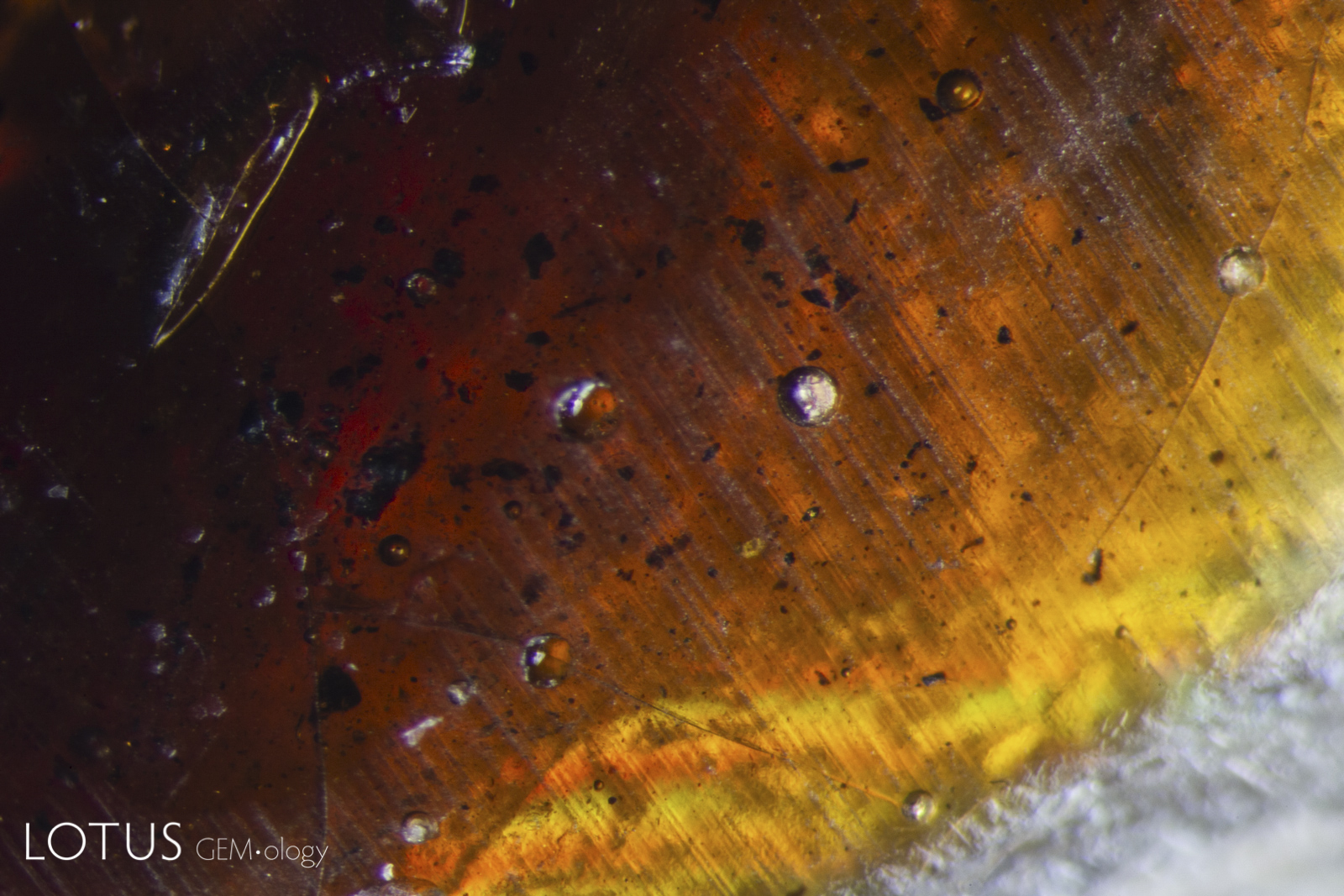
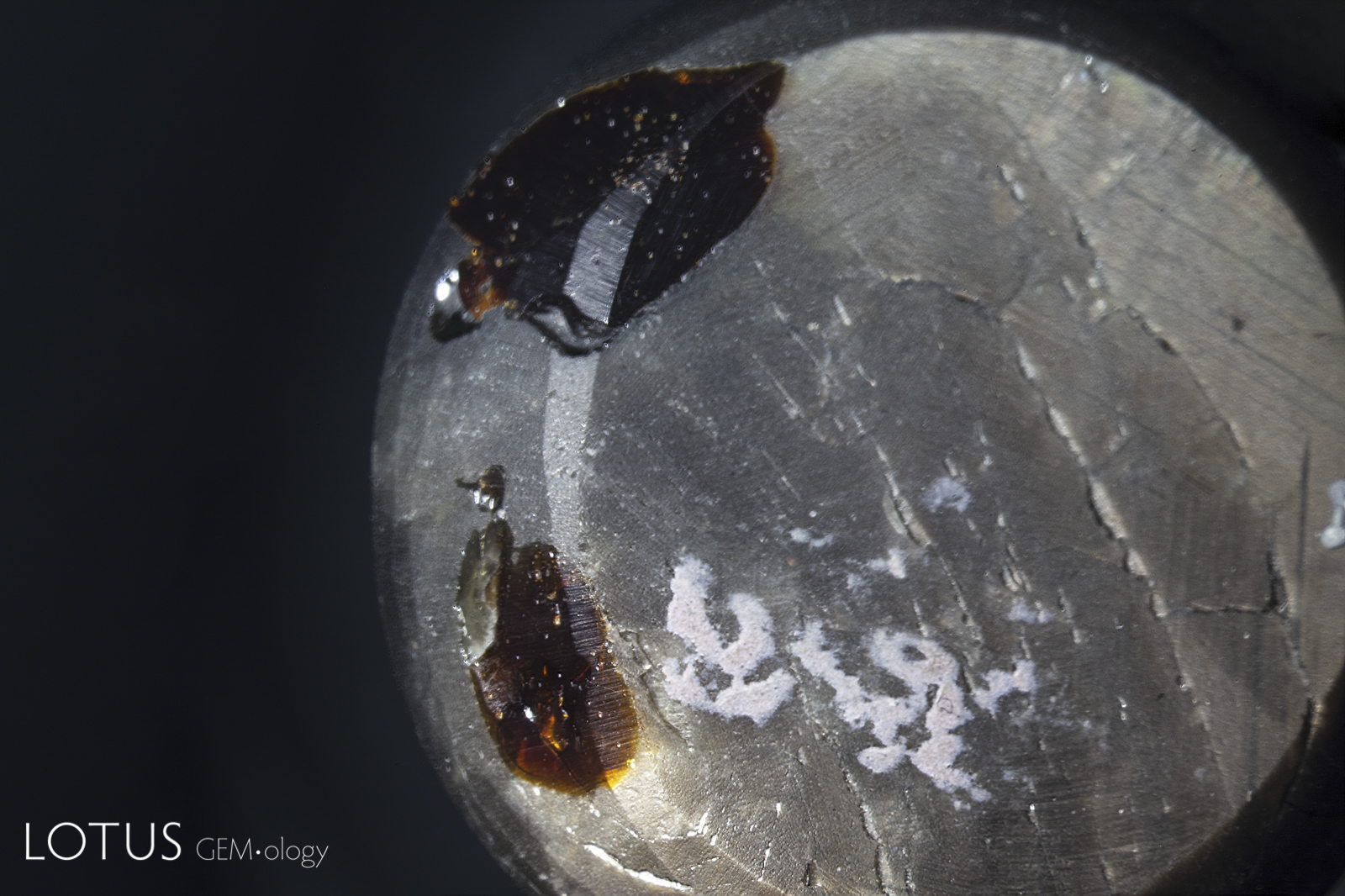
This black star sapphire from Chanthaburi, Thailand has large pits on the base filled with a brown dopping varnish. Careful examination reveals gas bubbles trapped in the varnish.
Natural Star Sapphire •
Thailand (Siam); Chanthaburi •
Enhancements:
Heat + Glass Cavity/Fissure Filling (H-GF3) •
Lighting Conditions:
Fiber Optic: Oblique
Photographer:
Richard W. Hughes •
Image Number:
A-003-6241-3
• Field of View = 5mm
This black star sapphire from Chanthaburi, Thailand has large pits on the base filled with a brown dopping varnish.
Natural Star Sapphire •
Thailand (Siam); Chanthaburi •
Enhancements:
Heat + Glass Cavity/Fissure Filling (H-GF3) •
Lighting Conditions:
Fiber Optic: Diffuse Overhead
Photographer:
Richard W. Hughes •
Image Number:
A-003-6241-1
• Field of View = 30mm
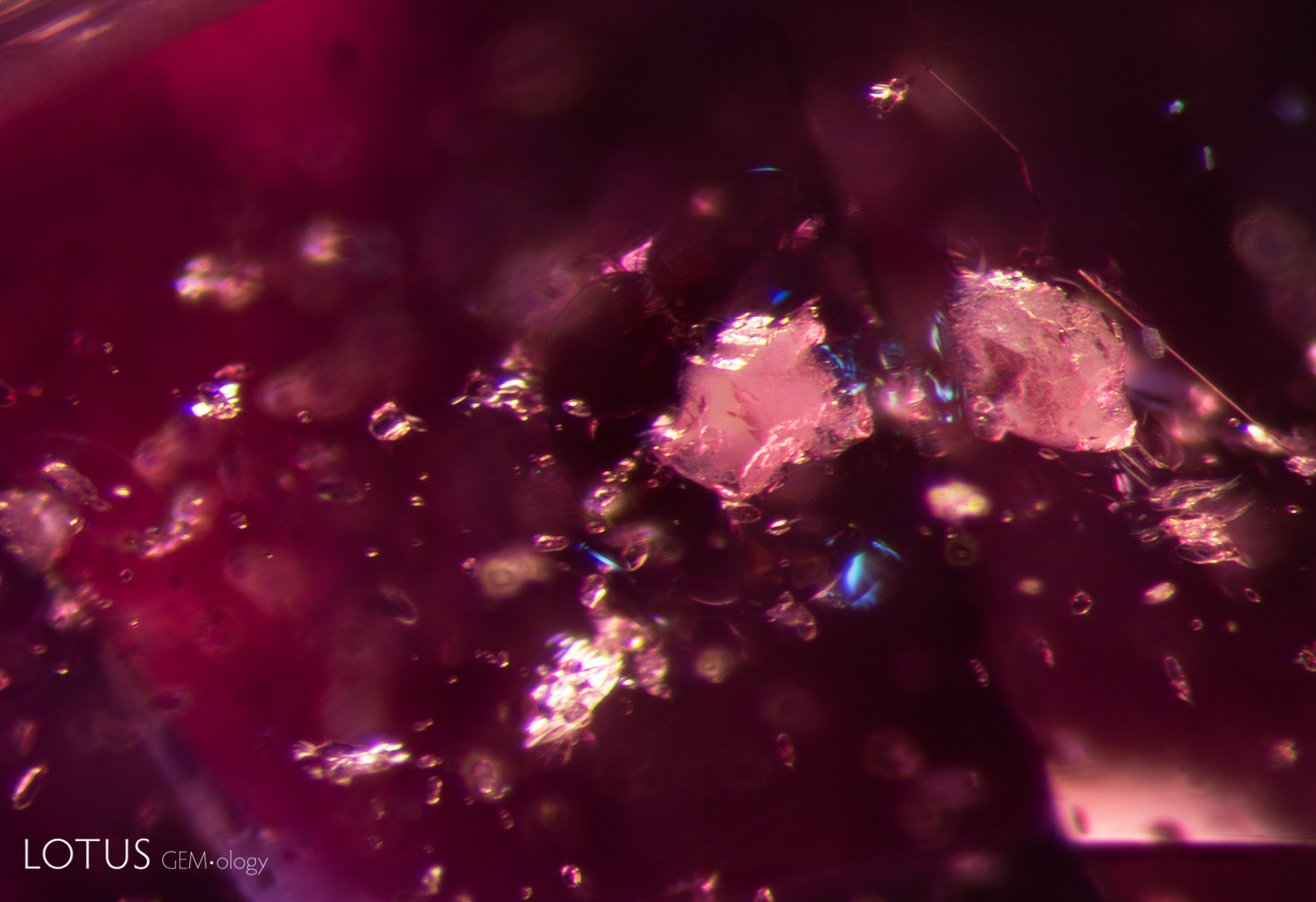
A blocky, white crystal of what is either carpathite or analcime stands out in this Madagascar sapphire.
Natural Padparadscha Sapphire •
Madagascar •
Enhancements:
None Detected (None) •
Lighting Conditions:
Dark Field + Diffuse Fiber Optic
Photographer:
E. Billie Hughes •
Image Number:
A-003-6226-1
• Field of View = 2mm
Hairy hematite/ilmenite silk in a gold sheen sapphire from Kenya.
Natural Gold-Sheen Sapphire •
Kenya •
Enhancements:
None Detected (None) •
Lighting Conditions:
Fiber Optic: Oblique
Photographer:
Wimon Manorotkul •
Image Number:
A-003-6157-1
Bui, T.N., Deliousi, K., Malik, T.K. and Corte, K., de (2015) From exsolution to 'gold sheen': A new variety of corundum. Journal of Gemmology, Vol. 34, No. 8, October, pp. 678–691; RWHL*.
Moon, A.R. and Phillips, M.R. (1984) An electron microscope study of exsolved phases in natural black Australian sapphire. Micron and Microscopica Acta, Vol. 15, No. 3, pp. 143–146; RWHL.
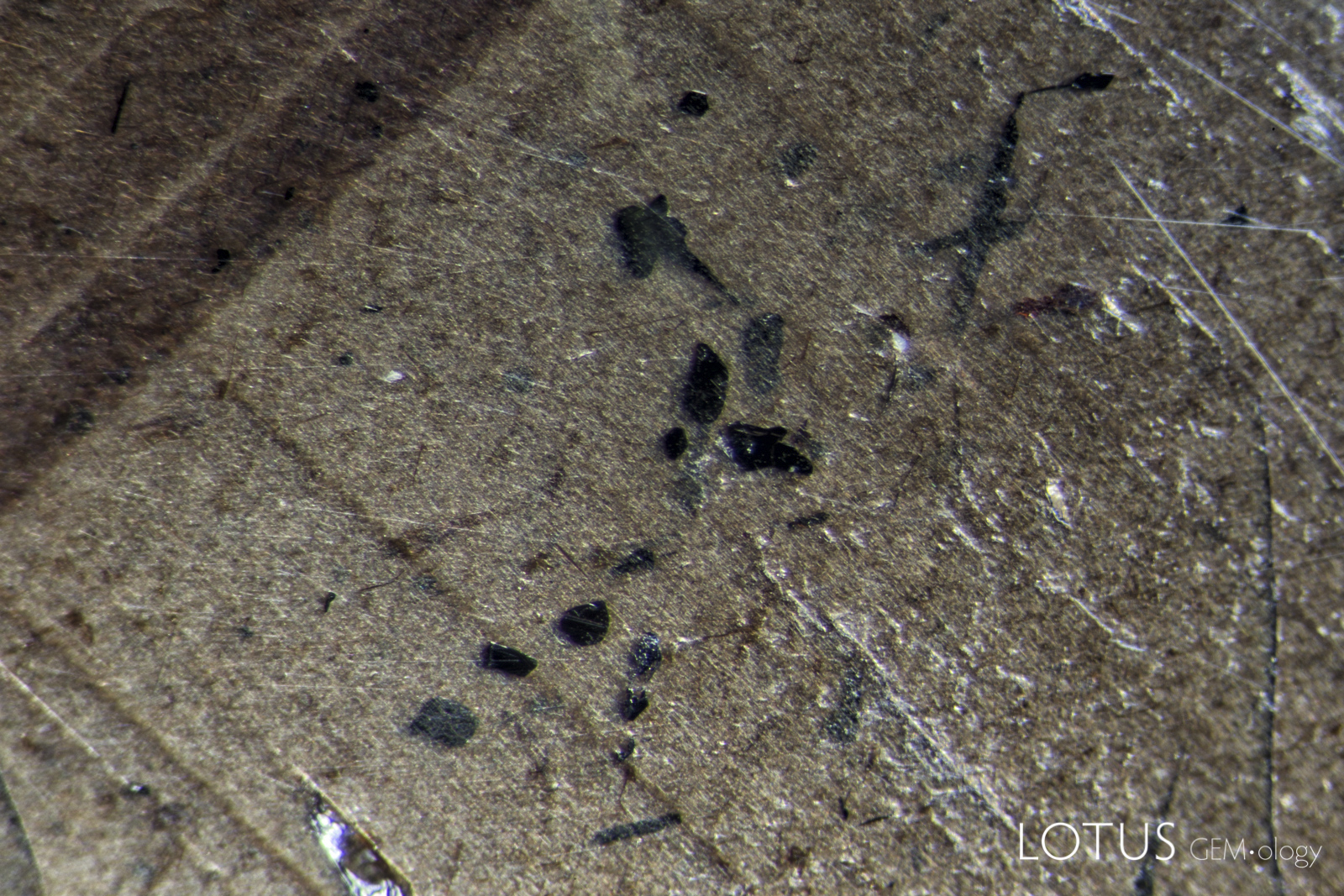
Black crystals cut through on the surface of a gold sheen star sapphire from Kenya. We identified these via micro Raman as magnetite, an Fe-rich member of the spinel group.
Natural Gold Sheen Star Sapphire •
Kenya •
Enhancements:
None Detected (None) •
Lighting Conditions:
Fiber Optic: Diffuse Overhead
Photographer:
Richard W. Hughes •
Image Number:
A-003-6163-1
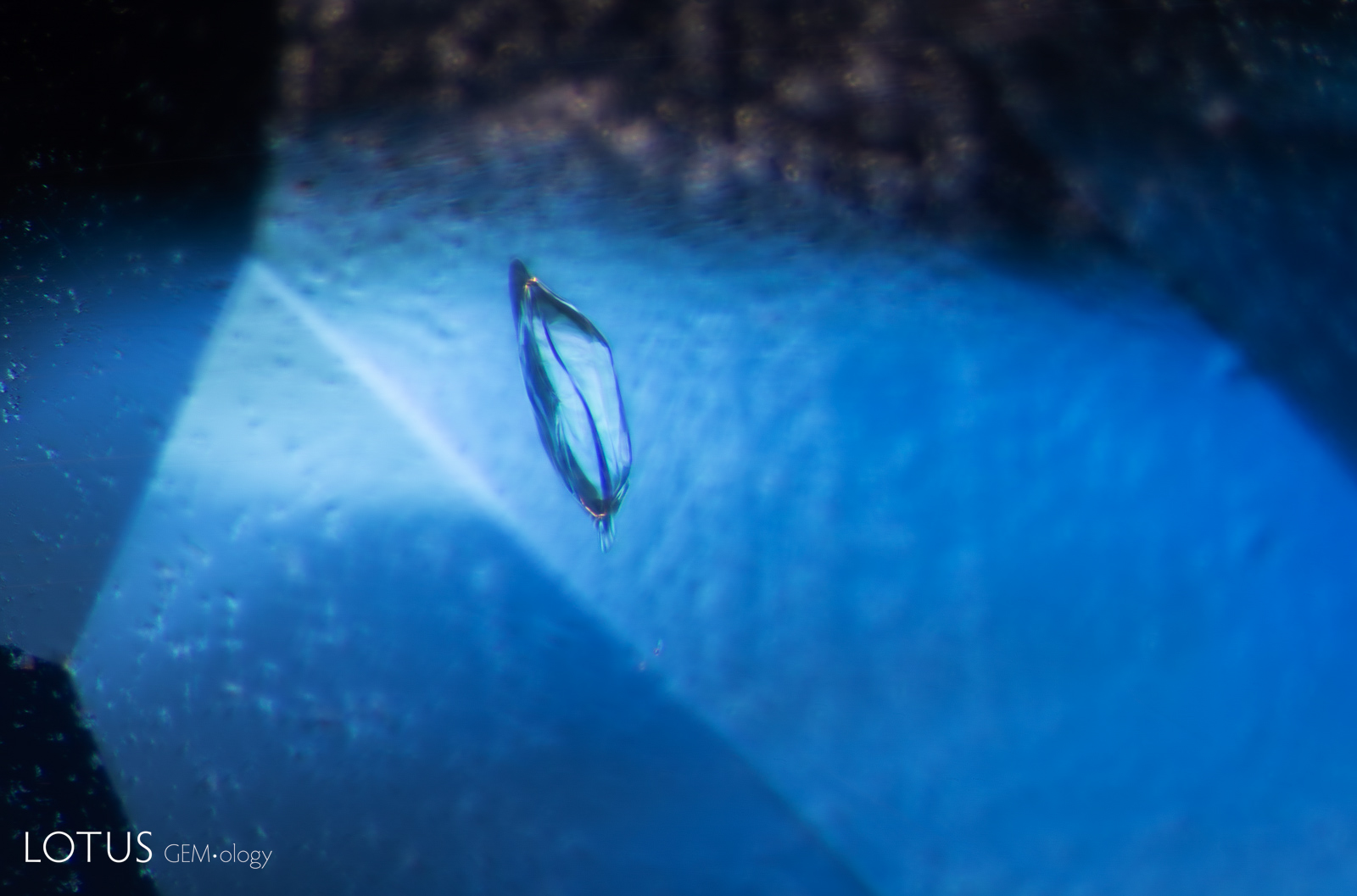
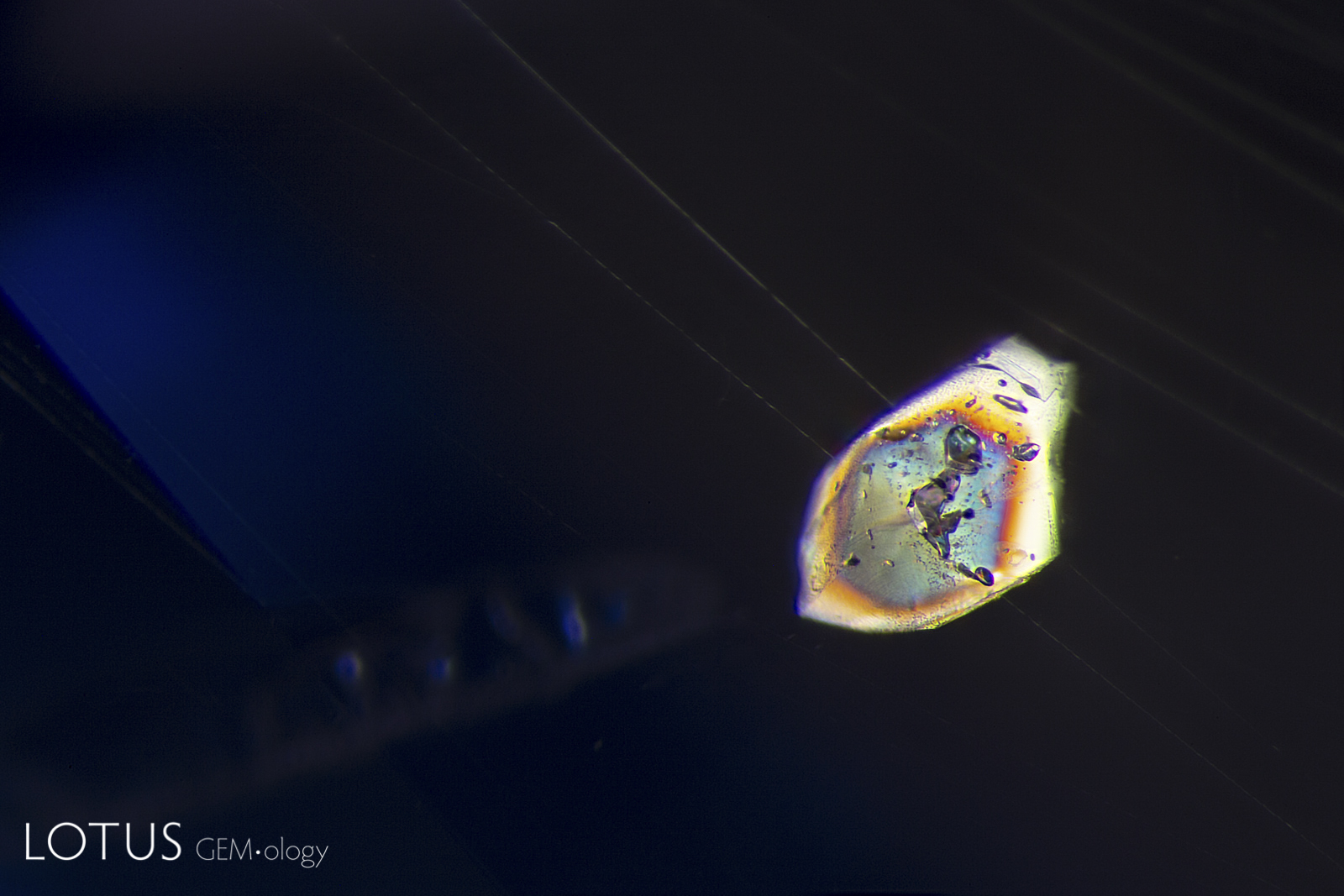
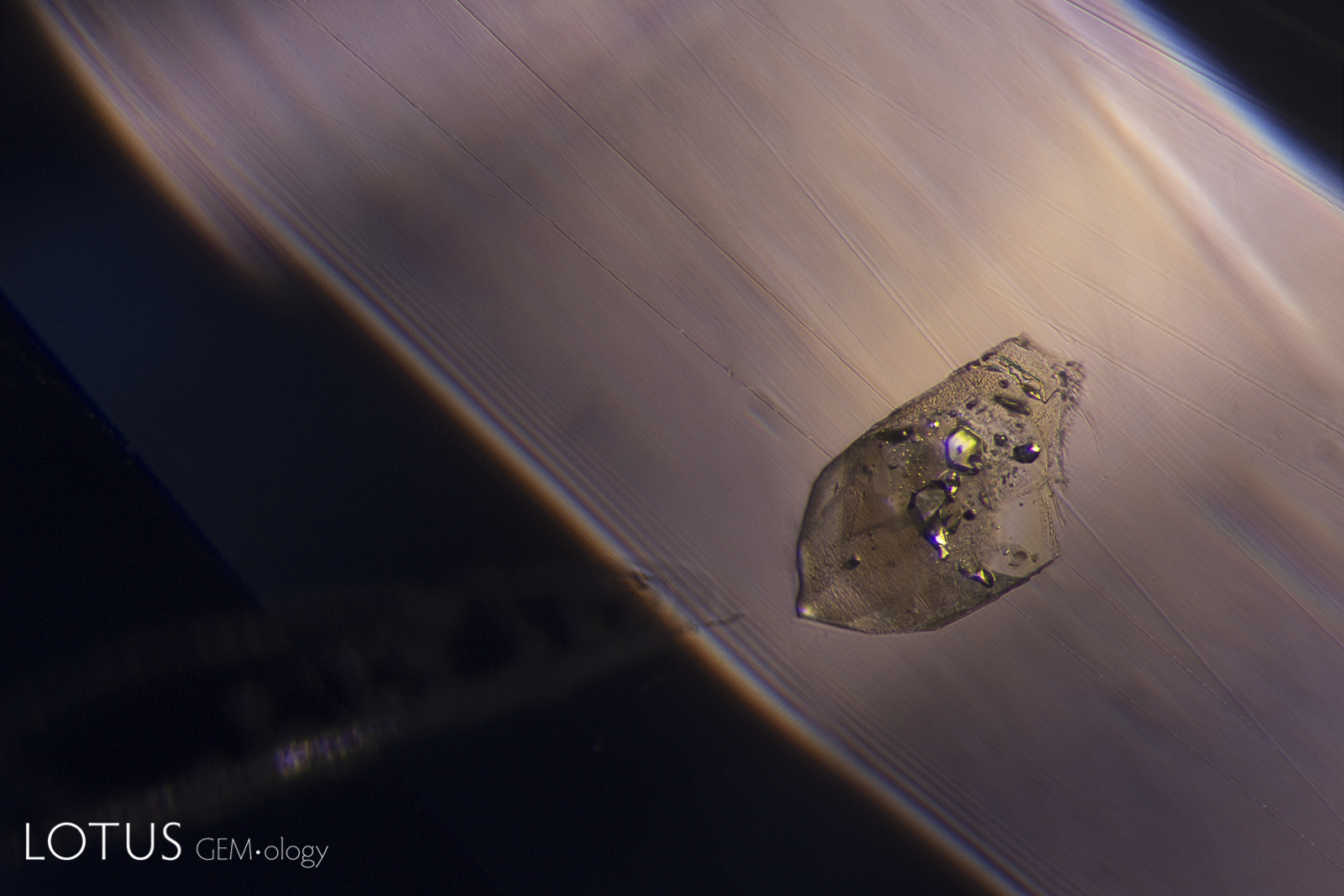
This teardrop-shaped anorthite feldspar crystal was found in a sapphire from Madagascar. The same stone also contained orange crystals of baddeleyite.
Natural Sapphire •
Madagascar •
Enhancements:
None Detected (None) •
Lighting Conditions:
Light Field + Oblique Fiber Optic
Photographer:
E. Billie Hughes •
Image Number:
A-003-6073-1
This heat-treated blue sapphire from Sri Lanka featured a corundum crystal included in the sapphire that was cut through on the surface. When viewed between crossed polars, the corundum crystal is brilliantly silhouetted against a dark background.
Natural Sapphire •
Sri Lanka (Ceylon) •
Enhancements:
Heat (H) •
Lighting Conditions:
Diffuse Light Field + Crossed Polars
Photographer:
Richard W. Hughes •
Image Number:
A-003-5747-2
• Field of View = 2mm
This heat-treated blue sapphire from Sri Lanka featured a corundum crystal included in the sapphire that was cut through on the surface.
Natural Sapphire •
Sri Lanka (Ceylon) •
Enhancements:
Heat (H) •
Lighting Conditions:
Light Field + Shadowing
Photographer:
Richard W. Hughes •
Image Number:
A-003-5747-1
• Field of View = 2mm
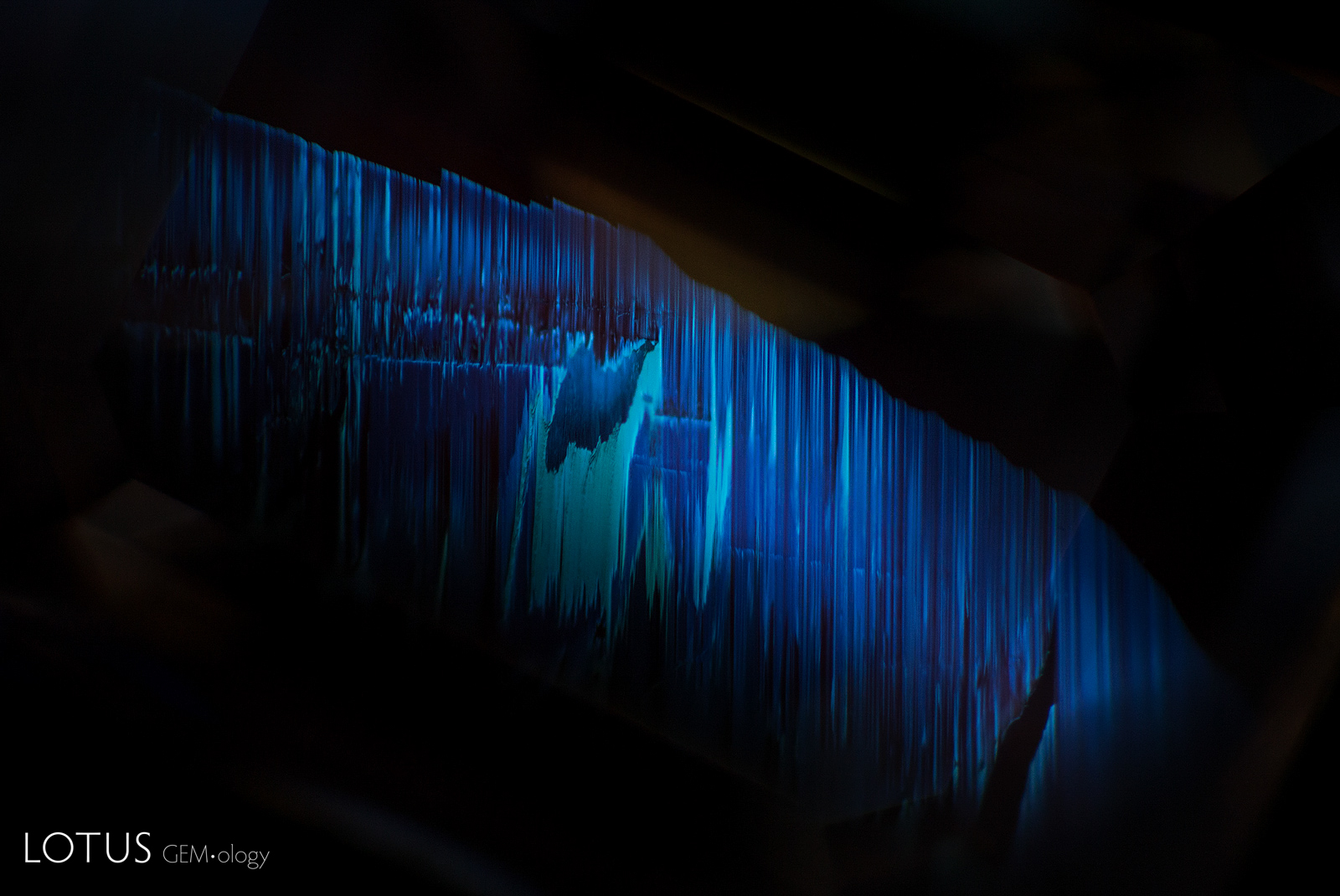
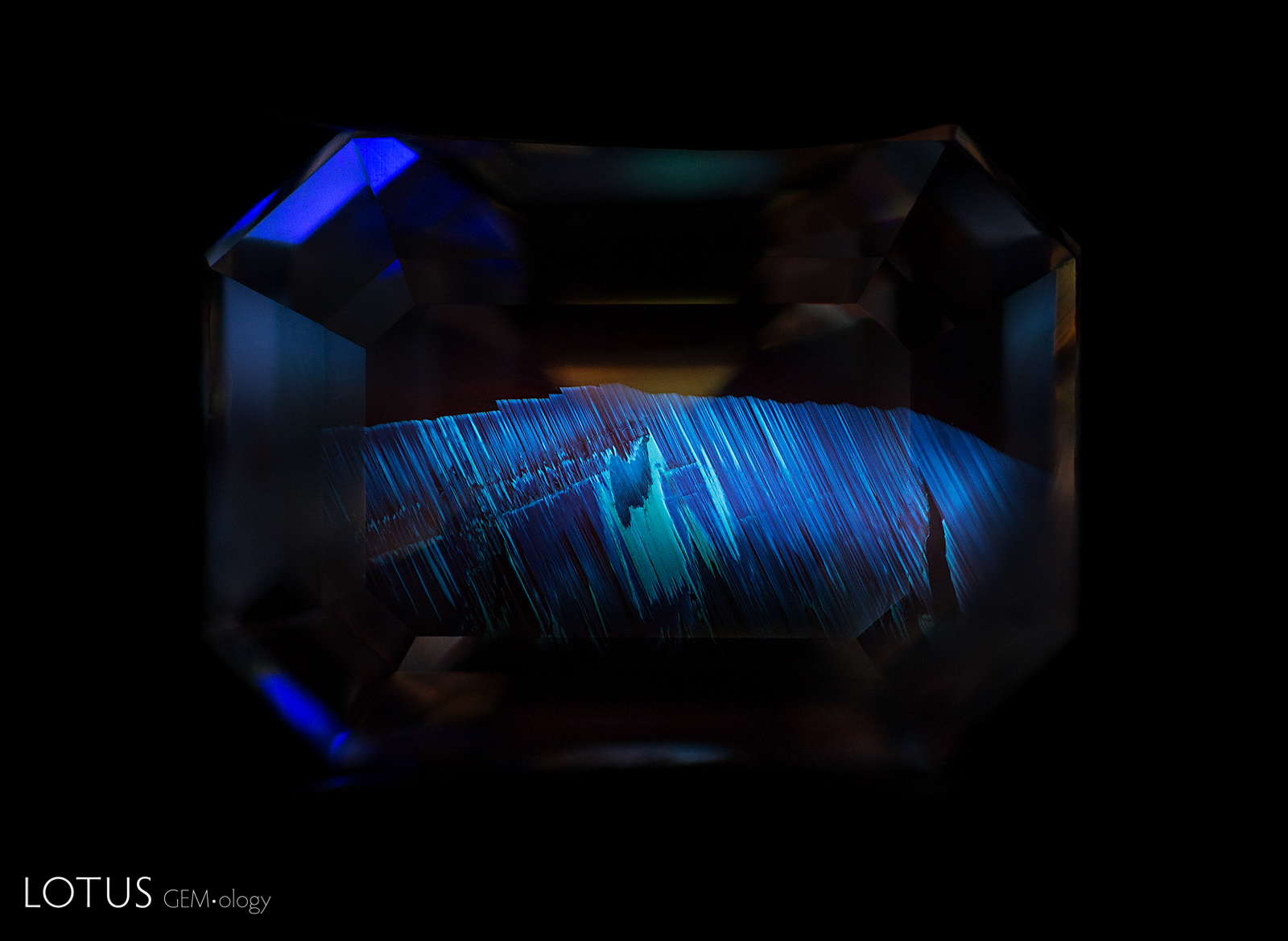
When viewed in shortwave UV illumination, chalky angular zoned clouds of particles become evident. This is a clear sign of heat treatment.
Natural Sapphire •
Sri Lanka (Ceylon) •
Enhancements:
Heat (H) •
Lighting Conditions:
Ultraviolet: Shortwave
Photographer:
E. Billie Hughes •
Image Number:
A-003-5760-3
When viewed in shortwave UV illumination, chalky angular zoned clouds of particles become evident. This is a clear sign of heat treatment.
Natural Sapphire •
Sri Lanka (Ceylon) •
Enhancements:
Heat (H) •
Lighting Conditions:
Ultraviolet: Shortwave
Photographer:
E. Billie Hughes •
Image Number:
A-003-5760-2
When viewed in shortwave UV illumination, chalky angular zoned clouds of particles become evident. This is a clear sign of heat treatment.
Natural Sapphire •
Sri Lanka (Ceylon) •
Enhancements:
Heat (H) •
Lighting Conditions:
Ultraviolet: Shortwave
Photographer:
E. Billie Hughes •
Image Number:
A-003-5760-1
A euhedral apatite crystal floats within the milky depths of a sapphire from Madagascar. The apatite was identified by micro Raman. Note the fine texture and sharp growth zoning, both of which are hallmarks of many Madagascar sapphires.
Natural Sapphire •
Madagascar •
Enhancements:
None Detected (None) •
Lighting Conditions:
Dark Field + Diffuse Fiber Optic
Photographer:
Richard W. Hughes •
Image Number:
A-003-5654-1
• Field of View = 3mm
Search the Complete Hyperion Database
Sapphire inclusions may include mineral crystals, rutile silk, healed fissures, fluid inclusions, negative crystals, color zoning and other features formed during or after crystal growth. Such features are important to gemologists because they can provide evidence useful in identifying sapphire, understanding its geological history, recognizing treatment and, in some cases, determining geographic origin.
Sapphire Inclusion Photomicrographs
The Hyperion sapphire gallery includes microscopic features found in sapphires from major deposits around the world. Each entry is accompanied by descriptive information and, where available, references to the gemological literature.
What Inclusions Can Reveal About Sapphire
Inclusions are an important part of sapphire identification. Their form, composition, orientation and alteration can help gemologists distinguish natural sapphire from synthetic material, recognize evidence of heat treatment, and study the geological environment in which the sapphire formed.
Hyperion combines inclusion photomicrography with supporting gemological information so that individual features can be compared with documented examples from known sapphire deposits.
About Hyperion
Hyperion is the Lotus Gemology searchable inclusion database. It allows users to browse gemstone inclusions by gem type, geographic origin, treatment and keyword.