Spinel Inclusions
Explore spinel inclusions in Hyperion, the Lotus Gemology inclusion database. Hyperion contains photomicrographs of inclusions and internal features in natural spinel, documented with information on geographic origin, treatment, lighting conditions, field of view, photographer and published references.
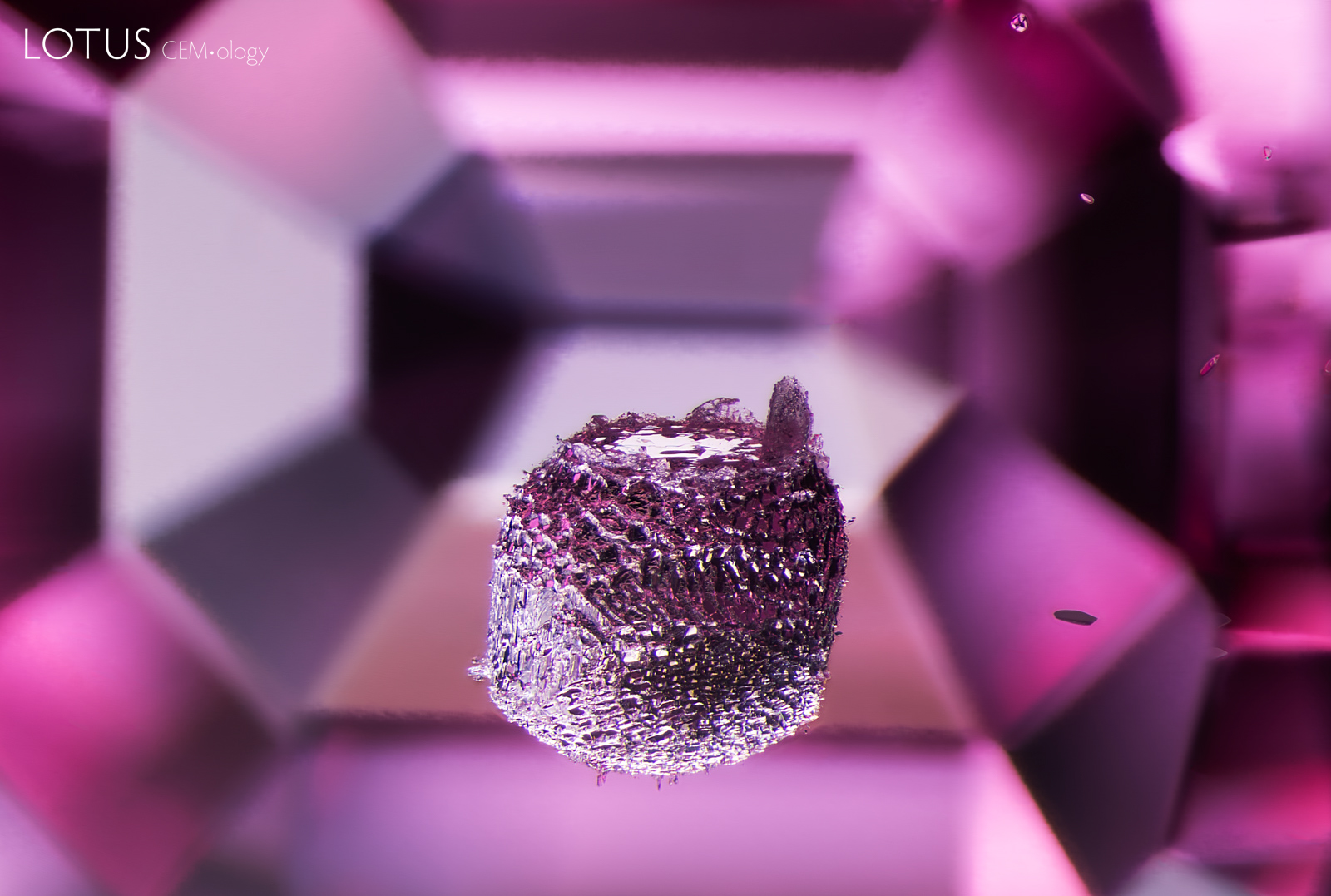
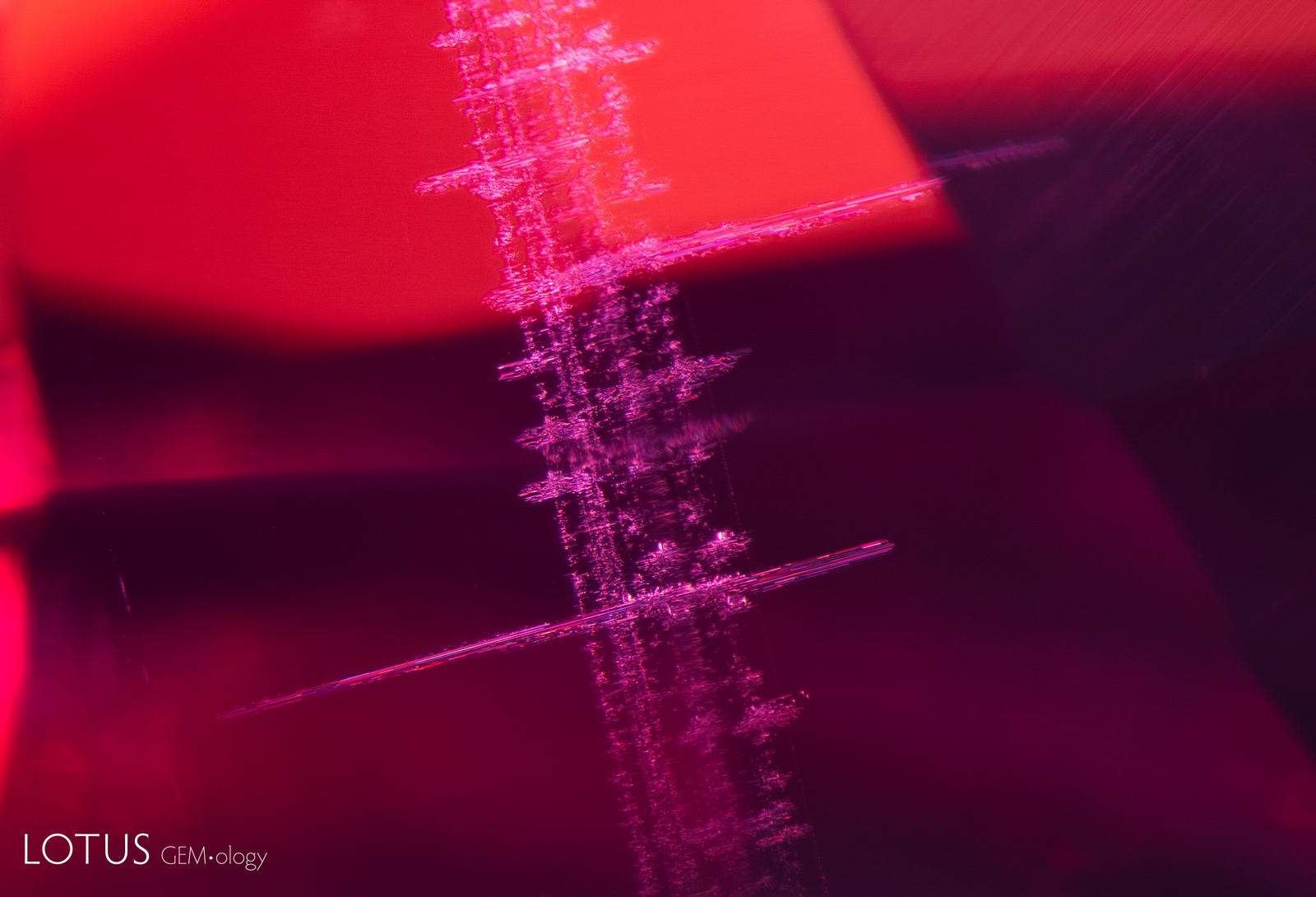
A strikingly textured crystal, likely metal sulfide, is beautifully suspended within this spinel. Sample courtesy Pamir Gems.
Natural Spinel •
Not Determinable •
Enhancements:
None Detected (None) •
Lighting Conditions:
Dark Field + Diffuse Fiber Optic
Photographer:
E. Billie Hughes •
Image Number:
R-005-5843-1
• Field of View = 3.4mm
Hughes, E.B., Koivula, J.I., Manorotkul, W., Renfro, N. and Hughes, R.W. (2019) Spinel inclusions: An exercise in aesthetics. InColor, No. 43, pp. 48–55; RWHL*.
Gübelin, E.J. and Koivula, J.I. (2005) Photoatlas of Inclusions in Gemstones, Volume 2. Basel, Switzerland, Opinio Publishers, 830 pp.; RWHL*.
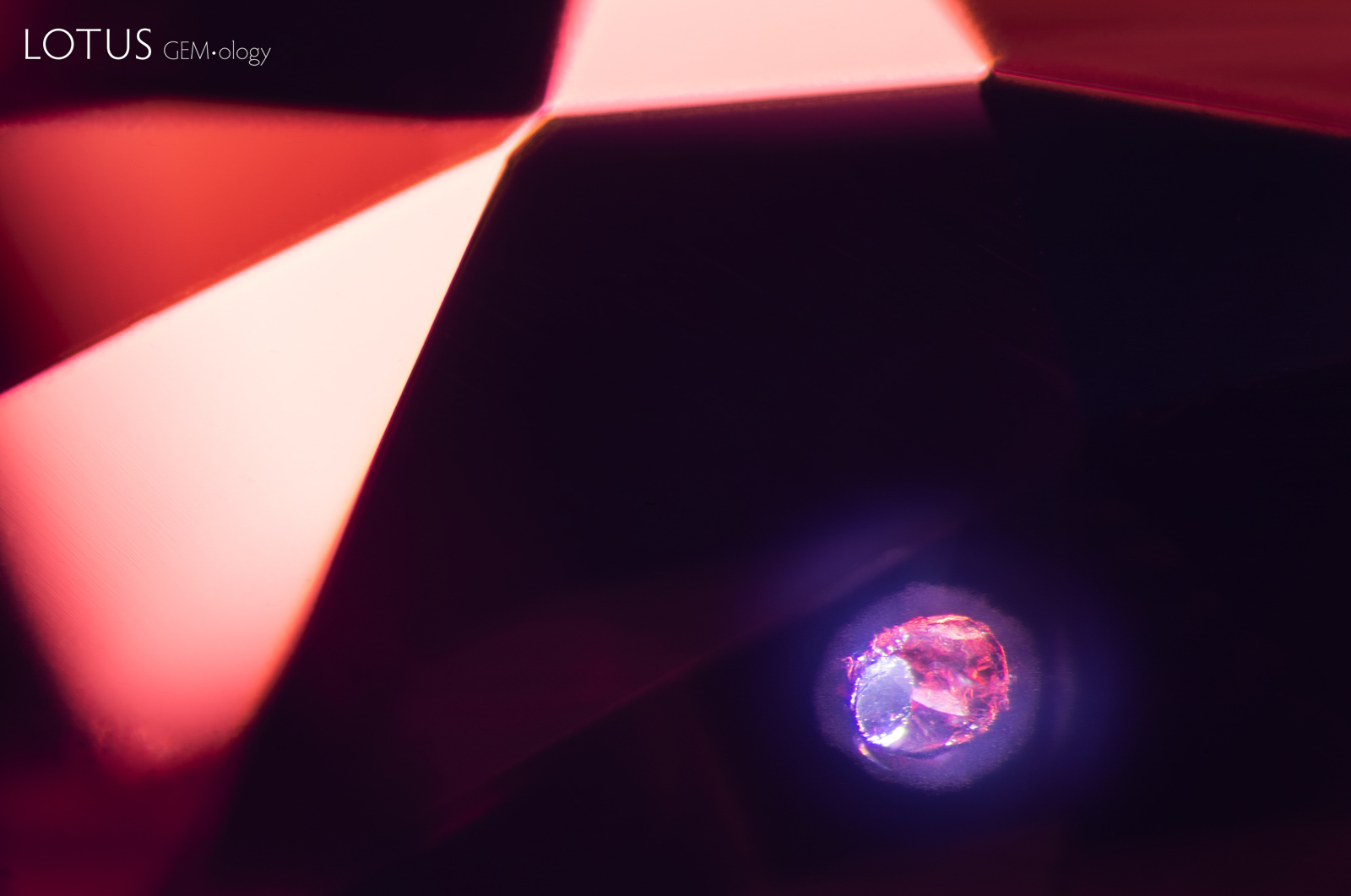
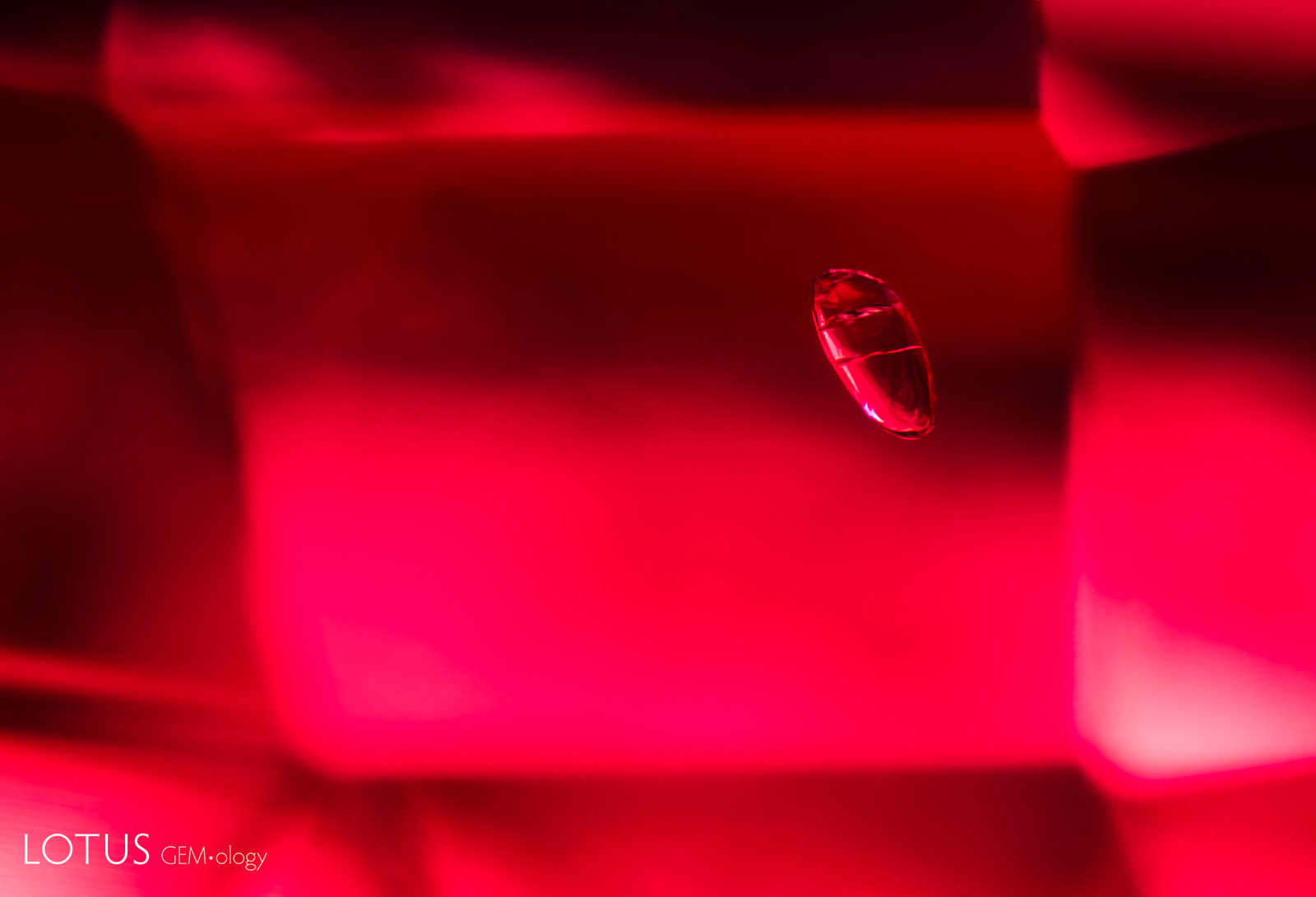
This spinel contains a rounded forsterite crystal (identified with micro Raman), surrounded by two layered halos of fine, milky particles.
Natural Spinel •
Not Determinable •
Enhancements:
None Detected (None) •
Lighting Conditions:
Dark Field + Diffuse Fiber Optic
Photographer:
E. Billie Hughes •
Image Number:
A-005-5515-2
• Field of View = 2.2mm
Hughes, E.B., Koivula, J.I., Manorotkul, W., Renfro, N. and Hughes, R.W. (2019) Spinel inclusions: An exercise in aesthetics. InColor, No. 43, pp. 48–55; RWHL*.
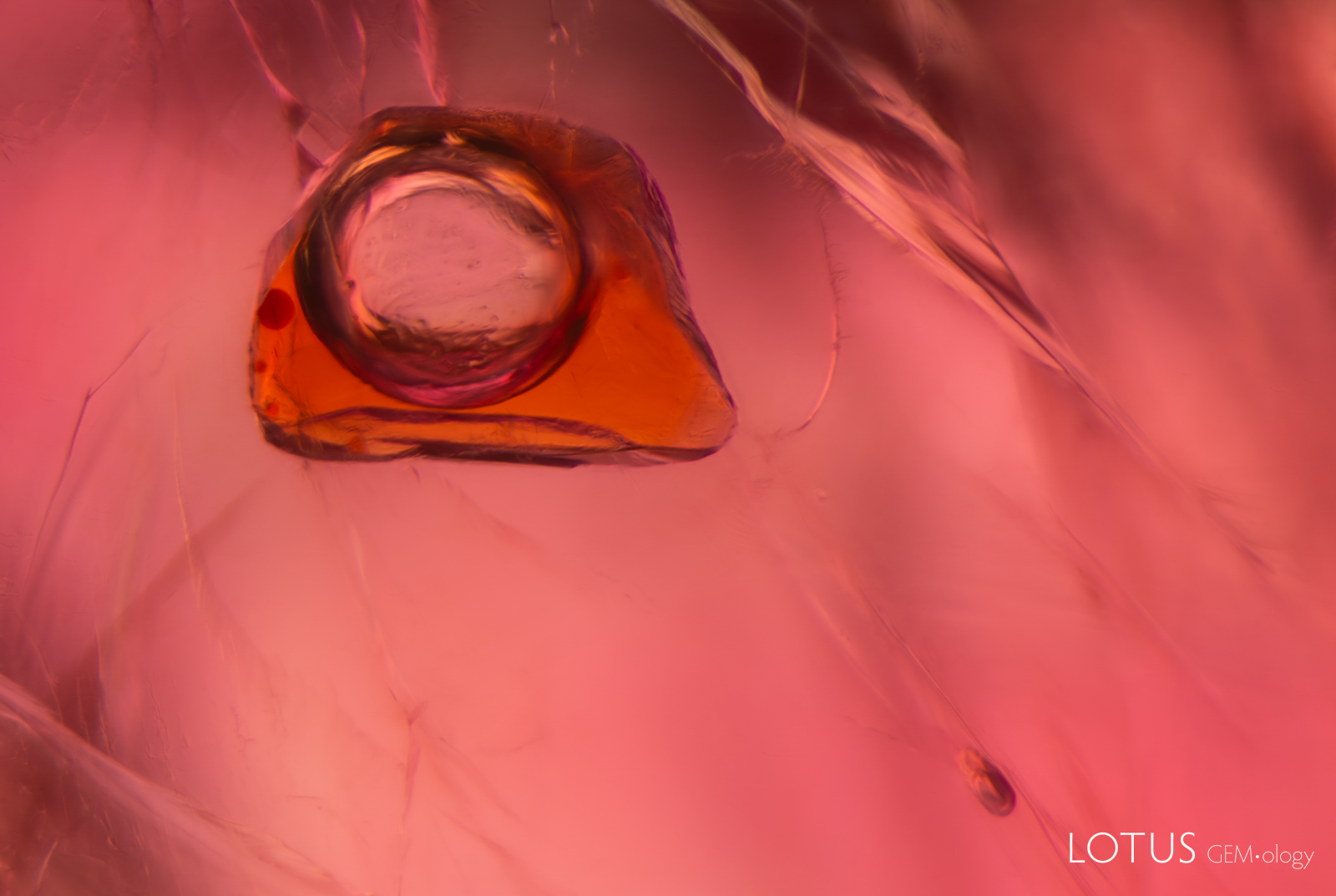
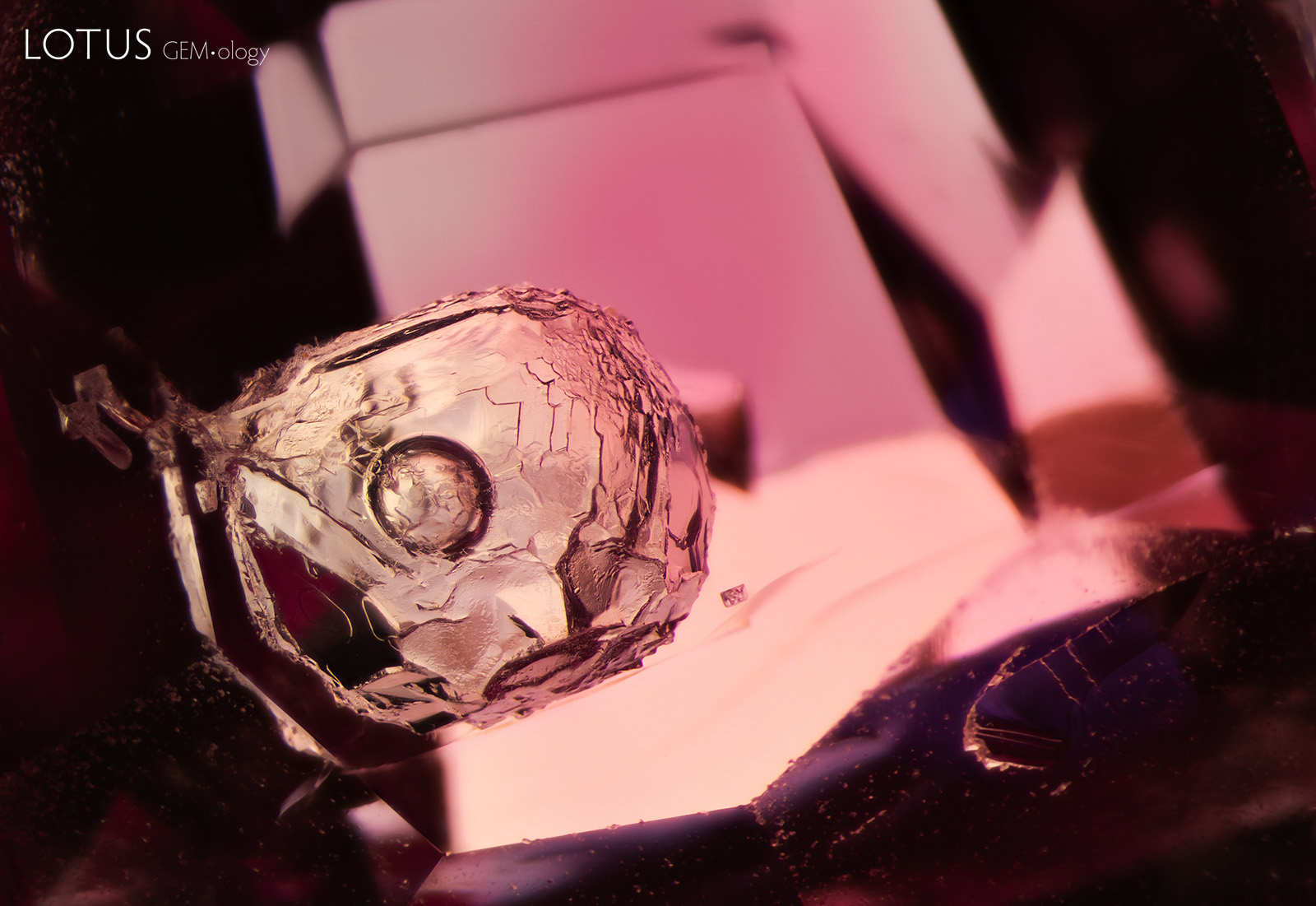
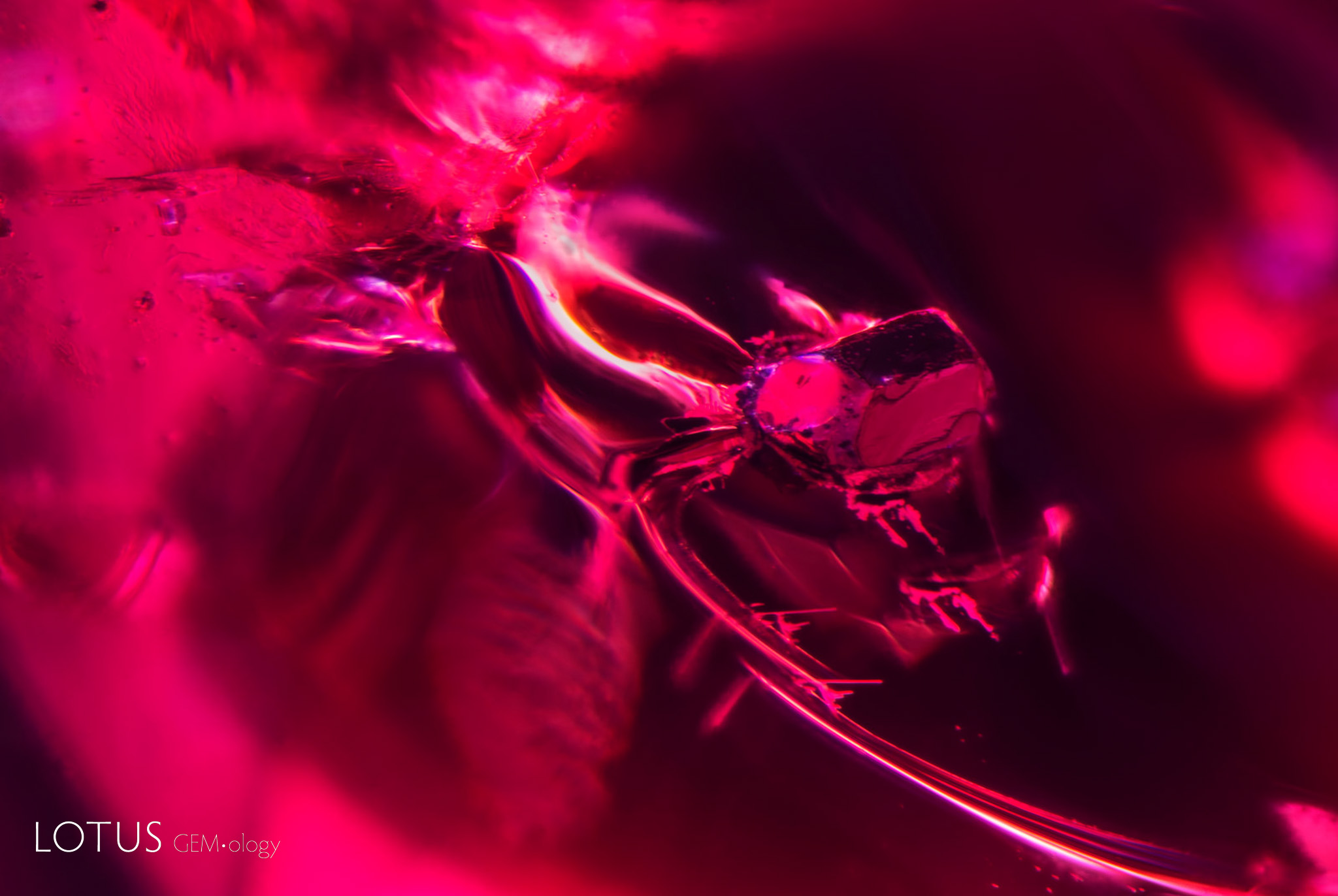
This negative crystal is filled with a yellowish orange liquid and contains a gas bubble at its center. These fluid inclusions, likely sulfur-rich liquids, are typically observed in Burmese spinels.
Natural Spinel •
Myanmar (Burma); Mogok/Namya •
Enhancements:
None Detected (None) •
Lighting Conditions:
Diffuse Light Field (Transmitted Light)
Photographer:
Pimmada Rojtanat •
Image Number:
R-005-4726-3
• Field of View = 2.6mm
Hughes, E.B., Koivula, J.I., Manorotkul, W., Renfro, N. and Hughes, R.W. (2019) Spinel inclusions: An exercise in aesthetics. InColor, No. 43, pp. 48–55; RWHL*.
Vertriest, W. and Raynaud, V. (2017) Complex yellow fluid inclusions in red Burmese spinel. Gems & Gemology, Vol. 53, No. 4, Winter, p. 468; RWHL*.
Peretti, A., Mullis, J., Franz, L., de Capitani, C., Mathys, D., and Günther, D. (2017) Spinel formation by sulfur-rich saline brines from Mansin (Mogok area, Myanmar). 15th Swiss Geoscience Meeting, Davis, Switzerland.
Dislocations in this spinel mimic the appearance of barbed wire.
Natural Spinel •
Sri Lanka (Ceylon) •
Enhancements:
None Detected (None) •
Lighting Conditions:
Dark Field
Photographer:
E. Billie Hughes •
Image Number:
A-005-3418-1
• Field of View = 5.4mm
Hughes, E.B., Koivula, J.I., Manorotkul, W., Renfro, N. and Hughes, R.W. (2019) Spinel inclusions: An exercise in aesthetics. InColor, No. 43, pp. 48–55; RWHL*.
A gas bubble floats inside this cavity in a spinel from Burma. To date, we have not been able to verify whether this is a natural or man-made feature. Specimen courtesy Gil Yuda.
Natural Spinel •
No Origin •
Enhancements:
() •
Lighting Conditions:
Diffuse Light Field (Transmitted Light)
Photographer:
E. Billie Hughes •
Image Number:
R-005-2683-1
• Field of View = 3.5mm
Hughes, E.B., Koivula, J.I., Manorotkul, W., Renfro, N. and Hughes, R.W. (2019) Spinel inclusions: An exercise in aesthetics. InColor, No. 43, pp. 48–55; RWHL*.
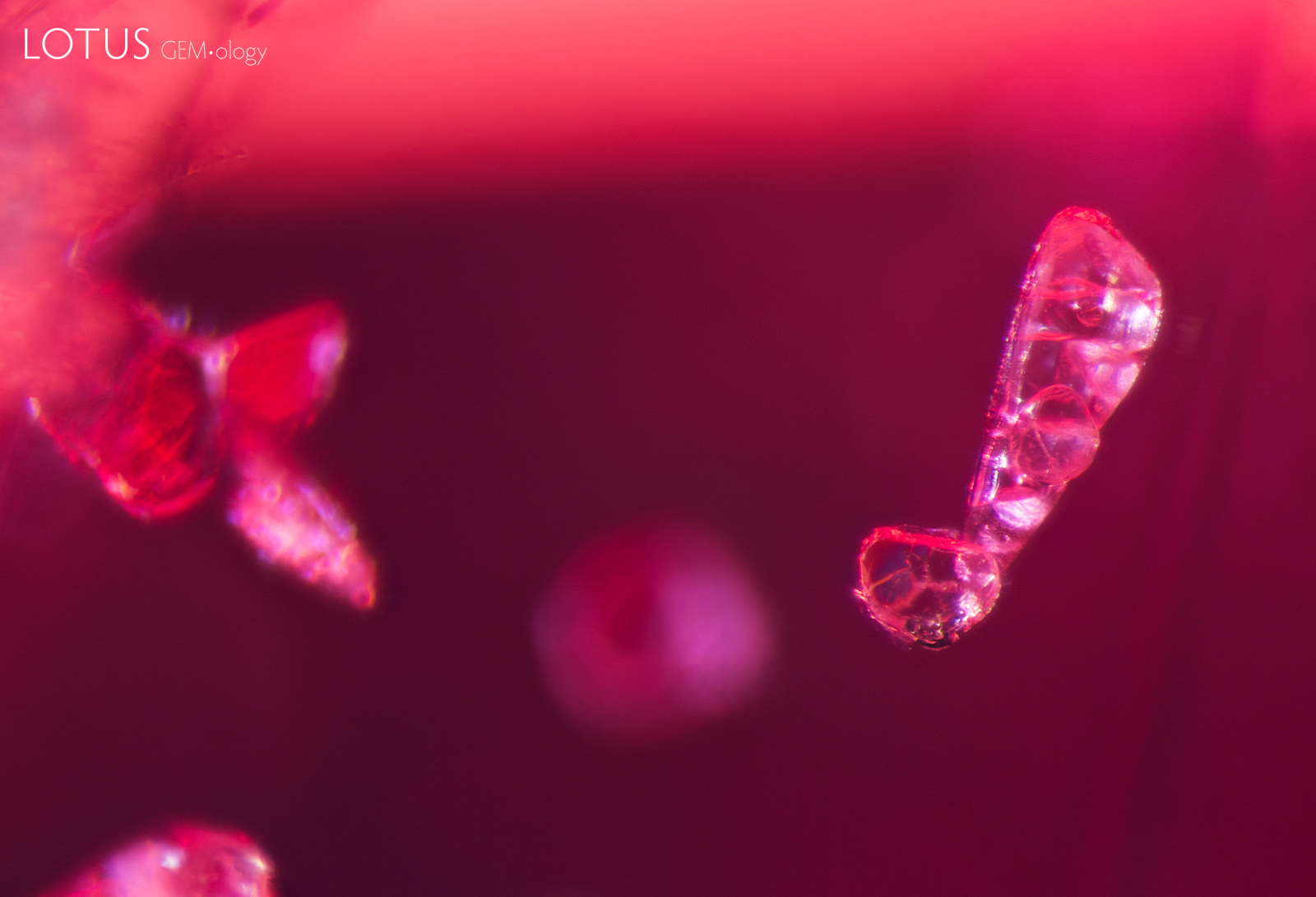
These exclamation mark-shaped crystals make a strong statement in their spinel host. They were identified as dolomite using Raman spectroscopy.
Natural Spinel •
Tanzania •
Enhancements:
None Detected (None) •
Lighting Conditions:
Dark Field + Diffuse Fiber Optic
Photographer:
E. Billie Hughes •
Image Number:
A-005-2208-1
• Field of View = 1.5mm
Hughes, E.B., Koivula, J.I., Manorotkul, W., Renfro, N. and Hughes, R.W. (2019) Spinel inclusions: An exercise in aesthetics. InColor, No. 43, pp. 48–55; RWHL*.
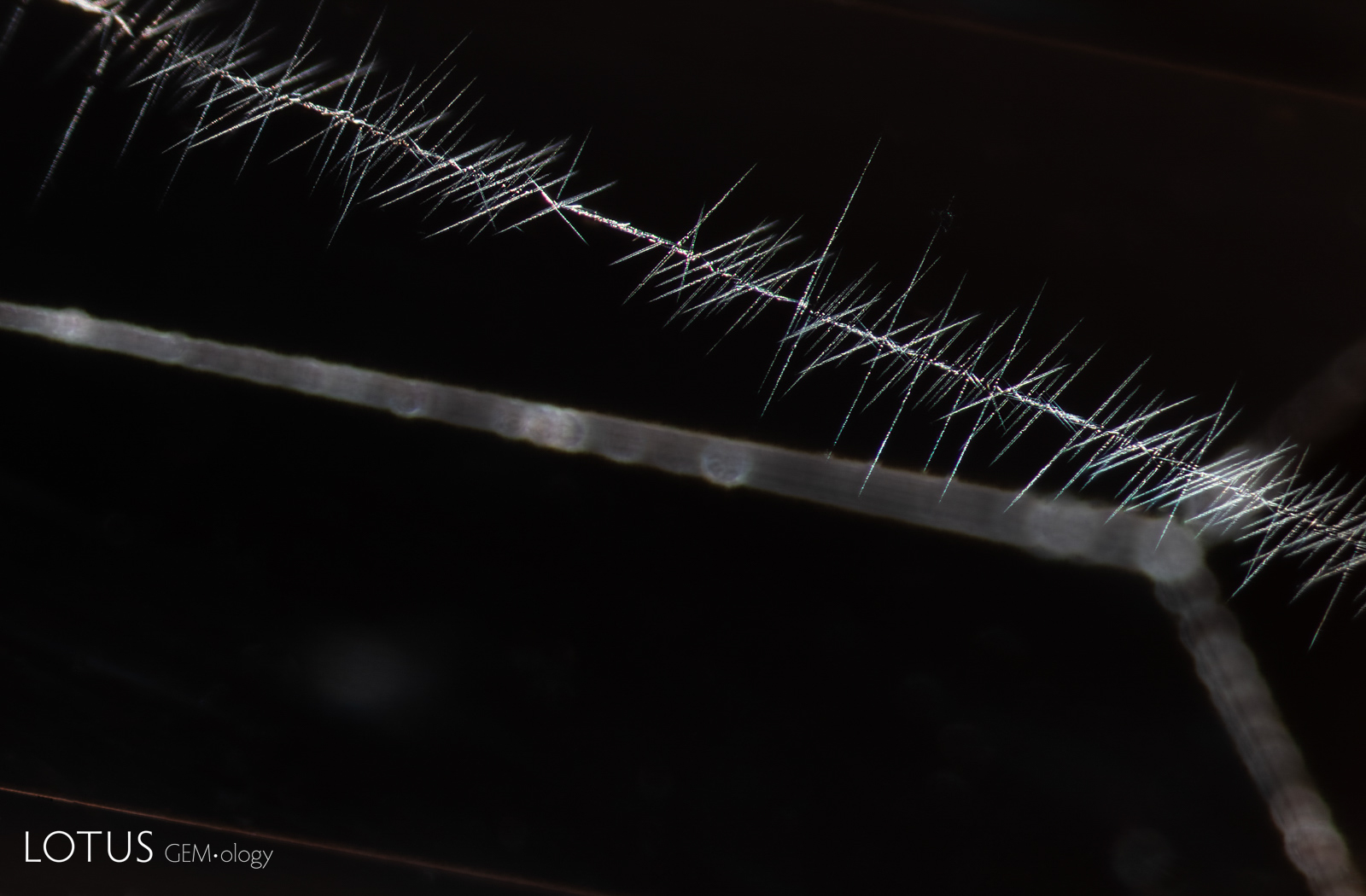
Fine dislocation needles, as pictured here, are frequently seen in spinels from Vietnam.
Natural Spinel •
Vietnam •
Enhancements:
None Detected (None) •
Lighting Conditions:
Dark Field + Diffuse Fiber Optic
Photographer:
E. Billie Hughes •
Image Number:
A-005-2207-1
• Field of View = 2.4mm
Hughes, E.B., Koivula, J.I., Manorotkul, W., Renfro, N. and Hughes, R.W. (2019) Spinel inclusions: An exercise in aesthetics. InColor, No. 43, pp. 48–55; RWHL*.
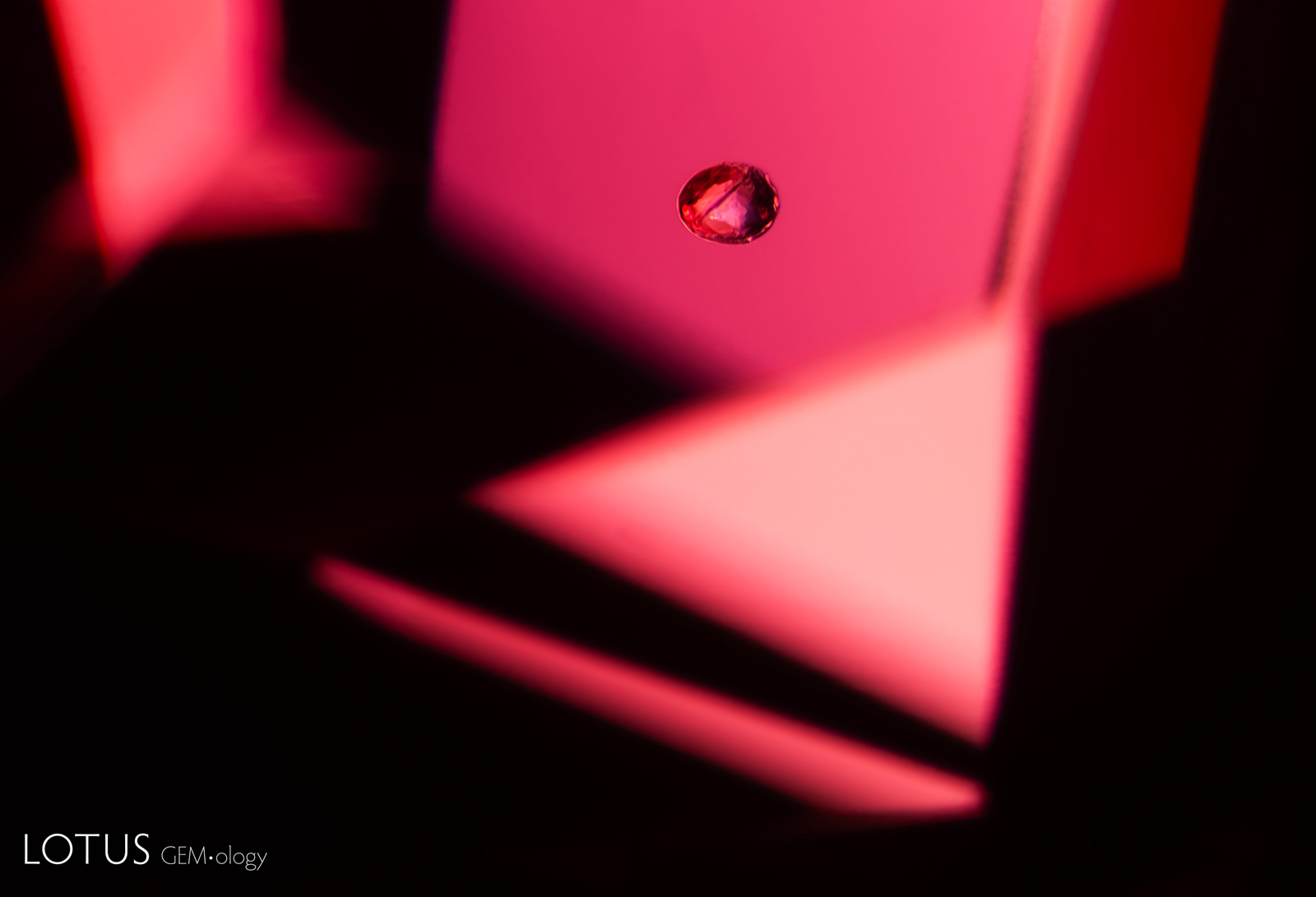
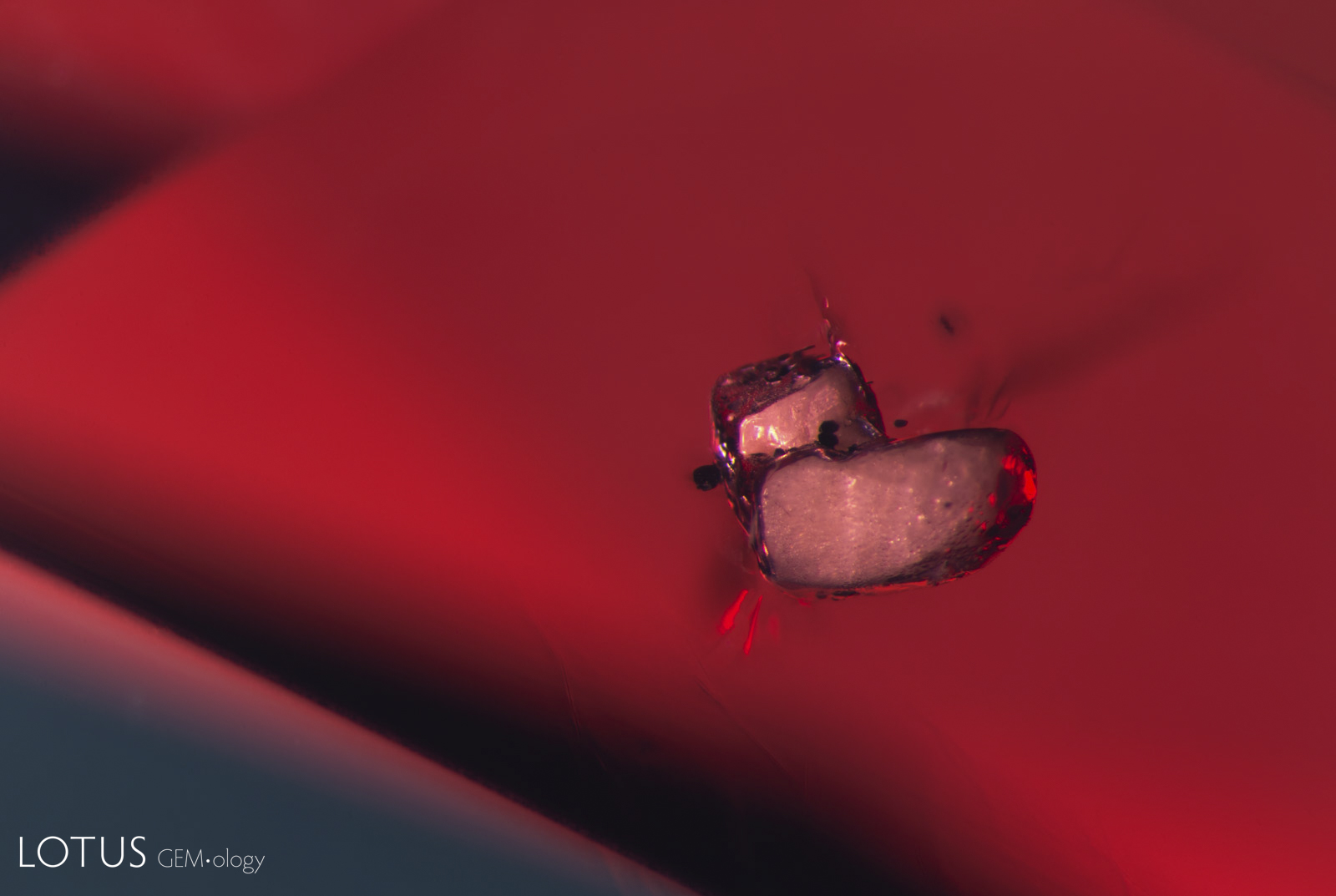
A small, rounded crystal can be seen suspended in this spinel. Analysis with micro Raman identified it as a dolomite.
Natural Spinel •
Tanzania •
Enhancements:
None Detected (None) •
Lighting Conditions:
Dark Field + Diffuse Fiber Optic
Photographer:
E. Billie Hughes •
Image Number:
A-005-1710-1
• Field of View = 2.7mm
Hughes, E.B., Koivula, J.I., Manorotkul, W., Renfro, N. and Hughes, R.W. (2019) Spinel inclusions: An exercise in aesthetics. InColor, No. 43, pp. 48–55; RWHL*.
257 Total Images
Results: 25 – 36 | Page 3 of 22 Pages
Search the Complete Hyperion Database
Spinel inclusions may include mineral crystals, healed fissures, fluid inclusions, negative crystals, growth features and other internal features formed during or after crystal growth. Such features are important to gemologists because they can provide evidence useful in identifying spinel, understanding its geological history, recognizing treatment and, in some cases, determining geographic origin.
Spinel Inclusion Photomicrographs
The Hyperion spinel gallery includes microscopic features found in spinels from major deposits around the world. Each entry is accompanied by descriptive information and, where available, references to the gemological literature.
What Inclusions Can Reveal About Spinel
Inclusions are an important part of spinel identification. Their form, composition and alteration can help gemologists distinguish natural spinel from synthetic material, recognize evidence of treatment, and study the geological environment in which the spinel formed.
Hyperion combines inclusion photomicrography with supporting gemological information so that individual features can be compared with documented examples from known spinel deposits.
About Hyperion
Hyperion is the Lotus Gemology searchable inclusion database. It allows users to browse gemstone inclusions by gem type, geographic origin, treatment and keyword.