Mozambique Ruby Inclusions
Explore Mozambique ruby inclusions in Hyperion, the Lotus Gemology inclusion database. Hyperion contains photomicrographs of inclusions and internal features in natural rubies from Mozambique, documented with information on treatment, lighting conditions, field of view, photographer and published references.
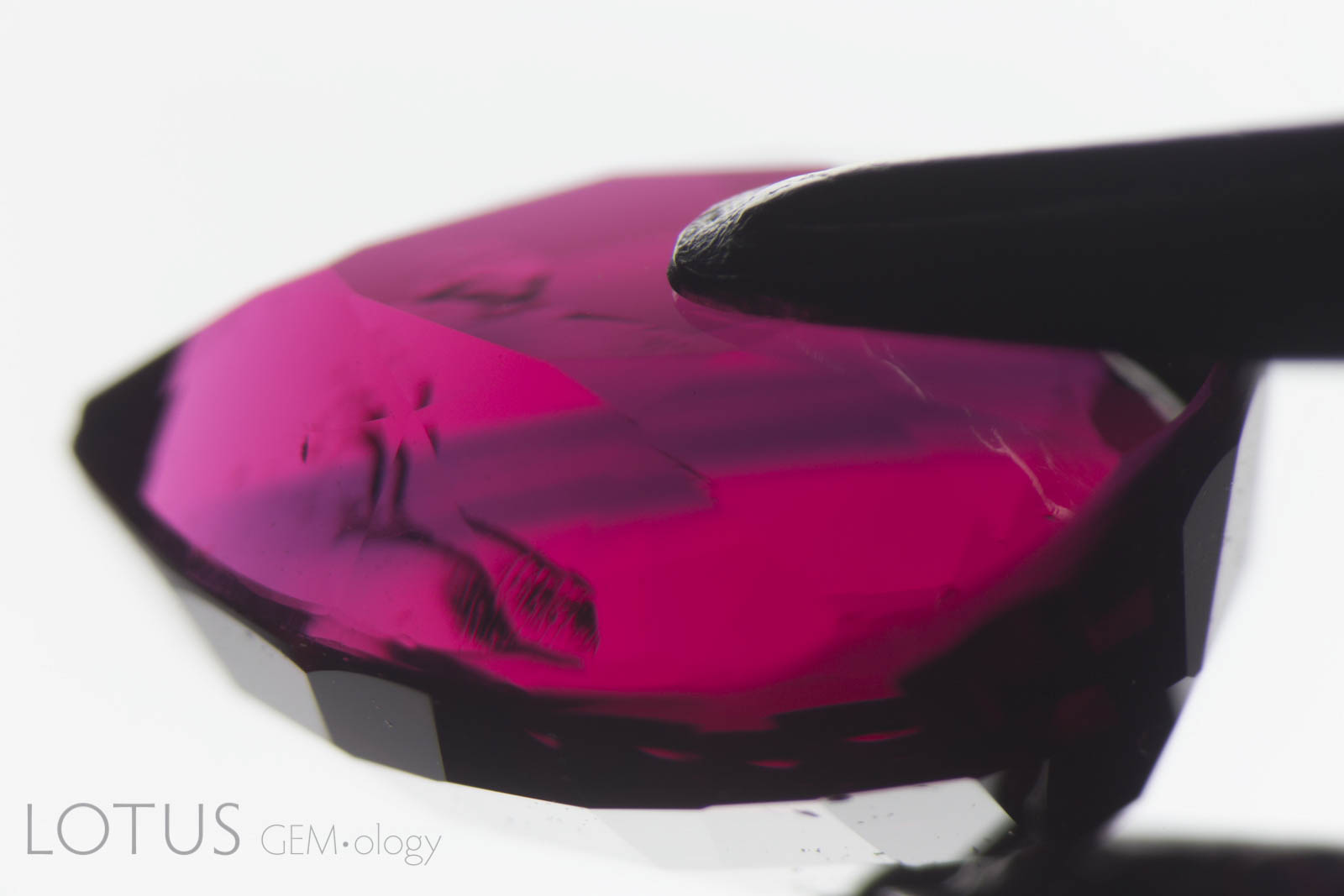
Although somewhat uncommon, vague blue color zones are sometimes found in Mozambique rubies. Dealers will often heat-treat such stones to remove the blue color.
Natural Ruby •
Mozambique •
Enhancements:
None Detected (None) •
Lighting Conditions:
Diffuse Light Field (Transmitted Light)
Photographer:
Richard W. Hughes •
Image Number:
A-001-0468-1
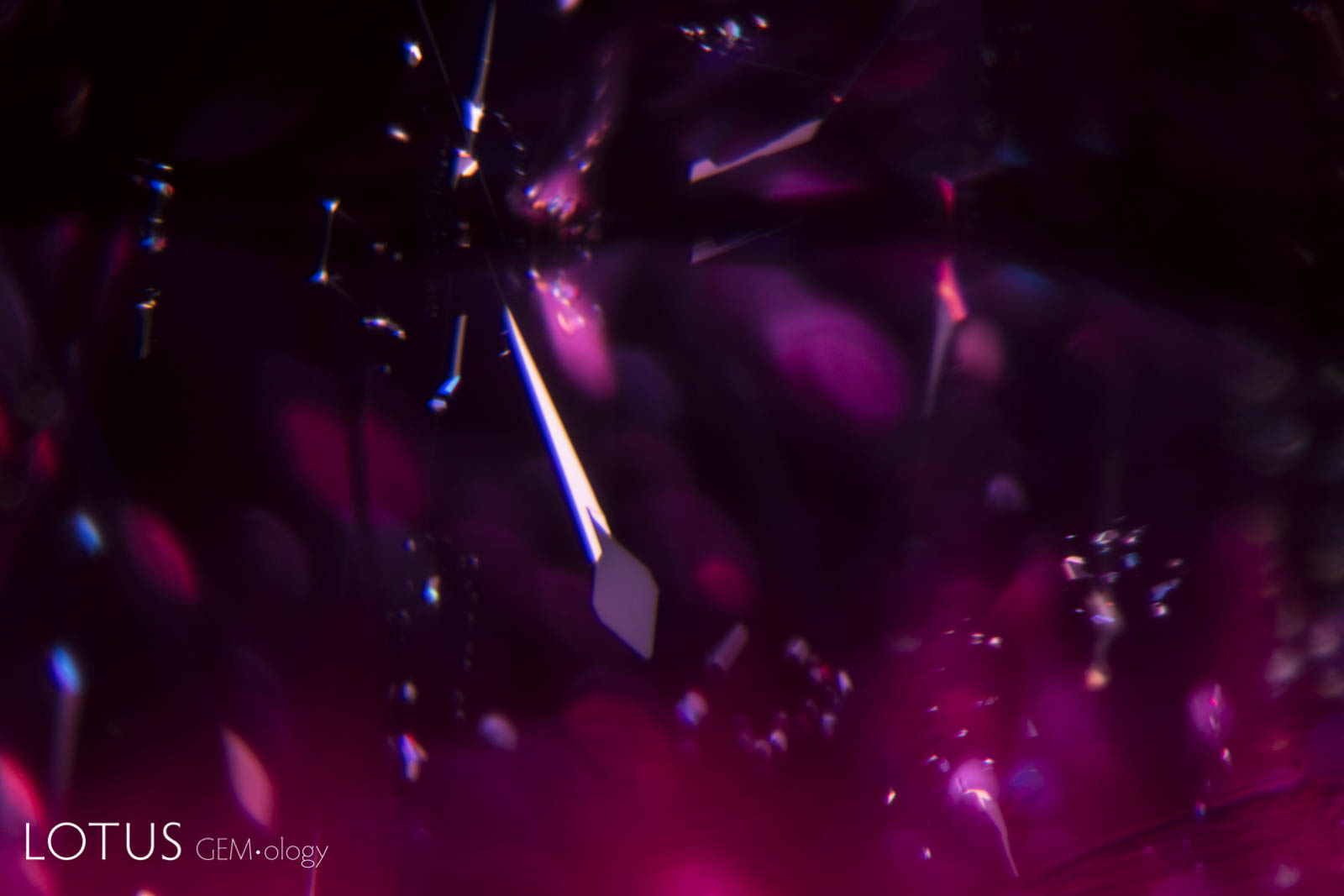
Dart-like exsolved rutile silk (high relief) with daughter crystals (lower relief) at the broad ends is a common feature of Mozambique rubies. Heat treatment often produces a breakdown of the daughter crystals, producing white spots or bubbles within the daughter.
Natural Ruby •
Mozambique •
Enhancements:
None Detected (None) •
Lighting Conditions:
Fiber Optic: Diffuse Overhead
Photographer:
Richard W. Hughes •
Image Number:
A-001-0464-1
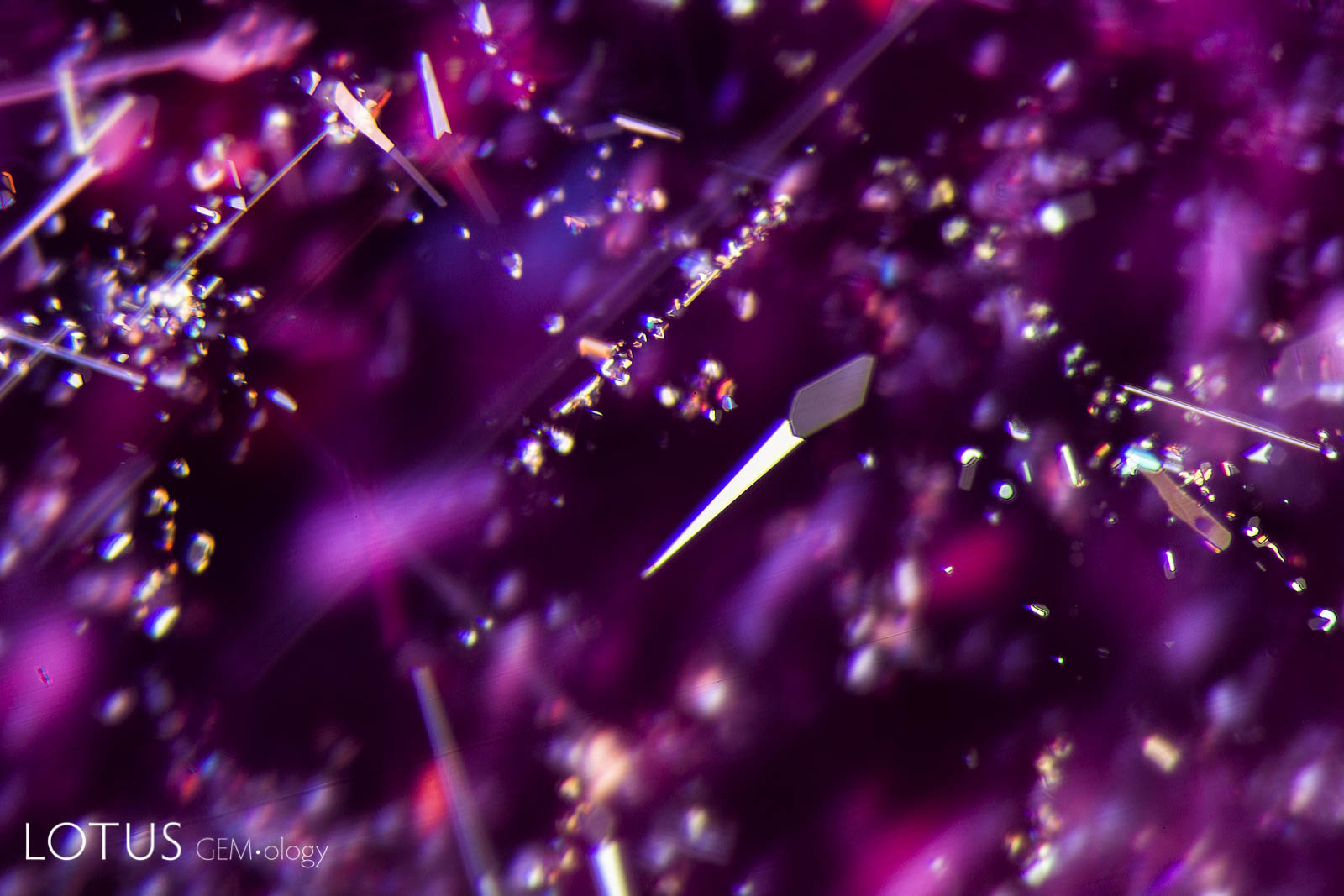
Rutile silk (high relief) with daughter crystals (lower relief) at the broad ends is a common feature of Mozambique rubies. Heat treatment often produces a breakdown of the daughter crystals, producing white spots or bubbles within the daughter.
Natural Ruby •
Mozambique •
Enhancements:
None Detected (None) •
Lighting Conditions:
Fiber Optic: Diffuse Overhead
Photographer:
Richard W. Hughes •
Image Number:
A-001-0411-1
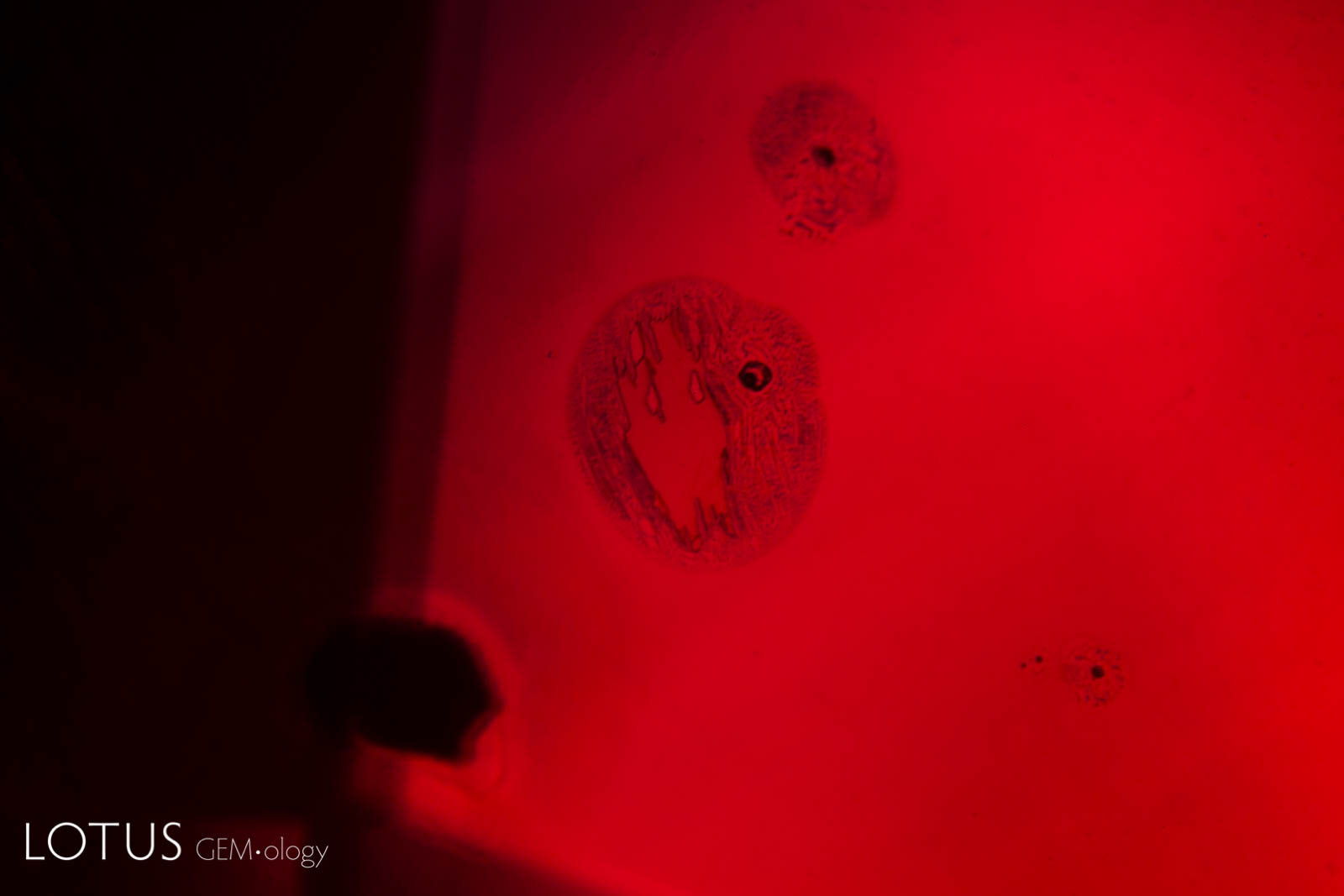
Some inclusions in Mozambique rubies are thermally sensitive. Here we find small crystals that have melted. The melted crystal (glass) occupies less volume than the original crystal, resulting in a frozen contraction bubble. A small fingerprint surrounds each melted crystal.
Natural Ruby •
Mozambique •
Enhancements:
Heat (H) •
Lighting Conditions:
Fiber Optic: Transmitted
Photographer:
Richard W. Hughes •
Image Number:
A-001-0443-1
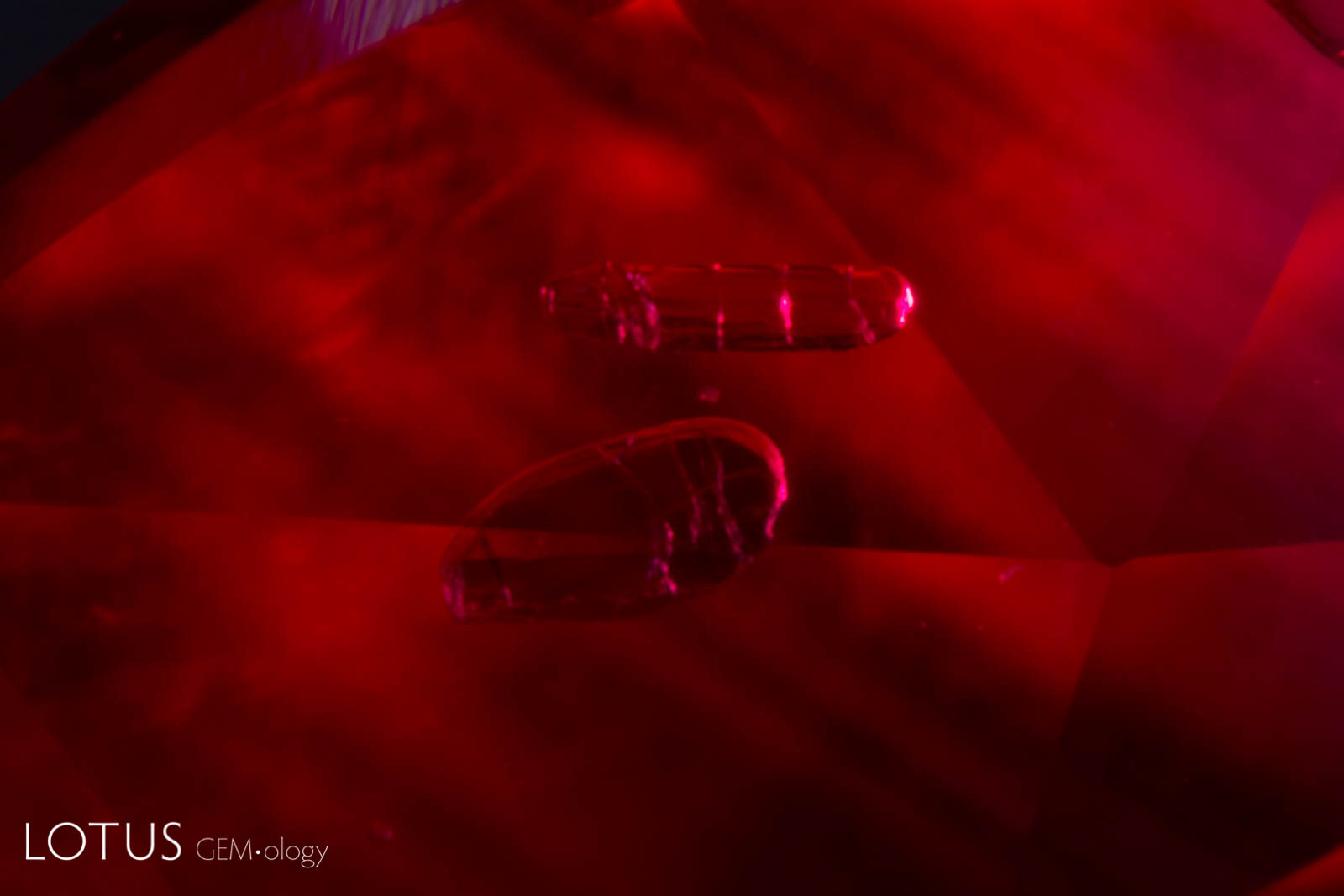
Amphibole rods are a common feature of Mozambique rubies, not surprising since the ruby formed in amphibolite (a metamorphic rock consisting mainly of amphiboles) matrix.
Natural Ruby •
Mozambique •
Enhancements:
None Detected (None) •
Lighting Conditions:
Dark Field
Photographer:
Richard W. Hughes •
Image Number:
A-001-0417-1
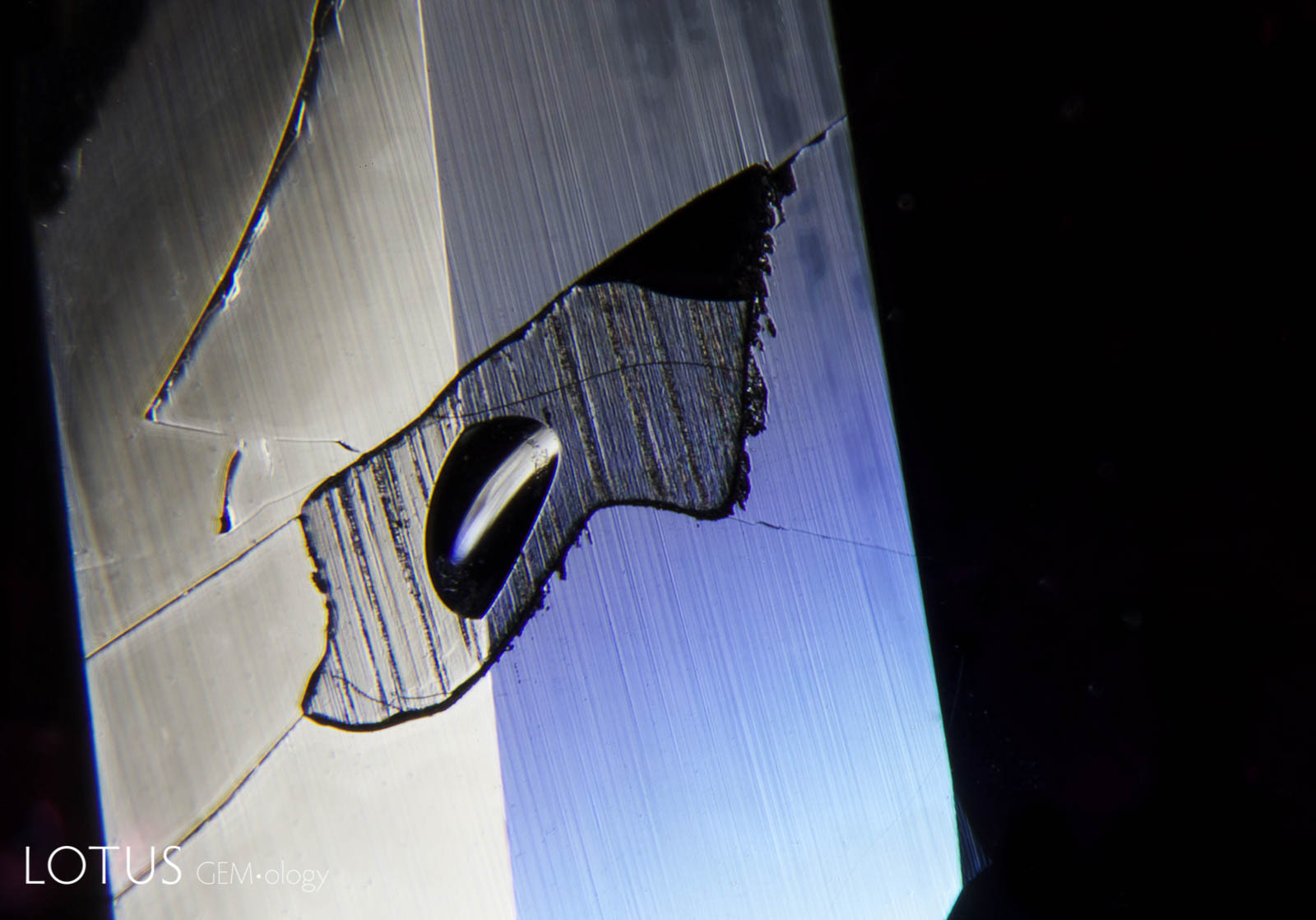
Glass filling in a surface-reaching cavity in a Mozambique ruby. Note the conchoidal fracture on the glass filling.
Natural Ruby •
Mozambique •
Enhancements:
Heat (H) •
Lighting Conditions:
Diffuse Overhead
Photographer:
E. Billie Hughes •
Image Number:
A-010-0250-1
Hughes, R.W. (1984) Repaired surfaces found on rubies. Jewellery News Asia, No. 6, pp. 1, 33; RWHL*.
Scarratt, K. (1984) Notes from the laboratory. Journal of Gemmology, Vol. 19, pp. 98–124; RWHL.
Search the Complete Hyperion Database
Mozambique ruby inclusions may include mineral crystals, rutile silk, healed fissures, fluid inclusions, negative crystals, growth features and other internal features formed during or after crystal growth. Such features are important to gemologists because they can provide evidence useful in identifying ruby and evaluating a possible Mozambique origin.
Mozambique Ruby Inclusion Photomicrographs
The Hyperion Mozambique ruby gallery includes microscopic features documented in rubies from Mozambique. Each entry is accompanied by descriptive information and, where available, references to the gemological literature.
What Inclusions Can Reveal About Mozambique Ruby
Inclusions are an important part of geographic origin determination in ruby. Their form, composition, orientation and associations can provide evidence that, when considered together with other gemological properties, may support or contradict a Mozambique origin.
Hyperion combines inclusion photomicrography with supporting gemological information so that individual features can be compared with documented examples from Mozambique rubies.
About Hyperion
Hyperion is the Lotus Gemology searchable inclusion database. It allows users to browse gemstone inclusions by gem type, geographic origin, treatment and keyword.