Gemology Books Bibliography

Gemology Books Bibliography

Explore books on gems, gemology, jewelry and mineralogy in Four Treasures, the Lotus Gemology reference database. This bibliography brings together matching book records from the collection, with publication details, abstracts and cover images where available.

Gemology Book References

The list below matches books concerning gemology and related subjects in the database's searchable fields. Some works cover several branches of gems, jewelry or mineralogy.

3,341–3,360 of 3,436 matching references
Les Pierres Précieuses

Les Pierres Précieuses

Precious Stones

Tardy, H.L. and Level, D. (1980)

Book · Publisher: self-published · Pages: 504 pp. · Language: in French

Abstract
Sinkankas from M. O’Donoghue: The bulk of this book consists of an alphabetical listing of stones, preceded by introductory chapters on gem testing. Much, if not all, of this section appears unchanged from the fourth edition, though some additions have been made to the alphabetical section. A large portion of each entry is devoted to discredited names, effectively giving them an undeserved extension of life—a practice that is hardly scholarly. Unfortunately, much of the material is inaccurate or carelessly presented. This is a pity, as the book is well-produced, and the colored illustrations—though largely taken from H.-J. Schubnel’s Pierres Précieuses dans le Monde—are still effective despite their reuse. The entire text would benefit greatly from revision by someone familiar with modern gemmology.
Keywords
gems, general gemology
Étude par spectroscopie raman d'inclusions dans les diamants, saphirs et émeraudes

Étude par spectroscopie raman d'inclusions dans les diamants, saphirs et émeraudes

Study by Raman spectroscopy of inclusions in diamonds, sapphires, and emeralds

Dele-Dubois, M.-L., Dhamelincourt, P. and Schubnel, H.-J. (1980)

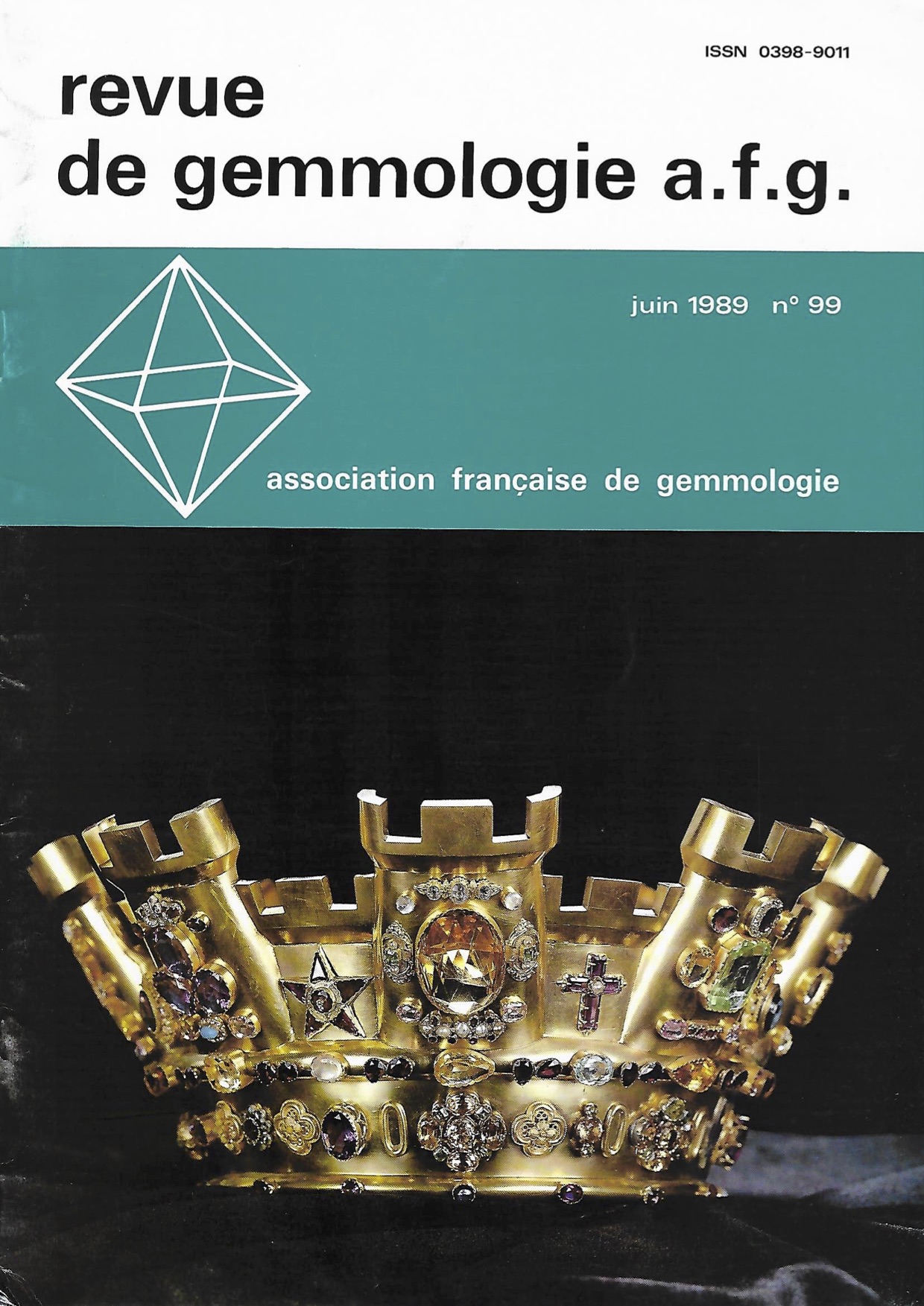
Journal Article · Source: Revue de Gemmologie A.F.G. · Issue: No. 63 · Pages: pp. 11–14 · Language: in French

Abstract
Dele-Dubois, Dhamelincourt, and Schubnel examine the application of Raman spectroscopy to the non-destructive identification of mineral inclusions in diamonds, sapphires, and emeralds. The technique permits inclusions to be analyzed in situ through the host gemstone by means of their characteristic Raman spectra, avoiding the need to extract or otherwise damage them. The authors demonstrate the usefulness of Raman spectroscopy for identifying very small inclusions that may be difficult to determine by conventional microscopy, illustrating its value both for gemological identification and for investigating the mineral assemblages trapped during gemstone formation.
Keywords
corundum, inclusions.5, diamond, beryl, emerald, spectroscopy, gems
Synthetische Rubine mit Edelsteinqualität, isometrischem Habitus und hoher Zahl unbeschädigter Kristallflächen

Synthetische Rubine mit Edelsteinqualität, isometrischem Habitus und hoher Zahl unbeschädigter Kristallflächen

Synthetic rubies with gemstone quality, isometric habit, and a high number of undamaged crystal faces

Gübelin, E.J. and Knischka, P.O. (1980)

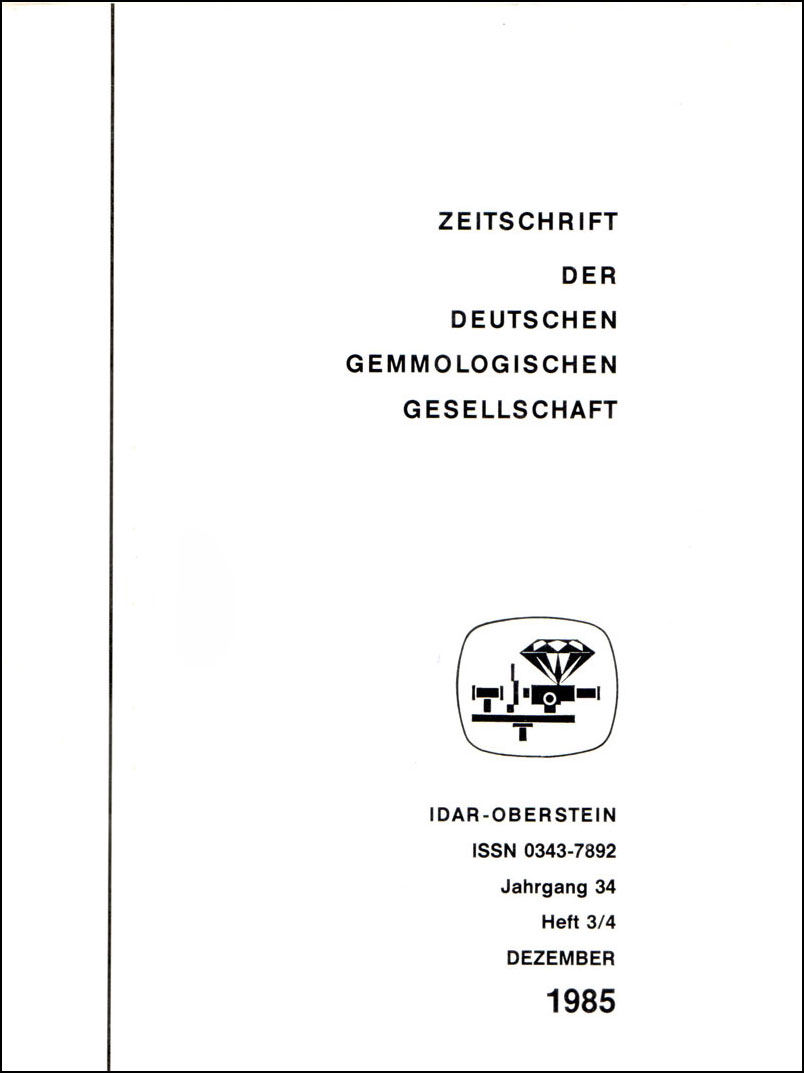
Journal Article · Source: Zeitschrift der Deutschen Gemmologischen Gesellschaft · Volume: Vol. 29 · Issue: No. 3/4 · Pages: pp. 155–185 · Language: In German

Abstract
Gübelin and Knischka describe a new gem-quality synthetic ruby produced by Paul O. Knischka using a proprietary “gradient technique” involving supersaturation and controlled cooling. The resulting crystals have an unusual nearly isometric or pseudocubic habit and exceptionally numerous well-developed, undamaged crystal faces, with examples possessing 32 or 38 faces. The authors compare several types of Knischka synthetic ruby with natural and Verneuil synthetic ruby, examining crystal morphology, trace-element chemistry, optical and gemological properties, fluorescence, and inclusions. In color and general appearance the material closely resembles natural ruby, although it tends toward a more violet red; refractive index, birefringence, and other standard properties offer little assistance in separation. Microscopic features include folded or feather-like inclusions, color zoning, two-phase inclusions, negative crystals, and occasional metallic platelets, some of which can resemble features in natural stones. The study emphasizes the increasing difficulty of distinguishing high-quality synthetic ruby from natural material and the potential diagnostic value of inclusions and trace-element composition.
Keywords
corundum, synthetic corundum.7, gems
Jade, part two, a brief review: Occurrence and structure

Jade, part two, a brief review: Occurrence and structure

Ball, R.A. (1980)

Journal Article · Source: Australian Journal of Gemmology · Volume: Vol. 1 · Issue: No. 7 · Pages: pp. 10–14

Abstract
Following a review of the properties of nephrite and jadeite, Ball discusses the geology of the nephrite de-posits in Australia. In New South Wales, the nephrite occurs in ultramafic rocks, while in South Australia it is associated with metamorphic rocks that were later recrystallized. The author states that there are no known economically important occurrences of jadeite in Australia. This discussion is followed by a description of jadeite from Burma, Japan, and Guatemala and of nephrite from British Columbia, New Zealand, and the Philippines.. The remainder of the article reports on a study of fracture surfaces in both minerals. Jadeite features tri-angular cleavage fractures, while nephrite has fibers and bundles extending from the surface. Thirteen scan-ning electron micrographs, including five of jade sub-stitutes, illustrate these features. A helpful bibliography is included.
Keywords
gems, jade, nephrite, jadeite, fei cui, Australia, Burma, Japan, Guatemala, British Columbia, New Zealand, Philippines
Jade (part one)

Jade (part one)

Ball, R.A. (1980)

Journal Article · Source: Australian Journal of Gemmology · Volume: Vol. 1 · Issue: No. 4 · Pages: pp. 4–9

Keywords
gems, jade, Chinese jade, nephrite, Chinese jade carving, jadeite, fei cui, Burma, New Zealand
Prof. Dr. Hugo Strunz zum Siebzigsten

Prof. Dr. Hugo Strunz zum Siebzigsten

Professor Dr. Hugo Strunz on his seventieth birthday

Gübelin, E.J. (1980)

Journal Article · Source: Zeitschrift der Deutschen Gemmologischen Gesellschaft · Volume: Vol. 29 · Issue: No. 3/4 · Language: In German

Abstract
Gübelin’s contribution is a commemorative tribute to the German mineralogist Hugo Strunz on his seventieth birthday (24 February 1980), rather than a gemological research paper. It concerns Strunz’s career and scientific contributions, particularly his work in mineralogy, crystallography, and crystal chemistry and the systematic classification of minerals for which he became internationally known; Strunz had retired from his chair at the Technical University of Berlin in 1978 after a long academic career and had produced roughly 200 scientific publications.
Keywords
gems
Scheinbare Unstimmigkeiten in gemmologischen Textbüchern

Scheinbare Unstimmigkeiten in gemmologischen Textbüchern

Apparent inconsistencies in gemological textbooks

Gübelin, E.J. and Schmidt, K. (1980)

Journal Article · Source: Zeitschrift der Deutschen Gemmologischen Gesellschaft · Volume: Vol. 29 · Issue: No. 1/2, June · Pages: pp. 20–32 · Language: In German

Abstract
Gübelin and Schmidt discuss apparent discrepancies encountered when comparing numerical data and descriptive statements in gemological textbooks, explaining how apparently conflicting values can arise from differences in specimens, measuring techniques, instruments, environmental conditions, terminology, and the degree of precision with which gemological constants are reported. The paper is intended to show that variations between authoritative texts need not represent actual errors, but may reflect the natural variability of gem materials and differences in the circumstances under which observations were made.
Keywords
gems, gemology,
Ammolith: Ein neuer fossiler Schmuckstein

Ammolith: Ein neuer fossiler Schmuckstein

Ammolite: A new fossil gemstone

Gübelin, E.J. (1980)

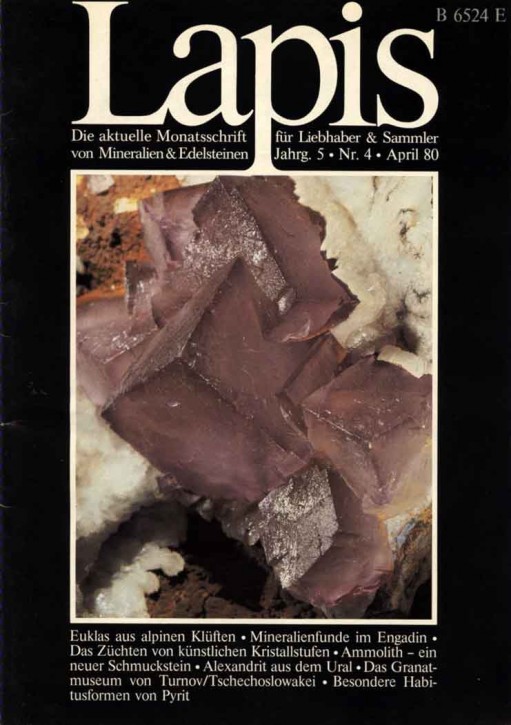
Journal Article · Source: Lapis · Volume: Vol. 5 · Issue: No. 4, April · Pages: pp. 19–24 · Language: in German

Abstract
Gübelin introduces ammolite as a newly recognized fossil gem material derived from the iridescent aragonitic shell layers of ammonites from southern Alberta, Canada. He discusses its fossil origin, striking opal-like play of spectral colors, structure and gemological characteristics, and its preparation and use as an ornamental stone. The material’s color results from interference within the thin aragonite layers of the preserved shell, while its relative softness and thin gem-quality layer present difficulties in cutting and jewelry use. The article represents one of the earliest gemological descriptions of ammolite as a distinct commercial gem material.
Keywords
ammolite, Canada, gems
L’escarboucle médiévale, pierre de lumière

L’escarboucle médiévale, pierre de lumière

The medieval carbuncle, stone of light

Miguet, T. (1979)

Journal Article · Source: Marche romane · Publisher: Association des romanistes de ­ l’Université de Liège · Volume: Vol. 29 · Issue: No. 3–4 · Pages: pp. 37–60 · Language: in French

Abstract
Miguet examines the medieval escarboucle (carbuncle) as the legendary “stone of light,” tracing its appearances and symbolic functions in medieval French literature. The carbuncle is represented as a marvelous gem capable of emitting its own light: illuminating rooms, showing the way at night, and shining from helmets, crowns, jewelry, and other precious objects. The study draws on works including the Roman de la Rose, Raoul de Cambrai, the Voyage de Charlemagne, and other romances and chansons de geste, examining how the stone developed from the ancient carbuncle tradition into a literary and symbolic gem whose supernatural luminosity signified magnificence and wonder. Later scholarship repeatedly cites Miguet as an important study of this medieval gemstone tradition.
Keywords
gems, ancient gemology, carbuncle, corundum, history.1, garnet, spinel, ruby
Neue Edelsteine aus Sri Lanka

Neue Edelsteine aus Sri Lanka

New gemstones from Sri Lanka

Gübelin, E.J. (1979)

Journal Article · Source: Zeitschrift der Deutschen Gemmologischen Gesellschaft · Volume: Vol. 28 · Issue: No. 4 · Pages: pp. 194–196 · Language: In German

Abstract
Gübelin describes four unusual gem materials from Sri Lanka, presenting their physical properties: a saturated blue sillimanite resembling sapphire or cordierite; a yellow-brown epidote whose color is attributed to iron; a warm-brown idocrase (vesuvianite), somewhat more yellow than comparable material from Canada and Kenya; and a red stone initially believed to be taaffeite but subsequently recognized as a distinct mineral of the taaffeite group, provisionally called “taprobanite.” The paper was presented at the 17th International Gemmological Conference at Idar-Oberstein in September 1979.
Keywords
Sri Lanka, gems
Fiskenaesset: Rubinvorkommen auf Grönland

Fiskenaesset: Rubinvorkommen auf Grönland

Fiskenaesset: Ruby deposits in Greenland

Gübelin, E.J. (1979)

Journal Article · Source: Lapis · Volume: Vol. 4 · Issue: No. 3, März · Pages: pp. 19–26 · Language: in German

Abstract
Gübelin describes the ruby occurrences of the Fiskenæsset (now Qeqertarsuatsiaat) area of West Greenland, where ruby and pink corundum occur within the Archean Fiskenæsset complex. The article places the rubies in their mineralogical and geological setting and discusses the associated minerals of this unusual assemblage. Later geological work confirms that the district contains numerous ruby–sapphirine occurrences, commonly associated with ultramafic rocks near contacts between anorthosite and amphibolite, with associated minerals including sapphirine, kornerupine, gedrite, enstatite, cordierite, spinel, pargasite, and phlogopite. Gübelin’s 1979 article is one of the early gemological accounts of the Greenland ruby deposits, which had been discovered in 1966 and were attracting commercial exploration during the 1970s.
Keywords
corundum, Greenland.12, gems
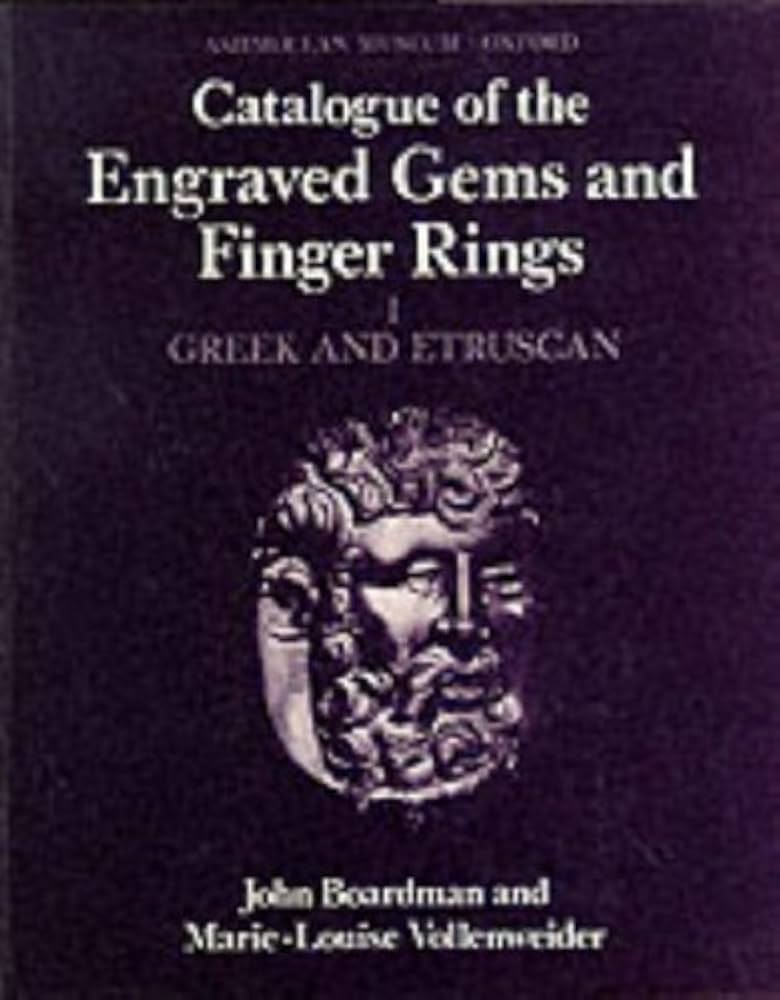
Catalogue of the Engraved Gems and Finger Rings in the Ashmolean Museum

Catalogue of the Engraved Gems and Finger Rings in the Ashmolean Museum

Boardman, J. and Vollenweider, M.-L. (1978)

Book · Publisher: Oxford University Press · Pages: 122 pp.

Abstract
The Oxford University collection of Greek, Etruscan and Roman gems and rings is one of the most representative in the world. The Minoan gems, unrivalled outside Crete, and the Roman series are destined for publication in other volumes. The present wor4ks offers full descriptions, comments, and enlarged photographs of the 385 Greek and Etruscan engraved gems, scarabs, and rings, from the eighth-century B.C. to the end of the Hellenistic period. To Arthur Evans, explorer of Knossos, is due the wealth of Geometric and early Archaic stones, including a fine range of Island Gems. The later Archaic and Classical periods are well-represented, and the gifts of Greville Chester offer an unusually full sequence of the Greco-Persian stones. Charles Drury Fortnum’s great collection of finger rings, the subject of a special exhibition in the home, the Ashmolean Museum, in 1978, includes many of Greek and Roman date. The full range of the styles and engraving on Etruscan scarabs is represented, and particular attention has been paid to the Hellenistic gems, whose styles in portraiture and symbolism inspired the glyptic of early Imperial Rome. The study of ancient gems flagged in the first half of the twentieth century until recent years, and the two authors of this catalogue have done much in their previous publications to direct the attention of scholars and art historians again to these examples of a prime miniaturist art: Mr. Boardman in his studies of Greek gems and rings; Miss Vollenweider in her studies of Hellenistic and early Roman engraving. Modern methods of photography and styles of publication are called for to present the gems satisfactorily, and this is the first major catalogue of an English collection of mainly Greek gems to complement the new publications of some European collections.
Keywords
gems, ancient gems, glyptic, archaeology, archaeogemology, rings, Greek, Roman
Bericht über gemmologische Untersuchungserfahrungen

Bericht über gemmologische Untersuchungserfahrungen

Report on gemological examination experiences

Gübelin, E.J. (1978)

Journal Article · Source: Zeitschrift der Deutschen Gemmologischen Gesellschaft · Volume: Vol. 27 · Issue: No. 1 · Pages: pp. 33–40 · Language: In German

Abstract
Gübelin reports on noteworthy cases and observations encountered during practical gemological examination and identification.
Keywords
gems, gemology, gemological education
Sinhalit und Diopsid aus Ceylon

Sinhalit und Diopsid aus Ceylon

Sinhalite and diopside from Ceylon

Bank, H. (1977)

Journal Article · Source: Zeitschrift der Deutschen Gemmologischen Gesellschaft · Volume: Vol. 26 · Issue: No. 2 · Pages: pp. 78–79 · Language: in German

Abstract
A gemological note on sinhalite and diopside from Ceylon.
Keywords
gems, Ceylon, Sri Lanka, sinhalite, diopside
Or, émeraudes et griffons à travers la Patrologie latine

Or, émeraudes et griffons à travers la Patrologie latine

Gold, emeralds, and griffins through the Latin Patrology

Camès, G. (1977)

Journal Article · Source: Gazette des Beaux-Arts · Volume: Series 6, Vol. 90 · Issue: No. 119 · Pages: pp. 105–108 · Language: in French

Abstract
Camès examines references to gold, emeralds, and griffins in the Patrologia Latina, considering their place in medieval Christian literature and symbolism.
Keywords
gems, early lapidaries, early gemology, early mineralogy, Albertus Magnus
Über die Steine: das 14. Ahmad des Muhammad Ibn Kapitel aus dem Kitab-Mursid" Al-Tamīmī, nach dem Pariser Manuskript herausgegeben, übersetzt und kommentiert"

Über die Steine: das 14. Ahmad des Muhammad Ibn Kapitel aus dem Kitab-Mursid" Al-Tamīmī, nach dem Pariser Manuskript herausgegeben, übersetzt und kommentiert"

On Stones: Chapter 14 of the Kitāb al-Murshid of Aḥmad ibn Muḥammad al-Tamīmī, Edited, Translated, and Annotated from the Paris Manuscript.

Schöenfeld, J. (1976)

Book · Source: Islamkundliche Untersuchungen · Publisher: Klaus Schwarz Verlag · Issue: Vol. 38 · Pages: 259 pp. · Language: in German

Abstract
Mineralogical and gemological extracts from the large Arabic treatise on medicine and medicaments, based on the Paris manuscript. Schönfeld notes that this pharmacopoeia is “one of many dealing with simple healing materials, which borrow from Greek pharmacopoeias, particularly those of Dioscorides and Galen.” Among its contents are a list of abbreviations, an index to the literature, a biography of al-Tamīmī, descriptions of the manuscripts, orthographic and stylistic peculiarities, a discussion of medicine and magic, and a heavily annotated translation accompanied by the Arabic text. In general, the two classes of stones found in this work are: (1) “eye-healers,” including antimony, pearl, zircon, emerald, carnelian, hematite, coral, lapis lazuli, jet, turquoise, and meerschaum, among others; and (2) personal protective devices incorporating diamond, malachite, bezoar, and other substances. Isis, Critical Bibliography, vol. 69, 1978, p. 64.
Keywords
gems, Arabic mineralogy, Persian gemology, history of gemology, Arabic gemology, al-Tamīmī, pearl,
Il Lapidario Estense: edizione e glossario

Il Lapidario Estense: edizione e glossario

The Estense Lapidary: edition and glossary

Tomasoni, P. (1976)

Journal Article · Source: Studi di filologia italiana · Volume: Vol. 34 · Pages: pp. 131–186 · Language: in Italian

Abstract
Tomasoni presents a critical edition and glossary of the Lapidario Estense, a medieval Italian vernacular lapidary whose principal sources include Marbode of Rennes’s De lapidibus and Bartholomaeus Anglicus’s De proprietatibus rerum. The study makes the lapidary text available in an edited form and provides a glossary for its medieval vocabulary, making it particularly valuable for the history of Italian gemstone and mineral terminology and for tracing the transmission of classical and medieval traditions concerning stones and their properties.
Keywords
gems, early lapidaries, early gemology, early mineralogy
Neue Untersuchungen am blauen Zoisit (Tansanit)

Neue Untersuchungen am blauen Zoisit (Tansanit)

New studies on blue zoisite (tanzanite)

Gübelin, E.J. and Weibel, M. (1976)

Journal Article · Source: Zeitschrift der Deutschen Gemmologischen Gesellschaft · Volume: Vol. 25 · Issue: No. 1 · Pages: pp. 23–32 · Language: In German

Abstract
Gübelin and Weibel report further investigations of blue zoisite (tanzanite) from Tanzania, examining this relatively new gem variety from a mineralogical and gemological perspective.
Keywords
zoisite, tanzanite, Tanzania, gems

Building a Gemological Library

Gemological books range from general identification manuals and textbooks to specialized works on individual gems, mineralogy, jewelry, treatments, synthesis, history and gem-producing regions.

For a curated selection of particularly useful books, read The Gemologist's Core Library — Classic Books on Gemology, Jewelry and Mineralogy.

About Four Treasures

Four Treasures is Lotus Gemology's freely accessible gemological reference database. Use the full database to search by author, title or keyword and explore literature on gemology, mineralogy, jewelry and related fields. Where available, hyperlinks on titles may lead directly to the full publication.

Search the Complete Four Treasures Database