Gemology Books Bibliography

Gemology Books Bibliography

Explore books on gems, gemology, jewelry and mineralogy in Four Treasures, the Lotus Gemology reference database. This bibliography brings together matching book records from the collection, with publication details, abstracts and cover images where available.

Gemology Book References

The list below matches books concerning gemology and related subjects in the database's searchable fields. Some works cover several branches of gems, jewelry or mineralogy.

3,381–3,400 of 3,434 matching references
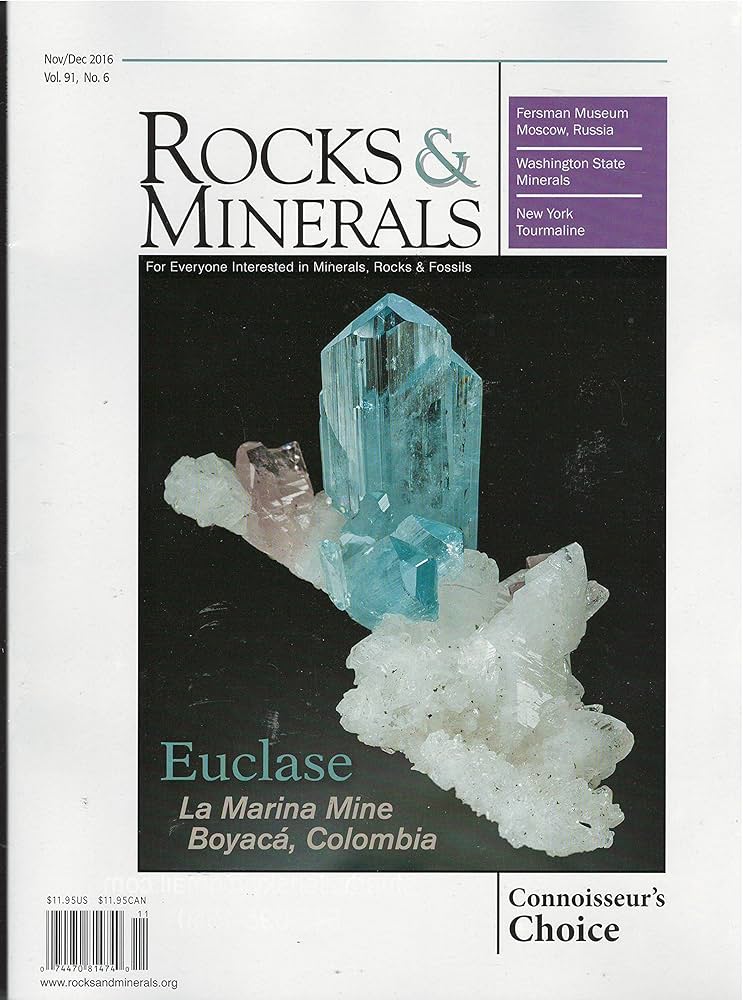
Black star corundum

Black star corundum

Peterson, H. (1968)

Journal Article · Source: Rocks & Minerals · Volume: Vol. 43 · Pages: pp. 492–493

Abstract
Peterson discusses black star corundum, a dark variety of corundum that displays asterism when cut en cabochon. The article describes the appearance and gemological characteristics of the material and the inclusions responsible for the star effect, produced by oriented needle-like inclusions that reflect light along crystallographically controlled directions. It considers the relationship between the dark body color, inclusions, and visibility of the star, as well as the orientation required in cutting to display the phenomenon effectively. The brief account provides a practical description of black star corundum and the optical phenomenon responsible for its distinctive appearance.
Keywords
corundum, Canada.12, gems
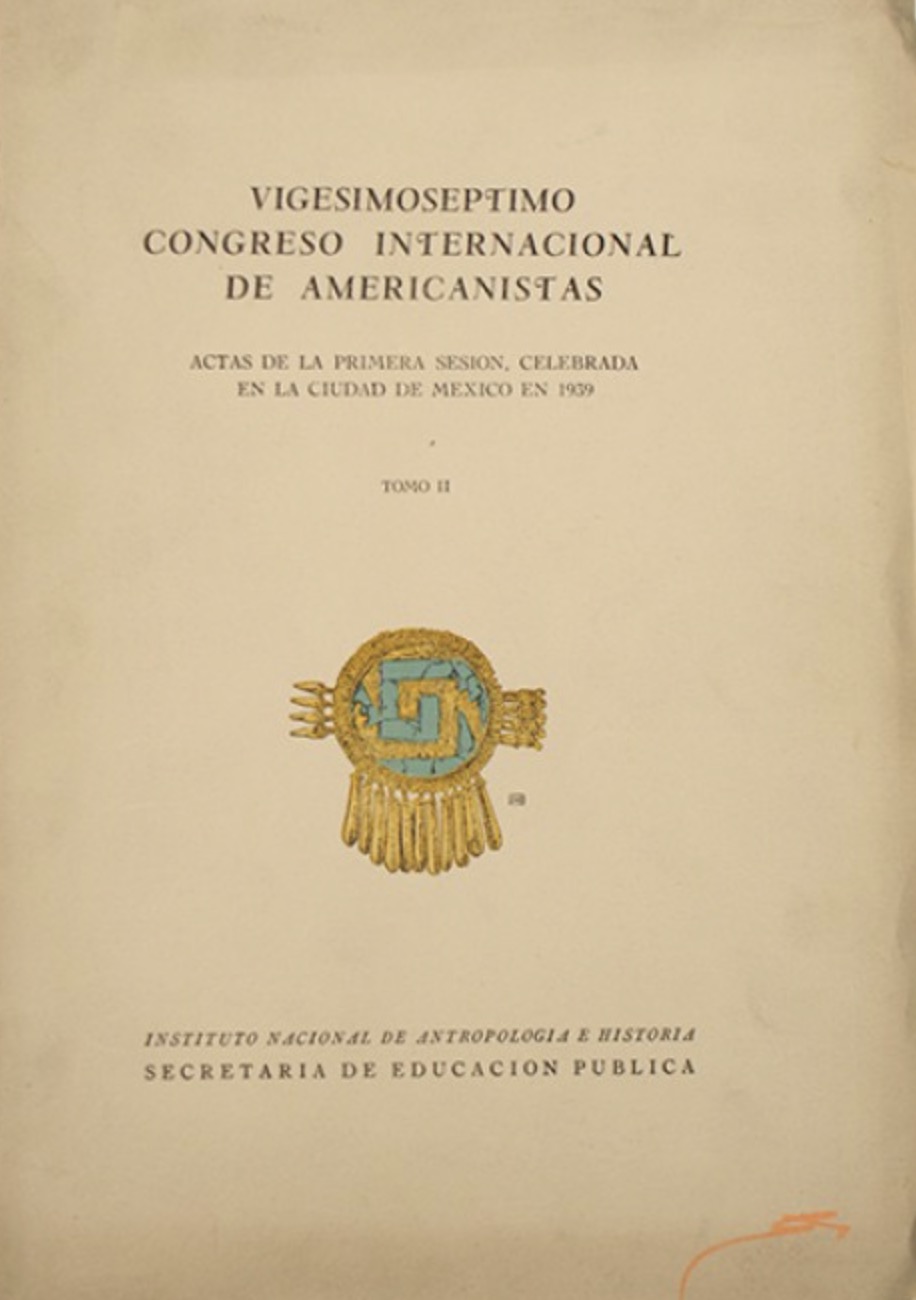
Aboriginal jade use in the New World

Aboriginal jade use in the New World

Stirling, M.W. (1966)

Conference Paper · Source: Actas y Memorias del XXXVII Congresso Internacional de Americanistas

Keywords
gems, jade, jadeite, fei cui, Mesoamerica, Mexico, Guatemala, Costa Rica, Mayans, Olmecs, Aztecs, archaeology, history, archaeogemology, Pre-Columbian jade; Costa Rica; Maya; exchange; iconography, lapidary
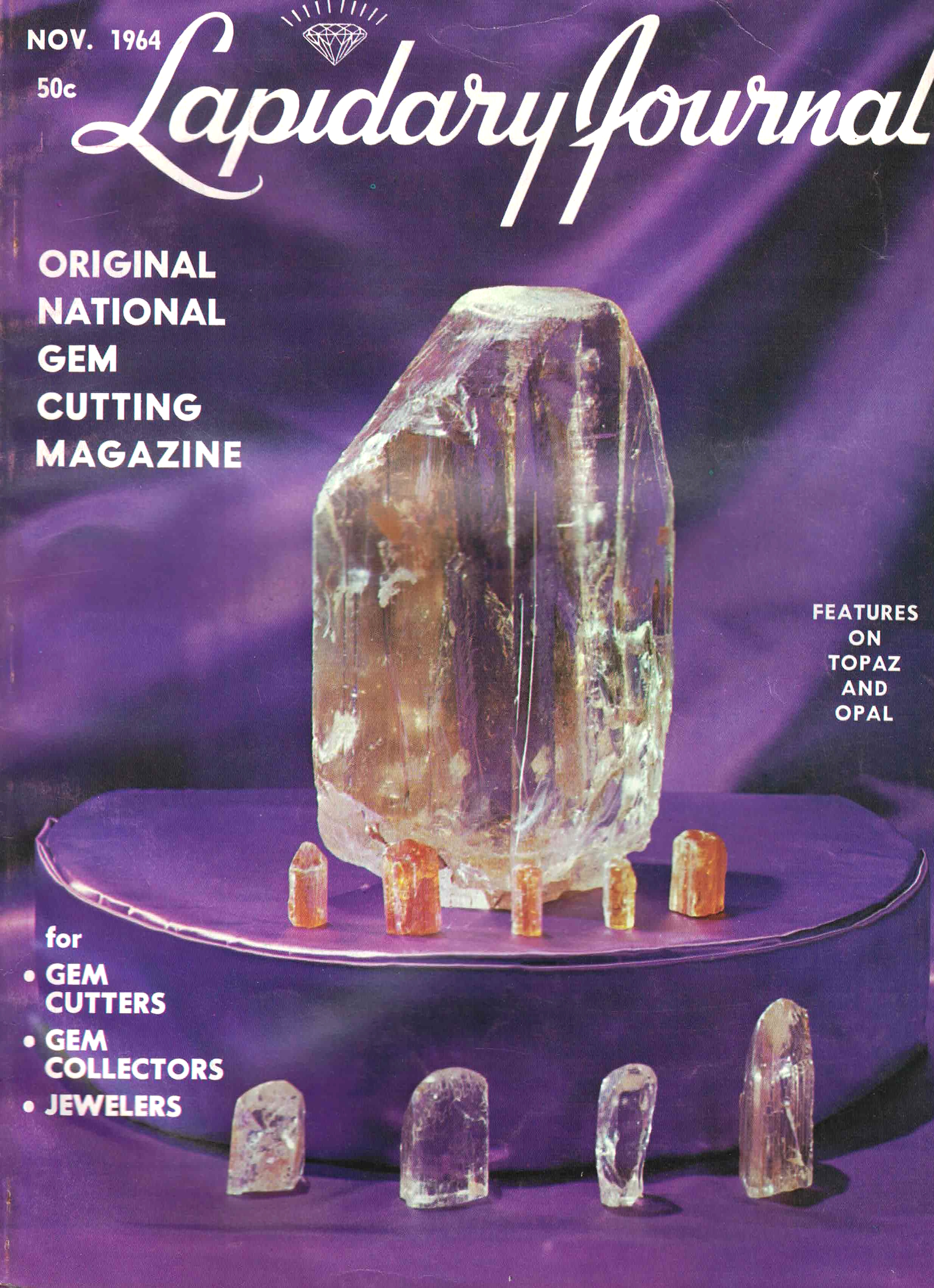
Topaz

Topaz

Pough, F.H. (1964)

Journal Article · Source: Lapidary Journal · Volume: Vol. 18 · Issue: No. 8 · Pages: pp. 852–854, 856, 858, 860, 862, 864

Abstract
Discusses the gemological properties of topaz.
Keywords
gems, Topaz, Brazil
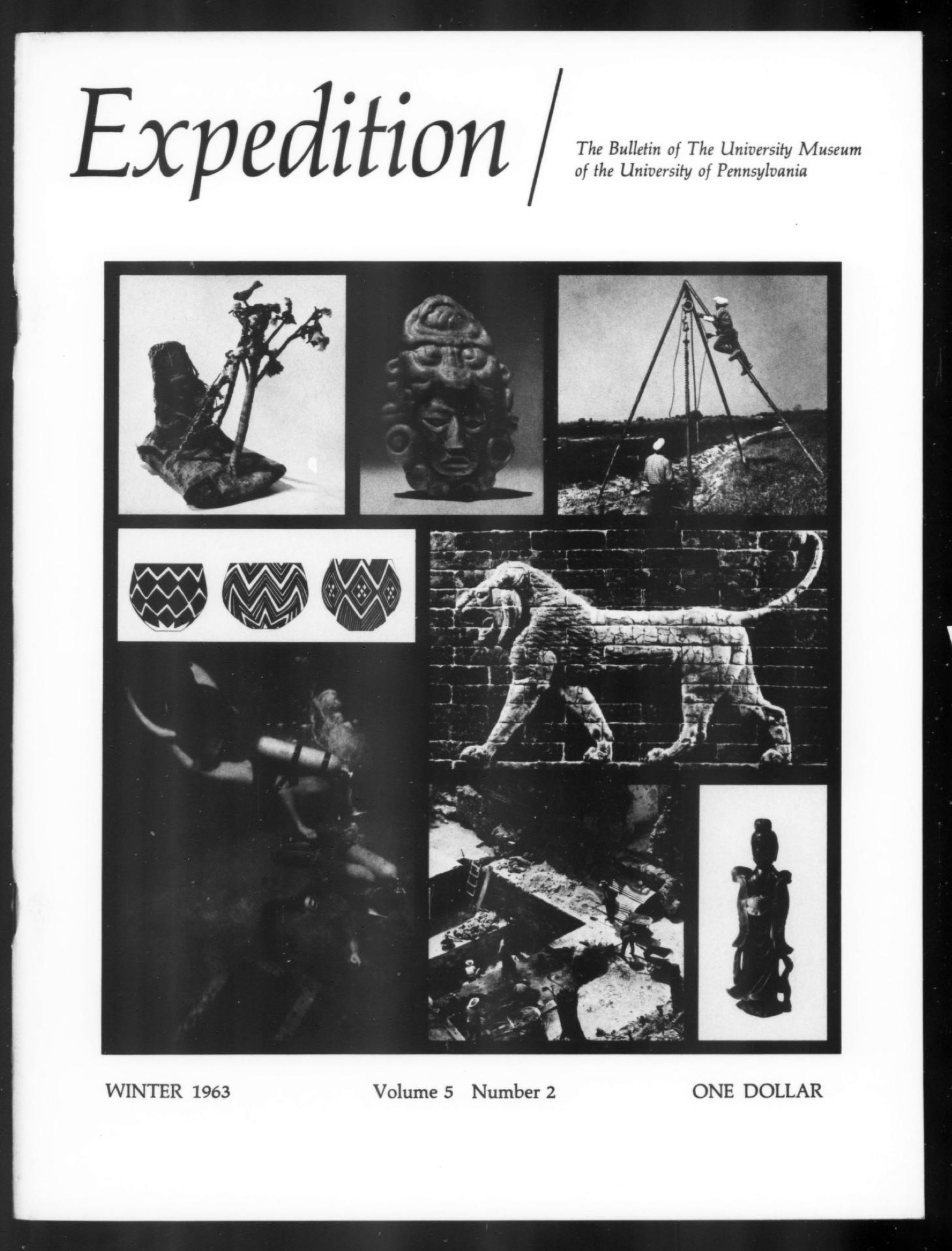
Apuntes sobre un Jade y dos Colgantes de Esteatita del Norte de Costa Rica

Apuntes sobre un Jade y dos Colgantes de Esteatita del Norte de Costa Rica

Notes on a jade and two steatite pendants from northern Costa Rica.

Stone, D. (1963)

Journal Article · Source: Hombre y Cultura, Revista del Centro de Investigaciones Antropologicas de la universidad Nacional · Publisher: Museo Nacional de Costa Rica · Volume: Vol. 1 · Issue: No. 2, December · Pages: pp. 47–54 · Language: in Spanish

Keywords
gems, jade, jadeite, fei cui, Mesoamerica, Mexico, Guatemala, Costa Rica, Mayans, Olmecs, Aztecs, archaeology, history, archaeogemology, Pre-Columbian jade; Costa Rica; Maya; exchange; iconography, lapidary
Jade: Its character and occurrence

Jade: Its character and occurrence

West, E.H. (1963)

Journal Article · Source: Expedition · Volume: Vol. 5 · Issue: No. 2, Winter · Pages: pp. 2–11

Abstract
Jade, regarded as a material used for prehistoric tools and works of art, presents numerous aspects of interest. The distinctive properties of nephrite and jadeite, which are responsible for their characteristic appearance and hardness, may be used to distinguish them from one another and from other minerals. The occurrence of jade in relatively few localities throughout the world, together with the relationship between these localities and the regions in which jade was worked, raises important questions. Finally, the study of the history of jade working reveals evidence of considerable technical skill, even during very early periods.
Keywords
gems, jade, jadeite, fei cui, Mesoamerica, Mexico, Guatemala, Costa Rica, Mayans, Olmecs, Aztecs, archaeology, history, archaeogemology, China, New Zealand
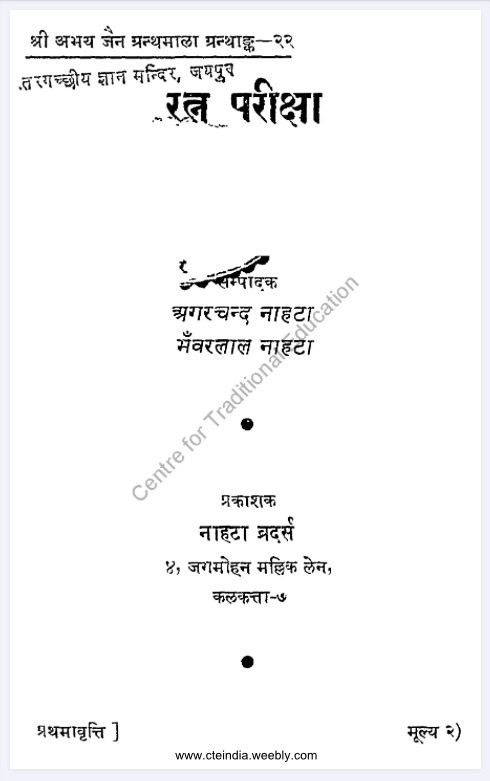
Ratna Pariksha

Ratna Pariksha

Gem Testing

Pherū, Ṭ. (1962)

Book · Publisher: Nahata Bradarsa · Pages: 168 pp. · Language: in Hindi

Abstract
This is a Hindi translation of Ṭhakkura Pherū’s medieval Ratnaparīkṣā, a treatise on the examination and evaluation of precious stones. Pherū, a Jain scholar and professional assayer active in northern India around the beginning of the fourteenth century, composed the work as a practical account of contemporary gem knowledge. It describes and classifies precious stones and discusses their characteristic qualities, defects, varieties, provenance, and criteria used in judging them, reflecting the commercial as well as traditional Indian approach to gem testing. The work belongs to Pherū’s group of technical treatises dealing with such subjects as metals, assaying, mathematics, and material commodities and is an important source for the history of gemology and the gemstone trade in medieval India. The bibliographic record needs correction: available cataloguing identifies Agar Chand Nahata and Bhanwar Lal Nahata with the Hindi translation, rather than Ratna Pariksha as the author; one bibliographic source records the 1962 Hindi translation as published by Abhay Jain Granthalaya, Bikaner, while another scholarly bibliography lists the Hindi translation as published in Calcutta without a date, so I would not retain “Calcutta: Nahata Brothers; 168 pp.” without checking the title page.
Keywords
corundum, history.1, India.12, gems, Indian lapidary
Placas de jade de las ruinas Mayas de Copan

Placas de jade de las ruinas Mayas de Copan

Jade plaques from the Maya ruins of Copán

Núñez Ch., J. (1959)

Conference Paper · Source: XXXIII Congreso Internacional de Americanistas · Volume: Vol. 2 · Pages: pp. 219–228 · Language: in Spanish

Abstract
Núñez Chinchilla describes a group of carved jade plaques from the Maya ruins of Copán, documenting their forms, workmanship, and iconography and illustrating several important examples. The pieces include anthropomorphic and supernatural figures carved in low relief and perforated for suspension, indicating their use as pendants or components of elite personal ornaments. Particular attention is given to recurring facial features, headdresses, bodily postures, and other symbolic elements that permit comparison with representations in Maya sculpture and with jade objects from other Mesoamerican sites. One of the objects illustrated in the article, later identified with the Principal Bird Deity, depicts a seated supernatural figure and has become an important comparative example in studies of Early Classic Maya jade imagery. The paper provides an early archaeological record of Copán’s carved jade ornaments and emphasizes their significance as objects of high status and ceremonial importance within Maya culture.
Keywords
gems, jade, jadeite, fei cui, Mesoamerica, Mexico, Guatemala, Costa Rica, Mayans, Olmecs, Aztecs, archaeology, history, archaeogemology, Pre-Columbian jade; Costa Rica; Maya; exchange; iconography, lapidary
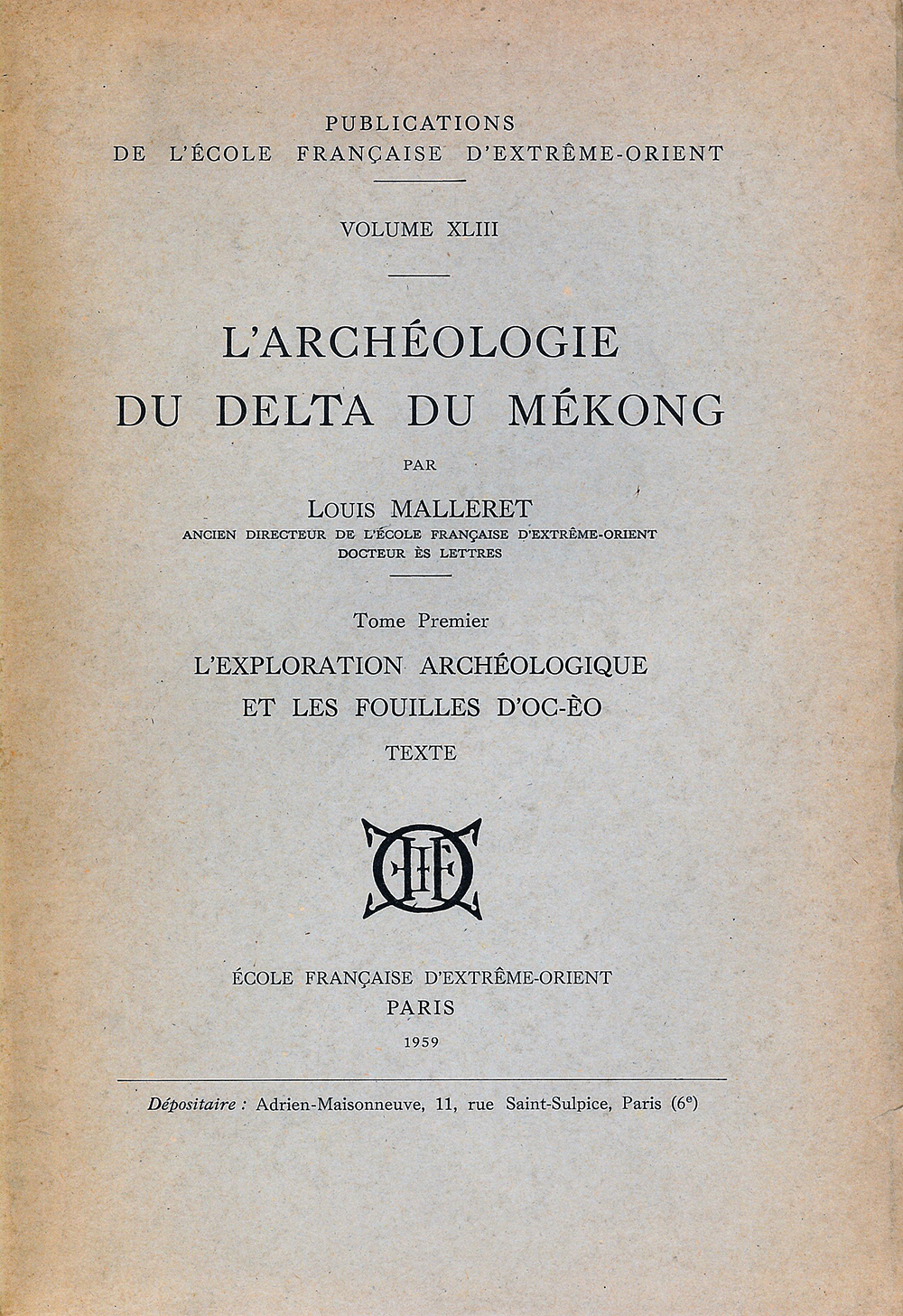
L'Archaéologie du Delta du Mékong, Part 1, L'Exploration Archéologique et Les Fouilles d'Oc-Èo

L'Archaéologie du Delta du Mékong, Part 1, L'Exploration Archéologique et Les Fouilles d'Oc-Èo

The archaeology of the Mekong Delta, Part 1: The Archaeological Exploration and Excavations of Oc-Èo

Malleret, L. (1959)

Book · Publisher: Ecole français de Extrême Orient · Pages: 473 pp. · Language: in French

Abstract
Malleret presents the first volume of his major archaeological study of the Mekong Delta, devoted to the exploration and excavations of Oc-Èo in southern Vietnam, a principal archaeological center associated with the ancient kingdom of Funan. He describes the history of archaeological investigation in the delta, the identification and topography of Oc-Èo and neighboring sites, and the results of excavations and surface surveys, including architectural remains, canals and other landscape features, religious monuments, sculpture, ceramics, stone implements, and other finds. Particular attention is given to the extensive settlement remains and their relationship to the wider Transbassac region, providing the archaeological foundation for the subsequent volumes dealing with the material culture of Oc-Èo and the culture of Funan. The work comprises xii + 473 pages with 72 figures and a separate section of 97 plates.
Keywords
gems, archaeology, archaeogemology, China, Southeast Asia, Thailand, Laos, Cambodia, Vietnam

Analyser an skerd og skjøld fra Bofunnet

Analysis of a fragment of a sword and shield from the settlement find

Rosenquist, A.M. (1959)

Journal Article · Source: Viking · Volume: Vol.  12 · Pages: pp. 33–34 · Language: in Norwegian

Keywords
gems, archaeology, archaeogemology, analytical
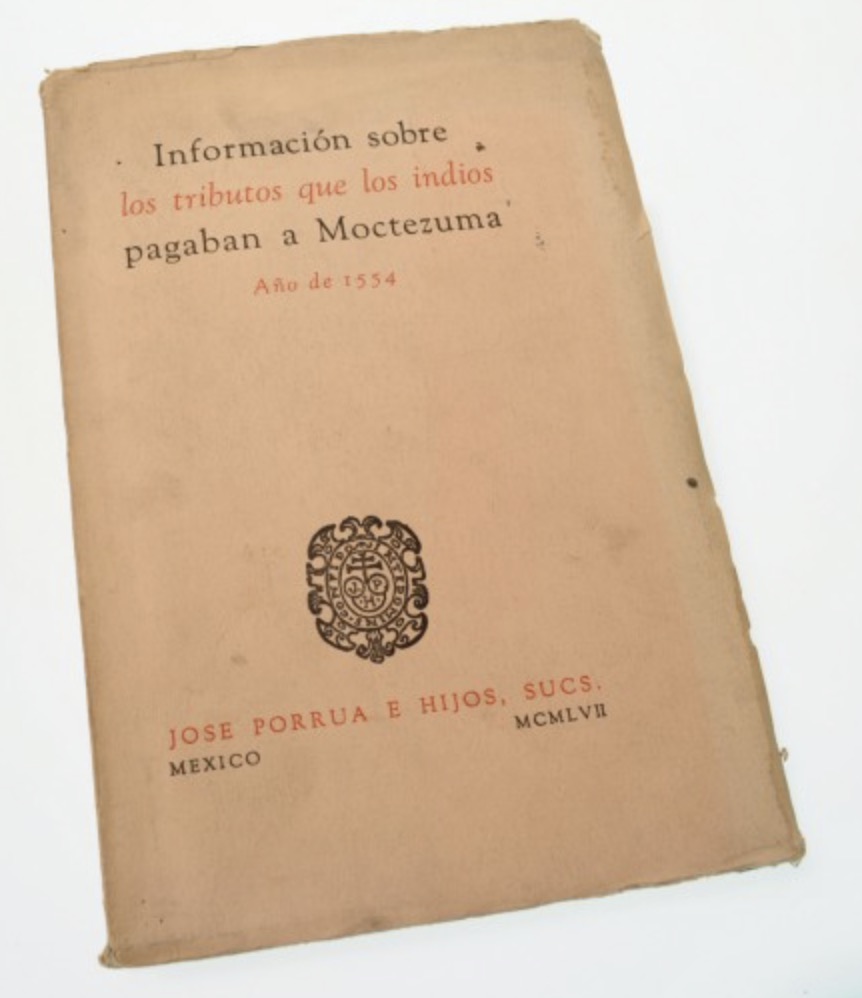
Información sobre los tributos que los Indios pagaban a Moctezuma, año de 1554

Información sobre los tributos que los Indios pagaban a Moctezuma, año de 1554

Information concerning the tribute that the Indians paid to Moctezuma, 1554

Scholes, F.V. and Adams, E.B. (1957)

Book · Source: Documentos para la Historia del México Colonial, No. 4 · Publisher: J. Porrúa · Pages: 236 pp. · Language: in Spanish

Abstract
The document published here by Francis V. Scholes and Eleanor B. Adams is the first systematic commentary on the Aztec tribute rolls to emerge from the sixteenth century. It consists of the court testimony of six Tlatelolco principales in 1554 regarding the tribute paid to Moctezuma. The witnesses commented upon an actual tribute roll of the Matrícula de Tributos type, and their observations provide important new evidence for reconstructing the Aztec imperial system and the tribute exacted from subject provinces. The imperial provinces appear in the order found in both the Matrícula de Tributos and the Codex Mendoza. The tribute roll examined by the witnesses evidently contained many more town names than are preserved in either of the two rolls known today, a fact that supports the frequently expressed view that the Matrícula de Tributos and the Codex Mendoza are incomplete. The testimonies record the number of towns in each province, although, except in the case of Petlacalco, where some names are given, the towns themselves are not identified. The editors also offer new interpretations concerning the quantity and nature of the tribute, festival obligations, the frequency of payments, land tenure, succession, and the mid-sixteenth-century value of the tribute formerly paid. The document is an important one, but it is the reviewer’s duty to object to an edition so limited that individual copies are sold at 200 pesos. — Charles Gibson, University of Iowa.
Keywords
gems, gems, jade, jadeite, fei cui, Mesoamerica, Mexico, Guatemala, Costa Rica, Mayans, Olmecs, Aztecs, archaeology, history, archaeogemology, Pre-Columbian jade; Costa Rica; Maya; exchange; iconography, lapidary, tribute indians paid to Moctezuma
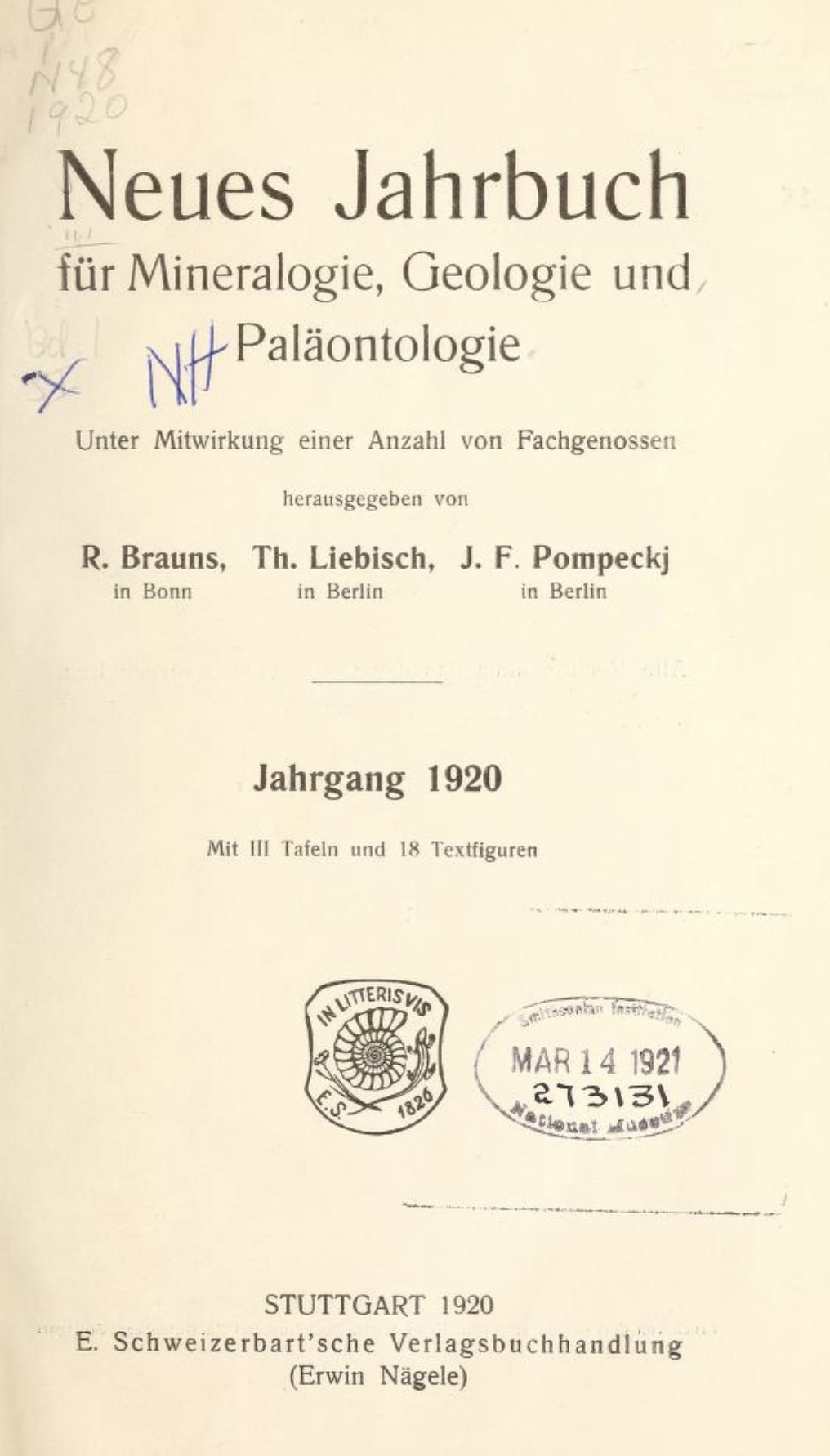
Zur optik und morphologie von synthetischen rubin

Zur optik und morphologie von synthetischen rubin

On the optics and morphology of synthetic ruby.

Jäger, E. and Huttenlocher, H. (1953)

Journal Article · Source: Neues Jahrbuch für Mineralogie, Geologie und Paläontologie · Volume: Vol. 12 · Pages: pp. 265–272 · Language: in German

Abstract
Jäger and Huttenlocher investigate synthetic ruby from the standpoint of crystallographic morphology and optical behavior, examining the relationship between the external form and growth of the synthetic material and the crystallographic structure of corundum. They consider the orientation of the optical and crystallographic axes and the characteristic morphology produced during artificial crystal growth, using optical observations to relate the grown material to natural corundum. Particular attention is given to features arising from the growth process and to the extent to which synthetic ruby retains the fundamental optical and crystallographic properties of natural ruby despite its artificial mode of formation. The study is primarily mineralogical and crystallographic rather than gemological, and represents an early investigation of the structure and growth characteristics of manufactured corundum at a time when synthetic ruby was becoming increasingly important for both jewelry and technical applications.
Keywords
corundum, synthetic corundum.7, Verneuil, gems
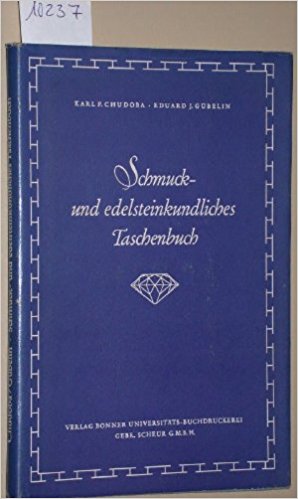
Schmuck- Und Edelsteinkundliches Taschenbuch

Schmuck- Und Edelsteinkundliches Taschenbuch

Jewelry and Gemstone Pocket Handbook

Chudoba, K.F. and Gübelin, E.J. (1953)

Book · Publisher: Verlag Bonner Universitäts-Buchdruckerei · Pages: xii + 158 pp. · Language: in German

Abstract
Chudoba and Gübelin provide a compact practical reference to gemology intended both for identifying gemstones and for standardizing the often confusing terminology used in the German gem trade. The principal gemstones and ornamental materials are arranged alphabetically and characterized by their chemical, crystallographic, and physical properties, important localities, trade names, and diagnostic features. Separate sections treat inclusions in natural gemstones, synthetic stones, doublets and triplets; tables of gemological constants; coated stones; synthetic gems and other imitations; the gemological microscope; and practical identification tables. Particular emphasis is placed on simple tests that can be performed with readily available gemological instruments and on microscopic inclusions as a means of distinguishing natural stones from synthetics and assembled or imitation materials. Conceived as a concise working handbook rather than a comprehensive mineralogical treatise, it became the basis for the substantially enlarged second edition of 1966, retitled Edelsteinkundliches Handbuch, and a further expanded third edition in 1974.
Keywords
gems, gemology,
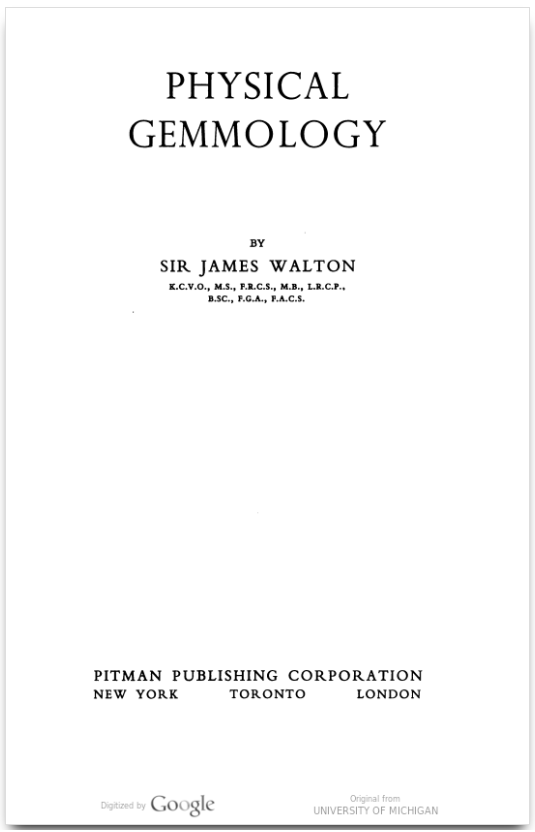
Physical Gemmology

Physical Gemmology

Walton, J. (1952)

Book · Publisher: Pitman Publishing Corporation · Pages: 304 pp.

Abstract
Sinkankas: No doubt influenced by the lack of explanation in ordinary gemological textbooks, Walton studied physical chemistry and crystallography to bring before other students of gemology a simply-written text on subjects that are ordinarily not broached until college. Topics: nature and properties of atoms, crystal structures and crystallography, geological environments of gemstone deposits (!) but returning to the main theme with discussion of the properties of gem crystals, and ending with a dissertion on lapidary treatments. This last chapter, according to Webster's review in Journal of Gemmology, Vol. 4, No. 1, 1953, pp. 36–37, seems lost" and could have been omitted without loss to the rest of the text. Eric Bruton, The Gemmologist, Vol. 21, 1952, pp. 218–219, puts it well, "not a book for the average jeweller, but it is a book, and a very good one indeed, for the keen gemmologist, who will find in this one column all the up-to-date information on the basic sciences that he would otherwise have to search for in the works of many authorities in different subjects." There are some trivial errors and surprisingly poor crystal drawings."
Keywords
gems, general gemology, gem testing, gem cutting, treatments, filters, physics, chemistry, crystallography, mineralogy, gem properties

Lapis lazuli and ultramarine in ancient times

Gettens, R.J. (1950)

Journal Article · Source: Alumni · Publisher: Revue du Cercle des Alumni des Fondations Scientifiques a Bruxelles · Volume: Vol. 19 · Pages: pp. 342–357

Keywords
gems, lapis lazuli, Afghanistan, ultramarine, history of gemology, gem trade, Central Asia
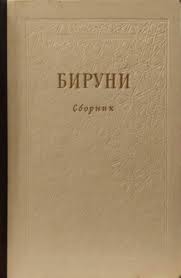
Mineralogical Information of al-Biruni

Mineralogical Information of al-Biruni

Минералогические сведения Ал-Бируни

Lemmlein, G.G. (1950)

Book Section · Source: Бируни: Сборник статей [Biruni: Collection of Articles] · Publisher: Akademija Nauk SSSR · Pages: pp. 106–127 · Language: in Russian

Abstract
Lemmlein examines the mineralogical information contained in al-Bīrūnī’s Kitāb al-Jamāhir fī maʿrifat al-jawāhir, assessing the work from the standpoint of modern mineralogy and the history of science. He considers al-Bīrūnī’s descriptions and identification of gemstones, minerals, metals, and alloys, including their colors, physical characteristics, localities, methods of extraction and working, and commercial uses. Particular attention is given to al-Bīrūnī’s quantitative investigations of specific gravity, which represent an unusually advanced experimental approach for the eleventh century, and to his attempts to distinguish minerals through observable and measurable properties rather than relying solely on traditional lapidary lore. Lemmlein also discusses the difficulties of correlating medieval Arabic mineral names with modern species and emphasizes al-Bīrūnī’s critical use of earlier authorities, craftsmen’s knowledge, and his own observations and experiments. The article presents the Jamāhir as one of the most important medieval contributions to mineralogy and gemology.
Keywords
gems, Arabic mineralogy, al-Biruni, corundum, spinel, pearl, early lapidaries

Building a Gemological Library

Gemological books range from general identification manuals and textbooks to specialized works on individual gems, mineralogy, jewelry, treatments, synthesis, history and gem-producing regions.

For a curated selection of particularly useful books, read The Gemologist's Core Library — Classic Books on Gemology, Jewelry and Mineralogy.

About Four Treasures

Four Treasures is Lotus Gemology's freely accessible gemological reference database. Use the full database to search by author, title or keyword and explore literature on gemology, mineralogy, jewelry and related fields. Where available, hyperlinks on titles may lead directly to the full publication.

Search the Complete Four Treasures Database