Explore books, articles and historical sources on inclusions in gemstones in Four Treasures, the Lotus Gemology reference database. This bibliography brings together matching records from the collection, with publication details, abstracts and cover images where available.
Gemstone Inclusion References
The list below matches the terms inclusion or inclusions in the database's searchable fields. Some references discuss inclusions as part of a broader subject.
241–260 of 1,175 matching references
Emerald and green beryl from Central Nigeria
Journal Article
Schwarz, D., Kanis, J. and Kinnaird, J. (1996) Emerald and green beryl from Central Nigeria.Journal of Gemmology, Vol. 25, No. 2, April, pp. 117–141.
Mineralogical and gemmological characteristics of emeralds and green beryls from the central Nigerian Kaduna and Plateau States are presented. A genetic model has been established for the occurrence of these gemstones within greisen associations of Mesozoic alkali granite ring complexes. Gemmologists should be able to distinguish Nigerian emeralds from those of other origins based on their unique inclusions and chemical characteristics. In Nigerian specimens containing solid inclusions, the specific mineral assemblage of albite + fluorides (fluorite, boldyrevite, ralstonite) + F-silicate + Fe-rich mica + ilmenite + monazite is diagnostic of the locality. Growth structures and fluid inclusions are extremely common; the latter display a wide range of features, including Colombian-type three-phase inclusions. For Nigerian emeralds exhibiting an inclusion pattern similar to Colombian material, the most reliable distinction is via absorption spectroscopy. Nigerian emeralds display ‘mixed spectra’ with absorption peaks due to Cr³⁺, Fe²⁺, Fe³⁺, and Fe²⁺/Fe³⁺, whereas Colombian emeralds typically show spectra largely devoid of iron-related features.
Investigations on sapphires from an alkali basalt, South West Rwanda
Journal Article
Krzemnicki, M.S., Hänni, H.A., Guggenheim, R. and Mathys, D. (1996) Investigations on sapphires from an alkali basalt, South West Rwanda.Journal of Gemmology, Vol. 25, No. 2, April, pp. 90–106.
Yet another new locality for natural blue and treatable sapphire surfaces in this description of material from the Cyangugu district of South West Rwanda. Following summary descriptions of the sapphires' geologic setting and apparent origin from alkali basalts, the results of testing 20 samples is reported. Absorption spectra (visible and infrared), quantitative chemistry (microprobe), and microthermometry were performed on two specially prepared samples. Ten prepared specimens were examined by SEMEDS for inclusions, and eight rough samples were also studied by SEM for detailed surface analysis. The appar ently meticulous methodology yielded high-quality detailed information that is a welcome addition to the gemological literature, despite the small sample size. Numerous illustrations also indicate that this material yields fine-quality gems of brilliant blue color. However, no mention is made of its commercial availability or potential supply.
Sapphires from the Andranondambo region, Madagascar
Journal Article
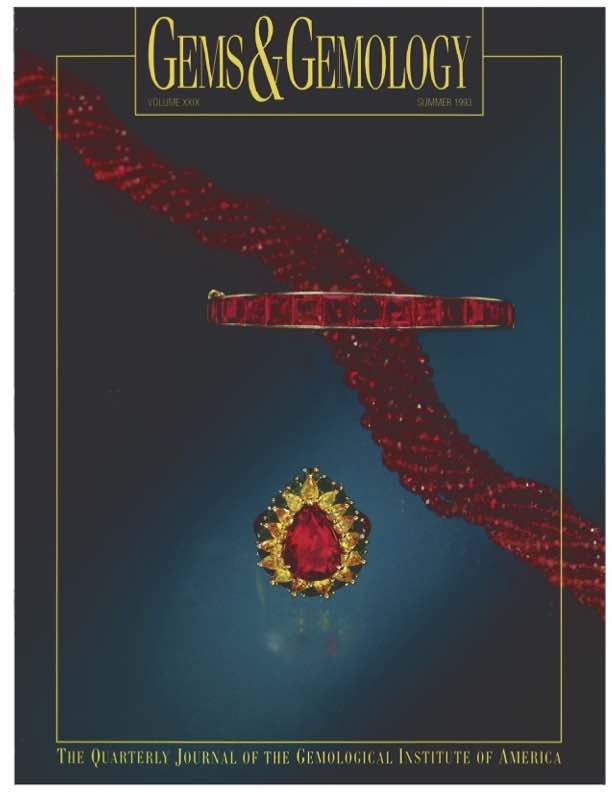
Schwarz, D., Petsch, E.J. and Kanis, J. (1996) Sapphires from the Andranondambo region, Madagascar.Gems & Gemology, Vol. 32, No. 2, Summer, pp. 80–99.
Since 1993, large amounts of gem-quality sapphires from the Andranondambo region of southern Madagascar have entered the international gem market. These sapphires, which are found in metamorphic skarn-type deposits, show a broad range of gemological and chemical properties, many of which are similar to those of sapphires from Sri Lanka, Myanmar (Burma), and even Kashmir. Most of the Andranondambo sapphires are heat treated in Bangkok; these can be separated from their non-heat-treated counterparts on the basis of inclusion features and absorption spectra. Key factors in the separation of Andranondambo sapphires from synthetic sapphires of different manufacturers are chemistry (especially the Ga content of the natural material) and internal features.
The role of fluorine in the formation of colour zoning in rubies from Mong Hsu, Myanmar (Burma)
Journal Article
Peretti, A., Mullis, J. and Mouawad, F. (1996) The role of fluorine in the formation of colour zoning in rubies from Mong Hsu, Myanmar (Burma).Journal of Gemmology, Vol. 25, No. 1, January, pp. 3–19.
Mong Hsu rubies are characterized by a black sapphire core and a ruby rim. This color zoning has been correlated with the presence of the trace elements Ti (violet to black) and Cr (red). Some examples of Mong Hsu rubies show a complex chemical zonation, which results in multiple zones of rubies, violet sapphires and black sapphires within one particular crystal. Rubies of this type have been studied by analyzing the solid and fluid inclusions as well as their chemical zoning. Minerals accompanying the rubies, such as tourmaline (dravite) and tremolite have also been analyzed. The formation conditions of the rubies have been reconstructed following the study of mineral associations and fluid inclusion analyses. Mong Hsu rubies were formed at 2–2.5 kbar and at temperatures between 500° and 550°C. The fluids were found to be water-bearing and multi-volatile CO₂-rich (multivolatile = composed of CO₂, CH₄ and other components, possibly N₂, H₂S and HF). Fluorite inclusions in the rubies indicate that fluids must have contained some HF. During the study of the homogenization temperatures in different populations of fluid inclusions, it was concluded that no major variations in temperature and pressure occurred during the growth of Mong Hsu rubies. However, the chemical zonation patterns found in Mong Hsu rubies and accompanying tourmalines are indicative of variations in the composition of the fluids, e.g. in contents of F, Ti and Cr. A preliminary model is proposed, which explains the cyclic growth of Mong Hsu rubies, with formation of alternating zones of ruby and sapphire by variation in HF concentration in the surrounding fluids. The possible multiple infiltration of fluids from metapelites into dolomites is discussed.
Guo, J., O’Reilly, S.Y. and Griffin, W.L. (1996) Corundum from basaltic terrains: A mineral inclusion approach to the enigma.Contributions to Mineralogy and Petrology, Vol. 122, pp. 368–386.
Record No. 4818 | Sinkankas/Born No.: NIS/NIB | RWHL*
Reference copied to clipboard!
corundum, inclusions.5, geology.11, gems
This paper investigates the origin of corun-dum megacrysts that occur in many basaltic terrains, and which are considered to be eroded from basaltic rocks. Geochemical data for over 80 primary mineral inclu-sions within corundum megacrysts are used to gain a new insight into the petrogenetic history of the corundum megacrysts. A wide spectrum of minerals is present as inclusions in the corundum; the most common are Nb Ta oxides (such as titaniferous columbite and uran-pyrochlore), alkali feldspar, low-Ca plagioclase (albite-oligoclase) and zircon. Rare inclusions include Fe, Cu-sulphide (low in Ni), cobalt-rich spinel, Th, Ce-rich phosphate and uraninite. The similar chemistry of some inclusion minerals from corundum occurring in widely separated areas suggests that the corundum megacrysts in basalts have a similar petrogenesis. Geochemical characteristics of the inclusions indicate a bimodal grouping, which is best explained by a mixing-hybridisa-tion process. This study indicates that the corundum megacrysts are not cogenetic with their basaltic hosts but are crustal fragments accidentally incorporated into the erupting magma. It is suggested that interactions between a silicic component and an intruding carbon-atitic or similar Si-poor magma is responsible for Al-oversaturation, resulting in locally distributed lenses of corundum-bearing rock of mixed paragenesis (“hybrid rock hypothesis ”). Feldspar exsolution textures provide strong evidence that this hybridisation occurred at mid-crustal levels. Subsequent volcanic eruptions brought the corundum-bearing rocks (later disintegrated in the magma) up to the Earth’s surface. This petrogenetic model for corundum megacrysts is experimentally testable.
Lab report: Kashan-like inclusion scene in Vietnamese rubies; synthetic ruby with seed plate
Journal Article
Du Toit, G., Charoensrithanakul, S., Dunaigre, C., Gawenuntavong, S., Looney, J., Niphatthanaphan, M., Pingkarawat, P. and Virunhaphol, V. (1996) Lab report: Kashan-like inclusion scene in Vietnamese rubies; synthetic ruby with seed plate.JewelSiam, Vol. 7, No. 4, Aug–Sept, pp. 110–111.
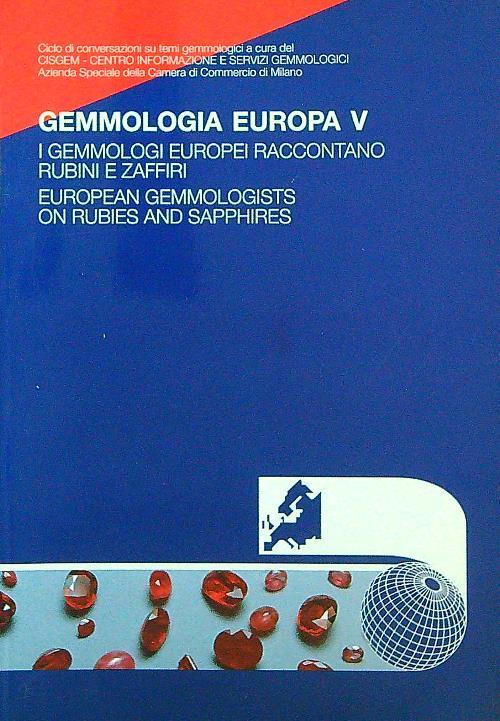
Collects the proceedings of the fifth Gemmologia Europa conference, held in Milan in October 1994, presenting illustrated accounts of ruby and sapphire in English and Italian. E.A. Jobbins discusses ruby occurrences, while Kenneth Scarratt surveys sapphire occurrences. Henri-Jean Schubnel examines the history and legends associated with these gemstones, Michael O’Donoghue addresses treatments, synthetics, and imitations, and Edward J. Gübelin describes their inclusions. Together, the contributions provide an overview of gem corundum, connecting its geographical occurrence and cultural history with practical questions of identification and treatment.
Wonders Within Gemstones: The Elusive Beauty of Gemstone Inclusions
Book
Goutiere, A., de (1996)Wonders Within Gemstones: The Elusive Beauty of Gemstone Inclusions. Chicago, Gemworld International, 135 pp.
Record No. 3235 | Sinkankas/Born No.: NIS/NIB | RWHL*
Reference copied to clipboard!
corundum, inclusions.5, gems
Le saphir padparadscha
The Padparadscha Sapphire
Thesis
Notari, F. (1996) Le saphir padparadscha. [The Padparadscha Sapphire]., Nantes, France: Université de Nantes, 95 pp.
Record No. 2537 | Sinkankas/Born No.: NIS/NIB | Language: in French | RWHL*
Reference copied to clipboard!
corundum, color.4, quality.10, Sri Lanka.12, padparadscha, gems
Investigates the definition, colour, composition, inclusions, and identification of padparadscha sapphire through field enquiries in Sri Lanka and laboratory examination of reference specimens. Two principal appearance groups are distinguished: a pastel orangey-pink “native” type and a more pink-dominant “antique” type. These are compared with stones whose apparent padparadscha colour results from the optical mixing of separate colour zones or from iron oxides within fractures. Chemical analyses, ultraviolet–visible spectroscopy, fluorescence observations, and Raman identification of inclusions support discussion of colour mechanisms and diagnostic characteristics. The study also examines synthetic equivalents, heating, irradiation, colour stability, and distinctions between Sri Lankan and East African sapphires. A colour chart and diagnostic framework are proposed to clarify the boundaries of the designation, relating visual appearance to internal features, treatment history, and the historical meaning of padparadscha.
Smith, C.P. (1995) A contribution to understanding the infrared spectra of rubies from Mong Hsu, Myanmar.Journal of Gemmology, Vol. 24, No. 5, Jan., pp. 321–335.
The infrared absorption of the rubies from Mong Hsu was analyzed in order to classify the absorption features recorded. In the mid-infrared region, it was possible to distinguish two separate types of spectra. The first type was recorded in non-heat-treated ruby samples in the region from 1900 to 3400 cm⁻¹, identifying inclusions of diaspore. The second type was recorded in heat-treated ruby samples in the region from 3100 to 3600 cm⁻¹, indicating structurally bonded OH groups. Detailed for the first time in corundum, the building of OH groups is accomplished as a direct result of the dehydration of diaspore inclusions, demonstrated through heat treatment experiments.
The Yogo sapphire deposit
Journal Article
Mychaluk, K.A. (1995) The Yogo sapphire deposit.Gems & Gemology, Vol. 31, No. 1, Spring, pp. 28–41.
Yogo Gulch, discovered over a century ago, is one of four major sapphire-producing regions in Montana, United States. Yogo sapphires are celebrated for their uniform, richly saturated blue color, minimal inclusions and zoning, and exceptional luster and brilliance under both natural and artificial light; notably, they require no heat treatment. The rough crystals are typically flat with low cutting retention and usually weigh less than one carat, though specimens up to 19 carats have been reported. Unlike the other Montana sapphire sources, which are secondary deposits, Yogo sapphires are extracted directly from a lamprophyre host rock. At least six dikes are known in the Yogo area, five of which bear sapphire. Between 1895 and 1994, the Yogo deposit yielded an estimated 18.2 million carats of rough, from which over 500,000 carats of cut gemstones are believed to have been produced, and significant reserves remain.
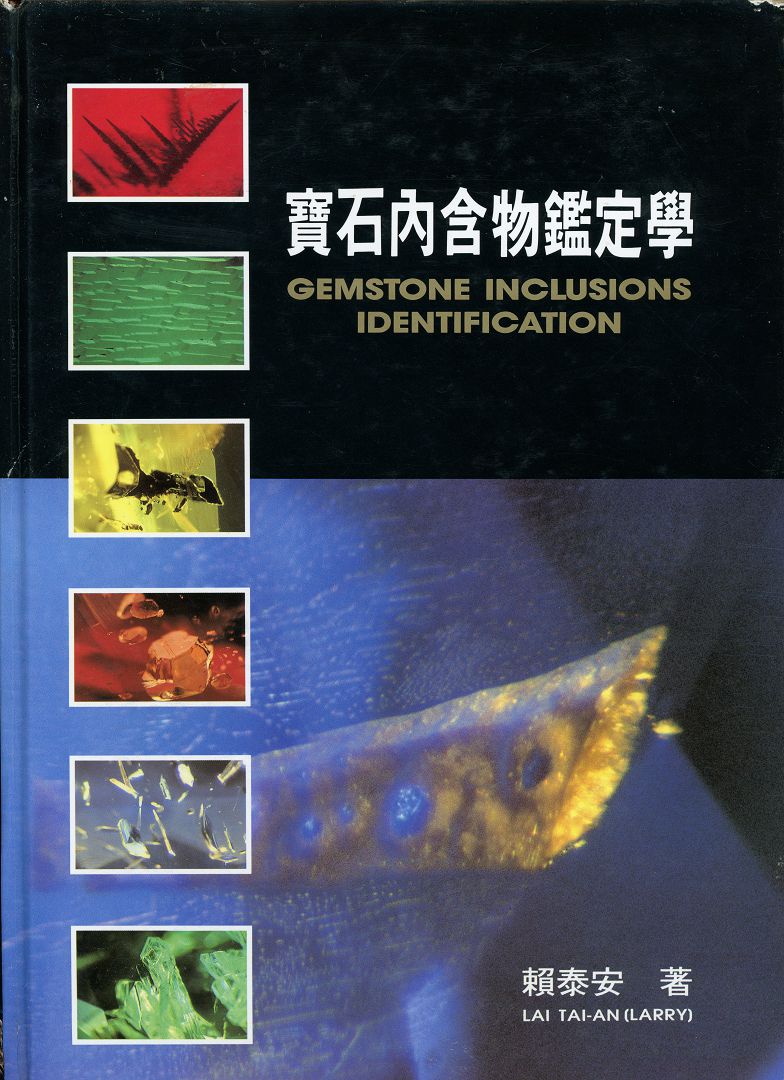
Gemstone Inclusions Identification
寶石內含物鑑定學
Book
Lai, T.-A. (1995)Gemstone Inclusions Identification. [寶石內含物鑑定學] Taipei, Gemological Institute of Lai Tai-An, 343 pp.
An extensively illustrated reference on gemstone identification through the examination of inclusions, written in Chinese with supplementary English captions. Lai begins with practical guidance on observing and locating diagnostically significant internal features, then surveys the major gem species, covering natural and synthetic materials as well as treated and enhanced specimens. Numerous color photomicrographs provide a visual basis for comparison, with several images on each opening illustrating the diversity of internal characteristics encountered in gemological examination. The English captions make much of the photographic material accessible to readers unfamiliar with Chinese. The volume’s principal strength is its extensive photographic documentation: a contemporary reviewer judged the images comparable with, and in some instances superior to, those in other established inclusion references.
Myanmar and its gems—An update
Journal Article
Kammerling, R.C., Scarratt, K., Bosshart, G., Jobbins, E.A., Kane, R.E., Gübelin, E.J. and Levinson, A.A. (1994) Myanmar and its gems—An update.Journal of Gemmology, Vol. 24, No. 1, January, pp. 3–40.
Synthetic rubies by Douros: A new challenge for gemologists
Journal Article
Hänni, H.A., Schmetzer and Bernhardt, H.-J. (1994) Synthetic rubies by Douros: A new challenge for gemologists.Gems & Gemology, Vol. 30, No. 2, Summer, pp. 72–86.
Greek manufacturer A. Douros introduced a new flux synthetic ruby in early 1993. Grown by spontaneous nucleation in a lead-based solvent, the Douros synthetic ruby occurs as rhombohedral single crystals and twinned tabular crystals, as well as in clusters. The tabular crystals typically have intense red cores that gradually decrease in saturation to a near-colorless outermost layer; the rhombohedral crystals have a deep red body and a thin near-colorless layer on the rhombohedral faces, with umbrella-like growth patterns in some areas. Some samples contain distinctive inclusions of yellow residual flux with spherical bubbles. Chemically, the crystals are heavily zoned, and EDXRF analyses revealed variable trace amounts of Ti, Fe, Cr, and Ga, as well as some Pb; SEM-EDS identified the flux particles as lead-bearing. Microprobe analyses showed high Cr values in the crystal cores; in certain growth zones, Fe replaces Cr in the outermost layers. If inclusions or typical growth structures are not present, chemical composition appears to be the best means of separating these Douros synthetic rubies from natural rubies.
Record No. 4245 | Sinkankas/Born No.: NIS/NIB | Language: in English & Italian | RWHL*
Reference copied to clipboard!
gems, diamond
A bilingual collection of contributions by European gemmologists on diamond, combining scientific examination with commercial assessment. Topics include diamond inclusions and their interpretation, together with the evaluation, sale, and certification of polished stones. The volume connects laboratory observations with practical questions encountered in the diamond trade.
Emeralds from the Mananjary region, Madagascar: Internal features
Journal Article
Schwarz, D. (1994) Emeralds from the Mananjary region, Madagascar: Internal features.Gems & Gemology, Vol. 30, No. 2, Summer, pp. 88–101.
Inclusions in emeralds from the Mananjary region in the eastern part of the island nation of Madagascar are reported and compared with inclusions in emeraldsf rom other, especially African, localities. Although most of these internal features are similar to those found in emeralds from other schist-type deposits, Mananjary emeralds usually can be separated from emeralds from other localities by means of associations of certain mineral inclusions (especially talc, carbonates, amphiboles, and quartz) with specific types of fluid inclusions.
Rubini e zaffiri: Inclusioni—Rubies and sapphires: Inclusions
Conference Paper
Gübelin, E.J. (1994)Rubini e zaffiri: Inclusioni—Rubies and sapphires: Inclusions. Gemmologia Europa: European Gemmologists on Rubies and Sapphires, Milan: CISGEM, pp.106–137.
Record No. 3139 | Sinkankas/Born No.: NIS/NIB | RWHL*
Reference copied to clipboard!
corundum, inclusions.5, gems
Flux-grown synthetic red and blue spinels from Russia
Journal Article
Muhlmeister, S., Koivula, J.I., Kammerling, R.C., Smith, C.P., Fritsch, E. and Shigley, J.E. (1993) Flux-grown synthetic red and blue spinels from Russia.Gems & Gemology, Vol. 29, No. 2, Summer, pp. 81–98.
gems, spinel, synthetic spinel, flux synthetic spinel, Russia
Examination of red and blue samples of relatively new flux synthetic spinel from Russia established criteria by which they can be separated from their natural counterparts. The flux synthetic blue spinels can be recognized on the basis of their inclusions, ultraviolet luminescence, and visible absorption spectrum. Magnification is insufficient to identify the flux synthetic red spinels when flux or metallic inclusions are present; in the absence of such inclusions, however, chemical analysis is required. Red and blue natural spinels both contain significantly more zinc than their flux synthetic counterparts. Also, trace amounts of Pb (from the flux) and Pt and Ir (from the crucible) were found in some of the flux synthetic spinels.
Emeralds and green beryls of Upper Egypt
Journal Article
Jennings, R.H., Kammerling, R.C., Kovaltchouk, A., Calderon, G.P., El Baz, M.K. and Koivula, J.I. (1993) Emeralds and green beryls of Upper Egypt.Gems & Gemology, Vol. 29, No. 2, Summer, pp. 100–115.
Egypt is the most ancient of sources for emerald. More than 2,000 years ago, emerald deposits in upper Egypt were supplying gems throughout the Graeco-Roman Empire. A recent visit to this emerald province revealed that the emeralds occur within a northwest-southeast trending belt of schistose rocks in the Red Sea Hills, near the port town of Marso Alam. At the time of the visit, there was no official commercial mining of emerald in the region, although there was evidence of sporadic activity by Bedouin tribespeople. Gemological examination of 14 cut emeralds and green beryls revealed properties consistent with those of material from similar geologic environments.
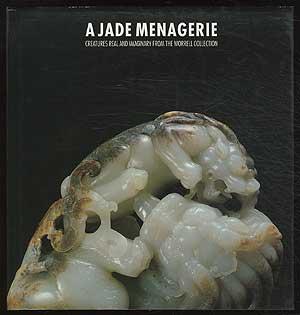
A Jade Menagerie: Creatures Real and Imaginary from the Worrell Collection
Book
Ayers, J. (1993)A Jade Menagerie: Creatures Real and Imaginary from the Worrell Collection. London, Azimuth Editions, 72 pp.
The Worrell Collection of Chinese jade animals has been assembled by T. Eugene Worrell, who is an avid outdoorsman and a noted animal art collector who resides in Charlottesville, Virginia. Believed to be unique among American jade collections, it numbers more than 150 carvings of real and imagined creaturess from the legendary Chinese bestiary, dating from the neolithic age to the twentieth century. Forty-one examples from the collection were chosen by John Ayers for inclusion in this book. Under his scholarly pen, A Jade Menagerie becomes an indispensable reference for the serious collector and a delightful introduction to jade collecting for everyone.
Exploring the Literature of Gemstone Inclusions
The literature of gemstone inclusions covers identification, origin determination, treatments, synthesis, mineral inclusions, fluid inclusions and other internal features of natural and synthetic gems.
Four Treasures is Lotus Gemology's freely accessible gemological reference database. Use the full database to search by author, title or keyword and explore literature on gemology, mineralogy, jewelry and related fields. Where available, hyperlinks on titles may lead directly to the full publication.