Explore books, articles and historical sources on inclusions in gemstones in Four Treasures, the Lotus Gemology reference database. This bibliography brings together matching records from the collection, with publication details, abstracts and cover images where available.
Gemstone Inclusion References
The list below matches the terms inclusion or inclusions in the database's searchable fields. Some references discuss inclusions as part of a broader subject.
261–280 of 1,197 matching references
The Heat Treatment of Ruby & Sapphire
Book
Themelis, T. (1992)The Heat Treatment of Ruby & Sapphire. No city, Gemlab Inc., 254 pp.
Record No. 1714 | Sinkankas/Born No.: NIS/NIB | RWHL*
Sapphires and rubies associated with volcanic provinces: Inclusions and surface features shed light on their origin
Journal Article
Coenraads, R.R. (1992) Sapphires and rubies associated with volcanic provinces: Inclusions and surface features shed light on their origin.Australian Gemmologist, Vol. 18, No. 3, pp. 70–78.
Record No. 593 | Sinkankas/Born No.: NIS/NIB | RWHL*
A condensed historical and mining survey is followed by a compilation of the most notable crystals of Colombian emeralds ever found and of the details of their chemical composition. A summary of the elemental substitutions and their effects on the outlined range of gemmological data is given. Special emphasis is placed on the cause of the famous, vividly green coloration, i.e. on the selective absorption of orange-red and violet light, dictated by minor contents of the chromophoric elements Cr and V substituting for Al³⁺ in octahedrally coordinated sites of the beryl lattice (Cr ≈ V, with the Cr/V ratio found to be ranging from 4.5 to 0.5, in extreme cases from about 10 to 0.1). Iron, however, has barely been detected in the UV/VIS absorption spectra of Colombian emeralds. Though generally present in slightly larger amounts than Cr³⁺, iron does not recognizably influence the colour (little Fe²⁺ and possibly some Fe³⁺ positioned in the axial channels of the ring-silicate structure). A detailed presentation of the currently known internal characteristics (inclusions and growth structures) is supplemented by a discussion of identification problems with treated emeralds and the disclosure of the treatment during transactions in the wholesale and retail trade. Allocation of the emeralds to individual Colombian mines on the basis of inclusion patterns does not appear possible in most instances. However, the differentiation of Colombian emeralds from other natural emeralds (such as those from the Panjsher Valley exhibiting very similar (s,l,g) three-phase inclusions) or from difficult, modern hydrothermal and flux synthetics is shown to be feasible by a combination of microscopy, refractometry, and absorption spectrometry (UV/VIS and NIR/MIR), assisted by chemical analysis only in the most difficult cases. Safe identification of authenticity, treatment, and origin of emeralds, however, is increasingly becoming the task of the experts in the specialized laboratory. The mineralogical definition of emerald as a yellowish to bluish-green variety of natural beryl is shown to be valid for any Cr and V-containing variety except possibly the rare, absolutely chromium-free (V,Fe)-beryls (modification of the former definition of type II emerald): in many of the preferred Colombian emeralds, chromium is clearly dominated by vanadium (Cr/V ratio < 1). However, chromium has a higher efficiency of coloration than vanadium and a much higher one than iron ions in the various substitutional and interstitial lattice sites of beryl. Cr influences colour even at very low trace levels. An extensive and up-dated selection of literature, covering all aspects cited, completes the synopsis.
Emeralds of Colombia, (Part 2)
Journal Article
Bosshart, G. (1991) Emeralds of Colombia, (Part 2).Journal of Gemmology, Vol. 22, No. 7, July, pp. 409–425.
A condensed historical and mining survey is followed by a compilation of the most notable crystals of Colombian emeralds ever found and of the details of their chemical composition. A summary of the elemental substitutions and their effects on the outlined range of gemmological data is given. Special emphasis is placed on the cause of the famous, vividly green coloration, i.e. on the selective absorption of orange-red and violet light, dictated by minor contents of the chromophoric elements Cr and V substituting for Al³⁺ in octahedrally coordinated sites of the beryl lattice (Cr ≈ V, with the Cr/V ratio found to be ranging from 4.5 to 0.5, in extreme cases from about 10 to 0.1). Iron, however, has barely been detected in the UV/VIS absorption spectra of Colombian emeralds. Though generally present in slightly larger amounts than Cr³⁺, iron does not recognizably influence the colour (little Fe²⁺ and possibly some Fe³⁺ positioned in the axial channels of the ring-silicate structure). A detailed presentation of the currently known internal characteristics (inclusions and growth structures) is supplemented by a discussion of identification problems with treated emeralds and the disclosure of the treatment during transactions in the wholesale and retail trade. Allocation of the emeralds to individual Colombian mines on the basis of inclusion patterns does not appear possible in most instances. However, the differentiation of Colombian emeralds from other natural emeralds (such as those from the Panjsher Valley exhibiting very similar (s,l,g) three-phase inclusions) or from difficult, modern hydrothermal and flux synthetics is shown to be feasible by a combination of microscopy, refractometry, and absorption spectrometry (UV/VIS and NIR/MIR), assisted by chemical analysis only in the most difficult cases. Safe identification of authenticity, treatment, and origin of emeralds, however, is increasingly becoming the task of the experts in the specialized laboratory. The mineralogical definition of emerald as a yellowish to bluish-green variety of natural beryl is shown to be valid for any Cr and V-containing variety except possibly the rare, absolutely chromium-free (V,Fe)-beryls (modification of the former definition of type II emerald): in many of the preferred Colombian emeralds, chromium is clearly dominated by vanadium (Cr/V ratio < 1). However, chromium has a higher efficiency of coloration than vanadium and a much higher one than iron ions in the various substitutional and interstitial lattice sites of beryl. Cr influences colour even at very low trace levels. An extensive and up-dated selection of literature, covering all aspects cited, completes the synopsis.
Emeralds of Colombia, (Part 1)
Journal Article
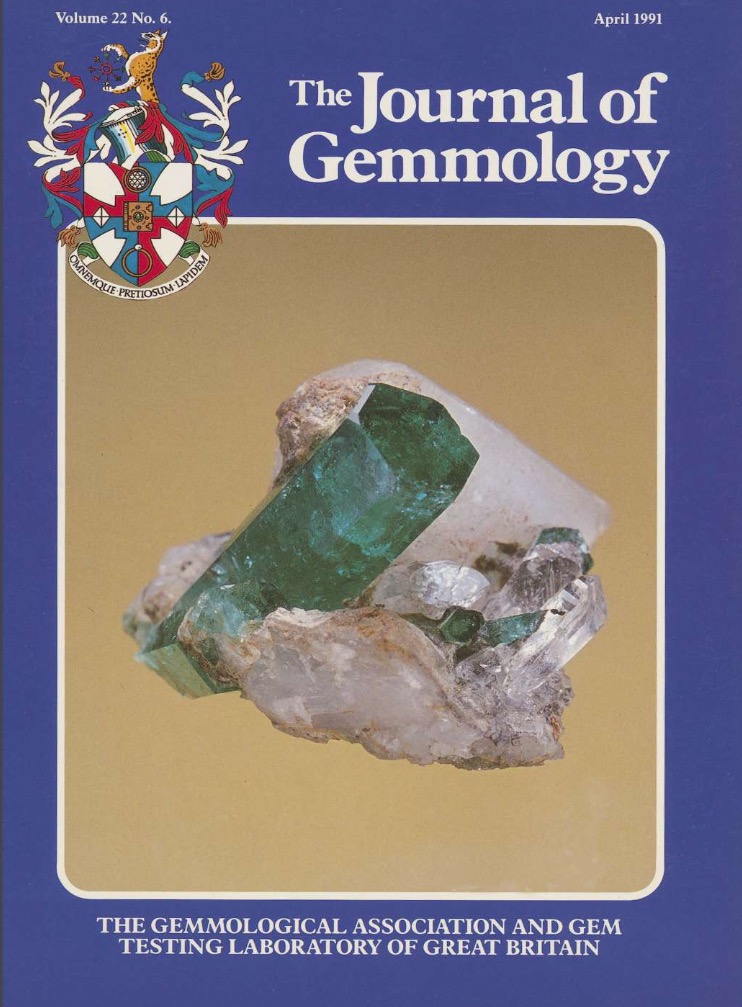
Bosshart, G. (1991) Emeralds of Colombia, (Part 1).Journal of Gemmology, Vol. 22, No. 6, April, pp. 355–361.
A condensed historical and mining survey is followed by a compilation of the most notable crystals of Colombian emeralds ever found and of the details of their chemical composition. A summary of the elemental substitutions and their effects on the outlined range of gemmological data is given. Special emphasis is placed on the cause of the famous, vividly green coloration, i.e. on the selective absorption of orange-red and violet light, dictated by minor contents of the chromophoric elements Cr and V substituting for Al³⁺ in octahedrally coordinated sites of the beryl lattice (Cr ≈ V, with the Cr/V ratio found to be ranging from 4.5 to 0.5, in extreme cases from about 10 to 0.1). Iron, however, has barely been detected in the UV/VIS absorption spectra of Colombian emeralds. Though generally present in slightly larger amounts than Cr³⁺, iron does not recognizably influence the colour (little Fe²⁺ and possibly some Fe³⁺ positioned in the axial channels of the ring-silicate structure). A detailed presentation of the currently known internal characteristics (inclusions and growth structures) is supplemented by a discussion of identification problems with treated emeralds and the disclosure of the treatment during transactions in the wholesale and retail trade. Allocation of the emeralds to individual Colombian mines on the basis of inclusion patterns does not appear possible in most instances. However, the differentiation of Colombian emeralds from other natural emeralds (such as those from the Panjsher Valley exhibiting very similar (s,l,g) three-phase inclusions) or from difficult, modern hydrothermal and flux synthetics is shown to be feasible by a combination of microscopy, refractometry, and absorption spectrometry (UV/VIS and NIR/MIR), assisted by chemical analysis only in the most difficult cases. Safe identification of authenticity, treatment, and origin of emeralds, however, is increasingly becoming the task of the experts in the specialized laboratory. The mineralogical definition of emerald as a yellowish to bluish-green variety of natural beryl is shown to be valid for any Cr and V-containing variety except possibly the rare, absolutely chromium-free (V,Fe)-beryls (modification of the former definition of type II emerald): in many of the preferred Colombian emeralds, chromium is clearly dominated by vanadium (Cr/V ratio < 1). However, chromium has a higher efficiency of coloration than vanadium and a much higher one than iron ions in the various substitutional and interstitial lattice sites of beryl. Cr influences colour even at very low trace levels. An extensive and up-dated selection of literature, covering all aspects cited, completes the synopsis.
Emeralds of the Panjshir Valley, Afghanistan
Journal Article
Bowersox, G.W., Snee, L.W., Foord, E.E. and Seal, R.R. (1991) Emeralds of the Panjshir Valley, Afghanistan.Gems & Gemology, Vol. 27, No. 1, Spring, pp. 26–39.
With the withdrawal of Soviet troops from Afghanistan, villagers in the Panjshir Valley are turning their attention to the emerald riches of the nearby Hindu Kush Mountains. Large, dark green crystals have been found in the hundreds of tunnels and shafts dug there. Teams of miners use explosives and drills to remove the limestone that hosts the emerald-bearing quartz and ankerite veins. The gemological properties of Panjshir emeralds are consistent with those of emeralds from other localities; chemically, they are most similar to emeralds from the Muzo mine in Colombia. Nodules," previously reported only in tourmaline and morganite, have been found in Panjshir emeralds as well. Approximntely $10 million in emeralds were produced in 1990; future prospects ore excellent."
Emeralds from the Ural Mountains, USSR
Journal Article
Schmetzer, K., Bernhardt, H.-J. and Biehler, R. (1991) Emeralds from the Ural Mountains, USSR.Gems & Gemology, Vol. 27, No. 2, Summer, pp. 86–99.
Emeralds are again being mined in the historic district of the Ural Mountains. Physical, chemical, spectroscopic, and ini-croscopic characteristics of stones from the recent production are presented and com-pared with data on older samples as well as those reported in the literature. Chemi-cal analysis and visible and infrared spec-troscopy provide information on crystal chemistry and color-causing trace ele-ments that is useful both to characterize these stones and to separate them from their synthetic counterparts. A variety of mineral inclusions as well as liquid, two-phase, and three-phase inclusions were seen with magnification. All of the data are critically evaluated with respect to the confirmation of unknown samples as Uralian.
The microscopic determination of structural properties for the characterization of optical uniaxial natural and synthetic gemstones. Part 3: Examples for the applicability of structural features for the distinction of natural and synthetic sapphire, ruby, amethyst and citrine
Journal Article
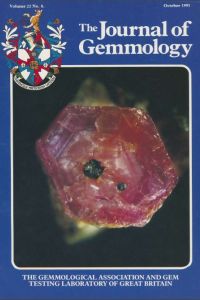
Kiefert, L. and Schmetzer, K. (1991) The microscopic determination of structural properties for the characterization of optical uniaxial natural and synthetic gemstones. Part 3: Examples for the applicability of structural features for the distinction of natural and synthetic sapphire, ruby, amethyst and citrine.Journal of Gemmology, Vol. 22, No. 8, October, pp. 471–482.
The application of diagnostic growth structures for the distinction of natural and synthetic optically uniaxial gem minerals such as corundum and quartz is discussed. Typical examples for the characterization of natural gem varieties of corundum and quartz are quoted, e.g. sapphires and rubies, amethysts and citrines from distinct sources are described by means of growth structures. In addition, their synthetic counterparts of some producers are compared using structural features of diagnostic value. Criteria, which are useful for the recognition of faceted gemstones as natural or synthetic, are underlined. Gem materials described in detail are natural sapphires from alkaline host rocks (Australian, Nigerian, Cambodian and Thai sapphires), Chatham synthetic sapphires, natural rubies from Malawi, Knischka synthetic rubies, natural amethysts and citrines from different sources as well as synthetic amethysts and citrines from different producers.
The growth of rubies in southeast Kenya
Journal Article
Key, R.M. and Ochieng, J.O. (1991) The growth of rubies in southeast Kenya.Journal of Gemmology, Vol. 22, No. 8, October, pp. 484–496.
Northern Vietnam began producing significant quantities of rubies and fancy sapphires in the late 1980s. Since then, mining has evolved at the two major producing areas: Luc Yen and Quy Chau. Heavy machinery is now used in both of these remote areas, but small-scale manual mining is ongoing. Efforts continue to establish organized cutting and distribution centers.
New rubies from the Morogoro area, Tanzania
Journal Article
Hänni, H.A. and Schmetzer, K. (1991) New rubies from the Morogoro area, Tanzania.Gems & Gemology, Vol. 27, No. 3, Fall, pp. 156–167.
corundum, ruby, Tanzania.12, East Africa, inclusions.5, gems
The authors present the mineralogical and gemological properties of rubies found recently in the Morogoro area of Tanzania that have many features in common with rubies from Myanmar (Burma) and other comparable marble-type deposits. Specifically, microscopic investigations of these Morogoro stones revealed some internal characteristics that are also seen in Burmese rubies-such as angular growth zoning, curved growth zoning (swirls"), negative crystals, spinel crystals, rutile needles, and clouds of minute particles in areas defined by both types of growth zones, which may also be related to color zoning. However, the Morogoro material appears to have (1) lower amounts of V and Ga than Burmese rubies, and (2) a characteristic angular growth with r, a, and r' faces. A gemological comparison of the recently produced Morogoro rubies with rubies found earlier in this area shows significant differences."
The Yogo sapphire deposit
Journal Article
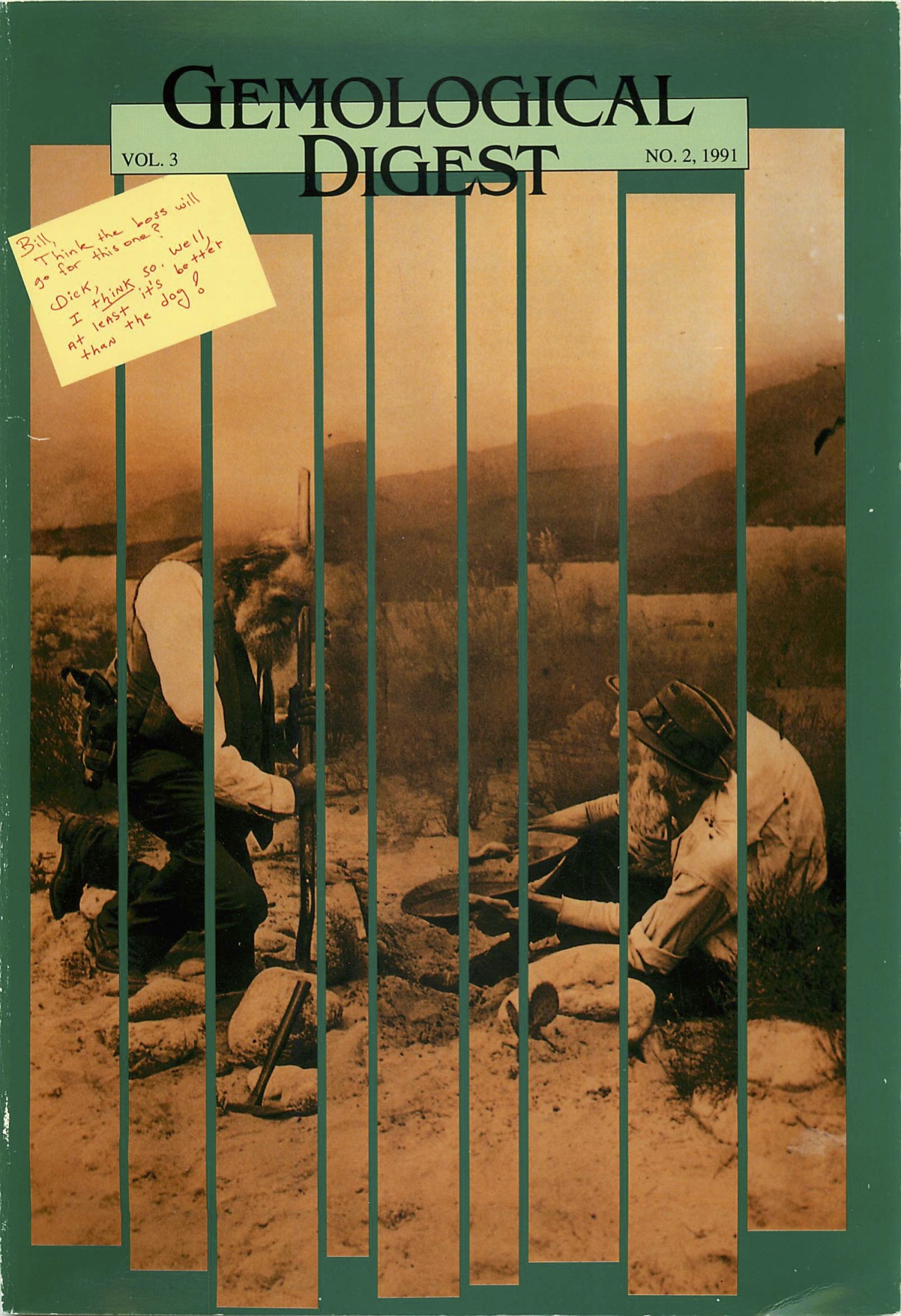
Allen, R.M. (1991) The Yogo sapphire deposit.Gemological Digest, Vol. 3, No. 2, pp. 9–16.
Record No. 1960 | Sinkankas/Born No.: NIS/NIB | RWHL*
Reference copied to clipboard!
corundum, inclusions.5, Montana.12, USA.12, gems
This article offers a brief description of the history and geology of the Yogo sapphire deposit the largest producer of gem sapphires in the Western Hemisphere. Until recently, the mine was largely inactive, and the factors leading to this period of low production and the associated economics of the deposit are discussed. Recent discoveries at the deposit and the development of a new mine in a sapphire rich zone mean that Yogo sapphires may become more well known than in the past. The gemology of this relatively inclusion-free and typically untreated gemstone is also discussed. Photographs of some of the inclusions that do exist are presented.
The Brazilian emeralds and their occurrences: Socotó
Journal Article
Schwarz, D. and Eidt, T. (1990) The Brazilian emeralds and their occurrences: Socotó.Journal of Gemmology, Vol. 22, No. 3, July, pp. 147–163.
Henn, U., Bank, H. and Bank-Scherner, M. (1990) Rubine aus dem Pamir-Gebirge, UdSSR. [Rubies from the Pamir Mountains, USSR]Zeitschrift der Deutschen Gemmologischen Gesellschaft, Vol. 39, No. 4, pp. 201–205.
Record No. 4807 | Sinkankas/Born No.: NIS/NIB | Language: In German | RWHL*
Describes gem-quality rubies from a marble-hosted deposit in the Pamir Mountains of the then USSR, near the Chinese border. The stones range from red through reddish to violet-red and have SG 3.98, refractive indices nₑ 1.761–1.762 and nₒ 1.769–1.770, and birefringence 0.008. Microscopic features include twinning lamellae, healed fissures, fluid inclusions, rutile dust and distinct growth striae. Trace-element analysis detected chromium, iron and titanium; absorption spectra show the characteristic chromium bands, and the stones exhibit strong red fluorescence.
Red and orange corundum (ruby and padparadscha) from Malawi
Journal Article
Henn, U., Bank, H. and Bank, F.H. (1990) Red and orange corundum (ruby and padparadscha) from Malawi.Journal of Gemmology, Vol. 22, No. 2, April, pp. 83–89.
Diehl, R. and Meng, K.H. (1990) Ein gravieter Kashmir-saphir. [An engraved Kashmir sapphire]Zeitschrift der Deutschen Gemmologischen Gesellschaft, Vol. 39, No. 4, pp. 193–200.
Record No. 4753 | Sinkankas/Born No.: NIS/NIB | Language: In German | RWHL*
Reference copied to clipboard!
corundum, sapphire, Kashmir.12, India.12, gems
Describes an unusual engraved Kashmir sapphire weighing 6.175 ct and measuring 12.19 × 10.04 × 5.32 mm. The antique-cut stone has 32 crown facets, a thin girdle and a pavilion arranged in four groups of 16 facets. Its characteristic silk and microscopic inclusions establish its Kashmir origin. The engraving depicts a lion seated upon a crown and was produced with fine diamond points using non-rotating tools. The complexity of the design would have made the seal difficult to counterfeit, and evidence indicates that the sapphire was repeatedly used as an official seal. Diehl and Meng suggest that it may have belonged to an Indian ruling family, possibly Sikh, although neither its precise provenance nor its age could be established.
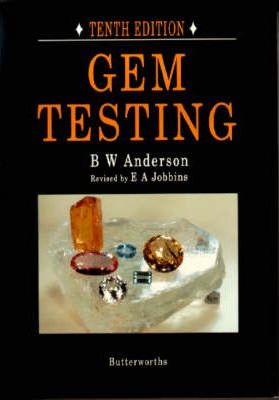
Gem Testing
Book
Anderson, B.W. and Jobbins, E.A. (1990)Gem Testing. London, Butterworths, 390 pp.
Record No. 4690 | Sinkankas/Born No.: NIS/NIB | RWHL*
Anderson’s Gem Testing is one of the most important gemology books of the 20th century. Revised many times as gemology changed, after his death, Alan Jobbins continued the tradition. Not surprisingly, this is the best of the editions, and should be on the shelf of every gemologist. In 2013, Anderson was named in the French Association of Gemmology’s 50 most influential gemmologists of all time.
Diagnostic features and heat treatment of Kashmir sapphires
Journal Article
Schwieger, R. (1990) Diagnostic features and heat treatment of Kashmir sapphires.Gems & Gemology, Vol. 26, No. 4, Winter, pp. 267–280.
A contribution to the distinguishing characteristics of sapphire from Kashmir
Journal Article
Hänni, H.A. (1990) A contribution to the distinguishing characteristics of sapphire from Kashmir.Journal of Gemmology, Vol. 22, No. 2, April, pp. 67–75.
This investigation was undertaken to contribute to the knowledge of sapphire from Kashmir, and over 50 cut stones were studied. Comparison of the observed inclusions with those described in other publications, identified in part using the scanning electron microscope SEM/EDS, confirmed the results of earlier findings (tourmaline, pargasite and zircon inclusions). In addition, some internal characteristics are newly described: plagioclase, uraninite, allanite and rutile (P) occurring in various forms, healed fissures and zoned growth. Spectral properties are presented. The significance of origin reports is discussed.
Exploring the Literature of Gemstone Inclusions
The literature of gemstone inclusions covers identification, origin determination, treatments, synthesis, mineral inclusions, fluid inclusions and other internal features of natural and synthetic gems.
Four Treasures is Lotus Gemology's freely accessible gemological reference database. Use the full database to search by author, title or keyword and explore literature on gemology, mineralogy, jewelry and related fields. Where available, hyperlinks on titles may lead directly to the full publication.