Gemstone Inclusions Bibliography

Gemstone Inclusions Bibliography

Explore books, articles and historical sources on inclusions in gemstones in Four Treasures, the Lotus Gemology reference database. This bibliography brings together matching records from the collection, with publication details, abstracts and cover images where available.

Gemstone Inclusion References

The list below matches the terms inclusion or inclusions in the database's searchable fields. Some references discuss inclusions as part of a broader subject.
401–420 of 1,247 matching references

Ruby and sapphire

Journal Article
Webster, R. (1957) Ruby and sapphire. Journal of Gemmology, Vol. 6, No. 3, July, pp. 101–146.
Record No. 1827  |  ISBN/ISSN: 221252  |  Sinkankas/Born No.: NIS/NIB  |  RWHL*
R. Webster presents a comprehensive review of ruby and sapphire, treating their historical associations, mineralogical properties, principal sources, manufacture by synthesis, and identification. Both gemstones are varieties of corundum, crystalline aluminium oxide, whose colours depend on minor constituents and their interaction with the host structure. The article describes crystal habits, colour ranges, twinning and parting, hardness, density, refractive indices, dichroism, absorption spectra, and luminescence, connecting these properties with practical examination and cutting orientation. Chromium accounts for ruby’s red colour and characteristic fluorescence, while the discussion of blue sapphire reviews contemporary interpretations involving iron and titanium and acknowledges unresolved aspects of the colouring mechanism. Spectral and fluorescence observations receive particular attention as diagnostic tools, but Webster stresses their limitations: fluorescence alone cannot reliably separate natural from synthetic ruby or establish geographical origin. He also cautions that trade descriptions such as Burma, Siam, and Ceylon may denote characteristic colour rather than verified provenance. Microscopic features, including rutile silk, mineral inclusions, liquid-filled cavities, healed fissures, colour zoning, and growth structures, are compared among stones from major producing regions. Oriented needles explain the reflected-light stars of suitably cut cabochons, with inclusion arrangement governing six-pointed stars, rarer twelve-pointed forms, and occasional cat’s-eyes. Accounts of Burma, Siam, Kashmir, Ceylon, Australia, Montana, and lesser sources combine geological occurrence with mining history and production methods. The Mogok discussion is especially extensive, tracing local administration, the operations and difficulties of the Burma Ruby Mines company, and changes in extraction technology. A substantial section follows attempts to manufacture ruby from early crucible experiments and so-called reconstructed stones to Verneuil’s commercially successful flame-fusion process. Webster explains furnace operation, feed preparation, boule growth, colouring additives, and the production of synthetic star corundum through titanium addition and subsequent heating. Because synthetic and natural corundum share essentially the same bulk physical properties, identification depends chiefly on growth structures and inclusions, supported by spectroscopy and ultraviolet transmission. Curved growth lines, colour bands, and characteristic gas bubbles are contrasted with natural internal features, while deceptive inclusions and inconclusive tests are discussed. Glass, garnet-topped doublets, and imitation star stones are also examined, including mirrored rose-quartz cabochons and artificially engraved stars. Photographs, diagrams, and a selected bibliography support a practical synthesis of corundum gemmology as understood at the time.

The emerald from Habachtal

Journal Article
Gübelin, E.J. (1956) The emerald from Habachtal. Gems & Gemology, Vol. 8, No. 10, Summer, pp. 295–309.
Record No. 2045  |  ISBN/ISSN: 0016626X  |  Sinkankas/Born No.: 2563  |  RWHL*
Gübelin investigates whether emeralds from Habachtal, Austria, possess characteristics that distinguish them from emeralds of other origins, combining a review of mining history and geology with measurements and detailed microscopic examination. He recounts the deposit’s reported exploitation from antiquity onward and the repeated difficulties encountered by later mining ventures. Its position at approximately 2,100 metres in the Hohe Tauern, hazardous access, prolonged winters, modest production, and short mining licences are presented as obstacles to sustained commercial development. The emerald-bearing zone lies near the contact between central gneiss and surrounding schists. Gübelin interprets its formation through contact metamorphism and the interaction of granitic residual solutions with neighbouring rocks, assigning the beryllium supply to granite and the chromium responsible for green colour to serpentinite. Biotite schist is the principal host, accompanied by tremolite, actinolite, chlorite, and talc-rich rocks; he draws parallels with emerald deposits in the Urals, India, and the Transvaal. Most local beryl is pale or greyish green, while only a small proportion displays fine emerald colour, and abundant inclusions commonly diminish transparency and value. Crystals generally show simple prismatic forms, sometimes flattened according to their orientation within the schist. Measurements on eleven specimens establish average refractive indices of approximately 1.591 and 1.584, birefringence near 0.007, and an average specific gravity of 2.74. Dichroism is generally weak, combining yellowish green and bluish green, and the absorption spectrum is typical of emerald. Chelsea-filter reactions range from pink to red; ultraviolet fluorescence is usually suppressed, attributed to iron, although some specimens fluoresce red and the response under a Stokes fluoroscope is more conspicuous. The principal diagnostic evidence comes from inclusions and internal fractures. Gübelin describes frequent basal cracks, intersecting fracture systems, healed fissures, and liquid-filled cavities or negative crystals, commonly containing two phases and forming dense featherlike patterns. Biotite is the most abundant mineral inclusion, occurring as isolated plates, clustered books, or material extending inward from the matrix, sometimes altered or strongly resorbed. Other identified inclusions include tremolite, tourmaline, apatite, epidote, sphene, and rutile. Emeralds associated with tremolite-bearing rocks are generally clearer and less fractured than those from biotite schist, though often more bluish, and contain green needles, rods, or blades that may cross the entire crystal, terminate internally, form bundles, or bend. Gübelin regards the appearance of these tremolite inclusions as especially characteristic of Habachtal and valuable for recognizing cut stones, while acknowledging resemblance to amphibole inclusions in Ural emeralds. Photomicrographs document the inclusion assemblages, supporting the article’s central connection between geological environment, internal features, and the assessment of geographic origin.

Sapphires in India and Kashmir

Journal Article
Brown, J.C. (1956) Sapphires in India and Kashmir. The Gemmologist, Vol. 25, No. 298, pp. 78–80; No. 299, 97–100; No. 300, 129–132.
Record No. 524  |  Sinkankas/Born No.: NIS/NIB  |  RWHL*

Inclusions as a Means of Gemstone Identification
Book
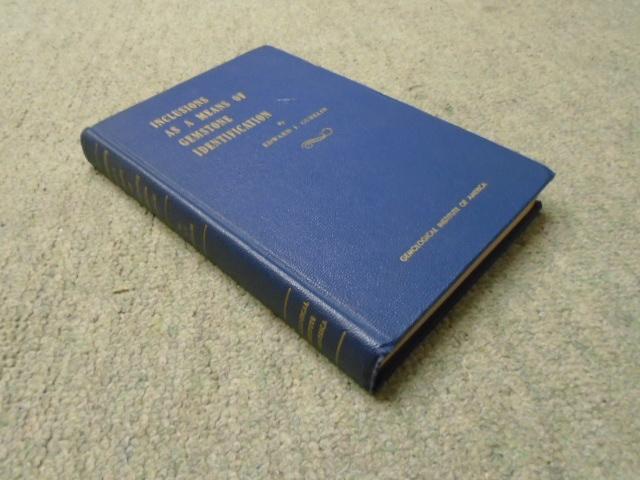
Gübelin, E.J. (1953) Inclusions as a Means of Gemstone Identification. Los Angeles, GIA, 220 pp.
Record No. 6416  |  Sinkankas/Born No.: 2562  |  RWHL*
Sinkankas: Unique among gemological monographs because of its very large number of inclusion photographs, taken by the author and clearly explained in the accompanying text. Preliminary chapters discuss inclusions in general, their types, formational causes, typical forms or accumulations, and inclusions in synthetic gem materials, glasses, and assembled stones. The work treats diamond, corundums, tourmalines, beryls, garnets, topaz, spinels, quartzes, peridot, moonstone, andalusite, kyanite, zircon, and fluorite. The color frontispiece shows inclusions in natural sapphire and ruby. A greatly enlarged color-plate version of this work, entitled Innenwelt der Edelsteine (1973), which see, provides essentially the same information, augmented with new material, but the present work continues in demand because it is more readily understood in some respects and more easily referred to. It is now rare. Review: Webster, The Gemmologist, 22, 1953, pp. 53–54, “cannot be overlooked … for the subject dealt with may be found in no other book studied in such great detail and from … a writer who has studied the subject so fully.” See also his comments in Journal of Gemmology, 4(2), 1953, pp. 78–80.

Oriented lines in synthetic corundum

Journal Article
Plato, W. (1952) Oriented lines in synthetic corundum. Gems & Gemology, Vol. 7, No. 7, Fall, pp. 223–224.
Record No. 1427  |  ISBN/ISSN: 0016626X  |  Sinkankas/Born No.: NIS/NIB  |  RWHL*
Straight, crystallographically oriented lines in synthetic corundum are described as a potentially useful identification feature that can resemble the angular colour zoning commonly associated with natural ruby and sapphire. Natural corundum colour bands follow definite crystallographic planes, whereas the curved accumulation bands of synthetic boules follow successive growth surfaces and have no fixed relationship to the optic axis. The additional lines examined here differ from these curved growth bands and from the comparatively rare twin lines found in synthetic material. Their associated planes are parallel to the optic axis, and they are difficult to detect because they become visible only within a restricted range of viewing orientations. Examination begins by locating the optic axis in convergent polarised light and orienting the stone so that the interference cross is centred in the microscope field. Observation in parallel polarised light while rotating the stage then reveals one, two or three systems of straight lines, with intersecting systems meeting at approximately 60° or 120°. The lines are accompanied by irregular shadows attributed to strain-induced, patchy extinction, and their intersections may display radiating effects resembling those around inclusions in garnet. With unpolarised light the straight lines remain visible throughout rotation; with a polariser or analyser alone they appear sharp when its vibration direction parallels them and disappear when it is perpendicular. Their orientation bears no consistent relationship to the boule’s accumulation bands. The associated shadow effects are interpreted as consequences of internal tension and are most conspicuous in strongly strained regions. Changes in the interference figure provide an additional indication of strain: a central neutral region may retain a normal cross, while towards the boule margins the cross opens according to the direction of internal pressure. Nearly all the many synthetic stones examined displayed individual lines or one or more line systems, including rubies and blue, other coloured and colourless sapphires. Colourless synthetic sapphire also showed fine straight lines perpendicular to the optic axis, detectable under strongly restricted illumination and liable to disappear with slight rotation. Natural corundum zoning can be distinguished by its behaviour under crossed polars and its lack of the characteristic shadow effects described in synthetics. These oriented lines therefore offer a supplementary means of recognising synthetic corundum, particularly yellow or lightly coloured stones in which curved growth striae and diagnostic inclusions cannot be found.

The diagnostic importance of inclusions in gemstones
Journal Article
Gübelin, E.J. (1950) The diagnostic importance of inclusions in gemstones. Journal of Gemmology, Vol. 2, No. 7, July, pp. 281–303.
Record No. 2037  |  ISBN/ISSN: 221252  |  Sinkankas/Born No.: NIS/NIB  |  RWHL*
E.J. Gübelin examines the diagnostic value of gemstone inclusions, extending his earlier general survey into a comparative account of internal features characteristic of particular gem species and localities. He argues that inclusion microscopy deserves a position alongside refractive-index measurement and absorption spectroscopy as a principal identification method, with applications extending beyond the separation of natural stones from synthetics and imitations. Improved dark-field illumination and a rotating specimen holder facilitate examination from different directions, allowing the observer to assess enclosed crystals, cavities, fluids, fractures, and their spatial relationships. The central principle is that diagnostic significance depends less on the isolated presence of an inclusion than on its recurrent appearance, morphology, arrangement, distribution, association with other internal features, and correspondence with minerals accompanying the host in its deposit. Numerous photomicrographs support descriptions organized principally by gemstone. Diamond inclusions include mineral crystals, enclosed diamonds, clouds, and fractures whose forms may preserve evidence of original growth surfaces and crystal orientation; Gübelin challenges the trade’s indiscriminate description of dark inclusions as carbon spots. Corundum receives detailed treatment, with contrasting inclusion assemblages attributed to Burma, Ceylon, and Siam. These include differing forms of silk, mineral crystals, zircon-related halos, liquid feathers, and opaque crystals associated with surrounding fluid features. Kashmir sapphire’s haziness is interpreted through extremely fine internal cracks or channels. Among beryls, the shapes and contents of liquid cavities, particularly three-phase inclusions containing liquid, gas, and crystals, are emphasized in emerald identification and geographical comparison. Aquamarine is discussed through fluid-filled channels and distinctive crystalline formations, while Gübelin acknowledges that similarly useful features had not been established for several other beryl colours. Garnet varieties illustrate the importance of inclusion arrangement: demantoid contains characteristic fibrous bundles, red garnets display three-dimensional distributions of needles, hessonite combines crystalline inclusions with a streaked internal appearance, and spessartite exhibits distinctive liquid-droplet feathers. Further examples include tourmaline trichites, ordered microscopic crystals in spinel, branching fissures associated with moonstone twin lamellae, angular structures in green metamict zircon, cleavage-related fissures in kyanite, and tetrahedral fluid cavities in fluorite. Gübelin recognizes that superficially similar inclusions can require considerable experience to distinguish and that some enclosed minerals remain unidentified. The article therefore offers selected diagnostic examples rather than an exhaustive inventory. It concludes that systematic study of internal mineral associations can unite practical identification with investigation of gemstone genesis, providing a productive field of collaboration among gemmologists, mineralogists, and crystallographers.

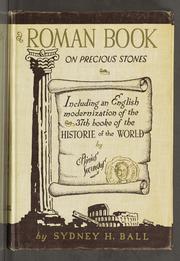
A Roman Book on Precious Stones

Book
Ball, S.H. (1950) A Roman Book on Precious Stones. Los Angeles, Gemological Institute of America, 338 pp.
Record No. 413  |  Sinkankas/Born No.: 333; NIB  |  RWHL*
Sinkankas: Adapted from the English translation of Philemon Holland, 1601. Published posthumously from materials assembled and edited by Kay Swindler of the Gemological Institute staff, but her services are not mentioned. Ball states (pref.): “Rightly or wrongly, I have for some years felt that the outstanding classical book on precious stones, the 37th book of Pliny’s Natural History, has never been edited by one well versed in the lore of precious stones.” With this goal in view, Ball provides an excellent study of Pliny’s book on gemstones, basing it on Philemon Holland’s London translation of 1601. D. E. Eichholz, in his translation of the same chapter (Loeb Classical Library, which see), comments that Ball’s work “contains a translation… with introductory chapters and a commentary, but the commentary is affected by the translation, which is merely a modernization of Philemon Holland’s version.” This statement may lend the impression that Ball’s book is trivial, and while there may be some merit in Eichholz’s remark, the fact remains that Ball’s translation and commentary, plus his introductory material, contain so much valuable information that one can look in vain elsewhere to find an equivalent fund of Plinian gemological knowledge. Furthermore, unlike Eichholz, Ball’s vast experience makes his comments and even his speculations perhaps more worthy of serious attention. The book is divided into three sections, with 15 chapters, the translation, and the commentary. In the introduction are treated such topics as Pliny himself, the authorities cited by him, his expertise in mineralogy and gemology, contemporary Roman jewelry, jewelers and lapidaries, sources of gemstones (with table), a historical summary of ancient commerce in gemstones, values and rankings of gemstones in Pliny’s day, gem mining, falsifications, and, importantly, attempts to correlate gemstones mentioned by Pliny with modern species and varieties (also with tables). The second part is the translation, specially decorated and printed upon tan paper. The third part, by far the most extensive, is the commentary and contains a wealth of ancillary information as well as discussions of etymological problems and obscure passages. While nearly all of the book is based on Pliny’s 37th book, Ball also adds Holland’s translation of the chapters of the 36th book wherein are treated gagates (jet) and obsidianus (obsidian). Rev. R. Webster, The Gemmologist, vol. 19, 1950, p. 211–12: “a volume built upon much painstaking research and the correlated information of years of work by one who understood gemstones;” also The Gemmologist, 2, 7, 1950, p. 317–19; P. Jordan Smith, Gems & Gemology, 6, 9, p. 323.

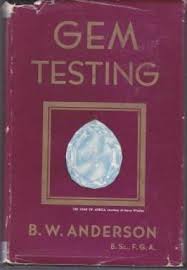
Gem Testing

Book
Anderson, B.W. (1948) Gem Testing. New York, Emerson Books, 256 pp.
Record No. 16796  |  Sinkankas/Born No.: 123  |  RWHL*
A practical introduction to scientific gem identification written primarily for jewellers, dealers, and pawnbrokers without formal gemmological training. Drawing on his experience at the Precious Stone Laboratory of the London Chamber of Commerce, Anderson explains how simple instruments and observations can supplement traditional visual identification and distinguish natural gemstones from synthetics and imitations. The opening chapters describe the principles and practical use of the refractometer, double refraction, colour filters, dichroscope, specific gravity measurements, microscope, and spectroscope. Particular attention is devoted to detecting synthetic corundum through curved growth lines, gas bubbles, colour zoning, and the absence of characteristic natural inclusions, with additional discussions of synthetic spinel, synthetic emerald, glass imitations, and composite stones. Subsequent chapters provide systematic identification procedures for diamond, ruby, sapphire, emerald, opal, alexandrite, zircon, aquamarine, topaz, quartz, garnet, tourmaline, peridot, spinel, and numerous other gem materials, including translucent and opaque stones. Organic materials such as amber, tortoiseshell, coral, jet, and pearls are also examined, with methods for distinguishing natural, cultured, and imitation pearls. Throughout, Anderson emphasizes inexpensive, nondestructive tests, practical experience, and the use of several independent observations to establish reliable identifications. Numerous photomicrographs, diagrams, comparative tables, and an appendix of gem properties complement the text. Published during the Second World War, the book provides an important historical record of gemmological testing techniques and instrumentation available to the jewellery trade in the early 1940s, particularly the developing importance of microscopy, absorption spectroscopy, and the Chelsea colour filter.

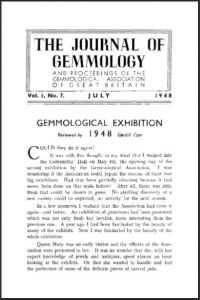
Gemstone inclusions

Journal Article
Gübelin, E.J. (1948) Gemstone inclusions. Journal of Gemmology, Vol. 1, No. 7, July, pp. 7–39.
Record No. 2032  |  ISBN/ISSN: 221252  |  Sinkankas/Born No.: NIS/NIB  |  RWHL*
E.J. Gübelin presents gemstone inclusions as records of geological formation and practical evidence for identifying gem species, distinguishing natural stones from manufactured materials, and investigating geographical provenance. Rejecting the view that inclusions are merely defects, he emphasizes their scientific significance, visual fascination, and capacity to preserve features of a crystal’s history. The discussion combines an explanation of formation processes with an extensive series of photomicrographs illustrating internal structures in natural and synthetic gems. Gübelin first classifies inclusions by their timing relative to the host crystal: pre-temporary inclusions existed before incorporation, con-temporary inclusions formed or were trapped during growth, and post-temporary inclusions developed through later alteration, recrystallization, or fracturing. For descriptive and diagnostic purposes, he then distinguishes solid inclusions, internal cavities containing liquids or gases, feathers and flags associated with fissures, and growth phenomena such as twinning and colour zoning. Solid inclusions encompass recognizable crystals, needles, grains, flakes, and less distinctly crystallized matter. Examples include rutile, mica, quartz, corundum, pyrite, garnet, zircon, amphiboles, and calcite. Their morphology, arrangement, optical appearance, and relationship to the host may be more readily diagnostic than exact mineral identification. Particular attention is given to oriented rutile producing silk and asterism, and zircon inclusions surrounded by radiation-related halos. The treatment of cavities explains negative crystals, liquid inclusions with gas bubbles, immiscible liquids, and combinations of solid, liquid, and gaseous phases, with three-phase inclusions emphasized in Colombian emeralds. Feathers and flags are interpreted as systems of fractures, droplets, and channels whose appearance depends on their contents, orientation, and illumination. Gübelin compares these structures with the wispy internal formations observed in contemporary synthetic emeralds. Growth features provide another major means of distinction: natural crystals commonly display straight or angular zoning reflecting successive growth surfaces, whereas flame-fusion synthetic corundum characteristically exhibits curved striae associated with boule formation. Gas bubbles, unfused particles, and bubbles concentrated along the joining plane of composite stones offer further diagnostic evidence. He stresses that conclusions require familiarity gained through examining many specimens and recognizing combinations of internal features. Microscopy is placed alongside refractive-index measurement and absorption spectroscopy as a principal gem-testing method. Beyond classification, Gübelin advocates documenting distinctive inclusions photographically to identify individual stones, even when their weight or external appearance has been altered by recutting. The article presents inclusion research as a developing field linking practical gemmology with mineralogical history and calls for further collaboration among mineralogists, gemmologists, chemists, and physicists.

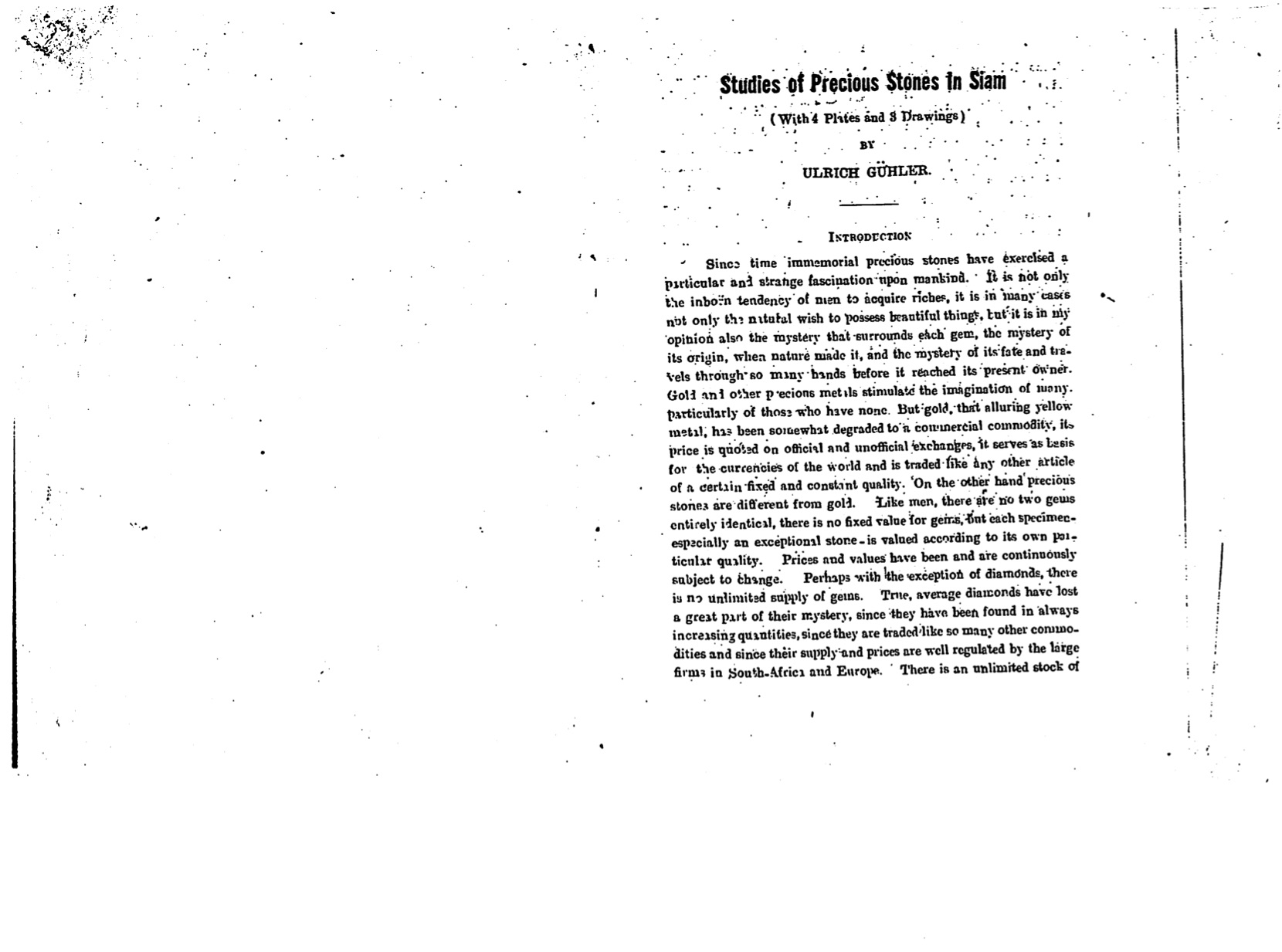
Studies of precious stones in Siam

Journal Article
Gühler, U. (1947) Studies of precious stones in Siam. Siam Science Bulletin, Vol. 4, pp. 1–39.
Record No. 908  |  Sinkankas/Born No.: NIS/NIB  |  RWHL*
Ulrich Gühler surveys the properties, occurrence, mining, cutting, and trade of precious stones in Siam, combining published historical and scientific accounts with personal observations and more than twenty years of commercial experience. The study concentrates on sapphire and ruby, while also discussing zircon, black spinel, topaz, garnet, and unconfirmed reports of local diamonds. Introductory mineralogical descriptions address crystal form, hardness, specific gravity, optical behaviour, colour, inclusions, and defects, linking these characteristics to identification, cutting, and valuation. Zircon receives particular attention for the colour changes produced by heating under oxidising or reducing conditions and the subsequent instability of some treated stones. Historical references establish the long-standing recognition of Siamese gem resources, followed by regional accounts of Pailin, Chanthaburi, Trat, northern occurrences, and Bo Ploi in Kanchanaburi. The Bo Ploi discussion draws on repeated visits and earlier geological investigations, describing sapphire-bearing weathered material, associated black spinel, discoveries in the parent rock, fluctuating production, concession arrangements, and the hazards of speculative mining. Gühler outlines recovery through small pits, excavation, washing, and hand sorting, emphasizing the importance of Burmese and Shan miners and the uncertain rewards for both labourers and concession holders. The commercial section follows stones from rough parcels through cutting, sorting, bargaining, export, wholesale distribution, and retail sale. Colour, transparency, weight, rarity, brilliance, proportions, and visible flaws govern value, while attempts to preserve excessive weight during cutting can impair optical performance. Comparisons distinguish typical Pailin and Kanchanaburi sapphires and contrast generally darker Siamese rubies with Burmese material. A proposed numerical valuation scheme is offered cautiously as an aid to comparison rather than a definitive price formula. Tables document approximate Bangkok prices before, during, and after the war, with exchange-rate changes, hoarding, smuggling, and incomplete statistics complicating interpretation. Gühler also explains the commercially introduced “small carat” method of pricing zircon and criticizes its potential to obscure price increases. A final chapter considers Verneuil synthetic corundum, diagnostic curved growth lines and gas bubbles, risks of misrepresentation, and the continuing appeal of natural stones despite inexpensive manufactured alternatives. An appendix corrects his initial scepticism about synthetic star corundum, reporting B.W. Anderson’s confirmation that asterism is produced by fine rutile needles and describing features useful for detection. The study concludes optimistically that systematic exploration, improved organization, machinery, and investment could expand Siam’s gem industry and its contribution to national income.

Gem Testing for Jewellers

Book
Anderson, B.W. (1942) Gem Testing for Jewellers.
Record No. 236  |  Sinkankas/Born No.: 120  |  RWHL*
A practical introduction to scientific gem identification written primarily for jewellers, dealers, and pawnbrokers without formal gemmological training. Drawing on his experience at the Precious Stone Laboratory of the London Chamber of Commerce, Anderson explains how simple instruments and observations can supplement traditional visual identification and distinguish natural gemstones from synthetics and imitations. The opening chapters describe the principles and practical use of the refractometer, double refraction, colour filters, dichroscope, specific gravity measurements, microscope, and spectroscope. Particular attention is devoted to detecting synthetic corundum through curved growth lines, gas bubbles, colour zoning, and the absence of characteristic natural inclusions, with additional discussions of synthetic spinel, synthetic emerald, glass imitations, and composite stones. Subsequent chapters provide systematic identification procedures for diamond, ruby, sapphire, emerald, opal, alexandrite, zircon, aquamarine, topaz, quartz, garnet, tourmaline, peridot, spinel, and numerous other gem materials, including translucent and opaque stones. Organic materials such as amber, tortoiseshell, coral, jet, and pearls are also examined, with methods for distinguishing natural, cultured, and imitation pearls. Throughout, Anderson emphasizes inexpensive, nondestructive tests, practical experience, and the use of several independent observations to establish reliable identifications. Numerous photomicrographs, diagrams, comparative tables, and an appendix of gem properties complement the text. Published during the Second World War, the book provides an important historical record of gemmological testing techniques and instrumentation available to the jewellery trade in the early 1940s, particularly the developing importance of microscopy, absorption spectroscopy, and the Chelsea colour filter.

Differences between Burma and Siam rubies
Journal Article
Gübelin, E.J. (1940) Differences between Burma and Siam rubies. Gems & Gemology, Vol. 3, No. 5, Spring, pp. 69–72.
Record No. 3182  |  ISBN/ISSN: 0016626X  |  Sinkankas/Born No.: NIS/NIB  |  RWHL*

Kashmir sapphires

Journal Article
Halford-Watkins, J.F. (1935) Kashmir sapphires. The Gemmologist, Vol. 4, No. 42, January, pp. 167–172.
Record No. 918  |  Sinkankas/Born No.: NIS/NIB  |  RWHL*

The Book of Amber

Book
Williamson, G.C. (1932) The Book of Amber. London, Ernest Benn Limited, 268 pp.
Record No. 4310  |  Sinkankas/Born No.: 7247  |  RWHL*
An exceptionally comprehensive and learned survey of all phases of the knowledge of amber as then known, and holding its place as the preeminent work on the subject in the English language until the recent appearance of P Rice's Amber: The Golden Gem of the Ages, 1980, which see. Rice's work contains much new information but does not entirely supersede Williamson's highly interesting monograph. The first chapters treat amber in general, discuss classical allusions, nomenclatural problems, the amber routes of antiquity, and the place of amber in anthropology and archeology. Amber is next considered as a substance with remarks on the geology of deposits, and the many inclusions of plant and animal life that have been found in it. Rather strangely, the flow of information on the natural history is here interrupted by a chapter on amber in art, after which the text returns to discussion of the famous amber deposits of the Baltic region, also those in England, and then again, rather jarringly, amber is discussed as a medicinal material and uses in amulets, or other lorical applications. However, from this point, the text treats amber in Sicily, Romania, and Burma, remarks on the similar-sounding ambergris, describes other fossil resins, the making of amber varnish, and amberoid or pressed amber. The bibliography is very extensive, possibly the largest to be assembled up to that time, but the entries lack paginations, and some lack the names of journals from which taken, and others are trivial. Rev K Andree, Bernstein-Forschungen, 3, 1933, 212. Copies are scarce and still much in demand. There is a reprint of same date in sepia-brown cloth, the gold spine Jett usually tarnished to copper.

Die künstlichen Edelsteine

The Artificial Gemstones
Book
Michel, H. (1926) Die künstlichen Edelsteine. [The Artificial Gemstones] Leipzig, Verlag von Wilhelm Diebener, 477 pp.
Record No. 1264  |  Sinkankas/Born No.: 4449; NIB  |  Language: in German  |  RWHL*
Sinkankas: Expanded, re-worked edition bearing little resemblance to its predecessor in respect to quantity of information and illustrations. New matter: formation of minerals in nature, more information on synthesis methods, new synthetic varieties, enlarged discussion of falsifications, imitations, and general problem of detection. In this connection, Ch. 3, on discrimination, now has become virtually a treatise on the principles and practice of gemological identification; it provides one of the earliest useful routines for the gemologist to follow, explaining the methods and their value, tests, gives examples of real identifications, a review of useful apparatus & accessories, and tables for identification purposes. The final chapter on pearls is much expanded also. Rev. W.F. Foshag, Amer. Min., 12, 6, 1927, 263.

The sapphire fields of Anakie

Journal Article
Dunstan, B. (1902) The sapphire fields of Anakie. Geological Survey of Queensland, Publications, pp. 1–26.
Record No. 683  |  Sinkankas/Born No.: 1807; NIB  |  RWHL*
Sinkankas: The first geological-mineralogical report on the famous Anakie gem corundum field and almost as interesting for its remarkable color plates as for its text. Describes general geology, details on specially productive areas, advice to prospectors, and much incidental information also useful to the lapidary and gemologist as washing sapphire-bearing gravel, the crystal forms of corundum, zircon and spinel, a note of a diamond discovery at one of the localities, a list of minerals found, historical notes, notes on foreign deposits, and descriptions of the plates. Though crudely executed, the plates depict sapphire crystals in various forms and inclusions in them, and appear to be the first colored illustrations of Anakie sapphires. Among the color plates is one that shows corundum faceted gems, brilliant-cut, in a variety of hues. An extremely scarce report.

The Bishop Collection: Investigations and Studies in Jade
Book
Bishop, H.R. (1900) The Bishop Collection: Investigations and Studies in Jade. Mershon, NJ, privately published, 378 pp.
Record No. 4323  |  Sinkankas/Born No.: 661  |  RWHL*
Sinkankas: Jade as a mineral, p l–14 (with F W Clarke, on jade colors, 6–10); SL Penfield, crystalline system, optical properties, 14–17; C Palache, properties & table, 17–36; JP Iddings, microscopic petrography, 37–60; tenacity, 60–62; L W Page, impact tests, 62–70; I H Woolson, compression & tension tests, 70–93, 93–95; fracture, hardness, 95–98; TA Jaggar, microsclerometer hardness tests, 98–110; W Hallock, SG, 111–15; sonorousness, 116–9; W Hallock, sonorousness tests, 120–4; F W Clarke, chemical constitution, 125–77; S L Penfield, chemical notes, 177–96; inclusions, 197–99; L V Pirsson, origin of jadeite, 200–7; JP Iddings, relation of jadeite to nephrite, 208–12; HS Washington, localities, geol occurrences, 213–64; G F Kunz, minerals mistaken for, 265–84; S W Bushell, jade in China, 285–320, also by Bushell: Yii-Shuo, a discourse on jade ... by T'ang Jung-Tso styled Hsi-Wu ... translated by Stephen W Bushell, p 321–66, with an appendix giving titles of 71 books quoted in the discourse, p 367–70, and illustrations of the modem manu- facture of jade... by Li Shih-Ch'iian, styled Cheng-Yuan, p 371–78 [actually descriptions of the illustrations and not the illustrations themselves, which are not given here]. Because of its importance, this contribution is described separately, see T'ANG JUNG-TSO.Aside from the detailed work on jades by H Fischer (l880), which see, no other work, even now, approaches the above for its wealth of property data; the occurrences section by Washington is richly supplied with bibliographical footnotes of continuing value to students of jades. Bushell's translation seems to be found nowhere else save here. This book, apparently printed in very few copies and probably for extremely limited private circulation is so rare that I have not seen advertised another copy in thirty years.

Jade

Book
Bishop, H.R. (1900) Jade. New Jersey, privately published, Mershon Company Press, 378 pp.
Record No. 2714  |  Sinkankas/Born No.: 661; Born: pp. 71–72  |  RWHL*
Bishop presents a preliminary collection of scientific and historical studies of jade, undertaken with the cooperation of mineralogists, chemists and Chinese scholars and drawing extensively on specimens in his collection. The volume distinguishes jadeite and nephrite by their chemical composition, mineral structure and physical properties, while examining the colours, translucency, optical behaviour and inclusions of both materials. Microscopic investigations describe their granular and fibrous textures, and experimental studies measure hardness, specific gravity, resistance to impact, compression and tension, and sonorousness. Particular attention is given to jade’s exceptional toughness and its relationship to the interlocking structure of its constituent minerals. Contributions by J.P. Iddings, F. W. Clarke, L.V. Pirsson and others explore chemical constitution, geological origin and possible transformations between jade-bearing rocks, presenting interpretations within the scientific knowledge then available. Henry S. Washington surveys geographical occurrences, distinguishing deposits observed in place from transported boulders, worked objects and uncertain locality reports, and discusses their implications for ancient trade and cultural connections. George Frederick Kunz examines minerals confused with jade, artificially coloured substitutes and glass imitations, outlining methods of discrimination. The historical sections concentrate on China: Stephen W. Bushell discusses jade-producing regions, varieties, literature, imperial collecting and ritual uses, and translates T’ang Jung-tso’s Yü Shuo, a discourse addressing sources, value, colours, antiquities, objects and the employment of jade by emperors and the state. Its supporting bibliography identifies 71 Chinese works. A concluding account associated with the artist Li Chêng-yuan describes contemporary manufacturing processes, from preparing abrasive sands and sawing rough blocks to shaping, hollowing, drilling, openwork carving and polishing. Together, these contributions connect jade’s mineralogical properties with its practical working, aesthetic appreciation and cultural significance.

Die steinigen Gemengtheile im Meteoreisen von Toluca in Mexico
The stony inclusions in the meteoric iron from Toluca in Mexico
Journal Article
Laspeyres, H. (1897) Die steinigen Gemengtheile im Meteoreisen von Toluca in Mexico. [The stony inclusions in the meteoric iron from Toluca in Mexico] Zeitschrift für Krystallographie und Mineralogie, Vol. 27, pp. 586–600.
Record No. 6478  |  Sinkankas/Born No.: NIS/NIB  |  Language: in German  |  RWHL*
Article about the first discovery of kosmochlor (ureyite). Laspeyres investigates the stony inclusions enclosed within the Toluca iron meteorite of Mexico, treating them as mineralogical components capable of providing information on the meteorite’s composition and history. He describes the appearance, distribution, and microscopic character of the inclusions and identifies their constituent minerals through crystallographic, optical, and chemical observations. Particular attention is given to silicate minerals embedded in the metallic iron and to their relationships with one another and with the surrounding meteoritic metal. Laspeyres compares these constituents with minerals known from other meteorites and terrestrial rocks, discussing their mineralogical identity and the implications of their occurrence within an iron meteorite. The paper contributes to the late nineteenth-century investigation of the Toluca meteorites by demonstrating that apparently metallic masses can contain a complex assemblage of stony mineral inclusions and by documenting the mineralogical character of those inclusions in detail.

The rubies of Burma and associated minerals; their mode of occurrence, origin and metamorphoses: A contribution to the history of corundum

Journal Article
Brown, C.B. and Judd, J.W. (1896) The rubies of Burma and associated minerals; their mode of occurrence, origin and metamorphoses: A contribution to the history of corundum. Philosophical Transactions of the Royal Society of London, Series A, Vol. 187, pp. 151–228.
Record No. 4717  |  Sinkankas/Born No.: 957; NIB  |  RWHL*
Brown and Judd present a detailed investigation of the ruby deposits of Burma, based on geological observations and specimens collected by Brown and mineralogical and petrographic examination by Judd. They describe the occurrence of ruby at Mogok and neighboring localities, emphasizing its association with crystalline limestone and the minerals accompanying it, and distinguish primary occurrences from the secondary gem-bearing deposits produced by weathering and erosion. Microscopic study is used to investigate the structure of corundum and the numerous inclusions, alterations, and secondary minerals developed within or around the crystals. Particular attention is given to the transformation of corundum into other minerals and to the evidence these changes provide concerning the geological history of the ruby-bearing rocks. The authors discuss the probable origin of Burmese ruby, the metamorphic processes affecting the deposits, and the subsequent concentration of resistant corundum crystals in superficial deposits. The paper is an important early study combining field geology, mineralogy, and petrography to explain the occurrence, origin, and alteration of the rubies of the Mogok district.

Exploring the Literature of Gemstone Inclusions

The literature of gemstone inclusions covers identification, origin determination, treatments, synthesis, mineral inclusions, fluid inclusions and other internal features of natural and synthetic gems.

For a curated selection of important sources, read Inclusions in Gemstones — Hyperion Literature Sources.

About Four Treasures

Four Treasures is Lotus Gemology's freely accessible gemological reference database. Use the full database to search by author, title or keyword and explore literature on gemology, mineralogy, jewelry and related fields. Where available, hyperlinks on titles may lead directly to the full publication.

Search the Complete Four Treasures Database